 Iranco Dergisi Ekibi
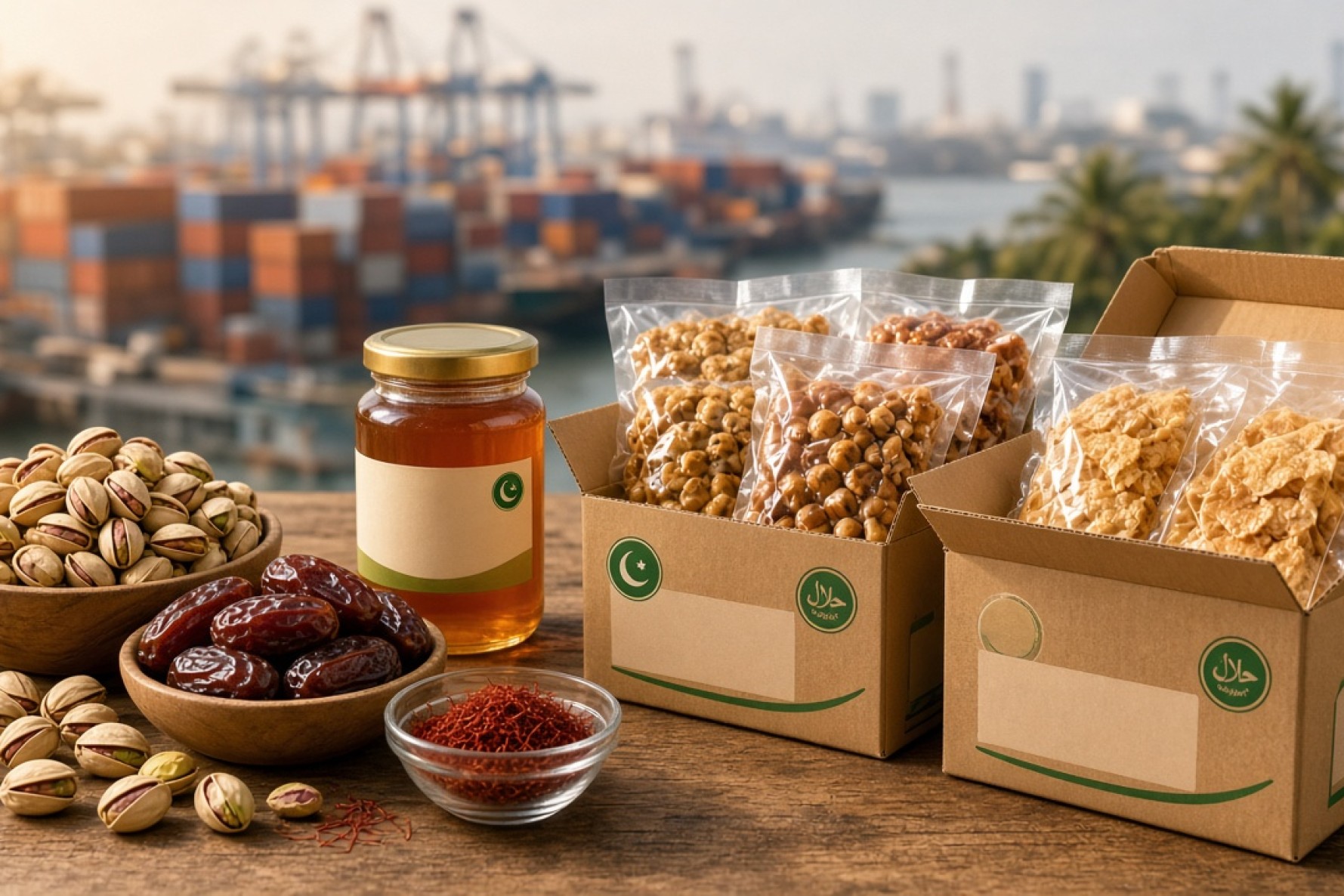
Hurmadan kuru üzüme ve gıda sanayi hammaddelerine — Endonezya talebi, helal kuralları, ürün kaydı, etiketleme, ambalaj, lojistik ve İranlı üreticilerin Güneydoğu Asya'nın en büyük Müslüman pazarına giriş rotaları
İhracat Rehberi · Endonezya · Helal · BPJPH · BPOM · Tanjung Priok
İran Gıda İhracatı Endonezya'ya: İranlı Helal Ürünler için Büyük Fırsat
Hurmadan kuru üzüme ve gıda sanayi hammaddelerine — Endonezya talebi, helal kuralları, ürün kaydı, etiketleme, ambalaj, lojistik ve İranlı üreticilerin Güneydoğu Asya'nın en büyük Müslüman pazarına giriş rotaları
These four indicators show Indonesia is not a distant side market — it is a large consumer economy where halal matters, date imports are substantial and Iran already has a measurable place in the chain. Success in 2026 is not only about the right product; halal files, BPOM registration, Indonesian labels and a local importer must be aligned before the contract is signed.
Four indicators and the commercial message
Population 284.67 million in the 2025 interim census, about 230 million Muslim consumers, 55.4 million kg of date imports in 2024 and 3.4 million kg from Iran — the market is serious on scale and halal demand, while Iran's share remains small and expandable.
| Indicator | Value | Message for exporters |
|---|---|---|
| Population | 284.67M (2025) | Consumption scale even at moderate per capita |
| Muslim | ~230M | Halal drives purchase decisions |
| Date imports | 55.4M kg / ~$79.7M | Proven import market |
| Iranian dates | 3.4M kg / ~$4.93M | Real presence; room to grow |
| Bilateral trade | ~$217.3M (2024) | Indonesia imports from Iran ~$11.1M |
| Tanjung Priok | 36.87% of imports | Java/Jakarta distribution focus |
Analytical introduction
With more than 284 million people, a large retail network and about 230 million Muslim consumers, Indonesia is one of the most important potential destinations for Iranian halal food exports in Asia. The opportunity is not only dates — food-industry inputs, dried fruit and nuts, tomato paste and selected processed foods can enter if halal rules, product registration, Indonesian labelling and local distribution are aligned.
Do not treat exports to Indonesia as mere distance selling. Three factors matter together: very large population, halal at the centre of buying decisions, and structural reliance on imports for many foods and inputs.
Dates are Iran's clearest proof point. In 2024 Indonesia imported more than $79.7 million of dates; Iran's direct exports were about $4.93 million. Iranian raisins also exceeded 220,000 kg in the same market that year.
From 18 October 2026 a new halal enforcement stage also covers foreign and imported products. Being Iranian or holding a domestic halal certificate alone is not enough for commercial entry — acceptance of foreign certificates depends on recognition of the issuing body and cooperation with BPJPH.
1. Why Indonesia matters for Iranian food
Indonesia is one of Southeast Asia's largest consumer economies. Population reached 284.67 million in 2025 and Muslims are estimated at about 230 million. Domestic food industries are broad — opportunity is not only supermarket shelves but factory inputs, confectionery, industrial bakeries, beverages and food service.
Total Indonesian imports in 2024 were about USD 235.2 billion. Tanjung Priok in greater Jakarta alone handled 36.87% of national import value.
Bilateral trade is still small, but the route is open
Two-way trade in 2024 was about USD 217.3 million; Indonesia's imports from Iran about USD 11.1 million, with dates among main lines. Iran's share of the total market remains limited with large upside.
The Iran–Indonesia preferential trade agreement (signed 2023) was ratified in Indonesia under Presidential Regulation No. 70 of 2025. For each shipment, tariff line, rules of origin and practical use of preference for that SKU must be checked separately.
2. Which Iranian foods have better odds in Indonesia?
A suitable market needs at least three traits: Indonesian import demand, competitive Iranian export capacity, and freight that does not erase the advantage.
| Product | Indonesia market | Iran position | Entry model |
|---|---|---|---|
| Dates | Large proven import market | Real presence (~3.4M kg) | Bulk, retail, seasonal & steady |
| Raisins | Multi-million-dollar imports | ~220,000 kg in 2024 | Bakery, confectionery, retail |
| Dried figs | Small niche market | Limited (~1.5 t) | Premium & ingredients |
| Saffron | Tiny; high unit value | Strong capacity; limited direct share | Hotels, restaurants, premium |
| Tomato paste | ~14.5M kg imports (HS 200290) | Industrial capacity | Industrial; compete with China |
| Nuts / dried fruit | Expandable after demand proof | Production diversity | Specialist importer |
| Food-industry inputs | Factory-spec dependent | Varied capacity | Industrial contract, bulk pack |
Dates — the clearest starting point
In 2024 Indonesia imported about 55.4 million kg of dates worth nearly USD 79.7 million. Iran supplied about 3.4 million kg worth USD 4.93 million. Egypt, Tunisia, Saudi Arabia and the UAE are main rivals. Buyers compare landed price, moisture, texture, defects, packaging and shipment consistency.
Semi-dry and dry dates are usually easier for ocean freight than very soft types; soft dates can sell but need tighter temperature and shelf-life control on the long route.
Raisins
2024 imports were about 4.17 million kg worth over USD 8.1 million; Iran ~220,000 kg (~USD 380,000). The US, India, China and Greece were larger suppliers. Compete on industrial price and retail uniformity.
Bakeries, confectionery, breakfast cereals and snack mixes are natural buyers. Industrial specs should define colour, count per kg, capstem, stones, foreign matter, moisture and surface oil.
Dried figs
Recorded fresh/dried fig imports in 2024 were about USD 121,000; Iran exported about 1.5 t worth over USD 6,000; Turkey dominated. A niche versus dates — premium packs and dried-fruit blends.
Saffron
Total saffron imports in 2024 were about USD 61,800. Afghanistan and Spain led registered trade. Not a volume market like dates — premium hotels, restaurants, confectionery and online premium retail.
Tomato paste
Indonesia imported over 14.5 million kg under HS 200290 worth ~USD 21.66 million in 2024. China is the main supplier. Iranian entry requires competition on Brix, colour, micro load, industrial pack and delivered price. National tariff lines beyond 200290 must be confirmed with the broker.
Nuts, dried fruit and inputs
After demand validation, Iran's diversity can enter via specialist importers and health/snack networks. Food-industry inputs depend on destination factory specs; industrial bulk contracts often beat unregistered direct retail entry.
3. Indonesia's halal market — commercial opportunity or legal requirement?
Both. The halal assurance system is based on Law No. 33 of 2014. From 18 October 2024 halal certification became enforceable for a large share of domestic production. From 18 October 2026 the scope extends to foreign and imported products.
Iran and Indonesia signed a memorandum in 2023 between BPJPH and Iran's National Standards Organization; this is not the same as automatic acceptance of every Iranian halal certificate. Acceptance depends on recognition of the foreign body and mutual recognition.
Four questions before printing the halal logo
- Which body exactly issued the certificate?
- Is that same body recognized at export time by BPJPH ?
- Does the scope of recognition cover the product group?
- Is the foreign halal certificate registered for the product in Indonesia?
Even a plant-based product can involve additives, surface oils, anti-caking agents, flavourings, contact cleaners and line cross-contamination in halal assessment. In compound products, gelatin, emulsifiers, enzymes, cheese, animal fat, glycerin and some carriers need traceable origin and documentation.
If the certificate was issued by a foreign body with valid cooperation in the relevant scope, the foreign certificate can be registered in Indonesia's system without repeating the full issuance process — provided the body's status is confirmed at export time.
4. Food entry rules beyond halal
Halal is only one compliance layer. Processed packaged products for retail are usually overseen by BPOM (the food and drug agency). Regulation No. 23 of 2023 sets the registration framework.
The importer registers many products as imported food with BPOM RI ML Official guidance lists items such as Indonesian business registration, trade activity documents, food safety management, importer appointment letter and GMP, HACCP, ISO 22000 or origin-government audit certificates. Some bulk industrial ingredients or minimally processed goods may follow a different path — e.g. a 12.5 kg industrial raisin bag versus a 250 g supermarket pack.
A common mistake is treating halal certification as an import permit. Halal is one layer; BPOMregistration, labelling, quarantine and customs documents are other layers. Product status must be fixed before printing the final pack.
Indonesian labelling
Processed food labels must be in Indonesian. At minimum: product name, ingredients, net weight or volume, manufacturer or importer, halal (where required), production date and code, expiry, distribution permit number and origin where required.
| Topic | Processed retail | Industrial ingredient | Minimally processed farm goods |
|---|---|---|---|
| Halal | Critical | Important for halal chain | By product group |
| BPOM registration | Usually required | Exempt in some cases | Depends on nature |
| Indonesian labelling | Required | Depends on offer | Depends on rules |
| Local importer | Essential | Essential | Essential |
| Quarantine | Product-dependent | Product-dependent | Usually more important |
Dates, dried fruit and nuts may be subject to phytosanitary control. Before loading, phytosanitary certificates, pre-arrival notice and origin requirements must be checked.
5. Important tariff codes for Iranian products
Determining HS Code must reflect the actual form of the goods, not a generic name. For Indonesian declaration, national line, duty, taxes and permits must be taken from exact specifications.
| Product | HS 6-digit | Notes |
|---|---|---|
| Dates | 080410 | Fresh or dried |
| Raisins | 080620 | Dried grapes |
| Figs | 080420 | Fresh or dried |
| Saffron | 091020 | Saffron |
| Tomato product | 200290 | Paste and similar |
6. What specs does an Indonesian buyer want?
Generic phrases like "grade-one dates" are not enough for professional trade. Specs must be measurable and written into the contract.
| Parameter | Example | Importance |
|---|---|---|
| Name and form | Whole, chopped, industrial | Use and HS |
| Size / moisture | Agreed range | Shelf life and price |
| Foreign matter / defects | Maximum limit | Grade and quarantine |
| Additives / allergens | Declared precisely | Halal and BPOM |
| Halal certificate | Body and validity | BPJPH alignment |
For dates: variety, origin, size, moisture, detached skin %, mushiness, damage, pest, surface sugar, stones and pack format. In bulk markets luxury appearance is not always an advantage; some buyers focus on price and wide distribution, others on uniform packs and brand.
For raisins: colour, size, moisture, capstem, stones, damaged berries, surface oil and SO₂ in relevant products. Industrial contracts should state whether product enters the line directly or needs rewashing.
For industrial paste: Brix, colour, pH, acidity, micro counts, concentration method, filling and aseptic pack. Indonesian factories usually value Brix and colour stability across shipments more than brand alone.
- Net weight per unit and master carton
- Shelf life based on a valid producer study
- Storage: ambient, cool store or chilled
- Production method for safety and halal review
7. Quality control — real deals vs promotional samples
In long-distance trade, gap between initial sample and final shipment is the costliest risk. "As per sample" without numbers is weak; the approved sample must become numeric criteria.
- Moisture, water activity, microbial, yeast and mould
- Pesticide residues, heavy metals, aflatoxin (where relevant)
- Foreign matter, insect contamination, sensory attributes
- For paste: Brix and processing specs
A sealed witness sample held by seller and buyer with batch code and lab report is more effective in disputes than messenger photos.
One fixed test list should not be used for all foods. Aflatoxin testing is more critical for some nuts and dried fruit than for typical dates; for paste, Brix and processing specs matter more.
8. Packaging and logistics from Iran to Indonesia
Distance favours shelf-stable goods at the start — semi-dry and dry dates, raisins, figs, saffron, aseptic paste.
Retail packs must tolerate Indonesia's hot, humid climate; moisture barrier is critical for dried fruit. Bulk factory packs must allow for pallet pressure and humidity.
Ocean freight is the main option for commercial volume — from southern Iranian ports with one or more transshipments to Indonesian ports. For Java and Jakarta, Tanjung Priok (>36.87% of 2024 imports) is the key gateway. Transit time must follow actual line booking, not a generic figure.
Bank, payment, insurance and carrier choice before final production is essential; some institutions apply strict compliance on Iran-related deals. A purchase order alone does not guarantee bank or carrier acceptance.
| Product | Suggested pack | Route | Note |
|---|---|---|---|
| Semi-dry/dry dates | Cartons, inner liner | Ocean — dry container | Moisture and pallet pressure control |
| Raisins | Industrial bag or retail pack | Ocean | Moisture ingress in warm warehouses |
| Saffron | Tin/vacuum | Ocean or air | High unit value |
| Aseptic paste | Drum/industrial bag | Ocean | Brix stability after transport |
9. Competitors — who does Iran face?
| Product | Main rivals | Main issue for Iran |
|---|---|---|
| Dates | Egypt, Tunisia, Saudi Arabia, UAE | Price, brand, distribution |
| Raisins | US, India, China, Greece | Industrial price and uniformity |
| Figs | Turkey | Distribution network |
| Saffron | Afghanistan, Spain | Small market; premium niche |
| Tomato product | China, US, Italy | CIF price and scale |
Iran in the date market
Iran's edge is product diversity and a real export track record to Indonesia. The main limit is competition from countries with stronger presence in Southeast Asian Muslim markets. To grow share, target a segment: economy dates for mass distribution, premium for gifting and retail, or industrial for processing. One identical offer to all importers usually underperforms.
Iran in the raisin market
Indian and Chinese raisins can compete hard on price; US product benefits from established trade channels. Iran's advantage shows when price, uniform specs and regular supply capacity combine.
Iran in the tomato paste market
China is very strong in Indonesia's tomato product trade. Iranian entry on "good quality" alone is not enough. The producer must compare delivered price, Brix, colour, payment terms, container volume and aseptic pack directly with existing suppliers.
10. Market entry strategy — from spot sales to stable distribution
Selling to a bulk importer
Easier to start. The importer handles distribution, registration and local market contact. Entry complexity drops, but the exporter has less control over final price and brand building.
Selling ingredients to factories
For raisins, paste, dried fruit, purée and concentrate this path can work better. Factories care more about technical specs, price and delivery consistency than consumer pack looks. Bulk ingredients not sold direct to consumers may follow a different registration path than retail product.
Iranian brand in retail
Highest potential added value and highest entry cost. The brand must be designed for Indonesia, not the same Farsi or English pack with a small extra label. Language, pack size, design, shelf price, halal mark, importer details and BPOM registration must be built into the project from the start.
For buyers planning to source from Iran, Iranco can receive purchase requests with product, pack weight, volume and destination to review sourcing options.
11. Pricing and 19-step importer checklist
A single unit price for "Iranian food" is meaningless. Two date offers can both be valid with large gaps. Main factors: grade and quality, size and class, moisture, season, input costs, order size, bulk or consumer pack, Indonesian label print, testing, certificates, private brand, pallet and container, freight route, delivery terms, destination port and payment. Comparing FOB alone is misleading; true cost to port or destination warehouse must be calculated. For paste, freight can erase much of the factory advantage.
A professional RFQ should include: full product name, grade, size, moisture, additives, test list, halal status, pack material, weight, brand, trial and commercial volume, destination port, Incoterms, use (retail or industrial) and documents the importer requires.
- Define exact product name and processing form.
- HS Code Match the actual goods.
- Confirm whether goods require BPOM registration or the industrial-ingredient path.
- Check halal requirement and body validity in BPJPH .
- Obtain a real commercial-batch sample and convert it to numeric criteria.
- Set defect limits and pre-shipment tests.
- Confirm unit weight, master carton and Indonesian label artwork before mass production.
- Put monthly capacity and lead time in writing.
- Test payment route, shipping, insurance and quarantine before production.
- Destination port (e.g. Tanjung Priok) and Incoterms must be explicit.
- Agree reject/accept criteria before final loading.
- Register foreign halal certificate in Indonesia's system if required.
- Manufacturer and importer details on the label must match.
- For paste: include Brix, aseptic and micro in the RFQ.
- For dates: clarify type, size, moisture and use (bulk/premium).
- For industrial raisins: specify rewashing or direct-to-line entry.
- Use preferential agreement only after verifying origin for that shipment.
- Review reorder plan and batch consistency for stable distribution.
- Send complete RFQ with destination, use and required importer documents.
12. Sourcing Iranian food for the Indonesia market
Entering Indonesia is more than a proforma. For retail, pack, registration, halal, label translation and importer must be designed together. For industrial orders, technical specs and batch stability matter more than pack appearance.
- Product, quality, quantity, packaging, destination
- Dates: type, size, moisture, pack weight
- Raisins: colour, moisture, foreign matter, industrial use
- Paste: Brix, aseptic, weight, micro
- Sample and spec approval before container order
Iranco is a platform to submit purchase requests. Fixing non-compliant cargo after arrival in Jakarta or Surabaya costs far more than control in Iran.
Summary
Iranian food exports to Indonesia are a real opportunity, but not equal for every product. Dates are the clearest proven market (55.4M kg imports; ~3.4M kg from Iran). Raisins have measurable presence; figs and saffron are niche; paste and ingredients are growth areas.
Success comes when product aligns with Indonesia's regulatory system: from 18 October 2026 imported halal enters a new stage, BPOM registration for retail, Indonesian labels, phytosanitary control and a specialist importer. Best path: one product group, numeric specs, controlled shipment and ongoing importer relationship.
Frequently asked questions
Is Indonesia a good market for Iranian dates?
Yes. In 2024 about 55.4 million kg of dates were imported and nearly 3.4 million kg came from Iran. Competition with Egypt, Tunisia, Saudi Arabia and the UAE is serious; delivered price, uniformity and packaging decide outcomes.
Must all Iranian foods have halal certification?
Halal rollout is phased and from 18 October 2026 extends to imported products. Certificate and registration path in BPJPH must be checked; a certificate issued in Iran alone is not automatic acceptance.
Is Iranian halal certification accepted directly?
It depends on the issuing body and its cooperation with BPJPH A 2023 MOU exists but mutual recognition and the body's scope are required.
Is BPOM registration required for retail packaging?
Imported processed foods sold in retail packs are generally subject to registration and BPOM RI ML Bulk and minimally processed ingredients follow different paths.
What language must export labels use?
For processed foods, mandatory information is in Indonesian: name, ingredients, weight, manufacturer/importer, dates, permit and halal where applicable.
Is saffron a large market in Indonesia?
Not at date scale. 2024 imports about USD 61,800 — premium opportunity for hotels, restaurants and high-end retail.
What is the opportunity for Iranian raisins?
Indonesia imported over 4.1M kg of raisins in 2024; Iran ~220,000 kg. Opportunity in consumer and bakery/confectionery with focus on moisture, colour and consistency.
What is the best shipping method?
For commercial shelf-stable cargo, ocean freight is primary. Dry or reefer container depends on product sensitivity; timing should follow actual line service.
What information is needed to price dates or raisins?
Type, size, quality, moisture, defect limits, pack weight, volume, brand, halal, tests and destination port. The same specs can be submitted in an Iranco purchase request.
Can you enter retail directly with an Iranian brand?
Possible but more complex than bulk. Importer, registration, labels, halal and distribution must be set before final pack production; starting with a specialist importer is usually more practical.
Halal export advice for Indonesia and links to Iranian suppliers
Send product specs, volume and port to Iranco so sourcing options for Indonesia can be reviewed.
Iranco ile iletişiminfo@iranco.com · WhatsApp: +98 913 104 4182 · Telegram: @irancofood
Öne Çıkan Ürünler










İlgili Yazılar



