 Iranco Dergisi Ekibi
Katar'da İran gıdası için gerçek fırsatlar — ürün ve alıcı seçiminden standart, etiket, ambalaj, nakliye ve fiyatlandırmaya
İhracat rehberi · Katar · Safran · Antep fıstığı · Hamad Limanı
İran Gıda İhracatı Katar'a: İranlı Üreticiler için Satış Fırsatları
Katar'da İran gıdası için gerçek fırsatlar — ürün ve alıcı seçimi, standartlar, etiket, ambalaj, nakliye ve fiyatlandırma
Analytical introduction
Iranian food exports to Qatar work when producers separate geographic proximity from real commercial advantage. Short sea legs, agricultural diversity and prior market presence help — but alone they do not win retail shelf space, hotel contracts or wholesale repeat orders.
Qatar produces part of its needs and invests in food security, yet imports remain central. Packaged food retail was about USD 2.42bn in 2023 and food services about USD 1.48bn. More than five million visitors in 2024 boosted hotel and restaurant demand.
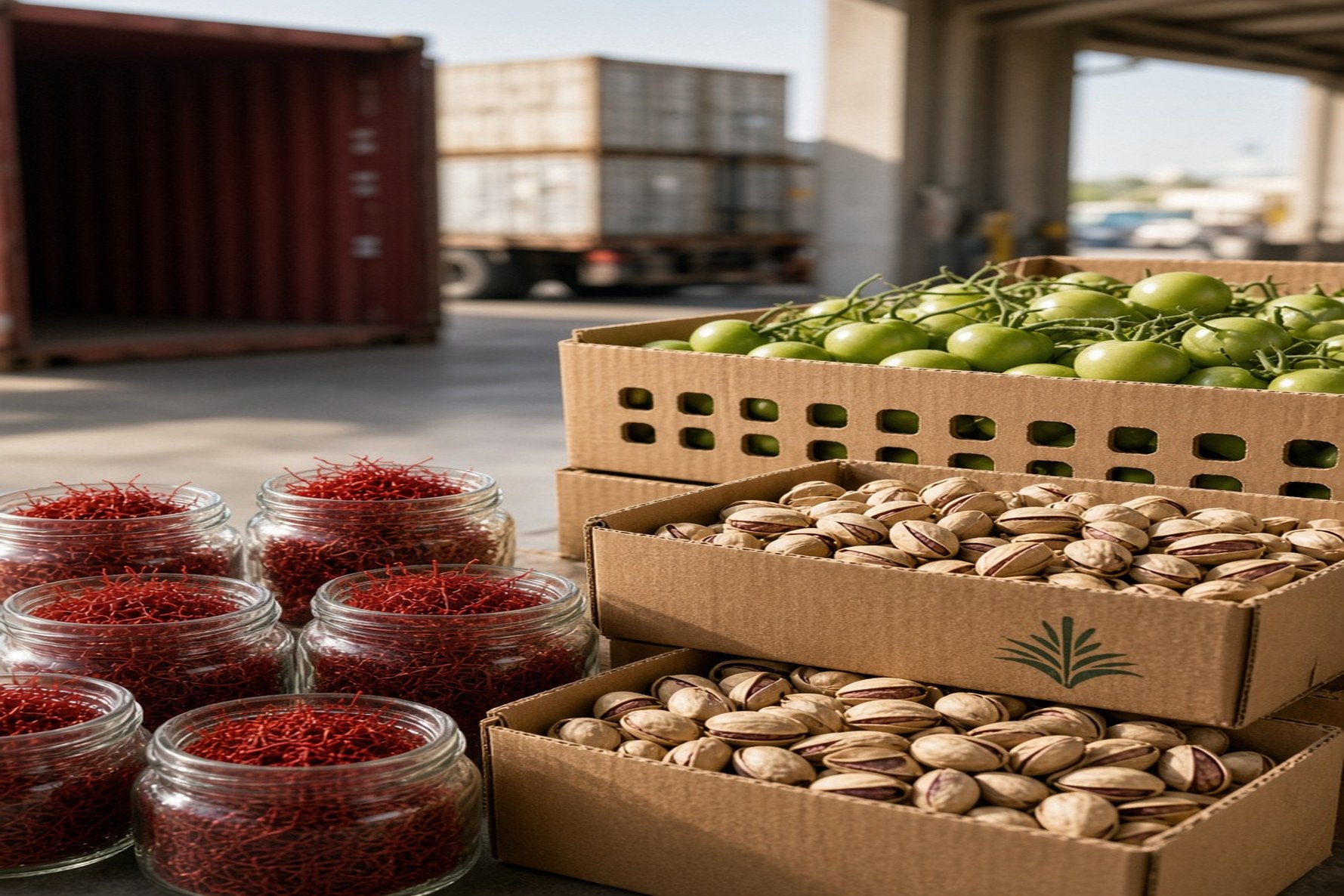
Trade data show measurable Iranian presence in fresh herbs, tomatoes, pistachios and saffron — e.g. roughly 38% of Qatar fresh tomato import value from Iran and over 90% of saffron. The key question is which product, quality, pack and channel becomes a repeatable order.
1. Qatar food market structure
Qatar is import-driven and highly competitive; Iran competes with India, Turkey, Jordan, Oman, Europe, Brazil and the US. Population size alone is a weak indicator — purchasing power, multicultural demand and food service matter more.
Household retail cares about pack appearance, Arabic labelling, shelf life and planogram fit. Hotels and restaurants focus on quality consistency, true net weight and supply continuity. Fresh wholesale hinges on turnover, perishability and delivered price.
2. Which Iranian foods have real opportunity?
| Group | Market evidence | Iran edge | Key sensitivity |
|---|---|---|---|
| Fresh herbs & veg | Large imports; visible Iran supply | Proximity & seasons | Shelf life & uniformity |
| Tomatoes | Iran top supplier 2023 | Regional shipping | Firmness, ripeness, waste |
| Saffron | Very high Iran share | Known origin | Authenticity & testing |
| Pistachios | Major Iran share | Variety | Aflatoxin |
| Seafood | Iran listed supplier | Gulf access | Cold chain |
Each product must be judged on real demand, Iran’s competitive strength and stable delivery. Qatar edible vegetable imports exceeded USD 250m in 2023; Iran was a major supplier after India.
Tomatoes: about USD 9.4m of USD 24.7m 2023 imports from Iran — yet buyers watch firmness, ripeness, uniformity and transit damage. Melons/watermelons: about USD 3.8m Iranian share in a USD 27.2m market.
Saffron: over USD 3.2m of USD 3.45m 2023 imports were Iranian origin. Pistachios: about USD 3.5m of USD 7.5m; the US is the main rival. Dates face stiff regional competition; seafood depends on cold chain and health permits.
3. Food buyers in Qatar
Importers and distributors are the main entry gate; they weigh producer track record, regulatory fit, spec stability, MOQ, delivered price, remaining shelf life and quality dispute handling.
Retail needs shelf-ready packs and Arabic labels. Fresh wholesalers care about turnover speed and post-unloading waste. Hotels and restaurants suit saffron, nuts, herbs, seafood and semi-industrial inputs. Food manufacturers look for physicochemical specs and industrial packs.
4. Technical specs before pricing
| Parameter | Example | Buyer need |
|---|---|---|
| Grade | Commercial, premium, industrial | Price comparison |
| Size | Weight, diameter, count | Uniformity |
| Moisture | Product-specific | Shelf life |
| Net weight | Actual pack weight | Financial control |
| Transport | Ambient, chilled, frozen | Quality retention |
Quotes for “export pistachio” or “premium saffron” fail without grade, size, moisture, defect limits and pack type. Fresh produce needs size, colour, firmness, ripeness, units per carton and loading temperature. Pistachios need open-kernel %, breakage, moisture and aflatoxin limits. Saffron needs COA covering colouring strength, moisture and purity.
5. Quality control and approved samples
Price may win the first order; consistency wins repeats. Samples must trace to batch, production date, grade and tests. Acceptance criteria must be numeric and written — “as per sample” alone is not enough.
Testing is product-specific: aflatoxin in nuts, authenticity and colouring in saffron, MRL and appearance in produce, microbiology in seafood and processed foods.
6. Standards, registration and entry
Entry is overseen by the Ministry of Public Health and customs. Arabic or Arabic–English labels are common; production and expiry dates must be on the primary pack by the manufacturer — later sticker dates are not accepted.
GS 150/2013 and GSO 9 underpin shelf life and labelling. Ingredients and allergens must match registration and the pack. Final artwork and claims should be agreed with the Qatari importer before mass production.
7. Customs documents, HS codes and landed cost
HS codes must reflect true product nature — raw pistachio, processed pistachio and mixed nuts are not one line. Detailed invoice, certificate of origin, transport docs and packing lists are routinely required.
5% appears on many lines but not all foods; confirm the exact HS row before final pricing.
8. Packaging for Qatar
| Product | Pack | Note |
|---|---|---|
| Fresh veg | Vented carton | Compression & airflow |
| Pistachio | High-barrier film | Oxidation |
| Saffron | Light-proof small pack | Aroma & security |
| Frozen seafood | Inner bag + strong carton | Freeze chain |
Packs must protect, comply and sell. Fresh cartons need pallet compression strength and ventilation. Nuts need moisture and oxygen barriers. Bulk saffron for industry differs from gift retail packs.
Domestic Iran packs without Arabic redesign, market weights and shelf layout rarely fit Qatar modern retail.
9. Shipping Iran to Qatar
| Factor | Iran | Rivals |
|---|---|---|
| Distance | Potential edge | Often longer |
| Saffron/pistachio | Very strong | Mixed |
| Export pack | Producer-dependent | Sometimes stronger |
| Brand | Needs build-out | Sometimes strong |
Proximity only helps with short, controlled logistics. Hamad Port is the main gateway; southern Iran ports and the Deir–Al Ruwais route serve fruit, veg, nuts and seafood.
Stable dry goods: sea container. Fresh: pre-cool before reefer — reefers are not designed to pull down hot field heat quickly. Low-volume saffron: air may work. Seafood: time and loading temperature are critical.
10. Pricing and competition
Buyers measure usable cost after delivery — a cheap quote with high waste can cost more. Price follows season, grade, sorting, tests, pack, volume, freight, Incoterms and remaining shelf life.
Compare quotes on one delivery basis. Rivals vary by product: India/Jordan on veg, US on pistachio, Oman/Tunisia on dates. Uniformity, export packaging and supply planning turn geography into advantage.
İthalatçı kontrol listesi (özet)
- Exact product, grade and size definition
- Traceable sample and written defect limits
- Pre-shipment tests agreed
- Arabic label, ingredients and allergens
- Net weight and pack type
- Remaining shelf life at entry
- Order volume and supply capacity
- Transport mode and Incoterms
- Invoice, origin and health docs aligned
- Batch traceability and dispute procedure
SSS
Is Qatar a good market for Iranian food exports?
For some groups yes — veg, tomato, saffron, pistachio and seafood show recorded presence; assess each SKU vs rivals, packs, rules and delivered price.
Which products have better odds?
Those with import demand plus Iran strength: saffron, pistachio, fresh herbs/veg, tomato, some fruit and seafood; processed lines depend more on brand and labelling.
Is Arabic labelling required?
Yes — Qatar/GSO rules; production and expiry dates on the primary manufacturer pack.
What is the import tariff?
5% is common on many lines but not universal — verify the exact HS code.
Does short distance always mean lower cost?
No — inland haul, port, waste and clearance shape landed cost.
What matters most for fresh produce?
Uniform sorting, ripeness, pre-cooling, strong cartons and supply speed.
How is export price set?
Only after specs, Incoterms and delivery point align — not kg price alone.
How to source from Iranian producers?
Start with technical specs, volume, pack and destination — including structured purchase requests on Iranco.
Özet
Katar gerçek bir fırsattır ancak her ürün için değil; sebze, domates, safran ve fıstıkta güçlü başlangıç var; başarı sınıflandırma, ihracat ambalajı, etiket, numune ve tedarik planına bağlıdır.
Katar pazarı için İran gıda tedariki
Teknik spec, hacim, ambalaj ve teslim noktası ile başlayın — sadece kg fiyatı değil. Iranco bu yapıda talep alır.
Iranco ile iletişimÖne Çıkan Ürünler










İlgili Yazılar



