 Iranco Dergisi Ekibi
Katar pazarı, sapısız vişne ayıklama kriterleri, kalite kontrolü, giriş gereklilikleri, ambalaj, soğuk zincir ve ihracat siparişi ticari notları
Export Guide · Qatar · Sour Cherry · Stemless Sorting
Fresh Sour Cherry Export to Qatar: Hot-Season Demand and Stemless Sorting
A review of the Qatar market, stemless sour cherry sorting criteria, quality control, entry requirements, packaging, cold chain and commercial ordering notes — from HS code and zero-percent duty to air freight and an importer checklist.
Introduction
Under Qatar's customs tariff, sour cherries with the scientific name Prunus cerasus are classified under heading 080921 and listed at a zero-percent rate in Qatar's 2025 tariff schedule. This line also appears on the controlled-goods list, and entry is subject to inspection by the relevant health and food-control authorities.
Qatar is not a major producer of temperate fruit, and a significant share of its fresh-fruit basket is supplied through imports. That structure creates opportunities for seasonal products with a distinctive appearance and retail potential in modern supermarkets, hotels, restaurants, juice bars and food-service channels. Sour cherry is one such product; commercially, however, it differs fundamentally from fruit such as apples or citrus: shelf life is shorter, moisture loss quickly affects appearance, and a few hours' delay in pre-cooling can erase part of the shipment's value.
For Iranian exporters, the relatively short geographic distance to Qatar is a practical advantage — provided it is paired with fast sorting, correct packaging and planned transport. In fresh sour cherries, the quality seen at harvest is not necessarily the quality delivered in Doha. The product must survive harvest, stem removal where stemless fruit is ordered, sorting, pre-cooling, packing, transit, import clearance and distribution with minimal deterioration.
Sensitivity is greater in stemless orders. Removing the stem may look like a simple operation, but if the stem attachment point is damaged, juice leakage, local softening and faster fungal decay follow. "Stemless" should therefore be defined as a processing and sorting specification, not merely a visual request.
The Qatar market also responds mainly to visible quality: colour uniformity, surface freshness, absence of cracking, no bruising, relatively even size and clean presentation all matter greatly. A successful transaction is one in which buyer and seller agree on measurable criteria before harvest.
1. The Qatar Market for Fresh Sour Cherries
Sour cherry in Qatar is not a high-volume staple like banana or apple; it sits more in the seasonal, premium and sensitive fruit category. That position shapes how it is bought and distributed. Importers usually cannot focus on price per kilogram alone, because spoilage percentage, sell-through speed and fruit appearance at shelf arrival affect real margin more strongly.
Demand in the Hot Months
Juicy fresh fruit in Qatar's hot season is attractive from a retail perspective, but ambient heat outside the cold chain raises operational risk. In such conditions, product left on a loading ramp, in non-refrigerated space or in unsuitable vehicles loses quality quickly.
For sour cherry, the selling season must align with Iran's harvest window and the ability to deliver fresh product to market. The main advantage for exporters close to Qatar is the ability to shorten the gap between harvest and sale. That advantage becomes commercially meaningful only when product enters sorting and pre-cooling immediately after harvest.
Qatari buyer demand appears across several main channels:
- Fruit and vegetable wholesalers
- Chain stores and premium supermarkets
- Specialist fresh-fruit retailers
- Hotels and restaurants
- Juice bars and dessert preparation units
- Food-service companies
- Units buying fresh fruit for culinary or pastry use
For premium retail, product appearance matters more. For food service, quality consistency, price, fast usability and, in some orders, stemless sour cherries may be more attractive.
The Stemless Market Is Not the Same as the Stem-On Market
In sweet-cherry trade and many similar products, a green stem is usually treated as a freshness indicator. Post-harvest sources also regard stem condition as a quality index.
Stemless sour cherry, however, can serve applications where the stem must be removed before use. Restaurant, pastry, dessert-manufacturing or food-service buyers may require stem removal as part of product preparation.
In these orders, stemless quality should not be compared mechanically with stem-on criteria. The key issue becomes the health of the stem-removal point and prevention of leakage and damage.
2. Export-Grade Sour Cherry Specifications for Qatar
A professional definition of export sour cherry must go beyond phrases such as "Grade 1" or "excellent quality." Those terms have little value in commercial disputes without technical specifications.
The buyer should agree at minimum on maturity, colour, size, firmness, skin integrity, cracking, soft fruit, decay and stem condition.
The UNECE standard for fresh cherries and sour cherries classifies product into three classes: Extra, Class I and Class II. Under this standard, minimum size for Extra is 20 mm and for Classes I and II is 17 mm. The standard also emphasises origin, quality and size uniformity within the pack.
These figures should not automatically be treated as the legal requirement for every Qatar transaction; they can, however, serve as a useful reference for contract definition.
| Parameter | Order specification | Buyer importance |
|---|---|---|
| Colour | Uniform and aligned with target maturity | Linked to appearance and flavour |
| Size | Minimum diameter or sort band defined | Prevents mixing small and large fruit |
| Firmness | Sound fruit resistant to handling | Reduces bruising |
| Cracking | Contractual maximum allowed | Cracks open a path to decay |
| Decay | Very limited, agreed threshold | Directly affects sellability |
| Mechanical damage | No bruising or visible cuts | Prevents rapid deterioration |
| Stem condition | Stem-on or stemless | Must be defined from the start |
| Stem-removal point | Sound, without deep tearing | Critical for stemless fruit |
| Pack uniformity | Consistent size and colour | Important for retail |
| Delivery temperature | Agreed cold-chain target | Controls shelf life |
Sour Cherry for Retail
For direct supermarket sale, visual uniformity is critical. A pack with large, sound fruit on top and smaller or soft fruit in lower layers increases return risk and disputes with the importer.
Sour Cherry for Food Service
In this channel, very large size is not always the top priority. If the product is used for sauce, dessert, garnish or fast preparation, colour consistency, texture integrity and ease of use may matter more than size.
Stemless sour cherry can offer a practical advantage in this segment, provided stem removal does not increase fruit damage.
3. Stemless Sour Cherry Sorting
Stemless sorting should not be equated with simple stem removal. Once the stem is removed, the fruit has a new sensitive point on its surface and must also be graded according to the quality of the removal site.
When Should Stems Be Removed?
Stem removal should be performed on fruit firm enough for the operation. Overripe fruit is more prone to tearing around the attachment point, bruising and juice leakage during removal.
The operation should not involve excessive pressure, throwing product or stacking large volumes of cherries on top of one another.
Sorting Criteria After Stem Removal
After stem removal, product should be checked at minimum for these defects:
- Split or tear at the stem attachment point
- Juice leakage
- Peeling or skin loss
- Bruising
- Surface or deep cracking
- Overripe, soft fruit
- Decay
- Mould
- Insect damage
- Immature fruit
- Off-colour fruit
- Shrivelling
- Foreign contamination
In stemless sour cherry, an important issue is that many defects become clearer several hours after the operation. Product may look sound immediately after stem removal, but the damaged area may soften or darken further along the chain.
For this reason, sample inspection after a short cold-holding period is highly valuable.
Manual or Mechanical Sorting?
For premium, sensitive shipments, a combination of initial mechanical sorting and human inspection can be appropriate. Equipment can standardise size and, on some lines, colour, but detection of stem-point damage, fine cracks and bruising often requires careful visual control.
At small scale or for air export, professional hand sorting can still be rational, provided line speed does not warm the product.
| Defect | Commercial consequence | Recommended action |
|---|---|---|
| Tear at stem point | Leakage and rapid decay | Reject in sorting |
| Skin crack | Increased decay | Separate out |
| Soft fruit | Bruising in the pack | Reject or use in immediate market |
| Shrivelling | Sign of moisture loss | Remove from premium grade |
| Decay | Spread of contamination in pack | Complete rejection |
| Uneven colour | Weak pack appearance | Colour sort |
| Very small fruit | Lack of uniformity | Size separation |
| Bruising | Severe loss of sellability | Reject |
| Surface contamination | Hygiene and appearance issue | Reject or clean under approved process |
An important point is that acceptance percentages should be defined in the buyer–seller contract. Using the phrase "normal market tolerance" without a number will cause disputes.
4. Pre-Export Quality Control
Sour cherry quality control should start in the orchard, not in the packing hall. Product that is overripe, cracked or warm at harvest cannot be converted into stable export fruit through sorting alone.
Maturity and Colour
Skin colour and soluble solids are common maturity indicators for cherries. In post-harvest studies and guides, skin colour, soluble solids content, acidity and the soluble-solids-to-acidity ratio are cited as eating-quality parameters.
For sour cherry, the buyer should confirm the target colour definition with a photo reference or physical sample; terms such as red, dark red or crimson can be interpreted differently.
Firmness
Fruit must be firm enough for the transport route. Soft sour cherry, even if it looks acceptable at packing, may bruise quickly under upper-layer pressure or transport vibration.
Cracking
Cracking is one of the highest-risk defects. It can result from orchard conditions, rain near harvest or mechanical pressure. In fresh export, cracked fruit should be separated with greater sensitivity.
Pesticide Residue Testing
Destination markets may apply risk-based food-safety controls. A professional exporter should align orchard pesticide programmes with the target market from the outset and maintain product traceability.
Residue testing should be designed around materials used in the orchard and applicable destination-market requirements — not a fixed, unrelated list applied to every shipment.
Traceability
Each shipment should be traceable to a specific orchard or orchard group, harvest date, sorting line and packing date. This is highly valuable in the event of quality complaints or test results.
5. Cold Chain
In fresh sour cherry, temperature control is one of the most decisive economic factors in the transaction. Warm product remains high-risk even with expensive packaging.
The University of California post-harvest guide for cherries reports an optimal temperature of about -0.5°C with a half-degree range and relative humidity of 90–95%. It also shows that respiration rate rises markedly as temperature increases.
For practical export planning, the main objective should be keeping product close to the appropriate temperature without local freezing.
Recommended Thermal Management Steps
- Harvest during cooler hours
- Prevent boxes standing in direct sun
- Move quickly to the sorting centre
- Perform stem removal and sorting in a controlled environment
- Pre-cool
- Pack with minimum pressure
- Hold under refrigeration until loading
- Maintain the cold chain in transit
- Check shipment temperature on delivery
Why Is Pre-Cooling Critical?
Cold storage is not always designed to pull down the temperature of warm product quickly. If several pallets of field-warm product enter storage at once, the centre of the pack may remain warm for a long time.
In sour cherry, that time erodes commercial shelf life.
Temperature Logging
For professional orders, using a temperature logger inside the shipment is highly useful. Disputes over whether product was "delivered cold" are not resolved by a single spot reading; a temperature trace through transit provides far more information.
6. Packaging
Sour cherry packaging must meet three goals at once: mechanical protection, moisture retention and temperature management.
A pack with insufficient ventilation can slow heat removal. A pack that is too open may accelerate fruit moisture loss. Pack design should therefore align with pre-cooling method and transport mode.
Retail Packaging
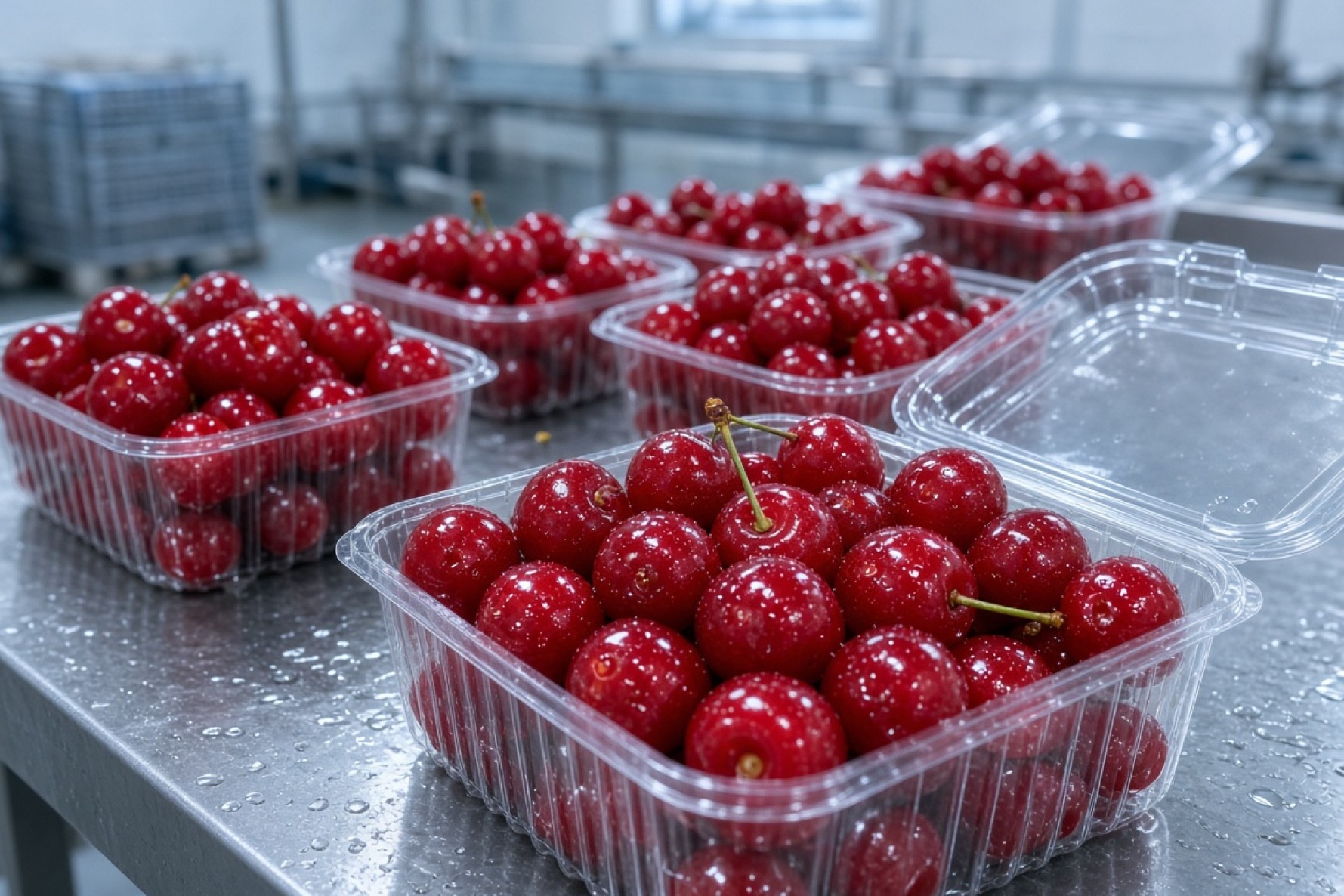
Small transparent containers for supermarkets offer several advantages:
- Direct visibility of quality
- Reduced product handling
- Fixed-weight retail sale
- Lower pressure from in-store handling
The container should not be so deep that lower layers are under pressure.
Bulk Packaging
For food-service customers or distributors, bulk packs may be more economical. In this case, fill height, carton strength and ventilation matter more.
| Pack structure | Suitable use | Key note |
|---|---|---|
| Small consumer container | Premium retail | Visual quality is critical |
| Multiple units in master carton | Chain retail | Easier distribution |
| Shallow bulk box | Food service | Prevents compression |
| Modified-atmosphere pack | Specific routes with technical design | Requires precise gas and temperature control |
Post-harvest studies on cherries show that controlled modified atmosphere and elevated carbon dioxide can reduce respiration and decay development; however, inappropriate oxygen or CO2 levels can also cause damage or off-flavour. This technology should therefore be used on the basis of actual pack design and product testing, not trial and error.
Stemless Sour Cherry Needs Low-Pressure Packing
The stem-removal point on stemless fruit is more sensitive. The greater the pressure and friction inside the pack, the higher the risk of juice leakage and staining.
For this product, it is better to ensure:
- Limited pack depth
- Fruit is not over-compressed
- Master cartons resist pallet pressure
- Uncontrolled void space does not allow excessive fruit movement
7. Entry Requirements
Fresh sour cherry in Qatar is not merely a customs commodity; it is a fresh food and agricultural product and may be subject to food-safety and phytosanitary controls.
The GCC imported food control guide states that food consignments must be accompanied by appropriate documentation and that entry control is risk-based. Core documents in this framework may include the customs declaration, relevant permits, health certificate and consignment contents list.
For fresh plant product, checking phytosanitary requirements before loading is especially important.
Documents to Align Before Shipment
For a commercial transaction, the document set should be matched exactly with the Qatari importer. Depending on shipment structure, these items are usually important:
- Commercial invoice
- Packing list
- Certificate of origin
- Relevant health certificate
- Phytosanitary documents if required
- Transport documents
- Consignment specifications and package count
- Buyer-agreed test results
- Temperature records if included in the contract
The GCC guide allows the importing authority to request additional documents and controls based on risk and consignment conditions.
HS Code
For fresh sour cherry Prunus cerasus, the six-digit HS code is 080921. Qatar's tariff system also shows the full line 080921000000 for sour cherry. In the 2025 schedule, this product is listed at zero-percent duty.
| Item | Details |
|---|---|
| Product | Fresh sour cherry |
| Scientific name | Prunus cerasus |
| HS Code | 080921 |
| Qatar line | 080921000000 |
| 2025 Qatar schedule duty | 0% |
| Border control | Subject to relevant health and food controls |
Zero customs duty does not mean exemption from sanitary, phytosanitary or documentary procedures.
8. Transport from Iran to Qatar
For a short-life product, the cheapest transport is not necessarily the lowest-cost route. If lower freight cost means product arrives several days later or at higher temperature, spoilage losses can exceed freight savings.
Air Freight
Air freight may be considered for small, premium shipments or orders where speed to market is the priority.
Advantages:
- Shorter transit time
- Suitable for fast sale
- Reduced working-capital tie-up
Limitations:
- Higher cost per kilogram
- Airport operations sensitive to ambient temperature
- Requires tight coordination between packing and flight schedule
A common mistake is to treat the cold chain lightly because the flight is short. In practice, pre-flight waiting, loading, unloading and ground transfer are also part of the product journey.
Sea Freight
Sea freight is logical only when route timing, reefer equipment and clearance speed are compatible with the product's commercial life.
For very fresh sour cherry, every day of delay matters. Before choosing sea freight, total time from "packing hall to importer cold store" should be calculated — not just vessel transit time.
Multimodal Transport
Some commercial structures may combine road and sea, or road and air. The decision should be based on delivered cost, time, delay risk and remaining product quality.
| Factor | Air | Reefer sea |
|---|---|---|
| Speed | High | Lower |
| Freight cost | Higher | Usually lower at large volume |
| Suitable for small shipments | More so | Less so |
| Delay sensitivity | High | Very high for sour cherry |
| Cold-chain planning required | Essential | Essential |
| Suitable for premium sale | High | Depends on actual route time |
9. Export Pricing
For fresh sour cherry, comparing price on "dollars per kilogram" alone can be misleading. Two offers at similar price may differ greatly in quality, spoilage, packaging and delivery conditions.
Main Price Drivers
Harvest timing: At the start, peak or end of season, supply structure and quality can change.
Size: Larger-size sorting usually requires more separation and yields a lower share of total harvested volume.
Colour and maturity: A narrower colour band increases sorting cost.
Stem-on or stemless: Stemless sour cherry adds a processing and quality-control step.
Allowed defect level: The lower the tolerance for softness, cracking and small fruit, the lower the acceptable yield.
Packaging: Consumer containers, labels, moisture-resistant master cartons and private-brand requirements all affect cost.
Pre-cooling: Product genuinely prepared through proper cooling is not the same as product merely placed in cold storage.
Testing: The scope of residue or other agreed tests affects final cost.
Transport mode: For Qatar, the difference between air freight and other routes can form a major part of delivered price.
Delivery terms: Price at the packing point is not directly comparable with delivered price in Qatar.
The table below is more useful for evaluating a supplier offer:
| Factor | Offer 1 | Offer 2 |
|---|---|---|
| Minimum size | To be specified | To be specified |
| Defect percentage | To be specified | To be specified |
| Stemless / stem-on | To be specified | To be specified |
| Net pack weight | To be specified | To be specified |
| Pre-cooling method | To be specified | To be specified |
| Loading temperature | To be specified | To be specified |
| Testing | To be specified | To be specified |
| Transport mode | To be specified | To be specified |
| Delivery terms | To be specified | To be specified |
Buyers can include these specifications when submitting a purchase request through Iranco so supply offers can be compared on a single specification set.
10. Common Risks
Buying on a Sample That Does Not Represent the Shipment
A sample may be selected from the best part of the load. The contract should therefore include measurable specifications in addition to the sample.
Early Stem Removal and Long Holding
In stemless orders, a long gap between stem removal and consumption increases damage and quality-loss risk. Production planning should be tied to shipment movement time.
Cold-Chain Break at Airport or Terminal
Origin cold-store temperature alone is not enough. Time outside controlled conditions must also be managed.
Unsuitable Cartons
Cold-store humidity can reduce the strength of some cartons. If master cartons deform under pallet pressure, fruit inside the pack is damaged.
Over-Packing
Filling a container beyond capacity increases sale weight but also raises spoilage. Sustained pressure on sour cherry causes pitting, bruising and leakage.
Mixing Different Harvests
Combining fruit from different orchards or harvest days without uniformity control causes part of the shipment to soften sooner.
Focusing on Price and Ignoring Spoilage Cost
If a cheaper offer creates a higher percentage of soft, cracked or unsellable fruit at destination, the real price per kilogram of saleable product rises.
11. Importer Checklist
For ordering fresh sour cherry from Iran, the following should be clarified before the purchase is finalised:
- Specify fresh sour cherry and match product exactly to the HS code
- Define stem-on or stemless product
- Define end use: retail, food service or wholesale
- Define minimum diameter or size group
- Define acceptable colour and maturity level
- Define firmness criteria and ban on overripe fruit
- Define maximum allowed cracking and bruising
- Define acceptance criteria for the stem-removal point on stemless product
- Define decay and defective-fruit limits in the contract
- Obtain a sample or controlled images of actual in-season product
- Obtain orchard information and harvest date
- Review pesticide programme and required testing
- Confirm sorting and stem-removal method
- Confirm pre-cooling method
- Define product temperature at loading
- Define net weight per pack
- Confirm container and master-carton design
- Define units per carton and per pallet
- Check carton strength under cold, humid conditions
- Specify transport mode and movement schedule
- Define each party's responsibility for export and import formalities
- Verify health and phytosanitary documents requested by the importer
- Use temperature loggers if agreed
- Define destination quality-control criteria
- Define procedure for handling possible discrepancies
A professional order should answer this question: "Exactly what product, at what quality, at what temperature and under what acceptance criteria will be received?"
12. Information Required for Pricing
A fresh sour cherry price request is comparable only when its technical specifications are clear. A suitable purchase request may include:
- Fresh stem-on or stemless sour cherry
- Intended use
- Size or minimum diameter
- Target colour
- Maturity level
- Cracking and bruising limits
- Stem-removal point quality criteria
- Net weight per pack
- Packaging structure
- Total order quantity or weight
- Private-brand requirement
- Required testing
- Delivery city or point in Qatar
- Preferred transport mode
- Delivery terms
- Desired receipt timing
For example, "price for one tonne of sour cherry for Qatar" is not sufficient for a professional enquiry. The cost structure of sorted stemless sour cherry in retail containers versus bulk stem-on product can be completely different.
Buyers wishing to review supply options from Iran can register these specifications in an Iranco purchase request so supplier review is carried out against the same criteria.
13. Supply from Iran
In international sour cherry buying, the difference between two offers is not price alone. Harvest date, size, maturity level, fruit soundness, stem-removal method, sorting quality, pre-cooling speed, pack type and transport plan all affect the volume of saleable product at destination.
For this reason, sourcing should begin with a purchase specification sheet. If the buyer wants stemless product, a precise definition of stem-removal point quality and the allowed level of damaged fruit should also be provided. For retail product, container weight, visual uniformity and master-carton layout should be defined from the outset.
Iranco provides a platform to submit purchase requests based on such specifications. The buyer can set approximate order volume, target quality, packaging, destination and purchase timing so available options in Iran can be reviewed on that basis. Where needed, sample specifications can also serve as the basis for comparing offers.
For reviewing fresh sour cherry supply for Qatar, it is best to include stem-on or stemless status, size, pack weight, order quantity and desired timing in the initial request.
Conclusion
Fresh sour cherry export to Qatar is less a simple fruit transaction than a time-sensitive cold-chain operation. Product value can change quickly between harvest and delivery, which is why sorting quality, product temperature and transport method matter as much as purchase price.
Sensitivity is greater in stemless orders. Stem removal should be defined as a processing stage, and stem-removal point quality should enter shipment control criteria. Fruit that is torn or bruised at that point carries higher holding risk even with acceptable colour and size.
Commercially, the best starting point for an importer is a clear specification sheet: size, maturity level, colour, cracking and bruising tolerance, stem condition, pack weight, delivery temperature, transport mode and required tests. Such specifications enable genuine price comparison.
Qatar can be a market worth reviewing for Iranian sour cherry, especially when proximity to origin is used to shorten the gap from harvest to sale. That advantage becomes a commercial one only with fast logistics, correct pre-cooling and precise document coordination.
Ultimately, in fresh sour cherry, transaction profit does not come from buying cheaply; it comes from delivering a higher percentage of sound, saleable product to the destination shelf.
Frequently Asked Questions About Fresh Sour Cherry Export to Qatar
Is export of fresh sour cherry from Iran to Qatar possible?
Yes. Fresh sour cherry has a defined line in Qatar's tariff and is classified under code 080921. The shipment must comply with customs, food-safety and, where applicable, phytosanitary requirements. For commercial export, aligning documentation with the Qatari importer before loading is highly important.
Is stemless or stem-on sour cherry better for export?
Neither is absolutely better. Stem-on product often looks fresher to many retailers, while stemless product can suit food service, pastry or fast-use applications. For stemless sour cherry, stem-removal point integrity must be controlled independently.
At what temperature should sour cherry be transported?
Specialist post-harvest guides for cherries and similar fruit recommend near-zero degrees Celsius and relative humidity of about 90–95%. In practice, transport temperature should be set in coordination with prevention of local freezing and pack design.
Which defects matter most in export sour cherry sorting?
Decay, cracking, bruising, softening, shrivelling, insect damage and off-colour are main defects. For stemless sour cherry, tearing and leakage at the stem-removal point should also be added to controlled defect lists.
What factors affect export sour cherry price to Qatar?
Harvest season, size, sort level, colour, stem-on or stemless status, allowed defect percentage, packaging type, order volume, testing, transport mode and delivery terms all affect price. Comparing offers without identical technical specifications therefore gives an inaccurate result.
Is air freight suitable for sour cherry to Qatar?
For fresh, small or high-value shipments, air freight can be a suitable option because it shortens transit time. However, airport ground-operation time and the risk of leaving product outside the cold chain should also be included in calculations.
How can Iranian sour cherry be sourced for Qatar?
Purchase specifications should first be defined, including stem-on or stemless status, size, maturity level, pack weight, order volume, destination and transport mode. Sample, quality specifications and preparation plan are then reviewed. Buyers can submit this information as an Iranco purchase request so available supply options in Iran are reviewed against their needs.
Is there a customs duty on fresh sour cherry in Qatar?
In Qatar's 2025 customs tariff schedule, fresh sour cherry under code 080921000000 is listed at zero percent. However, zero or exempt duty does not mean exemption from health controls, commercial documentation or possible phytosanitary requirements.
What condition matters most in a stemless sour cherry contract?
In addition to size and appearance, there must be a clear definition of stem-removal point integrity. Tearing, juice leakage, bruising or skin damage around the stem-removal point should be included in acceptance criteria to reduce buyer–seller disputes at destination.
Submit a Fresh Sour Cherry Purchase Request for Qatar
The Iranco B2B platform (iranco.com) provides a specialist channel for international importers and buyers:
- Submit purchase requests based on stem-on or stemless status, size, grade and packaging type
- Coordinate fresh sour cherry supply from Iran's production regions
- Advisory support on cold chain, air freight and export documentation for Qatar
In international fresh-fruit buying, choosing a supplier on price alone usually does not produce a satisfactory outcome. The difference between two purchase offers may relate to stem-removal method, sorting quality, packaging type, harvest timing, transport conditions and ability to supply consistently.
Importers planning to buy fresh sour cherry from Iran for the Qatar market should define their expected technical specifications before requesting a quote. Information such as stem-on or stemless status, size, packaging type, order volume, destination and delivery timing forms the basis of precise commercial negotiation.
Öne Çıkan Ürünler
İlgili Yazılar



