 Команда журнала Iranco
Анализ спроса импортеров Узбекистана на зерно, мясо, молочные продукты, фрукты и овощи, сахар, чай и сырьё для пищевой промышленности; коридоры Казахстана и Иран–Туркменистан, таможня, НДС, санитарный контроль и возможности для иранских экспортёров
Обзор рынка · Импорт продуктов · Узбекистан · Центральная Азия
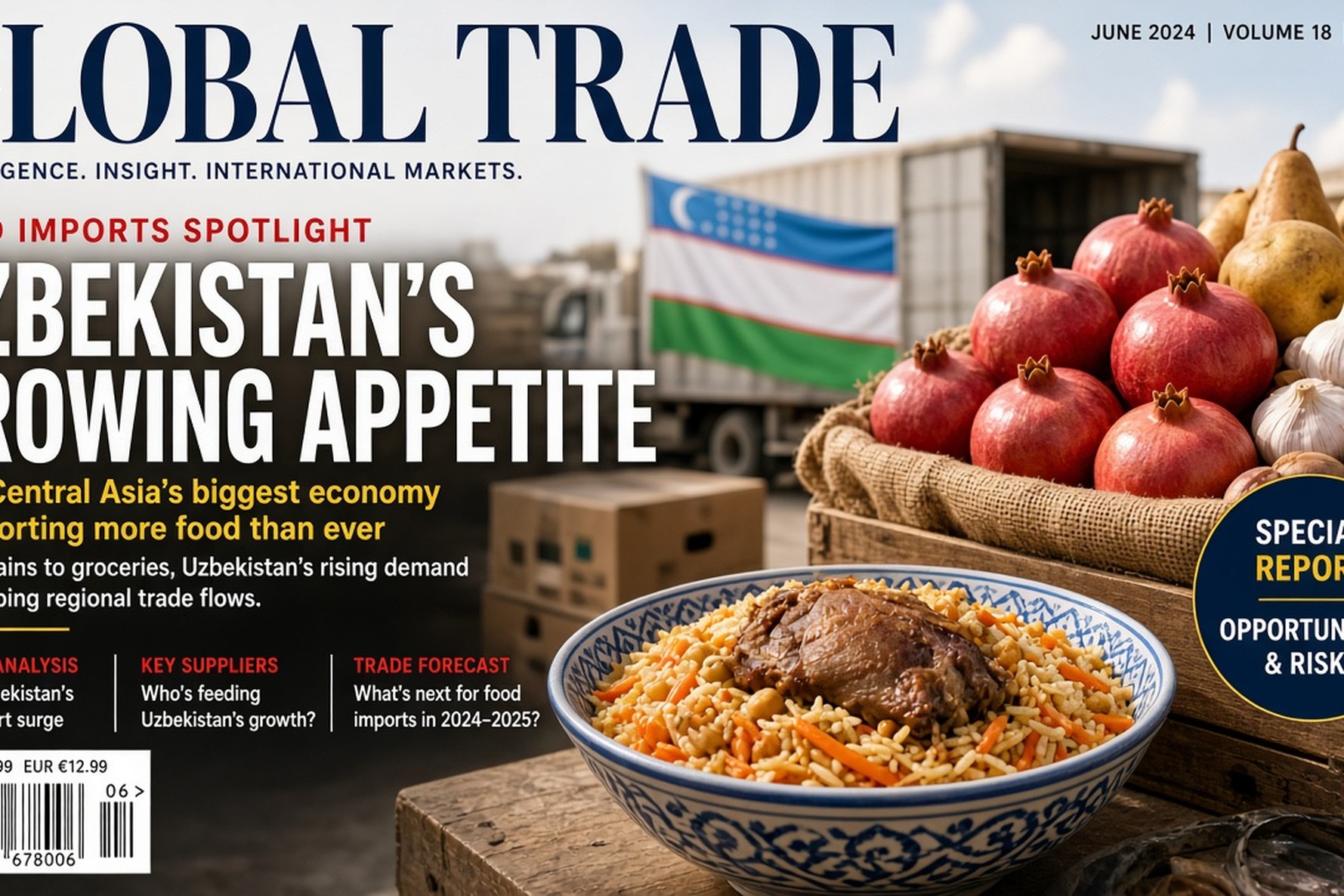
Импорт продовольствия в Узбекистан: товары, маршруты и правила
Анализ рынка импорта продуктов питания Узбекистана — востребованные зерно, мясо, молочная продукция, фрукты и овощи, сахар, чай и сырьё для пищевой промышленности; коридоры через Казахстан и Иран–Туркменистан–Алат, таможенное оформление, пошлины, санитарный контроль и возможности для иранских экспортёров.
Аналитическое введение
Рынок продуктов питания Узбекистана нельзя оценивать только по численности населения. География, внутреннее производство, зависимость от импортного сырья, рост перерабатывающей промышленности, расширение современной розницы и положение страны в Центральной Азии формируют импортный спрос. К началу 2026 года постоянное население превысило 38,2 млн человек, примерно половина проживает в городах. Такой рынок даёт как потребительские возможности, так и спрос со стороны пищевых предприятий.
В 2025 году стоимость импорта Узбекистана в группе «продукты питания и живые животные» достигла около 4,56 млрд USD. Крупнейшей группой были зерно и зернопродукты, но заметен рост импорта мяса, молочной продукции, готовых продуктов и растительных масел. Статистика первых четырёх месяцев 2026 года показывает сохранение импортной зависимости по нескольким основным группам продуктов.
Однако высокая стоимость импорта не означает автоматически лучшую возможность для иранского экспортёра. Рынок пшеницы и муки Узбекистана структурно связан с Казахстаном. Напротив, в свежих яблоках, некоторых фруктах и овощах, а также ряде переработанных продуктов Иран в последние годы имел реальное присутствие на узбекском рынке.
География — ещё один решающий фактор. Узбекистан не имеет выхода к морю и прямого доступа к морским портам. Наземные маршруты, железная дорога, транзитные страны, время на границе и фрахт поэтому составляют значительную долю конечной цены. Для иранских товаров особенно важен коридор Иран–Туркменистан–Узбекистан; для российских и казахстанских продуктов ведущую роль играют северные наземные и железнодорожные сети.
Профессиональная торговля с Узбекистаном требует большего, чем обзор рынка. До заключения контракта необходимо зафиксировать точные тарифные коды, импортные пошлины, НДС, сертификаты происхождения, карантинные или ветеринарные требования, санитарные разрешения, маркировку и расчёт затрат на оформление.
1. Какова структура рынка импорта продуктов питания в Узбекистане?
Импорт продуктов в Узбекистан сочетает базовое сырьё, белковые продукты, потребительские товары и сырьё для пищевой промышленности. Это различие важно для продавцов: покупатель пшеницы или промышленного масла ведёт себя совсем иначе, чем импортёр яблок, кондитерских изделий, сыра или упакованных продуктов.
Статистика 2025 года даёт ясную картину масштаба основных групп:
| Группа товаров | Стоимость импорта 2025 | Изменение к 2024 | Коммерческое примечание |
|---|---|---|---|
| Зерно и зернопродукты | USD 1,058.9M | +15.2% | Крупнейшая группа; высокая зависимость от региональных поставок |
| Мясо и мясопродукты | USD 868.8M | +70.6% | Быстрорастущий рынок с ветеринарными и холодовыми требованиями |
| Сахар, сахарные продукты и мёд | USD 578.9M | −6.8% | Крупный рынок сырья для пищевой и кондитерской промышленности |
| Кофе, чай, какао, специи и прочее | USD 518.9M | +21.5% | Привлекательно для потребительских товаров и сырья для переработки |
| Фрукты и овощи | USD 467.8M | +21.9% | Сезонные и внесезонные возможности; чувствительны к логистике |
| Молочная продукция и яйца | USD 322.7M | +40% | Растущий рынок с высокими требованиями к качеству и сроку годности |
| Корма для животных | USD 288.4M | +4% | В основном объёмный и промышленный рынок |
| Прочие пищевые препараты | USD 256.4M | +54.8% | Возможности для переработанных и брендовых потребительских продуктов |
| Рыба, ракообразные и моллюски | USD 57.5M | +34.7% | Меньший рынок, но зависимый от импорта и связанный с холодовой цепью |
Животные и растительные масла и жиры учитываются в отдельном статистическом классе. Стоимость импорта этой группы в 2025 году составила около 532 млн USD, из которых более 468 млн USD пришлось на растительные масла и жиры.
Что означает рост импорта в 2026 году?
За первые четыре месяца 2026 года Узбекистан импортировал продукты питания и живых животных на сумму около 1,88 млрд USD. Зерно оставалось крупнейшим сегментом — более 524 млн USD, за ним следовали мясо, сахар и мёд, фрукты и овощи, а также группа чая, кофе, какао и специй.
Для иностранных продавцов эти цифры несут два сообщения. Во-первых, импортный спрос структурен в нескольких группах — это не разовый дефицит одного продукта. Во-вторых, возможности следует оценивать на уровне подгрупп и даже тарифных кодов; «узбекский рынок продуктов питания» — не единый рынок с одинаковым поведением покупателей.
2. What Food Products Do Uzbek Traders and Importers Seek Most?
To identify products of interest to importers, three variables must be weighed together: actual import volume, margin potential and supply risk. On that basis, several groups stand out.
Cereals, flour and bakery raw materials
Cereals are Uzbekistan's largest food import group. Wheat, flour and related inputs for bread and milling are high-volume markets, but Kazakhstan holds very strong structural and logistics advantage here. In 2024 Uzbekistan imported about 3.13 million tonnes of wheat and wheat mixes worth roughly USD 595 million — over 3.11 million tonnes from Kazakhstan. In 2025 about 400,000 tonnes of the 422,600 tonnes of wheat flour imported came from Kazakhstan.
A large wheat market therefore does not mean an easy opportunity for Iran. Iranian exporters need a clear edge — specialist product, value-added form or differentiated supply terms. Competing purely on bulk commodity price against Kazakhstan's rail network is difficult.
Meat and protein products
Meat and meat product imports reached about USD 868.8 million in 2025, up more than 70% year on year. This makes protein one of the most important groups to review. Price alone is not the criterion — approved production units, required veterinary certificates, traceability, slaughter conditions, packaging, transport temperature and shelf life must be fixed before commercial talks.
For Iranian exporters each animal product must be assessed separately. Entry procedures that work for a general food shipment do not automatically apply to meat, poultry, fish or dairy.
Milk and dairy products
Dairy and poultry egg imports were about USD 322.7 million in 2025, up 40%. Milk powder, cheese, butter, cream and some dairy preparations may be worth review. Iran has presence in some dairy sub-groups — in 2024 trade data Iran was among suppliers of milk and cream with fat content above 1% and up to 6% for Uzbekistan. Each sub-group still needs independent analysis.
Sugar, confectionery and sugar products
Sugar, sugar products and honey imports were about USD 578.9 million in 2025, largely tied to food, confectionery and beverage industries. For Iran the more attractive segment is not necessarily raw white sugar but cocoa-free confectionery, boiled sweets, packaged sugar products and confectionery-industry inputs. 2024 data also shows Iranian sugar products in the Uzbek market.
Tea, coffee, cocoa and spices
This group's import value exceeded USD 518 million in 2025. Part enters retail directly; part supplies beverage, chocolate, confectionery and compound-product factories. Iran is not a major raw coffee or cocoa producer, but has supply capacity in processing, packaging, drink compounds, spices, saffron and blended products. Packaging, consumer price and distribution matter more here than bulk shipment.
Fresh fruit and vegetables
The fruit and vegetable market is especially important for Iran because geography and harvest-season differences can create advantage. But Uzbekistan is itself a major producer and exporter of some orchard and farm products — a strategy of "selling any Iranian fruit" is not sound. Best position usually arises when domestic supply falls, the Iranian product has distinct characteristics, or Iran can deliver with stable quality and packaging in a defined time window.
Fresh apples are a clear example. In 2024 Uzbekistan imported about 99,800 tonnes of apples; more than 60,400 tonnes came from Iran. Iran was also among the main suppliers of some other fresh fruits and fresh peppers in the same year.
Oils and fats for food industry
Vegetable oil and fat imports reached about USD 468.7 million in 2025. Beyond household edible oil, margarine, specialist bakery fats, confectionery oils and processed fats have industrial markets. Russia, Indonesia, Malaysia and Kazakhstan are strong in some sub-groups. Iranian sellers must compete on technical specs, melting point, oxidative stability, industrial application, packaging and price stability — not origin alone.
3. Main Suppliers and Iran's Position
Across total Uzbek imports, China and Russia are the largest suppliers and Kazakhstan holds an important place. In 2025 China's share of total imports was about 31.2%, Russia 18.3% and Kazakhstan 7.2%. Turkey, South Korea, Germany and India were also among major partners. These figures cover all commodities and must not be read as each country's food share.
In food, supplier mix depends heavily on product.
| Group | Suppliers with advantage | Decisive factor | Iran opportunity |
|---|---|---|---|
| Wheat & flour | Kazakhstan, Russia | Volume production, shared border, rail haul | Limited — mainly specialist products |
| Fresh fruit | Iran, regional & seasonal suppliers | Supply season, quality, distance, packaging | Strong in apples and some fruits/vegetables |
| Meat | Protein-exporting countries | Price, veterinary permits, cold chain | Case-by-case product and permit review |
| Dairy | Russia, Kazakhstan, regional suppliers | Shelf life, price, cold network | Selective opportunity in some sub-groups |
| Tea & coffee | Producing countries & processing hubs | Brand, price, consumption habit | Mainly processed and compound products |
| Oils & fats | Russia, Kazakhstan, Indonesia, Malaysia | Raw material, scale, price | Specialist or processed products |
| Confectionery & sugar products | Regional & international suppliers | Price, taste, packaging, distribution | Worth review for Iranian producers |
| Fresh vegetables | Regional countries including Iran | Season, freshness, freight cost | Attractive in suitable seasonal windows |
Iran–Uzbekistan trade
Total two-way trade between Iran and Uzbekistan in 2025 was about USD 578.9 million. This covers all exchanges and must not be confused with Iranian food exports alone. It does show active commercial infrastructure between the two countries.
Iran and Uzbekistan also have a preferential trade agreement. Tariff benefit depends on the product list, exact tariff code and rules of origin — not all Iranian foods enter automatically at preferential duty. Importers must check the ten-digit code, preference list and origin certificate before final pricing.
4. Through Which Routes and Borders Do Most Food Imports Enter?
Uzbekistan has no direct sea access. Origin country and transit state therefore matter almost as much as factory price in route choice. General trade statistics do not break food imports by every border crossing in a way that identifies one "main food border," but supplier mix and transport networks show several corridors play a prominent role.
Kazakhstan route — main axis for cereals and many northern goods
For wheat and flour, Kazakhstan is the most important origin and the rail network between the two countries is a fundamental advantage for bulk haul. In 2025 rail traffic between Kazakhstan and Uzbekistan grew significantly and grain movement from Kazakhstan to Uzbekistan increased. Northern and north-eastern road crossings, including the Yallama axis and other links to Kazakhstan, are important for regional goods. This route also matters for Russian cargoes that can enter Uzbekistan via Kazakh territory.
Iran–Turkmenistan–Uzbekistan route
For Iranian exporters this is one of the most practical land corridors:
Iran → Turkmenistan → Farap/Alat crossing → Uzbekistan
On the Uzbek side, the Alat customs post faces Farap in Turkmenistan. Both countries have focused in recent years on raising capacity and reducing crossing time. 2026 transport talks even discussed a separate lane for perishable cargoes on this axis — this should be treated as a development plan, not a guaranteed current service.
This route matters for fresh fruit, vegetables, packaged foods, shelf-stable dairy and many Iranian truck shipments.
Iran–Turkmenistan–Uzbekistan rail route
For heavier loads or goods with rail economics, the corridor from Iran through Turkmenistan to Bukhara and Tashkent is usable. A well-known regional path connects Bandar Abbas and Iran's rail network to Serhetabad in Turkmenistan and then to Uzbekistan's rail system. Countries in the Uzbekistan–Turkmenistan–Iran–Turkey corridor framework have also coordinated transit haul and tariffs.
Kyrgyzstan, Tajikistan and Afghanistan routes
Dostlik, Madaniyat and other Kyrgyz border points serve regional trade and some eastbound flows. The Oybek axis on the Tajik border matters for road trade. In the south, Termez and the Hairatan axis link Uzbekistan with Afghanistan. Route choice depends mainly on origin country, final destination in Uzbekistan and transit conditions.
| Corridor | Best suited for | Main advantage | Main limitation |
|---|---|---|---|
| Kazakhstan–Uzbekistan | Wheat, flour, bulk raw materials, Russian & Kazakh goods | Shared border & strong rail network | Dependence on line and terminal capacity |
| Iran–Turkmenistan–Alat | Fruit, vegetables, packaged food, truck loads | Direct commercial route for Iran | Third-country transit and transit cost |
| Iran–Serhetabad–Turkmenistan–Uzbekistan | Heavy and rail cargoes | Rail haul and Central Asia connection | Multi-network rail coordination & transit formalities |
| Kyrgyzstan–Uzbekistan | Regional goods & part of eastbound flow | Access to Fergana Valley | Border conditions & road capacity |
| Tajikistan–Uzbekistan | Regional trade | Short land access for Tajik origins | More limited for distant origins |
| Afghanistan–Termez | Afghan trade & southern axis | Important southern Uzbek terminal | Route suitability depends on cargo origin |
For perishable goods the shortest route on the map is not necessarily the cheapest. Truck dwell, border queue, document transfer, cold-hold capability, terminal stop and delay risk must all enter route selection.
5. Rules and Documents for Food Imports into Uzbekistan
Food entry into Uzbekistan begins with customs declaration, but depending on product nature health controls, phytosanitary quarantine, veterinary checks or conformity assessment may also be required. Documents must be determined by exact product code — not by a general product title.
Basic commercial and customs documents
A shipment usually requires:
- Foreign trade contract and related transaction documents
- Commercial invoice
- Packing list
- Road, rail or relevant transport document
- Customs declaration
- Certificate of origin where required for tariff, trade agreement or buyer request
- Health, quarantine or veterinary documents matched to the product
- Conformity assessment documents for covered groups
- Product label information per applicable regulations
To use Iran–Uzbekistan preferential trade benefits, certificate of origin and compliance with rules of origin are especially important. Production in Iran alone, without meeting origin rules, is not enough for preferential tariff.
Health and epidemiological conclusion
Uzbek implementing regulations for imported agricultural and food products require, for covered groups, a health and epidemiological conclusion. New implementing rules for this process were adopted in November 2025. Validity of the issued conclusion for imported goods is linked to product shelf life. The list of covered goods is not fixed and uniform for all foods — 2025 also saw amendments to lists under health, veterinary and quarantine control. Up-to-date tariff code review before shipment is essential.
Plant products
Fruit, vegetables, seed, plant products and some agricultural raw materials fall under phytosanitary quarantine where listed. Before loading, the following must be clear: import quarantine permit requirement, exporting-country phytosanitary certificate, pest and disease conditions, border inspection point, packaging conditions and sampling possibility. On the Iran–Turkmenistan axis, Alat and related rail stations also have quarantine control structures.
Animal products
Meat, meat products, milk, dairy, eggs and some aquatic products must be checked against veterinary control lists. Production unit status, accepted veterinary certificates, origin country or region status, test results, batch number, production date, shelf life and cold chain must be confirmed before contract.
Conformity assessment
Some foods must meet Uzbek technical requirements and conformity assessment. This may include sample testing through an approved laboratory or body. ISO or HACCP certificates at the seller's plant help assess quality management but do not replace legal requirements of the destination market.
| Product group | Controls to review | Key pre-purchase point |
|---|---|---|
| Fresh fruit & vegetables | Phytosanitary quarantine, pesticide residues, health requirements | Confirm documents before harvest and packing |
| Meat & poultry | Veterinary, hygiene, testing & cold chain | Confirm approved unit and product |
| Dairy | Veterinary, health, conformity & labelling | Shelf life and cold-store conditions |
| Confectionery & packaged food | Health, composition, additives, labelling | Formula and label check before print |
| Oils & fats | Technical specs, health & conformity | Match industrial parameter to buyer application |
| Spices & dried fruit/nuts | Contamination, moisture, pesticides; quarantine where required | Define acceptance limits in contract |
6. Food Labelling for the Uzbek Market
Labelling is one point where post-entry correction can cost significant time and money. Recent regulatory amendments have simplified some general mandatory labelling requirements, but for certain consumer groups obtaining a certificate or health conclusion may still depend on required information in Uzbek on the product. Do not assume labels can easily be corrected after entry.
For packaged foods, buyer and seller should review at least before final print:
- Product name, ingredients, net quantity
- Production date, expiry date or shelf life
- Country of origin
- Manufacturer or importer name and required details
- Storage conditions, necessary warnings and required conformity information
A digital marking system also exists for some groups. Water and non-alcoholic beverages are among categories where digital marking requirements should be checked.
Best practice for Iranian exporters: send the final label file to the importer before mass production and obtain written approval. Printing tens of thousands of packs with one missing phrase can cost far more than correct label design.
7. Tariffs, Taxes and Real Cost of Food Imports into Uzbekistan
There is no single tariff for all foods in Uzbekistan. Import duty depends on the ten-digit Uzbek classification code, product origin and whether preferential trade benefits apply. Statements like "Uzbek food import tariff is 10%" are not reliable for commercial decisions. Each product must be checked in the integrated tariff system by exact code.
Value-added tax
Import VAT in Uzbekistan is 12%. This is part of cash clearance cost and must be included when comparing seller prices.
Customs service fees
From May 2025, customs declaration processing fees are set by customs value and the Uzbek base calculation unit (BHM). Part of the official fee scale:
| Customs value of shipment | Declaration processing fee |
|---|---|
| Up to USD 10,000 | 1 BHM |
| Over 10,000 to 20,000 | 1.5 BHM |
| Over 20,000 to 40,000 | 2.5 BHM |
| Over 40,000 to 60,000 | 4 BHM |
| Over 60,000 to 100,000 | 7 BHM |
| Over 100,000 to 200,000 | 10 BHM |
To convert to cash amount, the valid BHM value on the declaration date must be applied. 2025 regulations also set separate rates for other services such as customs escort.
How is landed import cost calculated?
Professional importers do not compare offers on factory price alone. The cost model should include at least:
| Cost component | Determining factors | Buyer action |
|---|---|---|
| Product price | Quality, grade, order volume, packaging | Compare on identical specifications |
| Haul from origin | Distance, truck or wagon, refrigerated cargo | Quote actual route |
| Transit | Third country, terminal, haul permits | Review separately for Turkmenistan route |
| Insurance | Value and cargo risk | Define liability in contract |
| Import duty | Tariff code & origin | Check ten-digit code before order |
| VAT | Legal import base | Include 12% in cash flow |
| Customs services | Shipment value & service type | Calculate per BHM |
| Testing & control | Product type & regulatory lists | Allow for sampling and lab cost |
| Terminal & storage | Dwell duration | Reduce document delay |
| Cold chain | Temperature & transit time | Select suitable truck and equipment |
| Domestic distribution | Delivery city | Separate border cost from final delivery |
On the Iran route, freight must be quoted for the same origin city, exit border, vehicle type, transit country and final destination. A single "freight from Iran to Uzbekistan" figure without this detail is not a professional basis.
Customs value control
From 2025, declared value control has been strengthened for some product groups. For controlled categories, declared price may be compared with average values recorded in the previous period. Artificial invoice undervaluation is not only a poor cost-reduction tactic — it can complicate clearance.
8. Quality, Packaging and Order Specifications for Uzbek Buyers
In food exports to Uzbekistan, mismatch between sample and shipment is one of the main transaction risks. The remedy is precise purchase specification. Phrases like "grade-one apples," "export confectionery" or "quality dairy" are not enough for contract — measurable characteristics must be set.
| Product group | Key order specifications | Pre-loading control |
|---|---|---|
| Fresh fruit | Size, colour, ripeness, defects, pack weight | Sorting, sampling, product temperature |
| Fresh vegetables | Size, appearance, pesticide residues, pack | Sorting and health check |
| Dried fruit & nuts | Moisture, breakage %, pest, foreign matter | Testing and reference sample |
| Confectionery | Unit weight, composition, texture, shelf life | Production-line sample & pack check |
| Dairy | Fat, protein, microbiology, shelf life | Batch test & cold chain |
| Meat | Cut, weight, frozen state, production date, microbiological standard | Veterinary, temperature & pack |
| Oils & fats | Acidity, peroxide, technical specs & application | Analysis certificate & sample |
| Spices | Moisture, purity, particle size, contamination | Laboratory test |
Fresh products
For apples, peppers, citrus or greenhouse products, carton choice is not cosmetic. Carton compression strength, vent holes, stacking, net weight, pre-cooling and air circulation in the load directly affect loss percentage. Transport temperature must be set per product — one fixed temperature for all fruit and vegetables is wrong.
Packaged consumer goods
Importers look beyond product quality to pack size, retail sell price, label language, design, units per master carton and remaining shelf life at delivery. A product with 12 months nominal shelf life but only a few months left after production, warehousing and haul may not attract distributors.
Industrial raw materials
Food plants value specification stability over pack appearance. For oil, powders, sugar, spices, concentrate or additives, technical specs and acceptance criteria must be recorded from the start. Per-batch analysis certificate, test method, net weight, storage conditions and treatment of out-of-spec cargo must be clear in contract.
9. Sales Channels for Imported Food in Uzbekistan
Tashkent is the country's main commercial and distribution centre. In 2025 statistics, more than half of registered imports were linked to entities registered in Tashkent city, with Tashkent region also holding a significant share. This reflects importer registration location and must not be read as household consumption share in Tashkent alone.
For food sales, several main channels exist:
Importers and distributors
For a foreign brand or producer without a local network, working with an importer that has warehouse, distribution and sales team is usually the most practical entry point. Importer ability to sell the product matters more than holding an import licence alone. Buyers should specify whether goods go to supermarkets, wholesale markets, restaurants, factories or provincial distributors.
Wholesale markets
For fruit, vegetables, dried fruit/nuts and bulk goods, wholesalers remain important. Turnover speed is high but price competition is intense.
Modern retail
Chain stores and urban supermarkets matter for packaged foods, beverages, confectionery, dairy and branded products. Barcode, label, packaging, expiry date and delivery consistency gain importance in this channel.
Food-processing plants
For oil, fats, sugar, dairy powders, cocoa, spices, concentrate and raw materials, factories are a different buyer type. Talks must be based on technical specifications and industrial consumption price.
10. Real Opportunities for Iranian Exporters
Uzbekistan offers opportunity for Iran, but product choice should rest on real advantage.
Apples and some fresh fruits
More than 60,000 tonnes of Iranian apples in Uzbekistan's 2024 imports is clear evidence of a real trade channel. This market can grow for Iranian growers, sorters and exporters — provided supply timing, grade, packaging and shelf life are controlled.
Vegetables and greenhouse products
In fresh peppers Iran was among Uzbekistan's main suppliers in 2024 data. Iranian greenhouse products gain when domestic Uzbek supply is tighter or seasonal price difference covers transit cost.
Confectionery and processed products
Iran's industrial capacity in biscuits, wafers, boiled sweets, chocolate, snacks and sugar products may be worth review for Uzbekistan. Advantage over fresh goods is lower transport-time sensitivity — but competition with domestic production and imported brands is strong. Product testing by distributors and shelf-price comparison before large orders is smarter than starting with high volume.
Shelf-stable dairy
Recorded trade in some Iranian dairy lines with Uzbekistan shows activity is possible. Products with longer shelf life usually face lower logistics risk than very fresh dairy.
Dried fruit, saffron, spices and specialist inputs
Uzbekistan itself produces dried fruit, nuts and farm products — Iranian origin alone is not enough advantage. Real opportunity arises when the Iranian product has provable edge in specification, processing, packaging, industrial grade, supply timing or price. Saffron, some nuts, dates and specialist inputs should be assessed by buyer and application — not merely by product fame in Iran.
Lower-priority products
Wheat is a good example. The import market is very large, but Kazakhstan supplied more than 99% of Uzbek wheat import volume in 2024. Entry without a clear logistics or product edge is difficult. Market analysis should not stop at "which import group is big?" — the sharper question is "where can Iran create more value than the current supplier?"
11. Pre-Order Checklist for Importers
Before confirming a food order for entry into Uzbekistan, these points should be reviewed in writing:
- Define exact commercial name and technical specifications.
- Match HS code and ten-digit code used in Uzbekistan with broker or importer.
- Check import duty for that code and origin country.
- Confirm whether the product qualifies under Iran–Uzbekistan preferential trade agreement.
- Obtain physical sample or real production sample.
- Define acceptance criteria numerically and measurably.
- Specify required tests at origin and destination.
- Confirm health, phytosanitary or veterinary requirements before loading.
- Review Uzbek label file and mandatory pack information before final print.
- Fix net weight per pack and units per master carton.
- Set required remaining shelf life on arrival at buyer warehouse.
- Specify road or rail haul and transit route.
- For sensitive goods, include cold chain and temperature logging in contract.
- Write delivery terms (FCA, CPT, CIP, DAP, etc.) with named place precisely.
- Assign responsibility for transit, terminal, unloading, testing and clearance costs.
- Check required clearance documents before truck movement.
- Verify supplier capacity for repeat orders.
- Define contract treatment for weight shortage, pack damage or quality non-conformity.
What information is needed for an accurate quote?
A professional price request must let the seller quote comparably. "What is the price of food for Uzbekistan?" is not enough. A purchase request should include:
- Product name; processing form; grade; quality specifications
- Order quantity; weight per pack; consumer or bulk packaging
- Units per carton; private-label requirement if any
- Final destination in Uzbekistan; transport mode; delivery terms
- Required tests and certificates; label language and content
- Target delivery timing
For fresh goods specify size, ripeness grade, defect limits and carton type. For industrial raw materials, analysis certificate and required physical/chemical parameters matter more. Uzbek buyers seeking supply from Iran can submit these details in an Iranco purchase request so available options are reviewed against actual order specifications.
12. Sourcing Food from Iran Based on Buyer Specifications
Successful food purchase from Iran for the Uzbek market does not start with choosing the cheapest seller — it starts with defining precise purchase specifications. In a fresh apple order, size, grade, carton weight, harvest timing and destination must be known. In confectionery, unit weight, formula, shelf life and label file matter. In industrial raw materials, laboratory specifications, pack type and consumption volume are decisive.
Iranco can serve as a platform for purchase requests from buyers who want to review available supply options in Iran against these specifications. Buyers can specify product name, grade, required quantity, packaging type, destination in Uzbekistan and quality requirements so supply review proceeds on that basis.
Sample or technical specification before the main order is important next. Two prices are comparable only when quality, net weight, packaging, delivery terms and haul responsibility are identical in both offers. For reviewing supply of a food product from Iran, start the request with technical specifications, approximate order volume, destination city and packaging type — this gives a more accurate basis for comparing available options.
- B2B purchase requests with product specs, pack weight and approximate order volume
- Comparison of Iranian producers by product and Uzbek destination city
- Delivery coordination on Iran–Turkmenistan–Alat road and Iran–Turkmenistan rail corridors
- Expedited commercial documents, analysis certificates and shipment-related paperwork
Summary
Uzbekistan's food import market is multi-billion-dollar, but opportunities are not evenly distributed across products. Cereals and cereal products are the largest import group by value, yet Kazakhstan's dominance in wheat and flour shows market size alone is not the right entry criterion for Iranian exporters.
For Iran, products such as apples and some fresh fruits and vegetables have more proven advantage. Processed products, confectionery, some dairy lines and specialist food-industry inputs can also be reviewed by price, quality and sales channel.
Logistically, the Iran–Turkmenistan–Uzbekistan axis is the most important direct land route for many Iranian shipments. Farap–Alat matters for road haul and the rail network linked to Turkmenistan for bulk movement. Transit cost, border time and cold chain must be calculated before final selling price.
On regulations, decisions must rest on exact product code. Import duty, preferential agreement, 12% VAT, customs service fees, health control, phytosanitary quarantine, veterinary requirements and labelling are not uniform for all products. For professional exporters and importers, three factors above all determine outcome: choosing a product with real market advantage, defining precise purchase specifications and calculating landed cost to destination. Deals that get these three right are far more reliable than superficial seller price comparison.
Frequently Asked Questions
Which food products have the largest imports in Uzbekistan?
Cereals and cereal products are Uzbekistan's largest food import group — about USD 1.06 billion in 2025. Meat and meat products, sugar and sugar products, tea, coffee, cocoa and spices, fruit and vegetables, and dairy followed among the most important groups.
Is Uzbekistan a suitable market for Iranian food products?
For some products yes, but not all groups. Iran has notable presence in fresh apples and some fruits and vegetables. Markets such as wheat are dominated by nearby suppliers like Kazakhstan. Real advantage must be assessed per product against competitors, season, price and freight cost.
What is the main route for food exports from Iran to Uzbekistan?
For many truck shipments, Iran–Turkmenistan–Uzbekistan is the most practical option, with Farap in Turkmenistan and Alat in Uzbekistan playing key roles. For heavy loads, the Iran–Turkmenistan rail link to Uzbekistan's network is also worth review. Final choice depends on origin city, product type, destination and transport mode.
What is the food import tariff rate in Uzbekistan?
There is no single rate for all food. Import duty is set by exact ten-digit code, origin and in some cases preferential trade benefits. Tariff must be checked in Uzbekistan's tariff system for the specific product before contract. Import VAT is separate at 12%.
Do Iranian products receive preferential tariff?
Iran and Uzbekistan have a preferential trade agreement, but that does not mean preferential duty for all Iranian goods. The product must appear on the relevant list and meet rules of origin and required documents. Importers must check the exact code before calculating landed cost.
What documents matter for fruit and vegetable exports to Uzbekistan?
Beyond invoice, packing list and transport document, phytosanitary status and need for plant health certificate or other permits must be reviewed. Product code determines which controls apply. Labelling, packaging, shelf life and origin documents must align with importer requirements.
How is the final price of Iranian food in Uzbekistan calculated?
Factory price is only one component. Haul inside Iran, Turkmenistan transit, international freight, insurance, import duty, 12% VAT, customs fees, testing and certificates, terminal, storage and domestic Uzbek haul must all be included. Two sellers with similar factory prices can therefore produce very different landed costs.
How can spoilage risk for fresh cargo on the Uzbek route be reduced?
Initial product quality, pre-cooling, suitable packaging, appropriate refrigerated vehicle, temperature logging, reduced border dwell and planned loading timing are the main factors. Temperature specification must be set for each product — one fixed plan for all fruit and vegetables is not suitable.
What information should be given to a seller for a food price quote from Iran?
Exact product name, quality specifications, grade, order volume, pack weight, packaging type, destination in Uzbekistan, delivery terms, transport mode, required tests and certificates, and private-label needs should be specified. Buyers can submit these details in an Iranco purchase request so available supply options are reviewed against their actual needs.
Избранное Продуктs




Related Статьи



