 Команда журнала Iranco
От выбора апельсинов для экспорта до сортировки, ОТК, упаковки, холодовой цепи, целевых рынков и управления поставкой до прибытия
Экспорт апельсинов · Codex · Холодовая цепь · Россия и Ирак
Экспорт иранских апельсинов: зарубежные рынки, упаковка и перевозка
От выбора апельсинов для экспорта до сортировки, ОТК, упаковки, холодовой цепи, целевых рынков и управления поставкой.
Iranian oranges can supply neighbours, Russia, Central Asia and some distant markets — but export success depends more on uniformity, skin quality, size, ripeness, packaging and temperature control than on volume alone. FAO 2024 output ~2.23 million tonnes and 76,577 t exported from Mazandaran to Ordibehesht 1403 show supply capacity; commercial results hinge on sorting, QC, HS 080510, phytosanitary certificates and a stable 3–8°C chain.
1. Iran's orange production and export position
Iran is a major global orange producer; Mazandaran concentrates sorting lines, cold stores and export traders in the north.
To Ordibehesht 1403, Mazandaran shipped 76,577 t in 3,634 consignments versus 48,912 t in the prior comparable period.
Practical edges: bulk production, commercial-scale sorting, short hauls to Iraq, the Caucasus and Central Asia, and Caspian sea lanes to Russia.
2. Orange types for export
| Group | Trait | Commercial note | Use |
|---|---|---|---|
| Thomson navel | Known fresh-eating type | Wholesale & retail | Size uniformity |
| Washington navel | Distinct navel | Retail | Shape & colour |
| Blood orange | Distinct internal colour | Niche markets | Sample approval |
| Valencia | Juice & fresh | Beverage industry | Ripeness & juice |
Not every good domestic orange suits long transit — skin strength, size uniformity and cold-store behaviour matter.
Contracts must name the cultivar (Thomson, Washington, blood, Valencia); generic 'export orange' is not a professional order term.
3. Technical specs buyers expect
| Parameter | Define | Importance |
|---|---|---|
| Cultivar | Exact type name | Appearance & storage behaviour |
| Origin | Province & district | Traceability & uniformity |
| Diameter | mm range or size code | Pack uniformity |
| Skin quality | Spot/scratch limits | Fewer claims |
| Ripeness | Matched to transit time | Shelf life |
| MRL | Destination rules | Customs clearance |
Replace vague 'grade one' language with measurable parameters.
Codex sizing starts at 53 mm mid-diameter; smaller fruit falls outside commercial size classes. SS/TSS to acidity ratios help define internal eating quality in large deals.
4. Foreign markets for Iranian oranges
| Market | Status | Note |
|---|---|---|
| Russia | Caspian & Caucasus routes | Egypt rivalry; stable QC |
| Iraq | Short road haul | Price & carton strength |
| UAE | Re-export hub | Appearance & pack |
| Central Asia | Geographic proximity | Border transit time |
Russia: appearance, firm fruit and strong packs; Egypt shipped >137,000 t to Russia in 2024. Iraq: truck lanes and wholesale — price matters but weak cartons raise border losses.
UAE: appearance, packaging and competition with Egypt, South Africa and Spain. Central Asia and Armenia: geography helps but border time and handling risk remain.
5. Standards, documents and entry rules
Fresh/dried oranges: HS 080510 — align with national subcodes at destination. Codex CXS 245-2004 covers health, sizing, uniformity and marking.
Phytosanitary certificates where quarantine applies. MRL plans must match destination before harvest — legality in Iran does not auto-clear abroad.
6. Sorting and quality control
| Defect | Effect | Action |
|---|---|---|
| Decay | Spread in carton | Remove entirely |
| Mould | Cross-contamination | Immediate cull |
| Bruising | Short shelf life | Reject |
| Size mix | Weak presentation | Re-sort |
Sorting creates export value: cull decay, mould, bruising, abnormal softness and severe size mix.
A one-off sample is insufficient — acceptance criteria plus random carton checks across the load beat inspecting a few fruits on one pallet.
7. Export orange packaging
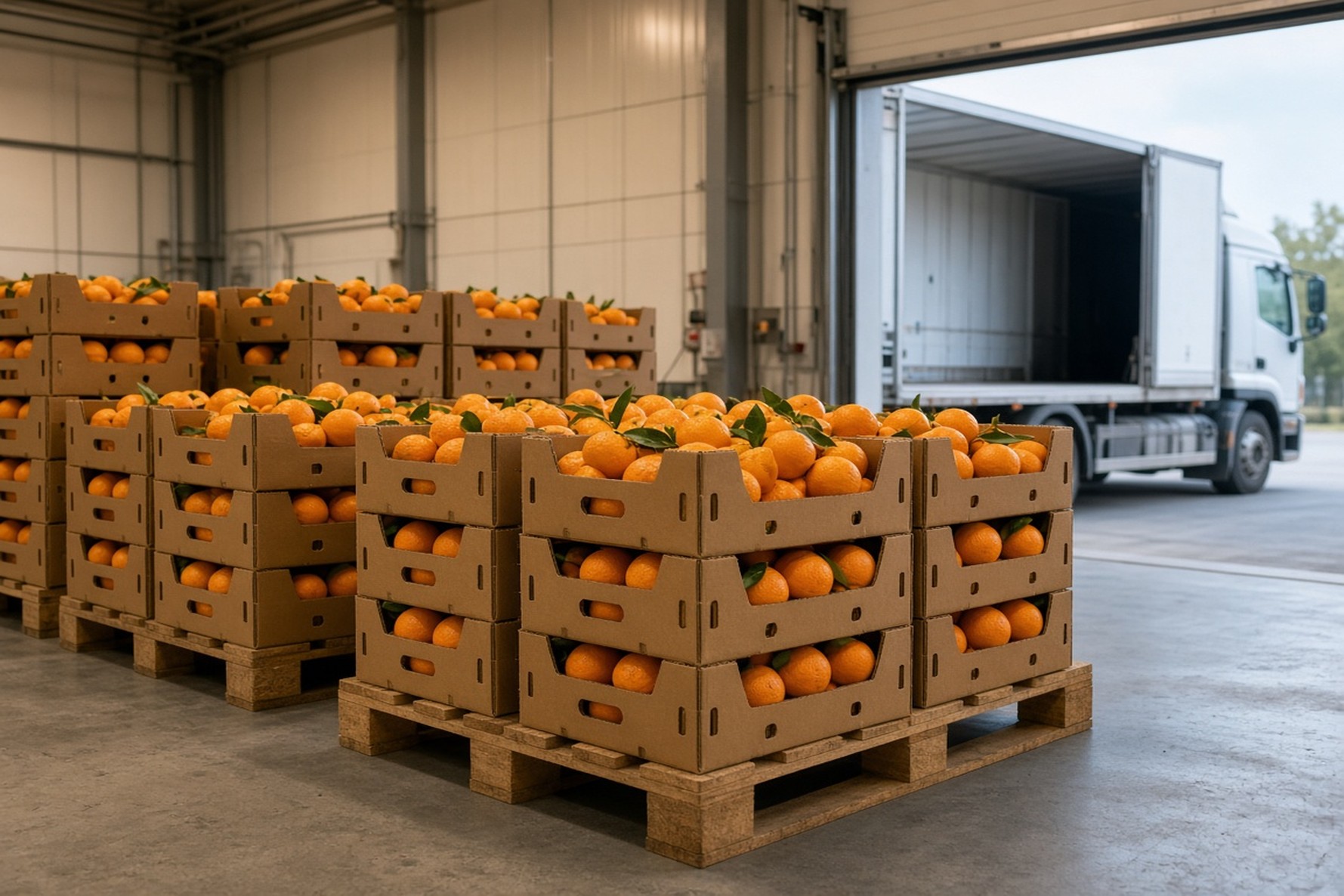
Primary job: protect against pressure, vibration and moisture — not only print quality. Corrugated cartons must match net weight, humidity and pallet height.
Vent holes must allow air between cartons without destroying wall strength; blocked vents after pallet stacking kill airflow design.
8. Cold chain and transport
| Method | Advantage | Limit | Use |
|---|---|---|---|
| Ventilated carton | Protection & pallets | Wet-strength needed | Bulk export |
| Regular lay-out | Premium look | Higher pack cost | Specialty retail |
| Plastic crate | High strength | Return logistics | Selected lanes |
| Consumer pack | Added value | Condensation control | Retail |
Many oranges store ~3–8°C at 90–95% RH for up to ~3 months (UC postharvest), depending on cultivar and maturity.
Pre-cool before loading — reefers maintain temperature, they do not quickly cool warm fruit. Data loggers are low-cost dispute evidence.
9. Export orange pricing
Price follows cultivar, season, size, sort-out %, cartons, tests, cold storage, inland/export freight, destination and payment terms.
Comparing farm-gate $/kg without defect %, pack and shelf life misleads — thin cartons can crush bottom layers at destination.
10. Competition with major exporters
Spain, Egypt, South Africa and Turkey (>233,000 t exports in 2024) compete hard — especially Egypt in Russia, UAE and Iraq.
Iran's sustainable edge is uniform, traceable, well-packed fruit on shorter lanes — not cheap irregular lots.
11. Importer checklist
Document all 16 points: cultivar & origin, size, season sample, colour/firmness/ripeness, defect %, MRL tests, carton weight, pack spec, labels, pallet height, temperature, loggers, quarantine docs, pre-shipment inspection, delivery terms.
Professional RFQs list cultivar, volume, diameter, count per pack, destination, net weight, pack type, tests and shipping mode.
12. Sourcing Iranian oranges on Iranco
Foreign buyers need fruit that matches written specs, pack and delivery schedule — Iranco is the B2B entry point to Iranian suppliers.
Because orange quality shifts by season and lot, sample exchange and technical detail must precede the final order.
Importer checklist (16 points — summary)
- State exact cultivar and production area.
- Define diameter range or fruit count per carton.
- Approve an in-season reference sample.
- Set colour, firmness and ripeness criteria.
- Write defect tolerances; reject decay/mould.
- Require destination MRL testing.
- Fix net weight and weight tolerance per carton.
- Confirm carton spec, vents and internal layout.
- Approve label artwork before bulk packing.
- Define pallet pattern and stack height.
- Set transport temperature per cultivar.
- Agree on temperature loggers.
- Verify quarantine documents before loading.
- Contract pre-shipment inspection rules.
- Clarify delivery point and INCOTERMS.
- Assign insurance and clearance responsibility.
Частые вопросы
Is Iranian orange suitable for export to Russia?
Yes, with firm uniform fruit, no decay and strong packs; both Caspian sea and Caucasus road routes are used depending on cost and delivery point.
Which Iranian orange is best for export?
Destination-dependent: Thomson for general trade, blood for niche retail, Valencia for juice — size and firmness often beat the cultivar name alone.
What size should export oranges be?
Define in contract; Codex commercial sizes from 53 mm; order by diameter band or count per pack.
What transport temperature?
Often 3–8°C at 90–95% RH; exact set-point depends on cultivar and pick maturity — some types chill easily.
Which lab tests are needed?
MRLs; SS/TSS and acidity on large contracts; visual QC for decay, pests, firmness and uniformity.
Why does mould appear at destination?
Mechanical damage, infected fruit packed, wrong temperature, condensation, weak sorting hygiene or long transit — cull damage and keep cold chain stable.
What makes a good export carton?
Adequate compression strength, wet strength where needed, working vents and pallet-friendly dimensions.
How is export price calculated?
Season, cultivar, size, sort-out, pack, tests, cold store, freight and destination — farm price ≠ export-ready orange cost.
Итог
Экспорт иранских апельсинов устойчив, когда цепочка от сада до прибытия управляется как единое целое с цифровыми спецификациями и стабильной холодовой цепью.
Избранное Продуктs










Related Статьи



