 Команда журнала Iranco
Объём рынка, конкурентные товары, поведение покупателей, требования к ввозу, упаковка, маршруты доставки и стратегия продаж иранских продуктов в Узбекистане
Market Report · Export · Uzbekistan · Central Asia
Iran Food Export to Uzbekistan: Market Capacity for Iranian Producers
Comprehensive analysis of demand capacity, technical specifications, sanitary and customs requirements, logistics advantages and routes into Tashkent retail and processing industries.
Analytical introduction
Uzbekistan is one of Central Asia's largest food markets. Permanent population passed 38.24 million in 2026; urban growth, modern retail expansion and processing-industry development reinforce import demand on several layers at once. For an Iranian exporter this is not only "geographic proximity": import capacity, bilateral trade history and land access via the Iran–Turkmenistan corridor determine whether your product stays in Uzbekistan or sells for a single season.
In 2025 Uzbekistan's "food and live animals" imports reached about USD 4.563 billion, up roughly 23.5% year on year. Import dependence in protein, fruit and vegetables, confectionery, spices and packaged foods remains structural. Bilateral Iran–Uzbekistan trade in the same period was about USD 579.5 million; Iran's agricultural and food export share within that total is traceable for several key products.
Iran has recently supplied apples, some citrus, fresh pepper, dates, pistachios, confectionery and selected dairy products to Uzbekistan. Export success is not copying the same SKU for every buyer. Wholesale importers, retail chains and food plants each apply different quality, packaging, landed-cost and documentation rules.
This report is for producers, export agents and B2B buyers who need market capacity, suitable products, risks, regulations, tariff codes, logistics and Iran supply routes in one place before placing orders. Iranco provides a purchase-request channel with precise product specs to match Iranian suppliers.
1. Uzbekistan import capacity and Iran's export position
Measure market capacity at product-group level and even HS code. The table below summarises main 2025 import groups and helps prioritise Iranian export products.
| Product group | Import value | Annual growth | Link to Iran exports |
|---|---|---|---|
| Cereals & cereal products | $1,058.9M | +15.2% | Mainly Kazakhstan; Iran limited in specialty flour |
| Meat & meat products | $868.8M | +70.6% | Case-by-case; veterinary approval critical |
| Fruit & vegetables | $467.8M | +21.9% | Proven Iran edge in apple, citrus, pepper |
| Sugar, confectionery & honey | $578.9M | −6.8% | Opportunity in packaged sweets and dates |
| Tea, coffee & spices | $518.9M | +21.5% | Saffron, barberry, processed spices |
| Nuts & edible seeds | $186.2M* | +18%* | Pistachio, almond, raisin — aflatoxin sensitive |
| Dairy | $322.7M | +40% | Selective; shelf-life and cold chain |
| Other food preparations | $256.4M | +54.8% | Canned goods, paste, beverages, snacks |
* Aggregated estimate for nut/seed sub-groups in trade statistics; exact HS code is mandatory for contracts.
USD 579.5M bilateral trade shows an active Iran–Uzbekistan channel, but each product's share must be measured separately. The preferential trade agreement can offer tariff advantages for listed goods subject to rules of origin and correct codes.
2. Iranian products with export potential and trade signals
The groups below appear most often in B2B talks with Uzbek buyers. Figures combine trade statistics, market reports and recent shipments — not a substitute for formal customs inquiry per deal.
| Product | Sample HS | Market signal | Iran advantage | Main risk |
|---|---|---|---|---|
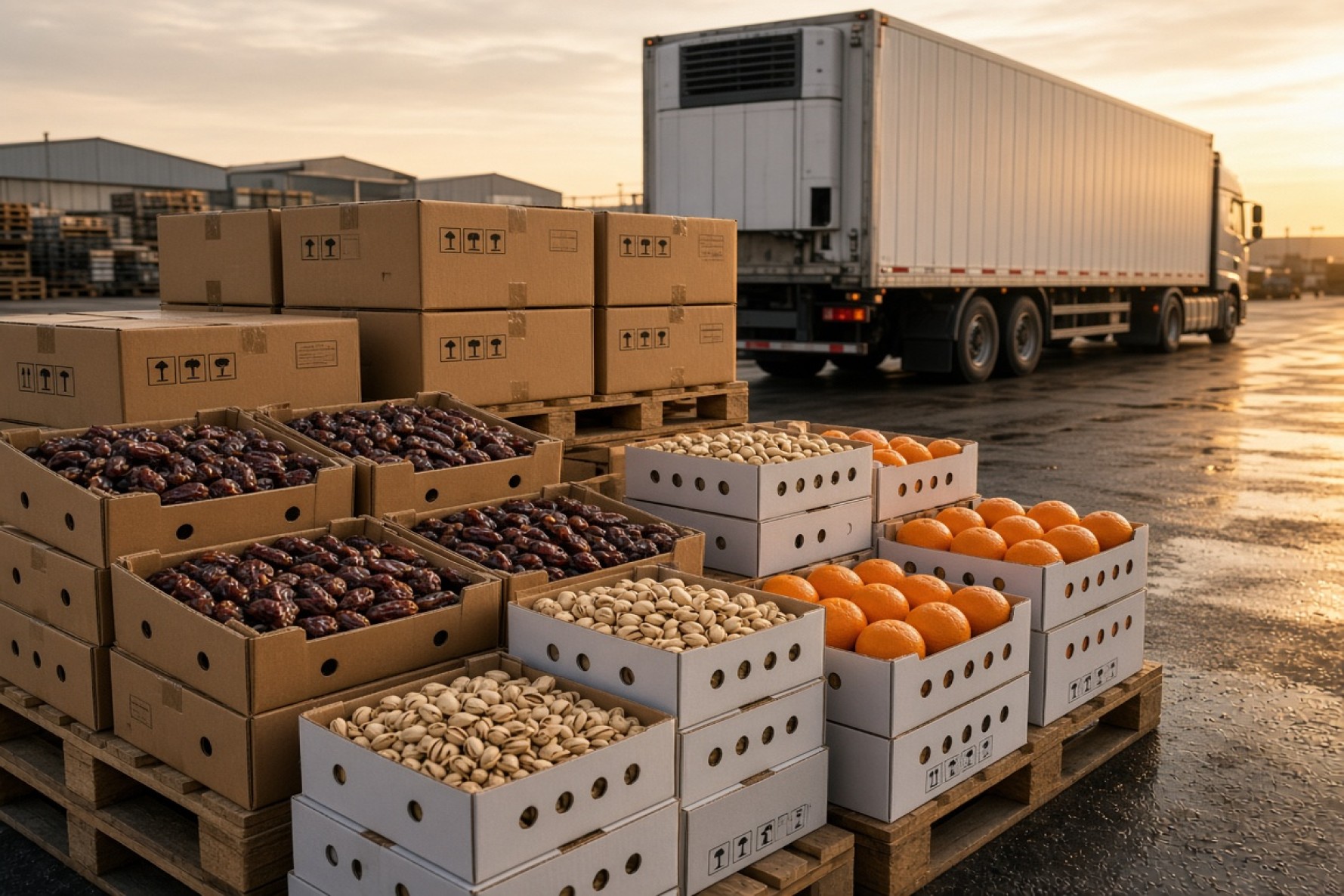
| Dates (Mazafati, Kabkab, Piarom) | 080410 / 080450 | Ramadan & wholesale demand | Variety, competitive FOB | Moisture, insects, vacuum pack |
| Pistachios (Ahmad Aghaei, Fandoghi) | 080252 | Retail & nut shops | Origin brand, flavour | Aflatoxin, open-shell ratio |
| Oranges & citrus | 080510 / 080521 | Winter season | Proximity, supply volume | Cold stress, border delay |
| Fresh greenhouse pepper | 070960 | Tashkent wholesale | Iran supply track record | Pesticide residues, sorting |
| Sweets, biscuits, candy | 1905 / 1704 | Modern retail growth | Flavour range, unit price | Uzbek label, additive list |
| Export-grade apples | 080810 | 60k+ tonnes from Iran in 2024 | Volume and sorting | Cartons, transport temperature |
| Barberry & saffron | 081340 / 091020 | HoReCa & distribution | Recognition of Iranian origin | Adulteration, purity, moisture |
Dates and pistachios: different contract logic
Dates are usually sold in bulk lots on FOB or border CPT terms; buyers focus on moisture, size, count per carton and pack type (bulk, branch, 5 or 10 kg cartons). Pistachios move in 10–25 kg packs for nut retailers; aflatoxin reports and open-shell percentage are payment preconditions.
Citrus, pepper and confectionery
Oranges and mandarins peak from December through February. Greenhouse pepper must arrive with uniform sorting and residues below limits. Sweets and biscuits for retail chains need stable quality, at least six months' shelf life on delivery and full Uzbek labelling.
3. Products to approach with caution
Some groups have large markets but high licence, price or regional competition risk for Iranian exporters. Align the table below with your legal and customs team before investing in packaging and labels.
| Group | Reason for caution | Competitive supply | Iranco recommendation |
|---|---|---|---|
| Bulk wheat & flour | Kazakh dominance in supply | Kazakhstan, Russia | Focus on specialty or blended flour |
| Frozen meat | Veterinary rules, approved plants | Brazil, Russia, Kazakhstan | Confirm approval before samples |
| Fresh milk | Short cold chain | Local and Russian suppliers | UHT or powdered dairy |
| Bulk edible oil | Volume price competition | Russia, Indonesia | Specialty or consumer-brand oils |
| Soft & energy drinks | Global brands and distribution | International brands | Local drinks or B2B ingredients |
| Goods without Uzbek labels | BHM hold or repackaging | — | Approve label artwork before production |
4. Quality control, critical defects and sample risk
Detecting quality defects before loading is the most critical step to stabilise relations with Uzbek companies. Common failures lead not only to price deductions but to cancellation of the importer's permits at destination customs.
- Agriculture: live insects, fungal rot, soft pepper, MRL above limits.
- Nuts: larvae, moisture damage, dark kernels, aflatoxin above standard.
- Processed: rancidity, tin corrosion, tin leaks, >5% biscuit breakage, unclear dates.
Include AQL tables in the contract and use independent pre-loading inspection with results on the waybill. Iranco records sample alignment with production-line specs for legal clarity.
5. Distribution architecture and Tashkent retail
Two main layers operate in parallel: open traditional markets and depots (over 80% of flow) and growing supermarket chains (about 13–18%, faster in Tashkent).
- Korzinka: 190+ stores; strict packaging, barcode and supply continuity.
- Havas: 340+ discounters; fast turnover for Iranian biscuits, chocolate, paste and canned goods.
- Makro: 50+ stores; fresh fruit and broad assortment.
- Magnum & Baraka Market: regional models for suburban households.
- Chorsu & Qo'yliq: Tashkent wholesale hubs; bulk packs and cash/credit settlement.
- HoReCa: Samarkand, Bukhara, Khiva — saffron, barberry, 5 kg paste, pizza cheese.
6. Technical specifications and order standards
B2B contracts need numeric parameters. Vague terms like "grade one" or "export quality" without a spec table invite disputes.
| Product | Key parameter | Acceptance limit | Document |
|---|---|---|---|
| Dates | Moisture, size, defective fruit % | Per contract (e.g. moisture below 18%) | Analysis certificate, phytosanitary |
| Pistachios | Open shell %, size, aflatoxin | e.g. B1 below 10 ppb | COA from accredited lab |
| Oranges | Calibre, Brix, skin defects | Percentage sorting in proforma | Phytosanitary, packaging |
| Pepper | Length, colour, pesticide MRL | Below CODEX/Uzbek limits | Residue testing |
| Confectionery | Net weight, moisture, dates | ±3% weight, X months shelf life | Label, ingredient list |
7. Legal requirements, Uzbek labelling and customs documents
| Area | Requirement | Responsible party |
|---|---|---|
| Customs | Declaration, invoice, waybill, insurance | Exporter + broker |
| Sanitary / phytosanitary | Health certificate, phytosanitary for plants | Iranian issuing authority |
| Labelling | Uzbek: name, ingredients, dates, origin | Manufacturer |
| Sampling | BHM and destination lab | Importer |
| Veterinary | For meat, dairy, fish | Approved export establishment |
| Customs value | Value control strengthened from 2025 | No invoice under-valuation |
Documents must be aligned with the Uzbek broker before trucks or wagons move. Each day at Farap–Alat border can mean direct loss for fresh fruit.
7. HS codes, duties and preferential trade
Import duty in Uzbekistan depends on the ten-digit code and origin. Import VAT is 12% and calculated separately from customs duty. Customs processing fees (BHM) have been tiered from May 2025 based on customs value.
| Product | HS (6 digits) | Note |
|---|---|---|
| Fresh dates | 080410 | Check preferential duty and phytosanitary |
| Pistachios in shell | 080252 | Aflatoxin control at destination |
| Oranges | 080510 | Seasonal; plant quarantine |
| Fresh pepper | 070960 | Pesticide MRL |
| Sweet biscuits | 190531 | Label and additive list |
Before proforma invoice, obtain the exact ten-digit code from your Uzbek broker. Iranco can query suppliers for suggested HS in your purchase request; final confirmation at destination remains the importer's duty.
8. Packaging and land-export logistics
| Product | Packaging | Transport | Typical time |
|---|---|---|---|
| Fresh fruit | Vented cartons, pre-cooling | Refrigerated truck | 5–8 days to Tashkent |
| Dates | 5–10 kg cartons, pallet | Dry truck | 4–7 days |
| Pistachios | 10–25 kg bags or boxes | Truck/wagon | 5–10 days |
| Confectionery | Shipper cartons, shrink wrap | Dry truck | 4–6 days |
| Heavy cargo | Big-bags, bulk rail | Sarakhs–Turkmenistan rail | 10–18 days |
Main route: Iran → eastern crossings → Turkmenistan (Farap) → Alat (Uzbekistan). Rail often runs Bandar Abbas or domestic network to Sarakhs then Uzbekistan. Cargo insurance, temperature logs and minimal border paperwork delays are part of landed cost.
10. International competitor comparison
| Country | Strengths | Challenges | Price level | Dominant segments |
|---|---|---|---|---|
| Russia | Brand recognition, EAEU zero duty | Rising production costs | Mid to high | Oils, sweets, premium dairy |
| Kazakhstan | Shared border, short transit | Limited horticulture | Economy | Wheat, flour, cereals |
| Turkey | Premium packs, active traders | Long haul, high freight | Premium | Confectionery, olive oil |
| China | Volume and low cost | Taste and halal fit | Low | Tea, industrial additives |
| Iran | Neighbourhood, complementary seasons | Retail branding | Competitive | Pistachios, dates, citrus, paste, biscuits |
11. Raw materials for processing industries
A large share of food flows serves sauce plants, semi-ready meal factories and bakeries around Tashkent and the Fergana Valley.
- Aseptic paste: 36–38° Brix, Bostwick <4.5 cm, 220 L aluminium drums.
- Raisins & date paste: moisture <16%, uniformity for wafer and cake lines.
- Nut slivers: controlled microbiological load for premium pastry.
- Essences & distillates: rose water, mint, natural colours for beverages.
12. Landed cost, Incoterms and FX risk
Common patterns: CPT Alat or Sarakhs border (seller pays freight to entry) and DAP buyer warehouse in Tashkent (includes Turkmenistan transit). Autumn–winter citrus and greenhouse veg prices can be up to 40% above summer.
- Reefer freight, Turkmenistan transit, sampling and insurance: typically 12–18% on FOB.
- Import duty + 12% VAT on CIF and trade margin.
- Settlement: trust brokers, licensed exchangers UAE/Tashkent, barter with cotton and pulses imports.
Ten-point importer checklist before ordering
- Define grade, calibre and numeric indices.
- Match ten-digit tariff code for preferential trade.
- Reference sample from active line; moisture, microbial and MRL tests.
- Approve Uzbek (Latin) label artwork before mass print.
- Include AQL and allowed defects in contract.
- Validate phytosanitary, veterinary, halal and COA.
- Packaging for route (5-layer carton, MAP, ISPM 15).
- Cold-chain protocol and temperature data logger.
- Customs broker at Alat or Tashkent for perishables.
- Delivery schedule, FX payment, insurance and arbitration.
Information needed for a proforma invoice
Product and grade, physicochemical targets, pack weight and format, tonnage and schedule, private label and Uzbek label, Incoterms and required certificates — submit via Iranco's enquiry form.
Direct supply from Iranian factories via Iranco
The professional path from "interest in Uzbekistan" to "delivery at buyer's warehouse" starts with a purchase spec. Iranco matches your B2B purchase request to Iranian producers and packers without replacing your customs broker or Uzbek importer.
- Register product, volume, destination city and specs via Iranco contact.
- Receive FOB/CPT offers from qualified suppliers.
- Coordinate samples, COA and export packaging.
- Support origin documents aligned with your forwarder.
Conclusion
Uzbekistan's USD 4.563B food import market growing 23.5% offers structural opportunity for Iranian exporters, especially in fruit, nuts, dates, pistachios, pepper and confectionery. Success depends on the right sub-group, Uzbek Latin labelling, cold-chain discipline and border logistics.
The Sarakhs and Lotfabad corridors to Alat customs remain the backbone of land freight. Complete HS, duties, labelling and the ten-point importer checklist before contract. Iranco is a practical starting point for purchase requests and supplier matching.
Frequently asked questions
Which Iranian foods are most profitable to export to Uzbekistan?
It varies by season and channel; dates, pistachios, apples, oranges, pepper and packaged sweets have repeated most in recent trade. Net margin comes after duty, freight and wastage.
What was Uzbekistan's food import value in 2025?
About USD 4.563 billion, up roughly 23.5% year on year.
What is the land export route from Iran to Uzbekistan?
Mainly eastern Iran to Turkmenistan and the Farap–Alat crossing; high-volume rail via Sarakhs or Bandar Abbas is also used.
Do Iranian products get preferential duty rates?
A preferential trade agreement exists; eligibility depends on HS code and rules of origin and must be checked per shipment.
Which pistachio tests matter in Uzbekistan?
Aflatoxin, moisture, open-shell ratio and foreign matter; COA from an accredited origin lab reduces risk.
What are confectionery requirements?
Full Uzbek label, additive list, production and expiry dates, and BHM sanitary compliance.
What is Iran–Uzbekistan bilateral trade worth?
About USD 579.5 million in 2025; food share must be analysed at product level.
How do I submit a purchase request to Iranco?
Use Iranco's contact page with product name, HS if known, volume, destination and Incoterms so Iranian supply options can be reviewed.
Избранное Продуктs








Related Статьи



