 Команда журнала Iranco
Анализ рынка Ирака для иранских продуктов — от выбора товара и контроля качества до импортных правил, календаря, границы, упаковки и контракта
Гид по экспорту · Продукты · Ирак
Экспорт иранских продуктов в Ирак: востребованные товары, маршруты и правила рынка
Анализ рынка Ирака — выбор продукта, контроль качества, импортные правила, сельхозкалендарь, границы, упаковка и контракты
Четыре ключевых рыночных показателя
Цифры основаны на торговой статистике 2024 года, сообщённой Ираном. Для анализа доли рынка используйте единую статистическую базу.
Iraq is a major regional market for Iranian food and farm products, but success is not only about geography. Product group choice, seasonal import limits, quality control, packaging, border selection and clear freight/customs responsibilities separate one-off sales from durable trade.
The Iraq market is close but not simple: domestic production policy, the agricultural calendar, standards, border operations and foreign competition all matter. Iraq's global imports in 2024 reached billions of dollars across cereals, meat, bakery, fruit, sugar and dairy groups.
Exports should be built on right product + right timing + right border + right technical specs. Exporters who align import status, standards, end market and delivery terms with Iraqi buyers before loading carry far less risk.
1. Iraq's Role in Iran's Food Trade
Iraq matters simultaneously for several product groups. Wide distribution, urban population and import dependence create competition among Iran, Turkey, Arab countries and other origins.
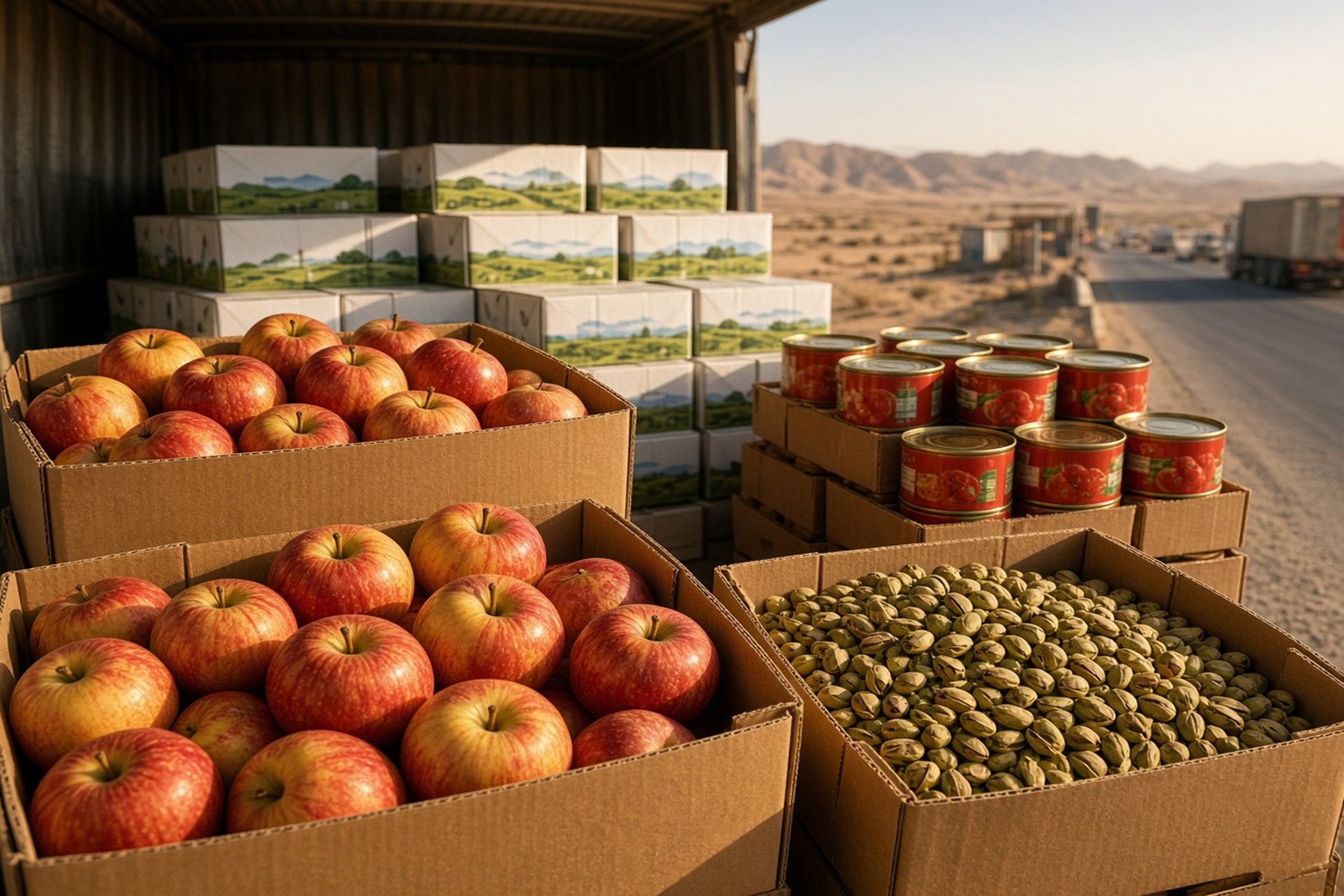
In 2024, reported Iranian fruit and nuts to Iraq were among the largest agricultural trade lines, followed by vegetables, dairy and processed fruit/vegetable products.
High demand does not mean year-round import of every item. Iraq's Ministry of Agriculture uses an agricultural calendar — in July 2026, 33 farm products faced calendar restrictions; tomato imports to Kurdistan were halted in February 2026 to protect local production.
Processed foods depend more on specs, standards, tariffs and distribution; strategy for tomato paste or biscuits differs from fresh tomato or apple.
Buyer note
- Check daily import permission before fresh produce contracts
- Separate fresh vs processed in RFQ and HS codes
- Align with importer on Iraq's agricultural calendar
- Include product swap or date shift clauses in seasonal deals
2. Which Iranian Foods See Stronger Demand?
| Group (HS) | Reported export value 2024 | Market trait |
|---|---|---|
| 08 Fruit & nuts | ~$1.468 billion | Seasonal, appearance, shelf life, fast route |
| 07 Vegetables & roots | ~$279.4 million | Calendar-sensitive, perishable |
| 04 Dairy & honey | ~$241.5 million | Cold chain, plant control |
| 20 Processed fruit/veg | ~$202.1 million | Long distribution, B2B/retail |
| 09 Tea & spices | ~$156.9 million | Quality, pack, price |
| 19 Bakery & cereals | ~$67.5 million | Intense packaged competition |
3. Technical Specs and Pre-Shipment QC
| Category | Order parameters | Pre-loading checks |
|---|---|---|
| Fresh fruit | Type, size, colour, ripeness, pack | Sorting, rot, damage, pests |
| Vegetables | Size, firmness, carton & ventilation | Decay, crushing, temperature |
| Nuts/dried fruit | Moisture, breakage, foreign matter | Aflatoxin where relevant |
| Dairy | Fat/protein, pack, shelf life | Microbiology, pack integrity |
| Paste/purée | Brix, salt, acidity | pH, weight, heat treatment |
| Biscuits | Weight, formula, allergens | Moisture, breakage, shelf life |
4. Entry Requirements and Trade Documents
Legal exit from Iran does not guarantee acceptance in Iraq. Iraq's Central Organization for Standardization and Quality Control sets national requirements; old spec sheets are not enough for new deals.
Files typically include commercial invoice, packing list, certificate of origin, transport document, insurance (if agreed), test/conformity certificates, health/quarantine certificates and manufacturer data.
Plant quarantine rules and phytosanitary certificates matter for fresh produce; the agricultural calendar is often even more critical.
Labels must match current Iraqi rules before mass printing; carton, consumer pack, invoice and certificates must not conflict.
5. Documents and Labelling (Short Checklist)
- Commercial invoice and packing list
- Certificate of origin and transport document
- Agreed test or conformity certificates
- Health/quarantine certificates where required
- Current product standard or technical regulation
- Approved Arabic label artwork before printing
- Approved sample with code and written specs
6. HS Codes and e-Customs
There is no single code for all food. Chapters 04, 07, 08, 19, 20 and 21 each have distinct subheadings. HS affects duty, documents and restrictions. Iraq expanded ASYCUDA automation in 2026; invoice, weight, code, value and origin must match before dispatch.
7. Packaging and Logistics
Pack for the whole journey. For fruit and vegetables, cartons and ventilation prevent crushing. For dry and processed goods, inner seal and pallet strength matter. For chilled goods, actual product temperature, border dwell time and airflow are critical.
8. Pricing and Incoterms
Two similar quotes can differ for quality, season, volume, packaging, testing, distance to border, truck type, reefer need, Iraqi destination, Incoterms, clearance and payment terms. Do not compare ex-works FCA with DAP delivered without Iraqi inland cost. Define truck waiting charges in the contract.
9. Iran–Iraq Border Routes
| Route | Typical markets | Use |
|---|---|---|
| Mehran – Zurbatiyah | Baghdad & centre | General & farm goods |
| Khosravi – Muntheriya | Diyala & Baghdad | Central corridor |
| Shalamcheh | Basra & south | Southern Iraq |
| Chazabeh – Ash Shib | Maysan & south | Southern alternative |
| Parvizkhan | Sulaymaniyah & Kurdistan | Fruit & produce |
| Bashmaq / Tamarchin | Kurdistan Region | North & east KR |
10. Competition with Turkey, UAE and Egypt
Turkey leads in packaged goods and bakery branding; the UAE acts as a regional distribution hub; Egypt competes seasonally in produce. Iran's edge is sustainable only when shorter distance becomes faster delivery and better quality on arrival.
11. Main Export Price Drivers
| Factor | Effect |
|---|---|
| Grade and quality | Price base |
| Season and volume | Supply swings |
| Packaging and testing | Direct cost |
| Border and transport mode | Time & spoilage risk |
| Incoterms and clearance | Delivered price |
Importer Checklist (18 Items)
- Exact product name and presentation
- Written quality grade
- For produce: size, colour, ripeness, defect tolerance
- For processed: key physico-chemical specs on PO
- Traceable approved sample
- Required tests for Iraq
- HS code with Iraqi broker
- Import permission at order time
- Current Iraqi standard
- Label approval before print run
- Remaining shelf life in contract
- Primary border and backup route
- Transport and temp/ventilation needs
- Incoterms and risk transfer point
- Sample vs shipment dispute rules
- Waiting charges and incomplete docs
- Real capacity for follow-on orders
- Match invoice, PL and COO before payment
12. Information for a Price Request
- Product name and processing form
- Grade and acceptance criteria
- Consumer or bulk packaging
- Factory or private label brand
- Initial and follow-on volumes
- Tests, COA or inspection
- Destination city and preferred border
- Incoterms and logistics mode
Sourcing Iranian Food for the Iraq Market
In international food buying, two offers differ beyond price per tonne. Iranco lets buyers submit purchase requests with product, quality, packaging, volume and destination so suppliers are compared on the same basis. For Iraq, stating destination city and preferred border in the request matters.
Conclusion
Iranian food exports to Iraq offer substantial opportunity, but proximity should not simplify the deal. For fresh produce, timing, Iraq's calendar, quality on arrival and border speed are decisive.
For factory goods, standard, formulation, labelling, shelf life and packaging dominate. Choose borders from the final destination and contract on measurable criteria.
Iraq rewards suppliers who turn quality, price, documents, transport and timing into a repeatable system.
FAQ
Is Iraq still an important market for Iranian food?
Yes. 2024 data show strong flows in fruit, nuts, vegetables, dairy and plant-based processed goods; Iraq also imports heavily in other large food groups.
Which group had the highest reported export value?
HS chapter 08 (fruit and nuts), about $1.468 billion in 2024.
Can fruit and vegetables be exported year-round?
No. Import status must be checked at deal time; Iraq's agricultural calendar restricts many products in domestic surplus seasons.
Best border for Baghdad?
Mehran–Zurbatiyah and Khosravi–Muntheriya are major routes; choice depends on origin, queues, product type and buyer warehouse.
For Erbil and Sulaymaniyah?
Parvizkhan, Bashmaq and Tamarchin are key Kurdistan Region corridors.
What is Iraq's food import duty rate?
There is no single rate; duty follows the exact HS code.
Is the same lab test list valid for all shipments?
No. Tests depend on product — nuts, dairy, paste and fresh produce differ.
How to source Iranian food for Iraq?
Define the order specs first, then compare suppliers on that basis. You can register the request through Iranco.
Избранное Продуктs




Related Статьи



