 Команда журнала Iranco
Рынок импорта продуктов в Индию — от пищевых масел и бобовых до орехов, фруктов, сырья пищевой промышленности и требований к выходу на рынок
Обзор рынка · Индия · Импорт продуктов
Рынок импорта продуктов питания в Индию: масла, бобовые, орехи, фрукты и требования к ввозу
Индия — одновременно один из крупнейших производителей продуктов питания и важный импортный рынок для масел, бобовых, орехов, фруктов, какао и сырья пищевой промышленности. До отгрузки нужно уточнить код ТН ВЭД, допустимость импорта, FSSAI, карантин, маркировку, порт и таможенные расходы.
India's food market cannot be assessed on population alone. India is a major producer of rice, wheat, milk, fruit, vegetables, spices and sugar. Import opportunity arises when there is structural domestic shortfall, supply volatility, or specific demand for products differing in quality, season, origin or technical profile.
Edible oils are a clear structural deficit. Pulses are imported in large volumes depending on domestic harvest, government policy and world prices. Nuts, dates, pistachios, fresh fruit, cocoa and health-oriented products are driven more by urban income growth, organised retail and food processing.
For Iranian exporters, India is not a uniform market. Port choice affects warehouse location, quarantine facilities, FSSAI authorised officer access, inland freight and end-market economics.
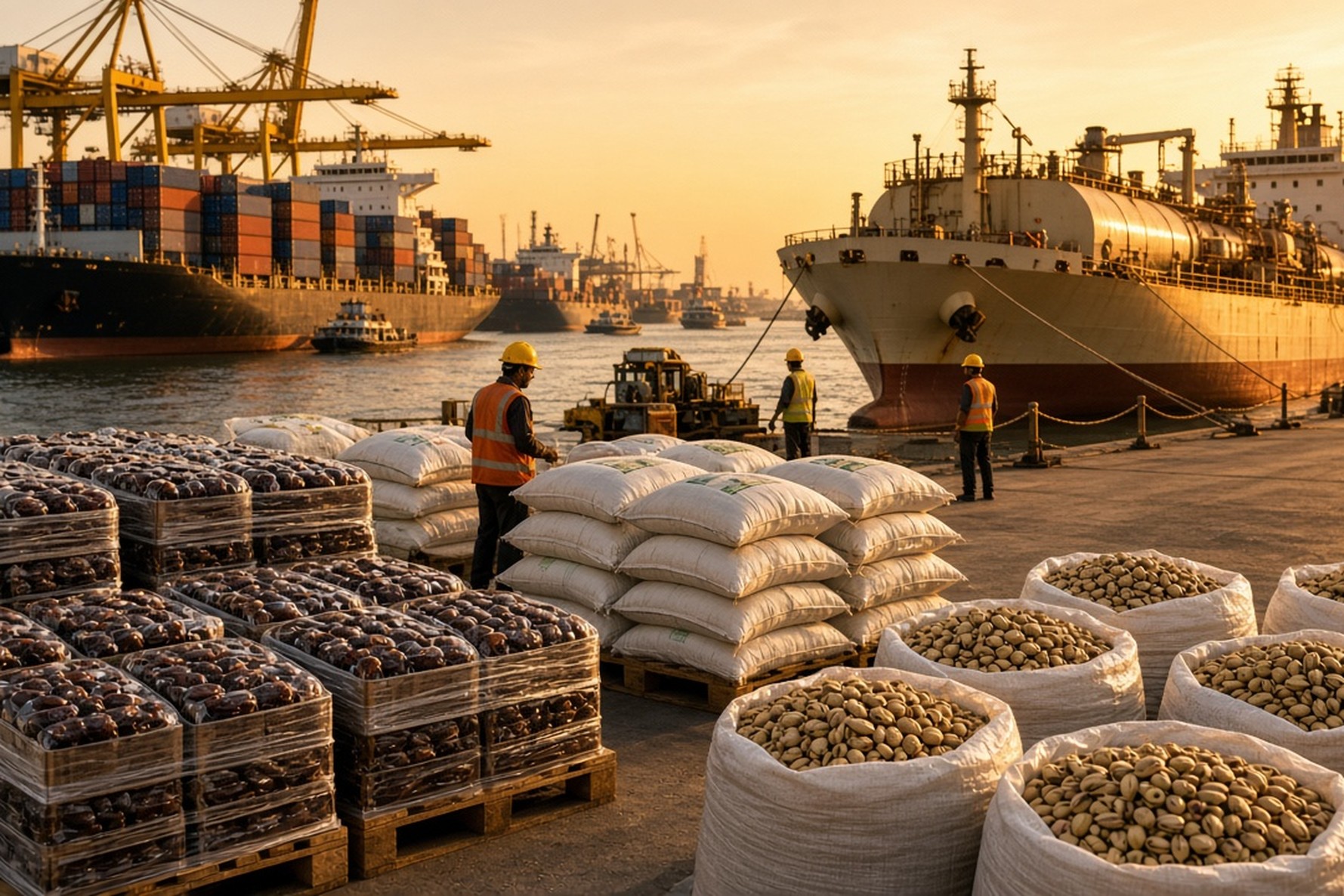
Iran exported over 105,000 tonnes of dates to India in 2024 — proof of an active market for Iranian suppliers.
1. Which foods attract Indian importers most?
India's largest food import segments are edible oils, pulses, and tree nuts and dried fruit. Fresh and processed fruit, cocoa and chocolate, food-industry inputs, select spices and health products follow.
Market size alone is not the selection criterion. Demand stability, tariff, origin access, price competition and logistics matter more than nominal market value.
| Product group | Demand nature in India | Main buyers | Key commercial factor |
|---|---|---|---|
| Edible oils | Very large structural demand | Refineries, oil companies | High price and tariff sensitivity |
| Pulses | Large, policy-linked | Bulk importers, mills | Import policy can change quickly |
| Tree nuts & dried fruit | Growing | Packers, wholesalers, retail | Quality, size, damage, price |
| Dates | High volume | Dried fruit importers | Iran is a key supplier |
| Fresh fruit | Urban, seasonal | Fruit importers, chains | Quarantine and cold chain critical |
| Cocoa & chocolate | Industrial and retail | Factories, brands | Global price and input quality |
| Food-industry inputs | Developing | Beverage, confectionery plants | Technical specs and batch stability |
Edible oils — largest import group
India's edible oil imports were worth about USD 16.9 billion in 2024. Palm, sunflower and soybean are the main groups.
This market is built for large cargoes. Crude oil is mostly imported in bulk and refined and packed in India.
Pulses — large but policy-driven
Pulse imports exceeded USD 5.1 billion in 2024.
Imports can be affected by government decisions on tariffs, quantitative limits or price controls.
Tree nuts and dried fruit
Tree nut imports exceeded USD 3.3 billion in 2024.
Appearance, size, breakage, moisture, aflatoxin and shipment uniformity matter greatly.
Dates — a clear opportunity for Iran
India imported over 526 million kg of dates in 2024. Iran supplied more than 105 million kg.
Competition turns on moisture, texture, colour, size, uniformity, packaging and delivered price in India.
Fresh fruit and health-oriented products
Apples, kiwi, berries, citrus and health-positioned products have urban buyers.
Fresh fruit is among the hardest groups to enter. Import eligibility must be checked per product and origin.
2. What makes a product attractive to an Indian trader?
Professional Indian importers evaluate five factors: landed warehouse price, legal entry, repeatable quality, supply volume and product turnover speed.
Factory or FOB price alone is misleading. Higher duty, poor packaging, testing cost or quarantine delay can raise the real price.
| Parameter | Example options | Buyer importance |
|---|---|---|
| Exact product name | Dates, pistachio, raisin | Standard and tariff |
| Product form | Fresh, dried, frozen, puree | Direct effect on HS code |
| Grade | Commercial, premium, industrial | Price and application |
| Moisture | Per product spec | Shelf life and quality |
| Country of origin | Production country | Quarantine, duty, label |
| Delivery point | Port or city | Real offer comparison |
3. Who buys imported food in India?
India's market is layered. Bulk importers and distributors are central for nuts, fruit and industrial inputs.
Food factories are more important buyers than retail for nuts, concentrates, cocoa and industrial ingredients.
Organised retail and online grocery are key channels for imported packaged foods.
4. Through which routes and ports does India import food?
For large food cargoes, sea freight is the backbone of India's import trade.
Port choice should follow cargo origin and consumption location, not port fame alone.
| Entry region | Key ports | Better suited for | Main advantage |
|---|---|---|---|
| West India | Kandla, Mundra, JNPA | Iran, Gulf | Access to Gujarat and Maharashtra |
| South India | Chennai, Kochi, Tuticorin | Southeast Asia | Proximity to southern consumption |
| East India | Kolkata, Visakhapatnam | Bangladesh, East Asia | Access to east and northeast |
| Air | Mumbai, Delhi, Bengaluru | High-value perishable | Short transit time |
Kandla in Gujarat is critical for bulk trade; nearly 4.59 million tonnes of imported edible oil moved there in FY 2024-25.
JNPA (Nhava Sheva) is India's main container hub; over 7.3 million TEU in FY 2024-25.
For Iranian sea exports, southern Iranian ports and western Indian ports are the natural geographic axis.
5. Legal steps for importing food into India
- IEC import-export code issued by DGFT
- Central FSSAI importer licence (INR 7,500 per year)
- HS code and ITC(HS) import policy status
- FSSAI food standard compliance review
- Plant quarantine (Plant Quarantine Order, 2003) or animal quarantine
- Shipment documents (invoice, CoA, certificate of origin, phytosanitary certificate)
- Bill of Entry filing in ICEGATE / SWIFT
- Inspection, sampling and NOC issuance
6. Standards, labelling and quality control
Many food import problems in India occur at FSSAI compliance, not customs alone.
Label text must be agreed before final printing. FSS (Labelling and Display) Regulations, 2020 is the main framework.
Remaining shelf life: minimum 60% of product life or three months to expiry, whichever is less.
| Topic | Essential control |
|---|---|
| HS code | Match actual product specification |
| Import eligibility | Check ITC(HS) |
| FSSAI | Product standard and importer licence |
| Quarantine | Verify origin-country conditions |
| Label | Check before printing |
| Shelf life | Calculate remaining life on arrival |
7. How are tariffs and import costs calculated?
There is no single 'India food tariff'. Duty must be calculated per exact HS code, origin and entry date.
Cost structure includes basic customs duty, Social Welfare Surcharge (10%), IGST and sometimes AIDC.
Oil example: crude palm, soybean and sunflower basic duty cut from 20% to 10%; effective 16.5%. Refined oils: 32.5% basic, 35.75% effective.
8. Packaging and transport by product group
Pulses: moisture control, insect contamination and container condition matter.
Nuts: sensitive to oxygen, moisture, insects and heat; manage fat oxidation and aflatoxin.
Dates: packaging depends on moisture and product type.
Fresh fruit: reefer containers and variety-specific temperature; quarantine may require cold treatment.
9. Key opportunities for Iran in India's food market
Success likely starts with products where Iran has real advantage, regulatory entry is feasible and sea freight is economical.
Dates are the clearest example. Pistachio, raisins, saffron, pomegranate, kiwi and fruit concentrates also offer potential.
| Product | Likely position | Iran advantage | Main risk |
|---|---|---|---|
| Dates | Very active | Production volume and sales history | Price competition |
| Pistachio | Specialist, high value | Variety and Iranian recognition | Contaminant control and price |
| Raisins | Industrial and retail | Production capacity | Competition and uniformity |
| Saffron | Low volume, high value | Recognised origin | Authenticity and purity |
| Fresh fruit | Product-specific | Relative sea proximity | Quarantine and cold chain |
10. Common risks when trading with India
- Wrong HS code — processing change can reclassify the product
- Quoting price without duty calculation — cheap FOB is not necessarily competitive
- Shipping before label approval
- Assuming origin certificate alone is sufficient
- Choosing port on ocean freight alone
- Shipping with insufficient remaining shelf life
11. Чек-лист импортёра перед заказом
- Define exact product name and form.
- Verify India HS code against actual specification.
- Confirm ITC(HS) import status.
- Calculate effective duty and surcharges for origin country.
- Check FSSAI, plant or animal quarantine requirements.
- Obtain a real production-line sample.
- Compare sample CoA with India standards.
- Numerically define grade, size, moisture and defect tolerance.
- Approve label language and content before printing.
- Calculate remaining shelf life on arrival in India.
- Select entry port based on warehouse location.
- Align payment terms with documentary and delivery risk.
Какая информация нужна для точной цены?
- Exact product name, form, processing, grade, size
- Moisture, defect limits, required lab specs
- Inner pack, unit weight, total order volume
- Origin country, India destination port, delivery terms
- Standard or reefer container requirement
12. Submit a purchase request for Iran supply to India
In India food trade, two offers differ by more than price per tonne. Product spec, HS code, quarantine, repeatable quality, packaging and port all affect the outcome.
Iranco can register structured purchase requests for Iranian products.
Итог
India's food market is one of shortage and differentiation. Largest import needs are edible oils and pulses; nuts, dates and industrial inputs offer better opportunities for mid-size exporters.
Western ports — Kandla, Mundra and Nhava Sheva — are especially important for Iran and Gulf trade.
Regulations are decisive: HS code, FSSAI, quarantine, duty, labelling and shelf life must be checked before ordering.
For Iranian exporters, dates are a proven active market.
Часто задаваемые вопросы
Which foods does India import most?
Edible oils (~USD 16.9B in 2024), pulses (over USD 5B) and tree nuts and dried fruit.
Best Indian port for food imports from Iran?
Western ports such as Mundra, Kandla and Nhava Sheva are usually key; compare inland freight and warehouse location.
Is FSSAI licence required for food imports to India?
Commercial food importers need a valid FSSAI licence. Shipments may undergo document review, inspection and testing.
What is the customs cost for food imports to India?
No flat rate. Basic duty follows HS code plus SWS, IGST and sometimes AIDC.
Is India a buyer of Iranian dates?
Yes. India imported over 105 million kg of dates from Iran in 2024.
What must an imported food label in India include?
Food name, ingredients, nutrition, allergens, net quantity, dates, origin and importer details.
Where to start for fresh Iranian fruit exports to India?
First confirm quarantine-table eligibility for that product from Iran and required treatments.
Is a sample shipment necessary before bulk order?
Highly recommended for nuts, industrial inputs and processed foods.
Избранное Продуктs












Related Статьи



