 Команда журнала Iranco
Анализ спроса на рынке Германии, привлекательные категории для импортёров, сухопутные, морские и воздушные маршруты, пограничный контроль, затраты на ввоз, правила безопасности пищи и возможности иранских продуктов
Обзор рынка · Германия · Импорт продуктов
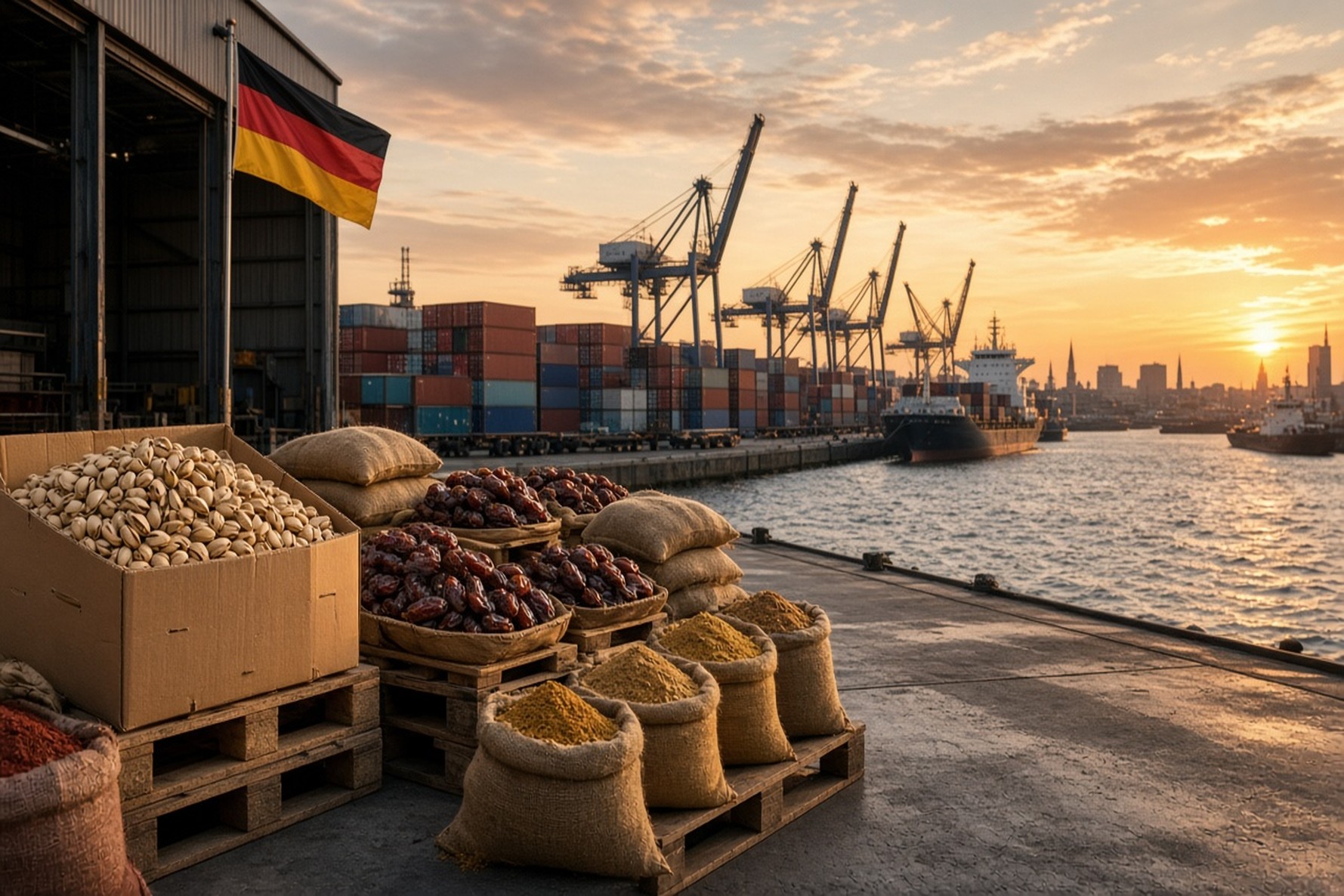
Рынок импорта продуктов питания в Германию: востребованные товары, маршруты, границы и правила
Анализ рынка импорта продуктов питания в Германию, востребованных категорий, возможностей поставок из Ирана, морских и наземных маршрутов, требований границы ЕС, таможенных и санитарных правил и реальной структуры себестоимости для экспортёров.
Аналитическое введение
Germany's food market should not be analysed as a country with a single import border. As a member of the EU single market and customs union, a large share of food sold in Germany as imported goods comes from France, the Netherlands, Italy, Spain, Poland, Belgium and other member states — with no repeat customs formalities when crossing Germany's land border. Even goods entering Rotterdam or Antwerp from Asia, Africa or South America and cleared there can enter Germany without a second customs clearance once they become Union goods.
For Iranian exporters this means the choice of European entry route can matter as much as the choice of German entry route. A shipment may arrive directly at Hamburg or Bremerhaven, enter the single market via another EU port, reach the EU external border by truck through Turkey, or — for light, high-value, sensitive goods — arrive by air at Frankfurt.
Germany is not simply a low-price market. Price remains critical for consumers, but demand has also grown for healthy products, simple ingredients, organic, plant-based, sustainable and international foods. In 2024 import growth was notable in pistachios, almonds, walnuts, processed foods, sauces, peanut products and bakery inputs.
With nearly 84 million consumers, Germany is the EU's largest national food market. Total agricultural imports in 2024 were about $145.6 billion, over 80% from EU members. Consumer-oriented imports reached $91.9 billion, 84% of which originated in the EU. For Iran, pistachios are the clearest commercial presence: in 2025 food exports were €153.9 million, 65.6% of Germany's imports from Iran, led by shelled pistachios at €78 million.
1. На какие продукты питания ориентируются немецкие импортёры?
Germany is both a major importer of food raw materials and of finished consumer products. Nuts and dried fruit, fresh produce, coffee and spices, processed foods, bakery inputs, sauces, international foods and some chilled and frozen lines all have meaningful import markets. Attractiveness for an Iranian exporter should be judged by real demand volume, Iran's competitive ability and regulatory difficulty of entry.
Official German data for January–November 2023 shows 44 million tonnes of agricultural imports worth €57.9 billion. About four-fifths of import volume was plant-based; cereals, oilseeds and nuts were important plant groups, with dairy and meat prominent on the animal side.
| Product group | Why importers care | Typical buyer | Main entry barrier |
|---|---|---|---|
| Pistachios & nuts | Direct and industrial use; established market | Nut importers, confectionery plants | Aflatoxin, grade uniformity |
| Dates & dried fruit | Retail, snacking and food industry | Wholesalers, stores, manufacturers | Strong competition, quality control |
| Saffron & spices | High value, specialist use | Spice importers, food industry, foodservice | Authenticity, residues, adulteration |
| Fresh fruit & vegetables | High daily consumption | Fresh produce importers, retail networks | Shelf life and cold chain |
| Sauces & processed foods | Dietary variety and international demand | Specialist importers, distributors | Formulation and labelling |
| Bakery & confectionery inputs | Large processing industry | Factories and industrial distributors | Spec stability and delivered price |
Nuts, dried fruit and tree nuts
Pistachios, almonds, walnuts and peanuts have shown import growth. For Iran the importance is greatest in pistachios, where commercial presence in Germany is already established and the market knows Iranian product.
In 2024 Germany imported about 63.6 million kg of pistachios worth $542.5 million. Iran supplied 4.72 million kg worth $76.3 million. HS codes: 08025100 (in shell) and 08025200 (shelled). Under EU 2019/1793, Iranian pistachios face identity and physical checks on 50% of shipments.
Dates, dried figs and other dried fruit
Dates, dried figs and other dried lines have a market, but competition is heavy. Tunisia leads in dates and Turkey in dried figs. Being Iranian is not enough — grade, taste, appearance, packaging, contamination control and delivered price decide the deal.
2024 date imports: 32.4 million kg / $95.6 million; Iran 2.62 million kg / $6.17 million (HS 080410). Figs: 17.2 million kg total, Iran 175,000 kg (HS 080420).
Spices, saffron and high-value lines
Saffron is one of the few lines where Iran has a visible, measurable share in Germany's import market. High value per kilo, low shipment volume and extreme sensitivity to purity and authenticity make the commercial model different from bulk dried fruit.
Germany's 2024 saffron imports: 5,306 kg / $5.96 million; Iran 3,037 kg / $3.83 million (HS 091020). Iran remains the main supplier but competes with Spain and Afghanistan on export grades.
Processed foods, sauces and industrial inputs
Germany's market is not limited to raw product. Processed foods, sauces, bakery lines and industrial inputs all have demand.
This area is attractive for Iranian producers who can meet European buyer expectations on formulation, ingredients, allergens, labelling, shelf life, quality stability and technical documentation. German buyers ask about formula stability, allergens, nutrition, shelf-life validation, monthly capacity and retail-ready packaging before final price.
2. Как устроены закупки продуктов питания в Германии?
Knowing the buyer matters as much as knowing the product. Many foreign producers assume they must negotiate directly with chain retailers, while in practice many German retailers buy imports through central buying offices, specialist importers and distributors.
Four major retail groups — Edeka, Rewe, Schwarz (Lidl/Kaufland) and Aldi — control about 75% of German food retail. In 2023 about 5,961 food companies employed nearly 644,000 people with turnover of about $251.7 billion.
Meat, dairy, bakery, confectionery and ready meals were major sub-sectors. Suppliers entering large networks need volume capability, delivery planning, documentation, traceability and product stability.
- Specialist importer: imports, clears, stores and distributes to several customers — usually the most practical entry point for foreign exporters.
- Food-industry distributor: supplies raw materials to confectionery, bakery, ready-meal, dairy and other plants.
- Retail buyer: focuses on volume, continuity, consumer packaging, private label and strict specifications.
- Foodservice market: restaurants, hotels, catering and wholesalers typically want larger packs and formats different from retail.
A 2024 official consumer survey found 99% prioritised taste and 91% health. 71% ate fruit or vegetables at least daily, 59% looked for organic labels and 39% often bought plant-based alternatives. Competition is not shaped by price alone — health credentials, ingredient transparency and product positioning matter.
3. По каким маршрутам и через какие границы ввозят продукты в Германию?
For much of the market the key fact is that most of Germany's consumer-oriented agricultural imports come from inside the EU. Large volumes enter by land from neighbouring countries without repeat third-country customs at the German border.
Hamburg is Germany's main seaport and handled about 8.3 million TEU in 2025. Bremerhaven is critical for chilled and frozen food with about 33,000 European pallet cold-storage positions.
Direct sea route to Hamburg
Hamburg is Germany's main seaport and handled about 8.3 million TEU in 2025. For nuts, coffee, spices, packed foods, canned goods, industrial inputs and large container loads, sea freight is usually the most economical option on long distances.
Bremerhaven and the cold chain
Bremerhaven is critical for chilled and frozen food. Infrastructure for fresh produce, fish, meat, poultry, frozen goods and temperature-sensitive cargo is well developed, with about 33,000 European pallet cold-storage positions.
Entry via Rotterdam or Antwerp
For many global supply chains the destination port is not necessarily in Germany. Containers may unload in Rotterdam or Antwerp and move by truck, rail or barge to a German warehouse after formalities. Third-country goods released into EU free circulation there do not pay import duty again on normal transfer to Germany.
Air freight from Frankfurt
For high value per kilo, short shelf life, urgent orders or low volume, Frankfurt airport matters. Dedicated perishable infrastructure supports multiple temperature zones. Saffron, commercial samples and urgent lines can justify air freight.
Land route from Iran to Germany
The main practical road route from Iran enters Turkey at Bazargan–Gürbulak, then may cross into the EU at Kapikule–Bulgaria or Ipsala–Greece. The entry point must be authorised for the product control category.
For officially controlled foods, the border crossing is not chosen only by shortest geography. Veterinary, plant-health or high-risk food requirements must be designed into the route.
Road haulage inside Germany
In 2024 registered German trucks moved food, beverages and tobacco for about 50 billion tonne-km; rail was 933 million and inland waterway 2.096 billion tonne-km. After port clearance, last mile is often trucking.
| Route | Best for | Commercial sensitivity | Main cost driver |
|---|---|---|---|
| Sea — direct to Hamburg | Nuts, inputs, shelf-stable goods | Transit time and container cost | Ocean freight and terminal charges |
| Sea — Bremerhaven | Chilled, frozen and perishable | Cold-chain integrity | Reefer and energy |
| Rotterdam/Antwerp then Germany | Wide product range | Place of clearance and destination warehouse | Secondary haul in Europe |
| Land Iran–Turkey–EU | Nuts and shelf-stable goods | Border stops and authorised entry | Truck, transit and waiting |
| Air — Frankfurt | Saffron, samples, urgent/high-value | Volumetric weight and delivery time | Air freight |
For a first shipment, professional importers often prefer Rotterdam or Hamburg with brokers experienced in CHED/TRACES. Direct land routes only make sense when total lead time and cost to a German warehouse are competitive.
Analysis of German import routes is incomplete without neighbouring EU ports. The entry point for officially controlled goods must be aligned with that product's requirements before transport is booked.
4. Правовые шаги ввоза продуктов питания в Германию
Importing food from outside the EU usually starts with correct product identification and the importer of record — not with transport. Before loading, the importer must know the tariff line, required documents and whether border control is mandatory.
Economic operators in EU customs processes need an EORI number. From 1 June 2026 the scope of ICS2 extends to all transport modes for goods entering the EU. Animal products, many plant health products and some high-risk foods must enter through approved border control posts.
TRACES handles official health certificates and documents for animals, plants and specified food and feed groups. Where required, a Common Health Entry Document or CHED must be completed in the official control process. Electronic CHED has been mandatory for covered groups since 14 December 2019.
Main customs codes
In-shell pistachios: CN 08025100 — shelled: CN 08025200 — dates: HS 080410 — figs fresh or dried: HS 080420 — saffron: HS 091020. For contracts, align the full TARIC code with the real product description, origin and processing status.
ICS2 and pre-arrival declaration
Entry summary declaration or related mechanisms must be filed with accurate shipper, consignee, goods description and customs code data. Errors cause holds or returns.
- Documentary check — invoice, CO, lab report and CHED/TRACES alignment
- Identity check — product matches documents and tariff classification
- Physical check and, where needed, sampling and testing — intensity set by product, origin and risk assessment
5. Безопасность пищевых продуктов, испытания и маркировка
For a German importer, sellability matters more than mere customs releasability. A shipment may be document-complete yet fail on residues, contaminants, composition, allergens or labelling.
Pesticide residues — EC 396/2005
Maximum pesticide residues in the EU are controlled under Regulation (EC) No 396/2005. Where no specific limit exists, the default is 0.01 mg/kg unless regulations specify otherwise. For fresh produce, dried fruit, spices and plant products, obtaining the grower's spray programme and EU-aligned pre-shipment testing reduces post-entry disputes.
Contaminants — EU 2023/915
Maximum levels for many contaminants, including certain mycotoxins, are set under Regulation (EU) 2023/915. For nuts, dried fruit and some plant inputs, aflatoxin control is a primary evaluation point.
Special case — Iranian pistachios under EU 2019/1793
Iranian pistachios are listed under intensified control for aflatoxin risk. In-shell 08025100 and shelled 08025200 from Iran face 50% identity and physical check frequency. This directly affects clearance time, sampling cost, detention risk and the importance of correct pre-shipment sampling.
Organic products — EU 2018/848
Products sold as organic in the EU must comply with Regulation (EU) 2018/848. Imports of organic product from third countries require an electronic Certificate of Inspection (e-COI) in TRACES; without it the shipment cannot be cleared and sold as organic.
Маркировка пищевых продуктов — EU 1169/2011
- Name of the food
- List of ingredients
- Allergen highlighting
- Quantitative indication of certain ingredients where required
- Net quantity
- Date of minimum durability or use-by date
- Storage and use conditions
- Name and address of the food business operator
- Country of origin where required by law
- Instructions for use where needed, and nutrition information
| Control area | Products most involved | Key importer note |
|---|---|---|
| Pesticide residues | Fruit, vegetables, dried fruit, spices | Testing against relevant active substances — EC 396/2005 |
| Aflatoxin | Pistachios and some nuts | Valid pre-shipment sampling — 50% check on Iranian pistachios |
| Microbiological control | Ready-to-eat and some processed lines | Micro specs must be in the contract |
| Labelling | Consumer-packed goods | Mandatory information and market language — German for retail |
| Organic | All products with organic claims | e-COI and EU 2018/848 compliance |
| Border control | Animal products and specified high-risk goods | Choose authorised BCP before booking transport |
6. Таможенная пошлина, НДС и реальная стоимость импорта продуктов в Германию
There is no single German food import tariff percentage. Duty depends on the full product code, origin, processing status and current TARIC rules. Quoting one flat rate for pistachios, dates, saffron or ready meals is commercially misleading.
Germany applies the EU common external tariff. Standard German VAT is 19%; many basic foods in the German VAT annex qualify for the reduced 7% rate, but each product must be classified individually.
Invoice price alone is insufficient to compare suppliers. Professional importers calculate delivered cost to warehouse. Incoterms define which cost elements sit in the seller's offer.
Delivered cost = product price + origin haulage + export formalities + international freight + insurance + port/airport charges + customs duty + import VAT + official control and testing + customs broker + storage + inland haul in Germany + packaging compliance
Компоненты стоимости доставки на склад
- Product price
- Origin inland haulage
- Export formalities
- International freight
- Insurance
- Port, terminal or airport charges
- Customs duty
- Import VAT
- Official control and testing where required
- Customs brokerage
- Storage and possible detention cost
- Inland haul to German warehouse
- Packaging cost and related obligations
- Financial cost of the transaction
| Cost component | What changes it | Importer action |
|---|---|---|
| Purchase price | Grade, season, volume, packaging | Same specification for all sellers |
| Freight | Route, weight, volume, container | Quote for the actual loading week |
| Customs duty | Code and origin | Check TARIC before ordering |
| Import VAT | Product classification | Confirm correct 7% or 19% rate |
| Official control | Risk category and origin | Check rules before loading |
| Testing | Product and related hazards | Agree test panel |
| Detention and storage | Document delay or control | Send complete documents before arrival |
| Inland distribution | Distance from gateway to warehouse | Compare several entry gateways |
Official control cost is not a single flat figure for all foods. Shipment type, control authority, sampling, testing and detention time all matter. For Iranian pistachios with 50% identity and physical checks, buffer time and budget must be built into the quote from the start.
7. Иранские товары с реальным присутствием на рынке Германии
Choose exports by distinguishing products that are theoretically sellable from those where German trade data confirm Iranian presence. Pistachios, saffron, dates and figs are examples with recorded imports from Iran.
Pistachios
In 2024 Germany imported about 63.6 million kg of pistachios worth $542.5 million. Iran's share was 4.72 million kg and $76.3 million. The US was the largest supplier. 2025 data show shelled pistachios at €78 million as Iran's leading food export line to Germany.
The pistachio opportunity is real but not easy. Sellers must be reliable on physical quality, sound kernel percentage, size uniformity, colour, taste, moisture, pest control and especially aflatoxin.
Saffron
Germany imported about 5,306 kg of saffron worth $5.96 million in 2024. Iran was the leading origin at 3,037 kg and $3.83 million. Purity, colouring strength, aroma, moisture and authenticity matter more than shipment volume.
Dates
German date imports in 2024 were about 32.4 million kg worth $95.6 million. Tunisia dominated supply. Iran exported about 2.62 million kg worth $6.17 million. Uniform appearance, moisture, texture and packaging must be defined in purchase specs.
Figs
Germany imported about 17.2 million kg of figs worth $82.5 million in 2024. Turkey supplied 13.9 million kg. Imports from Iran were about 175,000 kg worth $1.06 million.
| Product | Total DE imports 2024 | Imports from Iran 2024 | Commercial takeaway |
|---|---|---|---|
| Pistachios | 63.6M kg / $542.5M | 4.72M kg / $76.3M | Major established market; strict aflatoxin control |
| Dates | 32.4M kg / $95.6M | 2.62M kg / $6.17M | Large market; strong Tunisia competition |
| Saffron | 5306 kg / $5.96M | 3037 kg / $3.83M | Strong Iranian share; authenticity-sensitive |
| Figs | 17.2M kg / $82.5M | 175K kg / $1.06M | Smaller Iranian base; Turkey dominates |
Export strategy should not be identical for every product. Iran already has meaningful share in pistachios and saffron. Dates offer a large market with tougher competition. In figs, Iranian producers need a clear edge in quality, grade, packaging or niche positioning.
8. Упаковка и логистика — где теряется часть маржи сделки
A German importer buys a sellable or production-ready unit, not abstract product. If packaging causes weight loss, moisture uptake, oxidation, crushing or contamination, even good initial quality loses value.
Pistachios and nuts
Moisture control, insect exclusion, oxygen limitation and protection from foreign odours matter. Contracts should state whether delivery is bulk bag or carton, vacuum pack, inner liner, consumer pack or buyer-brand pack. Net weight and weighing method must be fixed upfront.
Dates and dried fruit
Packaging must prevent mechanical pressure, syrup leakage, excessive moisture exchange and secondary contamination. For retail, internal layout and visual uniformity gain importance.
Saffron
Besides moisture and light protection, consumer packs need security features — batch traceability, tamper evidence and anti-counterfeit measures.
Fresh and frozen goods
Packaging design is inseparable from the cold chain. Pre-cooling temperature, transit temperature, carton type, airflow and pallet pattern must match the product. Transport specs should be recorded on the product sheet and logistics instruction.
9. Упаковка, экологическая ответственность и требования рынка Германии
Packaged goods sold in Germany are subject to packaging rules as well as food law. The LUCID system is central to German packaging registration; depending on legal role, pack type and placing on the market, registration, system participation and reporting duties may apply.
From 12 August 2026 core elements of the EU's new packaging and packaging-waste framework (EU PPWR) take effect. German importers must confirm who is the responsible producer or market placer before sale.
Practical advice for Iranian exporters: have the importer approve final artwork before mass printing cartons or labels. Correcting labels after arrival in Europe costs far more than fixing files before production.
10. Чек-лист импортёра перед размещением заказа
An importer who fixes these points before issuing a firm order removes most quality disputes and unexpected costs:
- Exact product name and processing form: raw, roasted, dried, frozen, crushed, purée, packed or bulk
- Proposed HS/CN code matched to the real product description
- Country of origin and actual place of production or processing
- Grade and physical specs: size, colour, breakage, defects or related attributes
- Chemical and quality specs: moisture, acidity, Brix, fat or other product-relevant indices
- Contaminant and residue limits aligned with EU regulations
- Pre-shipment test panel and laboratory accepted by both parties
- Sampling method — test results without representative sampling have limited value
- Acceptance and rejection criteria with tolerances for defects
- Net weight per pack and total order weight
- Primary pack, outer carton and food-contact layer materials
- Pallet pattern and units per pallet
- Final label and German language where sold to consumers
- Entry documents and whether TRACES, CHED or official certificates are required
- Approved entry point for products under official control
- Incoterms and exact point of cost and risk transfer
- Transport route and target delivery time
- Cargo insurance and liability for transit damage
- Supplier's repeatable capacity, not only first-shipment stock
- Production batch traceability and recall capability
Buyers sourcing food from Iran can use this information as the basis of a professional purchase request on Iranco. The more precise the product spec, grade, volume, packaging and destination, the more actionable supplier comparison becomes.
Какая информация нужна для точной цены?
- Exact food name
- Product form and processing level
- Required grade
- Measurable technical specifications
- Acceptable country of origin
- Trial order quantity and regular order quantity
- Weight per pack
- Inner and outer packaging type
- Need or absence of private label
- Required tests and certificates
- Destination city, warehouse or port
- Mode of transport
- Delivery term (Incoterms)
- Expected delivery time
11. Стратегия продажи иранских продуктов питания в Германии
Successful entry usually starts by choosing one specific market segment, not by sending a long product list to dozens of buyers. A pistachio strategy might focus on bulk nut importers, confectionery plants, nut repackers or Middle Eastern food distributors — each with different buying specs.
Pistachios and saffron
A chocolate factory may prioritise kernel uniformity, colour, broken-piece percentage and aflatoxin control. A retail repacker also cares about appearance, size, traceability and print-ready packs. A spice importer may want industrial saffron packs; a premium retailer needs consumer packs and product security.
Dates and processed foods
In dates, price competition with North African suppliers makes segment choice critical. Iranian product wins when measurable advantage in taste, processing form, size, texture, packaging or delivered price can be proved.
For processed foods, German buyers want answers on stable formula, allergens, nutrition, shelf-life validation, monthly capacity and Germany-ready packaging before final price.
In international food buying, the gap between two offers is often much wider than the per-kilo price difference. Practical rule: approve sample, written specification and acceptance criteria before the commercial order; then price against that same specification.
Поставка иранских продуктов для рынка Германии по спецификации покупателя
To evaluate supply from Iran, define the product in the buyer's language first: name, grade, technical specs, quantity, packaging, required tests, destination, transport mode and delivery term.
Iranco can be used to register such requests and review available supply options in Iran. Buyers can state required specs, approximate volume, pack type and destination country so options are screened on the same basis.
- Define product in buyer language — grade, technical specs and acceptance criteria
- Coordinate pre-shipment testing to EU limits
- Support TRACES/CHED documentation with the German importer
- Route design: Hamburg by sea vs land transit
- Transparent landed-cost pricing for real negotiation
Итог
Germany's food market is large, but that must not be confused with easy entry. 84% of consumer-oriented agricultural imports in 2024 came from inside the EU, so non-European suppliers face a very close, fast, integrated competitor network from day one.
For Iran, the most logical starting point is products with proven commercial presence. Pistachios are outstanding; saffron, dates and, to a lesser extent, figs also have recorded imports. Pistachios face strict aflatoxin control; saffron depends on authenticity; dates compete with Tunisia; figs face Turkish supply strength.
Professional decisions should rest on final warehouse cost, not purchase price alone. Customs code, duty, tax, official control, testing, possible detention, packaging, inland haul and Incoterms are all part of true price. Sustainable entry needs precise technical specs, approved samples, laboratory control, complete documentation and correct logistics design more than a seemingly low headline price.
Часто задаваемые вопросы
Which foods are most suitable for export from Iran to Germany?
Pistachios are the clearest example by history and trade value. In 2025 Germany imported about €78 million of shelled pistachios from Iran. Saffron, dates and figs also appear in import statistics. Final choice should depend on the producer's real ability to control quality, testing, packaging, delivered price and continuity — not production capacity alone.
What is the main entry route for food into Germany?
By origin, most consumer-oriented imports come from other EU members through the single market. For third countries, Hamburg and Bremerhaven for sea, Frankfurt for air, and Rotterdam or Antwerp with subsequent road haul to Germany are practical routes. The right route depends on the product and border-control requirements.
If goods are cleared in the Netherlands, must they be customs-cleared again in Germany?
If third-country goods have been released into EU free circulation in the Netherlands, import duty is not charged again on normal transfer to Germany. Tax treatment, transit status, customs warehouse or special regimes must still be distinguished from final clearance.
What is the import tariff on food into Germany?
There is no single rate. Duty depends on the full CN/TARIC code, origin and product status. Import VAT is separate from duty; Germany's standard rate is 19% and many specified food groups qualify for the reduced 7% rate.
Why is quality control sensitive for Iranian pistachio imports to Germany?
Iranian pistachios are on the EU intensified-control list for aflatoxin risk. For in-shell and shelled pistachios from Iran, identity and physical check frequency is set at 50%.
What label information is required for packaged food sold in Germany?
Depending on the product, mandatory items include food name, ingredient list, allergens, net quantity, durability or use-by date, storage conditions, responsible operator, nutrition information and, where required, origin or instructions for use. For the German consumer market, a proper German version is standard practice.
What must be confirmed before payment on a trial order from Iran?
Approved sample, technical specification, defect limits, net weight, packaging, test panel, product code, entry documents, delivery term and transport method should be in writing. Samples should be approved against measurable criteria, not vague acceptance language.
Can Iranian organic product be sold directly as organic in Germany?
Organic claims require compliance with EU organic rules. Imports from third countries need an electronic Certificate of Inspection (e-COI) in TRACES. A domestic organic certificate or claim alone is not sufficient to sell as organic in the EU market.
Избранное Продуктs












Related Статьи



