 Iranco Magazine Team
Turkmenistan food market analysis — trade product groups, Iran land and rail routes, customs and sanitary requirements, tariffs, labeling and real import cost structure
Market Report · Food Imports · Turkmenistan · Iran Border Corridors
What Foods Do Turkmen Traders and Importers Focus On — and Through Which Routes, Borders, Costs and Regulations Does Import Take Place?
Turkmenistan food market analysis — high-demand product groups, Iran land and rail corridors, customs and health requirements, tariffs, labelling and the real structure of import cost for Iranian exporters.
Turkmenistan's food market offers defined opportunities for exporters who can supply the right product, competitive pricing, acceptable packaging and complete documentation. This report examines food groups of interest to Turkmen importers, main entry routes especially from Iran, registration and clearance rules, quarantine and veterinary permits, key tariffs and factors that determine final landed cost.
In 2025 roughly 20 million tonnes of goods crossed Turkmenistan's border gateways, of which more than 7 million tonnes were transit cargo. The transport-mode shares above relate to total foreign trade and transit, not food alone — but they are an important indicator of the country's logistics structure.
Analytical Introduction
At first glance Turkmenistan may appear a smaller food market for Iranian exporters than Russia, Iraq or Gulf states — yet its geography matters greatly. Iran shares a long land border in the south and several road and rail crossings connect the two countries. For products where freight cost, delivery speed and the ability to move medium-sized consignments are decisive, this adjacency can become a practical advantage.
Turkmenistan's market structure should not be analysed only through shortage or domestic production gaps. The country produces wheat, vegetables, greenhouse tomatoes, dairy, confectionery and other foods; its food exports have grown in recent years. Fresh tomato exports exceeded 181,000 tonnes in 2025. Iranian exporters must therefore identify precisely which product groups still attract importers, what advantage they hold over domestic, Russian, Turkish or Central Asian supply, and at what landed cost they reach the market.
Tariff policy also differs sharply among food groups. Staples such as sugar, some vegetable oils, butter and certain meat lines appear on customs duty exemption lists; honey, tomato paste, ice cream, some meat products, fresh lemon and grape carry specific weight-based duties.
For Iranian exporters the main question is not simply whether Turkmenistan imports food. The right question is: which product, with which specifications and in which season, through which border, for which importer and at what cost structure can compete?
1. What Is the Structure of Turkmenistan's Food Market?
Turkmenistan's food market combines domestic production, import of staples, import of food-industry raw materials and entry of packaged consumer goods. Government policy moves in two directions at once: developing domestic production while preserving access to some foods the market still needs from abroad.
This is visible in tariff structure. Sugar, some vegetable oils, butter and certain meat groups are exempt from import duty, while products with stronger domestic production or higher sensitivity carry defined customs charges.
From a foreign seller's perspective the market divides into four segments:
Staples and high-volume goods
Sugar, edible oil, some cereals, milling inputs, butter and meat sit in this group. Delivered price, supply stability and ability to move large consignments matter more than retail packaging appearance.
Fresh products
Fruit, vegetables, citrus, grapes and other orchard products fall here. Season, transport speed, visual quality, remaining commercial life and quarantine documents are decisive.
Processed foods
Canned goods, paste, juice, fruit and vegetable preparations, confectionery and chocolate, biscuits, dairy products and other packaged foods form part of Turkmenistan's food trade.
Food-industry raw materials
Fats, oils, sugar, some cereal products, semi-finished inputs and goods going directly to factories follow a different logic from retail. Technical specifications, batch uniformity and price per unit of material matter more.
For Iran three market features stand out: short haul distance, direct road access and several border gateways. This advantage weighs more for fresh goods or products where freight is a large share of final price.
2. Which Foods Matter Most to Turkmen Importers?
Not all foods can be ranked in one list. Turkmen import demand spans staples, industrial products and consumer packaged goods. Customs lists and official import procedures nonetheless show the groups below carry special weight for food traders.
| Product group | Import demand logic | Key note for seller |
|---|---|---|
| Sugar | Staple & factory input | Price, volume & delivery terms |
| Edible oils | Household & industry | Oil type, packaging & price |
| Meat & meat products | Direct consumption & processing | Veterinary permit & cold chain |
| Butter & dairy | Household & food industry | Expiry date & cold chain |
| Cereals & milling products | Consumption & industrial use | Tariff code & product type |
| Fresh fruit & vegetables | Seasonal demand | Quarantine, freshness & speed |
| Dried fruit | Retail & food industry | Moisture, quality & packaging |
| Confectionery & chocolate | Consumer market | Retail price, pack & composition |
| Canned & preserved fruit/veg | Household & food service | Shelf life & tariff |
| Juice & beverages | Consumer market | Weight, volume & freight |
Sugar
Sugar under HS Code 1701 appears on Turkmenistan's import duty exemption list — a sign of its special place in food-supply policy. Bulk importers focus on delivered price, quality, colour, polarity, moisture, pack format and ability to supply continuously. For Iranian or re-exported sugar, real source, tariff code, country of origin and commercial documents must be fully transparent.
Vegetable oil and edible fats
A large share of vegetable oils is duty-exempt; cottonseed oil is treated differently and carries a specified duty in the customs list. In oil sales the distinction between household oil, frying oil and factory input matters. The importer may want consumer packs or bulk for repacking and industrial use.
Meat
Codes 0201, 0202 and 0204 appear on the official duty exemption list. Animal-origin products are not only a tariff question — veterinary permit and control are fundamental. For frozen or chilled meat, country and slaughterhouse of origin, health status, product temperature, production date, remaining life, veterinary certificate and container integrity must be fixed before loading.
Butter and dairy
Butter under HS Code 0405 is duty-exempt. For other dairy lines the exact code determines rules and cost. Competition is not only on price — fat content, storage conditions, packaging, commercial shelf life and brand recognition all influence the importer's decision.
Fresh fruit and vegetables
Turkmenistan itself produces some orchard and greenhouse crops, so fruit and vegetable imports depend heavily on season, product and domestic supply. Iran's main advantage is products that can reach Ashgabat or Turkmen distribution centres quickly. Fresh goods must hold an import quarantine permit on the Turkmen side before dispatch, and the phytosanitary certificate from the exporting country must match the consignment. Official quarantine import permits are valid for 30 days.
Dried fruit
A separate official procedure for dried fruit imports shows this group has a recognised administrative structure. Plant dried fruit is subject to quarantine requirements; besides commercial documents, the relevant permit and food conformity certificate matter. For Iran, raisins, dates, some nuts and dried products can be reviewed for market entry — success depends on delivered price, packaging and buyer specifications.
Confectionery, chocolate and packaged foods
Tariff is not the only issue here. Product composition, additives, fats used, expiry date, product registration and labelling carry great weight. If the product contains animal-derived ingredients, import may require a veterinary permit. Turkmenistan's official trade portal also foresees veterinary permits for confectionery imports where applicable.
3. Iran's Position Versus Russia, Turkey and Central Asia
Turkmen importers do not decide in isolation. Russia, Turkey, Central Asian countries and other regional producers compete with Iran across many food groups. Reported merchandise trade data for Turkmenistan shows Russia and Turkey among important partners. Statistical bases differ, so product analysis must use the same HS code and year — a country's total trade share should not be applied to all foods.
| Origin | Typical advantage | Limitation in Turkmen market |
|---|---|---|
| Iran | Direct border, short transit, agricultural & food diversity | Strict document & packaging alignment |
| Russia | Wide trade network & packaged range | Greater distance for some destinations |
| Turkey | Consumer brands & packaging | Longer land haul than Iran |
| Kazakhstan | Regional access, suited to bulky goods | Less orchard diversity |
| Uzbekistan | Adjacency & strong fruit/veg production | Direct competition in farm products |
| Caspian basin countries | Sea and rail options | More dependence on vessel and port schedules |
Iran's real advantage lies more in delivered cost and flexibility than factory price alone. An Iranian seller can move a full truck or steady consignments directly to the Turkmen border without transiting a third country. That matters for fresh fruit, vegetables, short-life foods, chilled products and medium-value orders.
4. Through Which Routes and Borders Does Food Enter Turkmenistan?
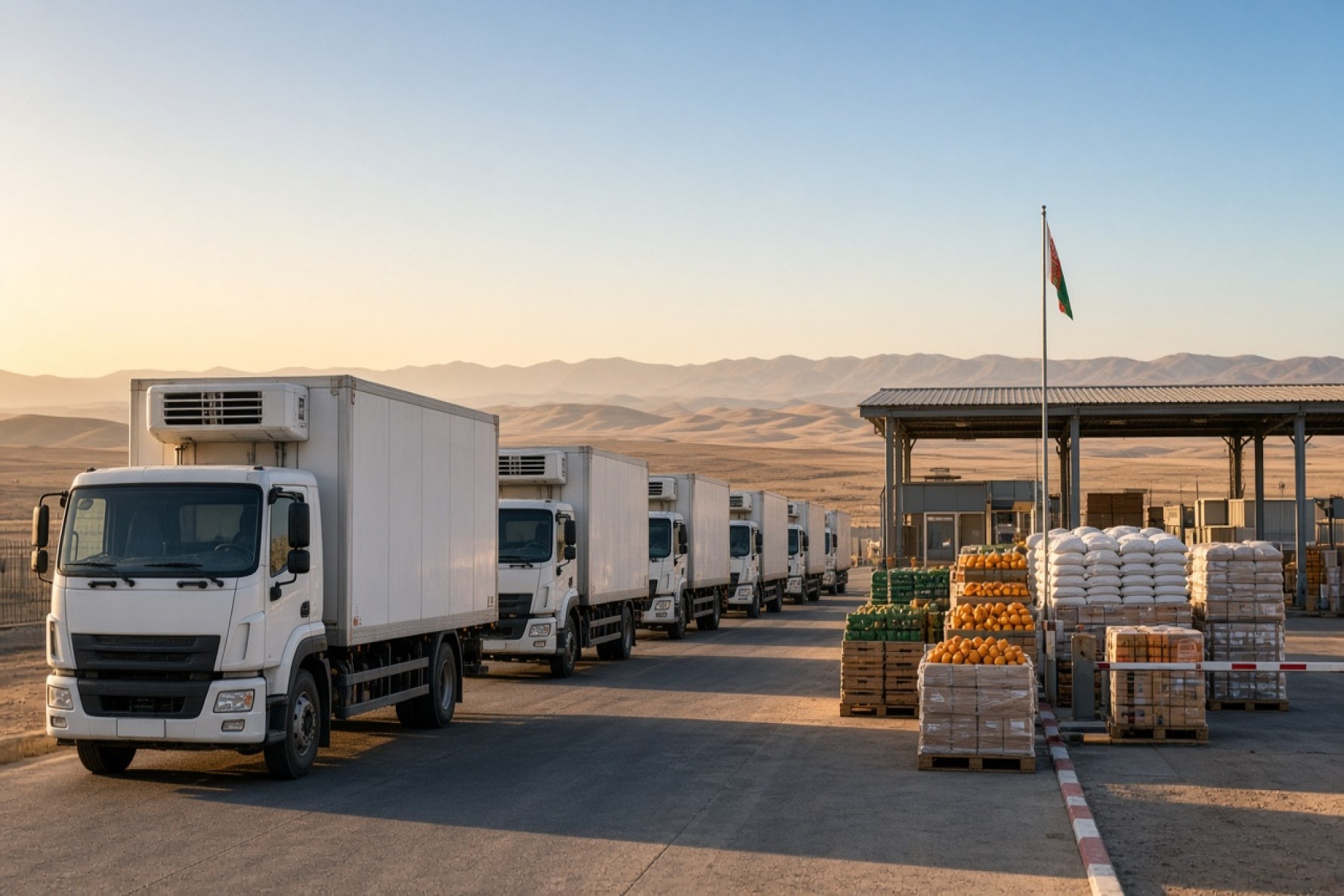
In Turkmenistan's total foreign and transit freight structure in 2025, road transport held the largest share at 43%. Sea accounted for 28%, rail 27% and air 2%. These percentages cover all external and transit cargo, not food alone — but they clearly show road weight in national logistics.
Iran–Turkmenistan corridor
Four main gateways handle cargo between Iran and Turkmenistan:
| Turkmen side | Iran side | Primary use |
|---|---|---|
| Sarakhs | Sarakhs | Road & rail; commercial & bulky cargo |
| Artik | Lotfabad | Road; North Khorasan trade |
| Hoodan | Bajgiran | Road; Mashhad–Ashgabat axis |
| Altin Asr | Incheh Borun | Northern Iran & regional rail network |
Turkmen customs in March 2026 listed Sarakhs, Artik, Hoodan and Altin Asr as active Iran-border gateways. Official documents from both countries specifically name Sarakhs–Sarakhs, Artik–Lotfabad and Hoodan–Bajgiran.
Sarakhs
Sarakhs is one of the most important options for Iranian exporters because it supports both road and rail. For bulky goods, cereals, sugar, food-industry inputs and consignments where rail economics matter, this route must be costed. For fruit and other sensitive products the Sarakhs land corridor can also work — but actual border crossing time, cold-storage capacity, vehicle schedule and clearance timing must be aligned with the importer.
Lotfabad – Artik
This axis is a major road link between the two countries. It suits cargoes originating in Khorasan Razavi or nearby production centres. In 2025 and 2026 both sides discussed capacity increases and infrastructure upgrades at Artik.
Bajgiran – Hoodan
Proximity to Ashgabat gives this border special importance. For road consignments destined for the capital and surrounding distribution networks, post-border distance is a practical advantage.
Incheh Borun – Altin Asr
This corridor strengthens links between northern Iran, western Turkmenistan and the regional rail network. Exporters whose production or warehouse is in northern Iran should include it in route calculations.
Turkmenbashi port
For goods entering from Azerbaijan, Russia and Kazakhstan across the Caspian, Turkmenbashi International Seaport is a key node. Sea lines connect with Baku, Astrakhan and Aktau; container, trailer and wagon movements are possible. For direct Iranian food exports to Turkmenistan land transport is usually simpler — but in multi-origin or Caspian-basin chains the sea option also matters.
5. Legal Steps for Food Import into Turkmenistan
Food import into Turkmenistan is a chain of commercial, banking, health and customs processes. Foreign sellers must know from the negotiation stage what documents the local importer needs for registration and clearance.
Active economic registration and contract
Importers must meet Turkmenistan's foreign-trade registration requirements. Many import contracts must be registered on the state commodity and raw-materials exchange before clearance unless exempt. For Iranian exporters this matters because post-signature contract changes may require amended registration. Product name, quantity, unit, value, delivery terms, packaging, country of origin and payment method must be written without ambiguity from the start.
Contracts above USD 10,000
For import contracts above USD 10,000 the importer must obtain a bank "transaction passport" before customs formalities and settle the contract under that document. This directly affects payment method, banking documents and shipment timing.
State registration of food products
Imported foods fall under state registration under the food safety and quality law unless regulations provide an exception. Turkmenistan's official trade portal states that a state registration certificate is required for a product entering for the first time or whose prior registration has expired. The certificate is issued for one product from one manufacturer for three years; single-ingredient products are exempt from this registration. For exporters the practical point is clear: changing factory or formula can matter for import registration.
Conformity certificate
Food importers must obtain a conformity certificate from state sanitary and epidemiological services for the consignment. Validity applies to that shipment and does not extend beyond product expiry.
Plant quarantine permit
Fruit, vegetables, dried fruit and other plant products subject to quarantine need an import quarantine permit. The official validity period is 30 days. The phytosanitary certificate from the country of origin is also reviewed.
Veterinary permit
Animal-origin products require a veterinary import permit. Under official procedure the permit is issued with 30-day validity. Higher-risk products may face additional controls.
Advance electronic information
From 1 June 2024 advance electronic information for imported and transit goods entered Turkmenistan's customs process. Data can be submitted through the ASYCUDA World system and, for road TIR transport, via TIR-EPD. Advance filing prioritises and speeds customs processing. Turkmenistan also activated a single window for export and import operations in 2024; in 2025 189,954 permits and licences were processed electronically through this system.
6. Tariffs and Import Cost for Food in Turkmenistan
A common exporter mistake is comparing import cost only with truck freight. Importers calculate final price from a full set of charges:
Product price + haul to border + insurance if agreed + customs duty + customs clearance fee + product controls and permits + brokerage + possible dwell + inland Turkmenistan haul + warehousing and distribution.
Customs clearance fee
The official customs clearance charge equals 0.2% of customs value. If goods are held under chargeable customs storage, the announced rate is 0.3% of value per day — so delay on valuable consignments can add cost quickly.
| Product | Tariff code or group | Stated duty |
|---|---|---|
| Wheat (listed) | from 1001 | USD 250 per tonne |
| Wheat flour grades 1–2 | from 1101 | USD 200 per tonne |
| Honey | 0409 | USD 3 per kg |
| Lemon & some fresh grapes | 080550 & from 0806 | USD 0.5 per kg |
| Cottonseed oil (listed) | from 1512 & 1516 | USD 1 per kg |
| Sausage & specified meat products | 160100 | USD 2 per kg |
| Chewing gum | 170410 | USD 2 per kg |
| Many Chapter 20 products | 20 | USD 0.15 per kg |
| Tomato paste (listed) | from 2001 & 2002 | USD 2 per kg |
| Ice cream | 210500 | USD 2 per kg |
| Sparkling mineral water (listed) | from 220110 | USD 0.4 per litre |
This table must be matched to the full product code; the word "from" in the customs list means not every subheading in a chapter necessarily shares the same rate.
Important duty-exempt groups
Under Turkmenistan's current customs list, groups including meat under codes 0201, 0202 and 0204, a large share of vegetable oils, butter under 0405, sugar under 1701 and some cereals and milling products are duty-exempt under stated conditions. Duty exemption does not mean cost-free import — clearance, product control, haul, border services and commercial charges still enter final price.
7. Standards, Food Safety and Labelling
Turkmenistan's Law on Ensuring Food Safety and Quality was adopted in 2014 and amended subsequently, including in 2022. It is the main basis for food entry and supply in the country.
Basic safety requirements
Imported goods must meet national safety and quality requirements. Foods may be checked for physical, chemical, microbiological and health-relevant contaminant indicators. Products without required registration, without proper labelling or containing prohibited ingredients may lose entry or market access. Turkmen law also sets explicit limits on foods produced using genetically modified organisms; exporters must verify raw materials and any non-GMO claims before label and document production.
Label information
Labelling regulations require information including:
- Country of origin
- Manufacturer name and address
- Product name
- Ingredients
- Nutritional value
- GMO-related information
- Production date
- Shelf life or expiry date
- Storage conditions
- Barcode and other required information
Food safety law allows packaging text in the state language of Turkmenistan and/or Russian and/or English; general market rules also stress required languages. For export consumer goods, agreeing the final label version with the importer before mass printing is the lower-risk approach.
Production and expiry dates
If only an expiry date appears on the pack and no production date, the law requires the importer to obtain written confirmation of production date from the manufacturer in accompanying documents. Iranian exporters should show both dates clearly and indelibly on the pack.
8. Packaging and Quality Control for the Turkmen Market
Suitable packaging varies by product. Iran's proximity allows some goods to ship with more economical packs than multi-week sea routes — but pack quality must hold to final delivery.
| Product | Main packaging issue | Pre-shipment control |
|---|---|---|
| Fresh fruit | Bruising, condensation & ventilation | Carton strength, temperature, fruit condition |
| Fresh vegetables | Moisture loss & wilting | Pre-cooling & ventilation |
| Dried fruit & nuts | Moisture & contamination | Moisture, insects, pack integrity |
| Confectionery & biscuits | Breakage & moisture ingress | Carton crush resistance & moisture barrier |
| Oil | Leakage & oxidation | Cap seal & container integrity |
| Dairy | Temperature & remaining life | Load temperature log & dates |
| Frozen meat | Cold-chain break | Core temperature & container log |
| Canned goods | Impact & swelling | Can integrity & seam |
| Juice | Leakage & quality change | Seal, dates & storage conditions |
Fruit and vegetables
The approved sample should match the commercial shipment as closely as possible. Size, colour, ripeness, visible defect rate, damage, net weight and carton type must be defined in contract or purchase specifications.
Dried fruit and nuts
Moisture, breakage, foreign matter, live pests, mould, size uniformity and sensory quality are key indicators. For aflatoxin- or residue-sensitive products, test results should match product and buyer requirements.
Packaged products
Beyond content quality, Turkmen buyers care about actual pack weight, print quality, barcode, label language, shelf life and shelf display. Difference between sent sample and final production is a common source of dispute — sample approval should be tied to written technical specifications.
9. Choosing Transport Mode by Food Group
Road transport
For Iran–Turkmenistan trade, road haul is often the first option for many foods. Advantages include direct routing, flexible load size and no transfer between multiple modes. For fruit, vegetables, dairy, frozen goods and short-life products, refrigerated trucks are a major advantage.
Rail transport
Rail suits bulky goods such as sugar, cereals, industrial inputs and larger orders. Sarakhs is a main rail connection between the two countries. The truck-versus-wagon decision should use cost per tonne, order volume, loading and unloading cost, movement schedule, border dwell and destination warehouse location.
Sea transport
Turkmenbashi port matters for Caspian-basin trade. Goods from Azerbaijan, Russia and Kazakhstan can enter by sea. For Iranian producers in the north or north-east, direct land routes are usually the first comparison; sea only makes sense when supply chain or foreign origin justifies it.
Air freight
Air's share of total border freight in Turkmenistan was only 2% in 2025. For ordinary food, air cost usually blocks commercial use — it is considered mainly for low-volume, high-value and extremely time-sensitive products.
10. How Is Real Export Price to Turkmenistan Calculated?
For importers the lowest factory price is not necessarily the best offer. The real benchmark is sellable delivered price.
Suppose two suppliers offer similar paste, dried fruit or juice. If one has documents ready, acceptable labels, delivery near the border and low dwell risk, it may end cheaper for the importer despite a higher ex-works price.
Main pricing factors include:
- Production or purchase price
- Production season
- Quality and grade
- Pack weight and type
- Order volume
- Haul cost to border
- Selected border
- Refrigerated truck requirement
- Customs duty for the exact HS code
- 0.2% customs clearance fee
- Permit and control costs
- Brokerage fee
- Possible dwell charges
- Inland haul to importer warehouse
- Payment and delivery terms
For tomato paste, honey or ice cream with fixed weight-based duties, tariff impact must be calculated before quoting final price. On low unit-value goods with fixed duty per kg, tariff can form a large share of landed cost.
11. Pre-Order Checklist for Importers
A professional food importer for Turkmenistan should finalise the following before payment transfer and production start:
- Confirm exact commercial product name and HS code.
- Identify manufacturer and country of origin.
- Check state registration status of the product.
- Receive and approve a real production sample.
- Write technical specifications and acceptance criteria.
- Align ingredients and additives with destination rules.
- Approve final label artwork before printing.
- Fix net and gross pack weight.
- Set production date and minimum remaining shelf life at delivery.
- For plant products, prepare import quarantine permit before dispatch.
- Ensure phytosanitary certificate from origin matches the goods.
- For animal-origin goods, verify veterinary permits and certificates.
- Plan required conformity certificate in clearance schedule.
- Clarify contract registration status in Turkmenistan.
- For contracts above USD 10,000, complete bank transaction passport process.
- Fix entry border before loading.
- Assign truck or container dwell cost responsibility in contract.
- Define delivery terms and risk transfer clearly.
- Take loading photos and reports.
- Reconcile transport documents, invoice and packing list.
This checklist is especially important for perishables — correcting a document after the truck reaches the border can add dwell cost and reduce sellable shelf life.
12. What Information Is Needed for an Accurate Quote?
A request for "food prices for Turkmenistan" alone is not enough to compare suppliers. A professional inquiry should include at least:
- Exact product name
- Ingredients or technical specifications
- Quality grade
- Weight per pack
- Packaging type
- Order quantity
- Producer brand or private label requirement
- Delivery city or border
- Preferred transport mode
- Transport temperature for chilled products
- Required tests
- Minimum remaining shelf life at delivery
- Payment terms
- Approximate delivery timeline
For fresh fruit specify size, ripeness, colour, carton weight and stacking method. For dried fruit specify moisture, size, breakage rate and defects. For oil specify type, container volume and household or industrial use.
Buyers reviewing Iranian options can submit these details in an Iranco purchase request so supply comparison is based on real order specifications.
13. Which Iranian Food Groups Suit Turkmenistan Market Review?
Iranian exporters should select products through market demand + logistics advantage + tariff + competition.
Fast-moving fresh fruit and vegetables
Short distance to Turkmenistan can build advantage for fresh goods — but products Turkmenistan produces cheaply in the same season are not automatic export opportunities. Both countries' supply calendars should be checked before contracting.
Dried fruit and nuts
Longer shelf life, higher value per weight and road transport without cold chain make this group attractive. Iran's edge holds when product is uniform and properly packed.
Canned and processed products
Iran has wide production in canned goods, paste, pickles, fruit and vegetable preparations and juice — but some lines carry notable duties. Tomato paste, for example, has a defined weight-based duty in the official list; factory price alone can mislead.
Confectionery, chocolate and biscuits
Competitive price, suitable packaging and taste close to regional consumption patterns can help Iranian producers. Here brand, pack appearance and importer distribution network matter far more than in bulk staples.
Food-industry raw materials
B2B sales to Turkmen factories may suit some producers better than direct retail shelf entry. Industrial buyers focus on price, technical composition, uniformity, continuous delivery and quality-control documents more than consumer pack design.
14. Practical Risks in Food Trade with Turkmenistan
The biggest risk is not always product quality. Sometimes goods are sound but mismatch among contract, label and documents causes border stop.
Wrong tariff code
Two apparently similar products may carry different duties. HS code must be aligned with importer or customs broker before final pricing.
Early packaging print
Printing tens of thousands of packs before destination label approval is high risk. Final print proof must be approved before mass production.
Short remaining shelf life
Product with adequate life at factory exit may lose commercial appeal after haul, border dwell, warehousing and distribution. Professional buyers usually control remaining life at delivery in the contract.
Dwell cost
Official customs storage can equal 0.3% of customs value per day. Separately, truck, driver or refrigeration equipment dwell may also arise.
Sample versus shipment gap
This is very common in agricultural and dried-fruit trade. Samples must link to numeric specifications and acceptance criteria — not approval by appearance alone.
15. Sourcing Iranian Food for the Turkmen Market via Iranco
Food purchasing for Turkmenistan becomes comparable only when the buyer's request turns into measurable specifications. A generic product name is not enough — product type, grade, pack weight, order volume, composition, shelf life, destination, entry border and quality-control requirements must be defined.
"Export raisins" is too vague. Raisins with defined size and quality, maximum moisture, 10 kg packs, one truckload and delivery at Sarakhs enables comparable offers. For processed foods specify brand, consumer weight, units per carton, label text and minimum remaining shelf life.
Iranco enables buyers and importers sourcing from Iran to register purchase requests so available options are reviewed against product specifications, packaging, volume and destination. When samples are needed, the same sample whose specifications will govern commercial production should be approved.
- B2B purchase requests with product specs, pack weight and approximate order volume
- Comparison of Iranian producers by product and Turkmen destination or border
- Delivery coordination at Sarakhs, Lotfabad–Artik, Bajgiran–Hoodan or Incheh Borun–Altin Asr
- Commercial documents, analysis certificates and shipment-related paperwork support
Summary
Turkmenistan's food market cannot be treated as purely import-dependent. The country has meaningful domestic production and also imports for part of consumer and industrial needs. Real opportunity arises when a product can offer price, quality or logistics advantage over domestic supply and Russian, Turkish or Central Asian competitors at a given time.
Sugar, some edible oils, meat, butter, cereals and food raw materials are major bulk-trade groups. Fresh fruit and vegetables, dried fruit, fruit and vegetable preparations, confectionery, juice, dairy and other packaged foods also have markets — but are more sensitive to season, tariff, product registration and distribution network.
For Iran the key advantage is not distance alone but usable direct access. Sarakhs, Lotfabad–Artik, Bajgiran–Hoodan and Incheh Borun–Altin Asr allow several land-route designs; Sarakhs also plays an important rail role. Pricing without calculating duty for the exact HS code, the 0.2% clearance fee, permits, inland haul and dwell risk is not sound. Professional importers check product registration, conformity certificate, quarantine or veterinary permit, label text and contract documents before ordering.
In this market the exporter with better odds knows before discussing price exactly which product, specifications, packaging, border and documents will be delivered.
Frequently Asked Questions
Is Turkmenistan a food importer?
Yes. Alongside domestic production Turkmenistan imports various food groups and raw materials — sugar, some oils, meat products, cereals, processed foods, fruit and vegetables and packaged goods appear in import structure and official procedures. Attractiveness of each item depends on domestic production, season and tariff policy.
What is the best route for Iranian food exports to Turkmenistan?
For many Iranian consignments road transport through Sarakhs, Lotfabad, Bajgiran or Incheh Borun is the first option to review. Final choice depends on cargo origin in Iran and destination in Turkmenistan. For bulky loads Sarakhs is also important because of rail access.
Must foods be registered before entry into Turkmenistan?
Many imported products fall under state food registration. A registration certificate for one product from one manufacturer can be valid for three years. Under official procedure single-ingredient products are exempt from state registration. Exact status must be checked by the importer before dispatch.
Do fruit and dried fruit need quarantine permits?
Quarantine-subject plant products need an import quarantine permit and phytosanitary certificate. The quarantine import permit is valid for 30 days under official procedure. It should be ready before the truck moves so the consignment does not wait at the border.
How much does customs clearance cost?
The official customs clearance fee is 0.2% of customs value. Import duty on the product itself is calculated separately and may be zero, weight-based or otherwise set by HS code. Sugar is on the exemption list, while honey and tomato paste carry defined weight duties.
Are there special banking formalities for import contracts?
For contracts above USD 10,000 the importer must obtain a bank transaction passport before clearance and pay under that structure. Payment terms should therefore be finalised between seller and importer before production and loading.
What language must appear on food packaging?
Turkmenistan's rules foresee packaging information in the state language and also Russian and/or English within the regulatory framework. For commercial shipments the importer should approve the final label; product name, origin, manufacturer, ingredients, nutritional value, dates and storage conditions must be complete.
How can Iranian food be sourced for Turkmen importers?
Define product, grade, quantity, packaging, expected shelf life and delivery border first. Then review sample, technical specifications and product documents; price becomes comparable on delivery terms. Buyers can submit these details through Iranco as a purchase request for review of available Iranian supply.
Why is factory price alone insufficient to compare two offers?
Importers calculate cost to their own warehouse. Freight, customs duty, clearance, packaging, permits, dwell, inland haul and remaining shelf life all change economic value. A cheaper factory quote that creates higher border cost is not necessarily the cheaper option.
Featured Products




Related Articles



