 Iranco Magazine Team
Shamsabad, Abbasabad, Shahriar, Pishva & Firuzkuh — distribution chain, automation & environmental compliance
Market Report · Industrial Parks
Atlas of Tehran Food Industry Parks & Factories: Infrastructure & Commercial Access Analysis
A comprehensive guide to Tehran Province food-production clusters — from Shamsabad to Firuzkuh — covering distribution chains, line automation, environmental compliance and B2B sourcing via Iranco.
1. Tehran’s Role in the Value Chain & Consumer-Goods Distribution
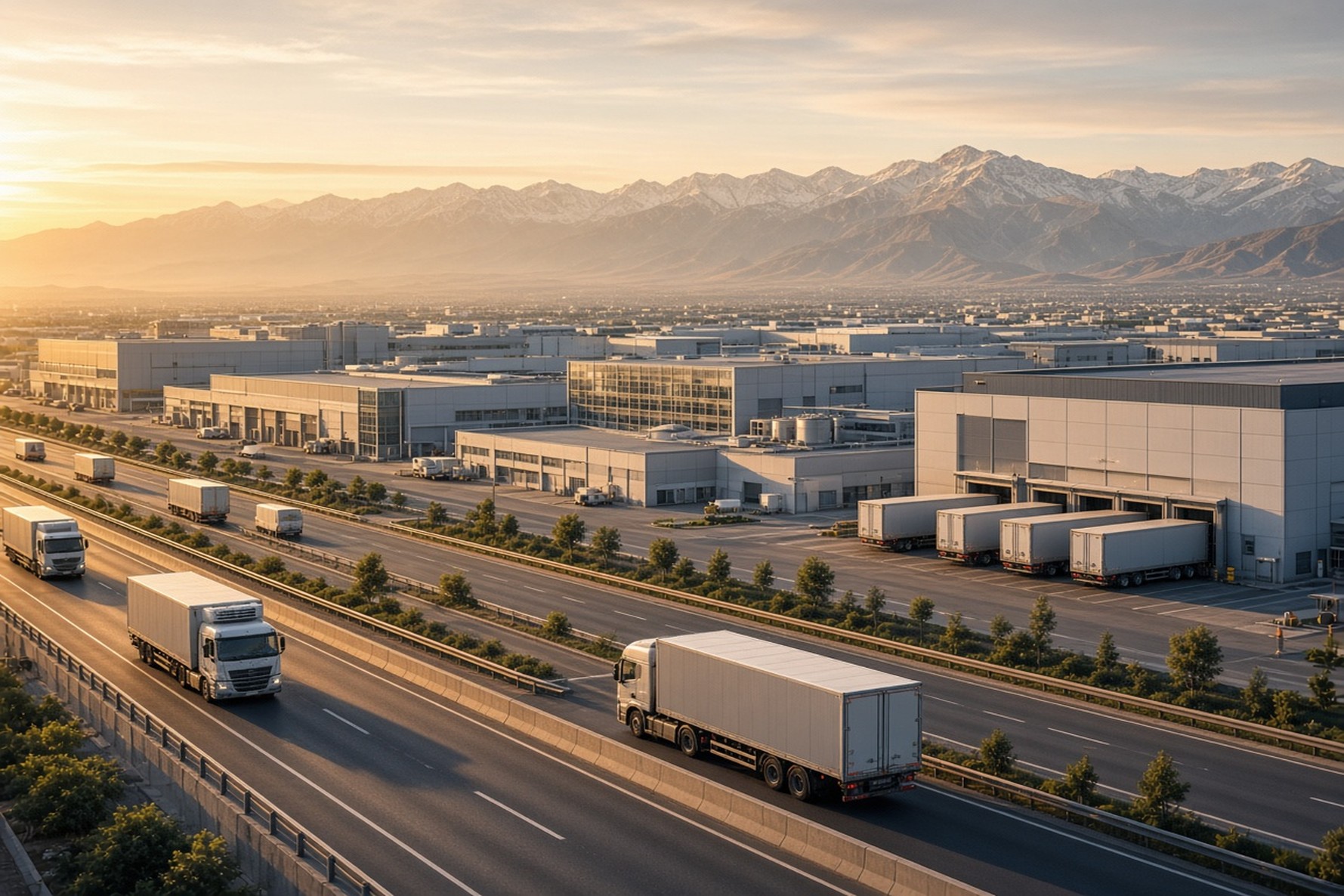
Tehran Province is Iran’s primary freight corridor thanks to high population density, an extensive expressway network and the national rail line. The north–south railway via Aprin dry port (20 km north of Tehran) and Imam Khomeini International Airport in the south-west guarantee national and international connectivity. Provincial officials stress that this infrastructure allows Tehran to act as an essential-goods supply hub; rapid food inflows and outflows through the Imam Khomeini Airport Free Zone strengthen nationwide supply and distribution.
Tehran is far more than a consumer market: cold-storage warehouses and logistics centres around the capital make it the heart of national distribution and warehousing. For wholesalers and commercial managers, proximity to a 15-million-person market, dry-port and international airport access, and dense food production lines make Tehran a B2B sourcing powerhouse.
- Aprin dry port & national rail — north–south transit gateway
- Imam Khomeini Airport & free zone — fast food import/export
- Cold-chain network & logistics hubs — nationwide warehousing
2. Food Industry Clusters & Industrial Parks
Shamsabad Industrial City (Rey)
Located at km 45 of the Tehran–Qom motorway, Shamsabad spans roughly 3,000 hectares with more than 2,000 industrial units — the largest industrial city in Iran and the Middle East. It hosts metal, chemical and food industries; snack, sauce, beverage and edible-oil packaging plants are especially prominent. Proximity to Imam Khomeini Airport and direct Qom expressway access enable rapid nationwide food transit.
Abbasabad (Pakdasht) & Paytakht (Aliabad) Industrial Cities
Abbasabad in east Tehran hosts over 1,640 industrial companies and ~35,000 workers. Metal, plastic and mineral industries operate alongside a confectionery, chocolate, puffed-grain and spice cluster. Paytakht Industrial City on the Tehran–Garmsar axis has become a hub for sweets and cereal packaging, with food packaging plants and specialty food-label printing.
West & South-East Tehran (Shahriar, Qods, Qarchak & Pishva)
West Tehran (Shahriar and Qods) has major processed-meat and protein producers — e.g. Sogol Shahriar (cocktail, hot dog, sausage) and Shahriar Kam in Safadasht (cakes, cookies, wafers). South-east along Qarchak and Pishva, dairy, beverages and non-meat canning lines are scattered. Pishva Industrial City’s 30 water wells (~910 L/s) secure fresh water for food plants.
Firuzkuh Industrial City
In north-east Tehran’s highlands, quality mountain water attracted major bottled-water producers such as Damavand Mineral Waters. Firuzkuh is a geophysical hub for mineral water and bottled beverages.
3. Comprehensive Table of Tehran Food Industry Hubs
| Industrial city | Location | Distance from centre | Key industries | Notable brands | WWTP | Industrial gas |
|---|---|---|---|---|---|---|
| Shamsabad (Rey) | Km 45 Tehran–Qom motorway | 40–45 km | Metal, food (snacks, juice), polymer | Diverse groups | Active | Pipeline |
| Abbasabad (Pakdasht) | Qaleh Now, Tehran–Garmsar road | ~45 km | Confectionery, chocolate, grains, spices | Food-active | Active | Pipeline |
| Shahriar (Safadasht) | West Tehran | ~20 km | Processed meat, cakes | Sogol | Active (municipal) | Pipeline |
| Pishva | South-east (Varamin) | ~45 km | Dairy, ready meals, juice | Varamin dairy | Active | Pipeline |
| Firuzkuh | North-east province | ~120 km | Mineral water & beverages | Damavand, Zolal | Active | Pipeline |
Wastewater treatment plants are installed in all major industrial cities; LPG and pipeline gas serve every hub.
4. Automation & Technology in Tehran Food Plants
Large Tehran food factories deploy modern automation: fully automatic thermoforming packaging (vacuum-formed plastic trays), modified-atmosphere packaging (MAP), robotic palletisers and clean-in-place (CIP) systems for tank and pipe sanitisation. These technologies raise throughput and ensure consistent product quality.
- Vacuum thermoforming: integrated tray forming and filling lines
- MAP: extended shelf life for proteins and ready meals
- Robotic palletising: automated case and pallet stacking for bulk freight
- CIP: in-place cleaning without line opening — lower microbiological risk
5. Environmental Rules & Wastewater Management
Under a 1967 cabinet decree, industries within 120 km of Tehran faced environmental restrictions. Despite administrative reform efforts, the rule remained in force until summer 2026; Tehran’s deputy environment chief called it “anti-production” and economic actors demanded repeal. Food plants must also manage wastewater properly.
Dairy effluent (including whey water) carries very high COD and BOD — e.g. BOD of one kg milk fat is ~0.89 kg. Industrial-city WWTPs must apply physical, chemical and biological stages to remove fat and salts. Tehran food factories under Environment Organisation oversight must install advanced treatment and organic-load equalisation tanks.
6. Research Centres & Accredited Laboratories
Tehran food industries benefit from FDA partner labs and National Standards Organisation facilities. Mad Laboratory in Tehran, accredited by the Food & Drug Organisation and Standards Institute, is a leading food QC provider. Accredited labs run microbiological, chemical and packaging tests to national and international standards.
Public research institutes also contribute — e.g. the Food Science & Industry Research Institute (Ministry of Science, based in Mashhad) supports novel food technologies, formulation upgrades and new product development. Universities and biotech centres collaborate with Tehran companies to accelerate R&D.
7. FAQ for Wholesalers & Commercial Managers
Q: How much toll-manufacturing capacity is available in Tehran plants?
Many large Tehran factories dedicate part of their lines to contract orders. SMEs can often use surplus capacity for co-packing or small-batch processing. Contact plant sales managers in industrial cities for exact availability — or browse factories on Iranco and send a co-manufacturing request via messaging.
Q: What documents are needed for a health licence (Sib Salamat)?
Each food SKU needs establishment and operating licences plus a technical-manager permit. Register on the FDA TTAC portal, enter company, line and formulation data, upload QC tests and pass safety review to receive the Sib Salamat health code.
Q: How is bulk and packaged food freight handled?
Bulk food moves mainly on refrigerated trucks and container trailers along Tehran–Qom, Tehran–Garmsar and southern expressways. Bulk loads use flatbed or container trucks at the plant gate; palletised orders use pallets and containers. Iranco also helps coordinate freight partners.
Q: How do we request direct factory prices?
On Iranco, filter industrial cities and food categories for Tehran Province, open the factory profile and submit the price-inquiry form. You receive wholesale pricing and terms within business days.
8. Direct Producer Access on Iranco
Bulk buyers, wholesalers and importers can search Tehran food factories on Iranco: open the food-industry list, filter Tehran Province and product type, then visit each factory profile for contacts, SKUs and the price-inquiry form. Your message goes directly to the producer’s sales team — simplifying correspondence and contract steps while connecting buyers to competitive factory pricing.
Related Articles



