 Iranco Magazine Team
Syria food market analysis — import-demand categories, Turkey, Jordan, Iraq and Mediterranean port routes, 2026 customs rules, seasonal restrictions, clearance costs and supply opportunities from Iran
Market Report · Syria · Food Imports
Syria Food Imports Market: High-Demand Products, Routes, Borders and 2026 Regulations
Analysis of Syria's food import market — high-demand products, supply opportunities from Iran, overland and sea routes, northern and eastern borders, Tartus and Latakia ports, customs and health requirements, and the real structure of import costs
Introduction
After years of economic strain and trade restrictions, Syria remains one of the most important food import markets in the Eastern Mediterranean and Western Asia. Domestic agricultural production and Syria's food industries are insufficient to meet demand from the population, flour mills, edible-oil plants, animal-feed producers, and wholesale distribution networks. Imports of wheat, rice, sugar, edible oil, animal feed, tea, coffee, and food-industry raw materials therefore form a large and steady trade flow.
In 2025, grain and oilseed imports into Syria reached approximately 2.8 million tonnes, with wheat alone accounting for nearly 2 million tonnes. These figures show that the Syrian market is primarily a high-volume, industrial supply market — not simply a shelf-ready packaged-goods market. In many deals, the Syrian importer is less focused on purchase price alone; supply stability, entry route, tariff, tax prepayment, and clearance cost are often more decisive.
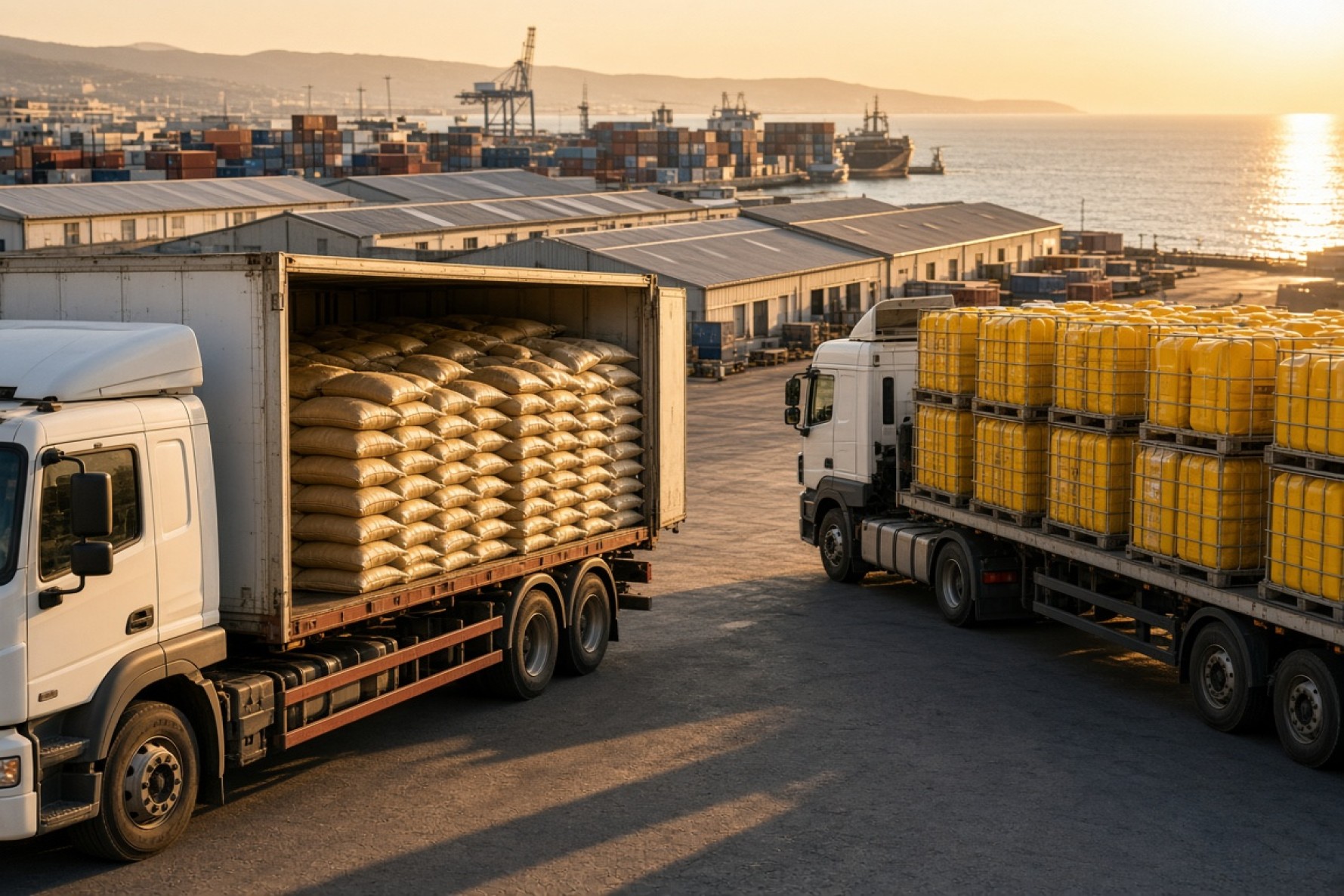
From a logistics standpoint, the Bab al-Salama border in northwest Syria is the most important overland gateway for food imports. In the first eight months of 2026, more than 46,480 trucks crossed this crossing, a significant share of which carried food, grains, oil, and essential goods. Bab al-Hawa, Jaber–Nasib, Al-Qaim, and the ports of Tartus and Latakia play complementary roles.
For Iranian exporters, geographic proximity and a history of regional trade are important advantages — but they do not create sales by themselves. Iran's advantage becomes practical when the right product is chosen, the tariff code and entry conditions are defined before selling, the Syrian importer is ready on permits, import committee approval, and tax prepayment, and delivered cost to warehouse in Damascus, Aleppo, Latakia, or Homs is calculated correctly. This report examines all of these layers for 2026.
Section 1 — What Food Products Do Syrian Importers Actually Buy?
Syria's food imports cannot be understood by looking at retail markets in Damascus or Aleppo alone. A large share of demand comes from mills, oil plants, animal-feed producers, biscuit and confectionery factories, wholesalers, and public and private distribution networks. The most important import groups can be reviewed in seven main categories.
Wheat and Grains
Wheat is the backbone of Syria's food imports. With nearly 2 million tonnes imported in 2025, this commodity mainly enters through Bab al-Salama and sometimes through ports, and is delivered directly to mills and public or private warehouses. Barley, corn, and feed blends are also imported alongside wheat.
Rice
Rice is a daily household staple in Syria. Imports come from Turkey, India, Pakistan, Thailand, and some sea routes. Quality, broken-grain percentage, and packaging matter for the retail market.
Sugar
White and raw sugar is imported for household use, confectionery and beverage industries. Brazil, India, France, and some regional suppliers hold market share. Moisture control and bulk or bagged packaging are important for overland transport.
Edible Oil
Sunflower, soybean, palm, and blended edible oils are among the market's highest-demand items. Part enters in bulk liquid form and part as packaged goods. Domestic packaging plants also process imported crude oil.
Animal Feed and Oilseeds
Corn, soybeans, meal, and feed blends are imported in large volumes for Syria's livestock and poultry sectors. This group mainly enters overland from Turkey and sometimes through ports.
Tea, Coffee and Beverages
Black and green tea, coffee, and some beverage powders are high-value, medium-volume items. Packaging, Arabic labelling, and quality consistency matter for retail sales.
Food-Industry Raw Materials
Fortified flour, starch, lecithin, flavourings, cocoa powder, fruit concentrate, spices, and preservatives are imported for biscuit, pasta, canned-food, and beverage plants. Buyers in this group purchase on the basis of technical specifications and analysis.
| Product group | Approx. volume | Key suppliers | Main buyer |
|---|---|---|---|
| Wheat | Nearly 2 million tonnes | Russia, Ukraine, Romania, Bulgaria | Mill, public warehouse |
| Rice | Over 200,000 tonnes | India, Pakistan, Thailand, Turkey | Wholesaler, retail |
| Sugar | Over 150,000 tonnes | Brazil, India, Europe | Confectionery industry, households |
| Edible oil | Over 300,000 tonnes | Turkey, Malaysia, Ukraine | Packaging plant, distribution |
| Animal feed | Over 400,000 tonnes | Turkey, Brazil, Argentina | Livestock, poultry |
| Tea and coffee | Tens of thousands of tonnes | Sri Lanka, Kenya, Brazil | Importer, retail |
| Food-industry raw materials | Varied | Turkey, Europe, Iran | Processing plant |
| Palm oil and soybeans | Hundreds of thousands of tonnes | Malaysia, Indonesia, Brazil | Oil mill, animal feed |
Section 2 — Which Products Are More Attractive and Which Are Higher Risk?
The Syrian market should be analysed by buyer type and entry route. A bulk wheat importer does not behave like an importer of packaged tea or industrial raw materials. Attractive groups usually have high volume, steady demand, and a clear distribution channel; higher-risk groups face seasonal restrictions, strict health controls, or intense price competition.
Attractive products for exporters
- Wheat and grains with defined technical specifications and bulk delivery at the border
- Packaged edible oil with Arabic labelling
- First-grade rice with standard packaging
- Spices, saffron, and dried fruit with high value per kilogram
- Food-industry raw materials with approved analysis
- Tea and coffee with branded or private-label packaging
Higher-risk or sensitive products
- Fresh fruit and vegetables — seasonal restrictions and perishability
- Dairy and meat products — strict veterinary controls
- Products with incomplete labels or no Arabic language
- Goods subject to seasonal import bans
- Products requiring special import committee approval
Before entering the market, three questions must be answered: Does the product compete on price and quality? Are there seasonal or health restrictions for it? Is the Syrian importer ready on permits, tax prepayment, and clearance route?
| Product | Restriction period | Reason | Alternative |
|---|---|---|---|
| Fresh tomatoes | May–October 2026 | Domestic harvest season | Paste and concentrate |
| Fresh potatoes | June–November 2026 | Support for domestic producers | Frozen potatoes |
| Fresh onions | July–December 2026 | Sufficient domestic supply | Dried onions |
| Live poultry | April–September 2026 | Poultry market balance | Frozen meat |
| Fresh eggs | May–October 2026 | Domestic production | Egg powder |
| Fresh grapes | August–November 2026 | Harvest season | Raisins |
Section 3 — Supply Countries and Supply Corridors
Syria's food imports are supplied through several main corridors. Each corridor is better suited to certain product groups, and the Iranian exporter must know who the main competitor is in each group and through which route they enter.
Turkey — dominant northern corridor
Turkey is Syria's largest overland food trading partner. Oil, rice, pasta, canned goods, biscuits, animal feed, and many raw materials enter through Bab al-Salama and Bab al-Hawa. Turkey's advantages are proximity, product diversity, and logistics infrastructure.
Jordan — southern corridor
Through the Jaber–Nasib border, goods from Jordan, Saudi Arabia, and some third origins enter Syria. This route matters for packaged products, beverages, and some processed foods.
Iraq — eastern corridor
The Al-Qaim border in the east is the entry route for goods from Iraq and, in some cases, Iran. For Iranian exporters, this corridor matters when cargo from western Iran moves via Basra–Al-Qaim–Deir ez-Zor.
Sea route — Tartus and Latakia ports
For wheat, sugar, bulk oil, and large-volume cargo, sea transport is more economical. The ports of Tartus and Latakia on Syria's west coast are the gateways for sea shipments from Russia, Ukraine, Europe, and the Mediterranean. Port clearance time and warehouse capacity vary on this route.
Overall, the Turkey–Bab al-Salama corridor dominates overland and packaged goods; the sea corridor dominates bulk grains and high-volume cargo; and the eastern corridor serves Iranian and Iraqi suppliers who prefer the eastern overland route.
Section 4 — Routes, Borders and Ports
Choosing the entry route is one of the most important commercial decisions. Each crossing has different capacity, waiting time, permitted cargo types, and cost. In the first eight months of 2026, Bab al-Salama was the busiest import gateway with 46,480 trucks.
| Crossing | Location | Transport mode | Main products |
|---|---|---|---|
| Bab al-Salama | Northwest — opposite Turkey | Overland | Grains, oil, packaged food |
| Bab al-Hawa | Northwest — Idlib province | Overland | Essential goods, humanitarian aid |
| Jaber–Nasib | South — opposite Jordan | Overland | Packaged food, beverages |
| Al-Qaim | East — opposite Iraq | Overland | Food products, Iranian goods |
| Tartus | West — Mediterranean coast | Sea | Bulk wheat, sugar, oil |
| Latakia | Northwest — coast | Sea | Grains, containers, raw materials |
Bab al-Salama — main import gateway
Bab al-Salama in northwest Syria, opposite the Turkish crossing in Kilis province, is the most important overland axis for food imports. More than 46,000 trucks crossed this border in the first eight months of 2026. After entry, cargo is distributed toward Aleppo, Idlib, Damascus, and other provinces. Queue time, customs working hours, and internal road conditions are important cost variables.
Bab al-Hawa
Bab al-Hawa in the northwest, near the Turkish border, is an important crossing for essential goods and food products. This border has had varying policies in different periods, so operational status and the permitted-goods list should be checked before planning any shipment.
Jaber–Nasib
This southern border connects Syria to Jordan. It is a suitable route for packaged products, beverages, and goods supplied from the Gulf or Jordan. Distance to Damascus is relatively short.
Al-Qaim
The eastern crossing opposite Iraq matters for Iranian exporters who choose the western Iran–Iraq–Syria route. Customs control and internal route security should be reviewed before dispatch.
Tartus and Latakia
The ports of Tartus and Latakia are used for sea imports of wheat, sugar, bulk oil, and containers. For cargo above 500 tonnes, sea freight is usually cheaper than overland transport, but port clearance time and storage cost must be included in the calculation.
Section 5 — Import Regulations 2026
The legal framework for food imports into Syria in 2026 rests on Customs Law No. 109 and Customs Tariff No. 110. In addition, the import committee, tax prepayment, and health controls form more practical layers for every shipment.
Customs Law 109
Law 109 defines the general framework for customs procedures, valuation, clearance, seizure, and penalties. The importer must provide an accurate customs declaration, commercial invoice, packing list, and certificate of origin. Any discrepancy in tariff code or customs value can lead to shipment hold and fines.
Tariff 110
Tariff 110 sets the import duty rate for each HS code. Basic food items such as wheat, rice, sugar, and oil usually have preferential or zero rates, but luxury or highly processed products face higher rates. Before quoting price, the exporter should confirm the exact tariff code and rate for Iranian origin with a Syrian customs broker.
Import Committee
The Ministry of Economy's Import Committee reviews and issues entry permits for certain goods. For sensitive food items, quota-controlled goods, or products with health concerns, committee approval is a precondition for clearance. The Syrian importer should check permit status in the system before placing an order.
Tax prepayment — 1%
One of the important 2026 changes is the requirement for a 1% import tax prepayment before clearance. This amount is calculated on the declared customs value and must be paid before goods leave customs. The importer must have sufficient cash flow for this prepayment; otherwise the shipment remains in the customs warehouse and storage costs increase.
In addition to prepayment, value-added tax, municipal charges, brokerage fees, and health inspection costs are added to the final cost. The Iranian exporter should specify in the proforma invoice who is responsible for paying each item according to the contract Incoterms.
Section 6 — Documents, Labelling and Product Testing
Food imports into Syria do not end with customs declaration alone. The Ministry of Health, Ministry of Agriculture, and customs each have separate controls. Incomplete documents, labels without Arabic, or invalid analysis can lead to detention, return, or destruction of the shipment.
Essential documents
- Commercial invoice with customs value
- Packing list
- Bill of lading or CMR
- Certificate of origin
- Health certificate for food products
- Phytosanitary certificate for plant products
- Certificate of analysis for industrial raw materials
- Import committee permit where required
Labelling
Packaged products must carry labels in Arabic. Required information includes product name, ingredient list, net weight, production and expiry dates, batch number, storage conditions, manufacturer name, and country of origin. For imported products, supplementary Arabic labels on the package are often accepted, but the text should be approved before final printing.
| Product group | Common tests | Controlling authority |
|---|---|---|
| Wheat and grains | Moisture, protein, impurities, aflatoxin | Customs + agriculture |
| Rice | Broken grains, moisture, pesticide residues | Health |
| Edible oil | Acidity, peroxide, heavy metals | Health |
| Sugar | Moisture, colour, purity | Customs |
| Spices and saffron | Colour, purity, pesticide residues | Health |
| Dried fruit and nuts | Aflatoxin, moisture, size | Health + agriculture |
| Tea and coffee | Moisture, purity, metals | Health |
| Dairy products | Microbiological, veterinary | Veterinary |
Section 7 — Cost Calculation Formula and Overland vs Sea Comparison
Purchase price is only the starting point. A professional Syrian importer usually reviews landed cost to warehouse. The basic formula is:
Landed cost = FOB price + freight + insurance + customs duty + tax prepayment (1%) + VAT + health inspection cost + brokerage + storage + inland transport
In customs valuation, freight and insurance to the point of entry into Syrian customs territory are included in the customs value. For basic food items, VAT is often one percent, but this rate cannot be applied to all products without verification.
In overland imports through Bab al-Salama, truck waiting cost is a serious variable. Border queues, public holidays, and customs working hours can push daily waiting cost to several hundred dollars. In sea imports, port clearance time and port storage cost are the main variables.
Syria's Ministry of Health and Ministry of Agriculture charge inspection, sampling, and laboratory fees for different food groups. These costs vary by number of test parameters and product risk group. The customs broker also charges separately based on file complexity and number of HS codes in the declaration.
| Cost component | Main variable |
|---|---|
| Customs duty (Tariff 110) | HS code, product group, origin |
| Tax prepayment | 1% of customs value — 2026 requirement |
| Value-added tax | Often 1% for basic food items |
| International freight | Route, season, vehicle type |
| Health inspection | Risk group, number of tests |
| Laboratory | Required parameters |
| Warehouse and terminal | Duration of hold at customs or port |
| Border waiting | Bab al-Salama queue, working hours |
| Customs brokerage | File complexity |
| Inland transport in Syria | Distance from border or port to warehouse |
| Criterion | Overland (Bab al-Salama) | Sea (Tartus/Latakia) |
|---|---|---|
| Best suited for | Packaged goods, medium volume | Bulk grains, large cargo |
| Minimum economic volume | 1 truck (20–25 tonnes) | 500+ tonnes |
| Transit time | 3–7 days (Iran–Bab al-Salama) | 15–30 days |
| Cost per tonne | Higher for bulk | Lower for bulk |
| Waiting risk | Border queue | Port clearance |
| Iran advantage | Direct northwest route | Limited — distant origin |
Section 8 — Packaging and Logistics
Appropriate packaging for food exports to Syria matters both for quality preservation and customs acceptance. Overland shipments through Bab al-Salama may experience vibration and temperature change on internal routes to Damascus or Aleppo; packaging should therefore be designed for road transport.
Packaging for grains and pulses
Bulk wheat and rice are usually carried in dedicated trucks or jumbo bags. Bags must be moisture-resistant and unit weight must be marked on each package. For packaged rice, standard 5 or 10 kg bags with Arabic labels are typical.
Oil packaging
Oil is transported in PET bottles, 16–18 litre cans, or IBC tanks. For overland transport, palletising and strapping are essential to prevent leakage. Transport temperature must not exceed permitted limits.
Cold chain and sensitive cargo
For frozen or temperature-sensitive products, refrigerated trucks with data loggers are recommended. The cold chain at the border and on internal Syrian routes is not always stable; products near ambient temperature (dried fruit, spices, tea) are therefore better suited to overland routes.
Transport documentation
CMR for overland transport, seal number, packing list, and photos of the shipment before loading should be present in the customs file. Any discrepancy between declared and actual weight can lead to full inspection and delay.
Section 9 — Competition and the Position of Iranian Suppliers
Syria's food import market is competitive. Turkey, as the northern neighbour, is the largest overland supplier. Russia and Ukraine hold share in wheat; India and Pakistan in rice; Malaysia and Indonesia in palm oil. The Iranian exporter must know in which groups Iran has a real advantage and in which groups competition with Turkey or distant suppliers is difficult.
Potential advantages of Iran
- Geographic proximity — shorter overland route than many competitors
- Agricultural product diversity — saffron, pistachios, dates, figs, spices
- Competitive pricing for some grains and oils in certain periods
- Ability to supply directly without a Turkish intermediary
- Regional trade history with Syria and Iraq
Main challenges
- Strong Turkish competition in packaged food
- Banking and international payment restrictions
- Need for import committee permit and tax prepayment by the importer
- Quality control and Arabic labelling
- Exchange-rate volatility and price fluctuation in the Syrian market
| Group | Iran | Turkey | Others |
|---|---|---|---|
| Wheat | Competitive price, eastern route | Dominant via Bab al-Salama | Russia, Ukraine — by sea |
| Rice | Limited | Strong | India, Pakistan |
| Oil | Possible | Very strong | Malaysia, Ukraine |
| Saffron and spices | Strong advantage | Third-country importer | India, Spain |
| Dried fruit and nuts | Moderate advantage | Competitor | USA, Afghanistan |
| Tea | Limited | Strong | Sri Lanka, Kenya |
Section 10 — 22-Point Importer Checklist
Before placing any food import order into Syria, importer and exporter should review and confirm these 22 items:
- Exact product name and form are defined.
- HS tariff code is confirmed by the customs broker.
- Import duty rate and VAT for origin are known.
- Import committee permit status has been checked.
- 1% tax prepayment is included in the budget.
- Product is confirmed as permitted for entry into Syria.
- Seasonal import ban for the product has been checked.
- Syrian importer holds an active licence.
- Sample was received and approved before contract.
- Technical specifications of sample and shipment are identical in the contract.
- Required Syrian tests are defined.
- Required health or phytosanitary certificate is identified.
- Certificate of origin and invoice match customs value.
- Arabic label text is approved before final printing.
- Packaging suitable for international transport is defined.
- Net and gross weight are specified.
- Delivery city and location in Syria are defined.
- Entry border or port (Bab al-Salama, Jaber, Al-Qaim, Tartus) is selected.
- Responsibility for border waiting cost is defined in the contract.
- Incoterms (FOB, CIF, DAP) are stated in the contract.
- Payment method and currency are agreed.
- Acceptance and rejection criteria for the shipment are written in the contract.
Section 11 — Information Needed for an Accurate Price Quote
Without precise information, comparing two export prices is usually incorrect. To receive a realistic proforma from an Iranian supplier, the following should be provided:
- Exact product name and type
- Processing form (raw, semi-processed, packaged)
- Grade and quality level
- Technical specifications (moisture, protein, purity, etc.)
- Size or calibre where relevant
- Acceptable defect limits
- Required tests and standard reference
- Weight per package and packaging type
- Total net order weight
- Number of pallets or trucks
- Destination city in Syria (Damascus, Aleppo, Latakia, etc.)
- Preferred entry border or port
- Desired delivery terms (FOB, CIF, DAP)
- Need for private brand or custom packaging
- Label language and requirements (Arabic)
- One-off or periodic delivery schedule
- Payment method and currency
Buyers can include these specifications in an Iranco purchase request so supply options can be reviewed on the basis of an exact product definition.
Section 12 — Requesting Supply Through Iranco
In export purchasing for the Syrian market, Iran's proximity is only one decision variable. The product must also be competitive on quality, price, tariff, packaging, Arabic labelling, and entry regulations.
Iranco can be used as the channel to register purchase requests for products to be supplied from Iran. The Syrian importer can include specifications, order quantity, packaging type, entry border or port, and destination city in the request.
If the goal is supply for Syria, it is best to define product type, approximate volume, technical specifications, destination city (Damascus, Aleppo, Latakia), and transport method (overland via Bab al-Salama or sea via Tartus) at the first stage. Iranco matches the request with qualified Iranian suppliers and presents price and delivery options on that basis.
Conclusion
Syria's food import market is large, high-volume, and primarily industrial. With nearly 2.8 million tonnes of grain imports and over 2 million tonnes of wheat in 2025, this market offers opportunity for suppliers who provide stability, quality, and a suitable entry route. Bab al-Salama, with more than 46,480 trucks in the first eight months of 2026, is the main entry gateway; Bab al-Hawa, Jaber–Nasib, Al-Qaim, and the ports of Tartus and Latakia play complementary roles.
The 2026 regulatory framework rests on Customs Law 109, Tariff 110, the import committee, and the 1% tax prepayment. Before contract, tariff code, permits, health documents, Arabic labelling, and real clearance cost must be clarified.
For Iran, advantage exists in groups such as saffron, spices, dried fruit, and in some periods grains and oil. The successful exporter is the one who defines product, route, and regulations before selling and coordinates with the Syrian importer.
Frequently Asked Questions
What are Syria's most important imported food products?
Wheat (nearly 2 million tonnes), rice, sugar, edible oil, animal feed, tea, coffee, and food-industry raw materials are among the highest-demand items. A large share of imports goes to mills and factories, not directly to retail shelves.
Which border is the busiest for food imports?
Bab al-Salama in the northwest, with more than 46,480 trucks in the first eight months of 2026, is the most important overland import gateway. Bab al-Hawa, Jaber–Nasib, and Al-Qaim are also used for specific flows.
What is the 2026 import tax prepayment?
Under 2026 regulations, the importer must pay 1% of import tax before clearance based on customs value. This amount must be included in the importer's cash-flow plan.
What are Syria's main customs laws?
Customs Law No. 109 defines the procedural framework and Tariff No. 110 sets import duty rates. The import committee requires separate permits for certain goods.
Is overland or sea transport better?
For packaged goods and medium volume from Iran, overland transport via Bab al-Salama is usually faster. For wheat and bulk cargo above 500 tonnes, sea transport to Tartus or Latakia is more economical.
In what language must imported product labels be?
Labels must be in Arabic and include product name, ingredients, weight, production and expiry dates, batch, and country of origin. Supplementary Arabic labels on imported packages are often accepted.
Are there seasonal import restrictions?
Yes. Products such as tomatoes, potatoes, onions, and live poultry face temporary import restrictions during domestic harvest seasons. The 2026 calendar should be checked before ordering.
In which product groups does Iran have a competitive advantage?
Saffron, spices, dried fruit, and under certain conditions grains and oil. Competition is harder in rice, packaged oil, and tea against Turkey and regional suppliers.
What information is needed for an export price quote?
Product type, grade, technical specifications, quantity, packaging, destination city in Syria, entry border or port, and delivery terms (Incoterms) must be specified.
How can supply from Iran for the Syrian market be arranged?
First define the product and purchase specifications; then check tariff, permits, and entry conditions. Buyers can register specifications with Iranco so supply options from Iran can be reviewed.
Related Articles



