 Iranco Magazine Team
Commercial guide to Russia's food market — high-demand import categories, main entry routes, the Iran–Russia corridor, EAEU regulations, tariffs, taxes, quality control and landed import cost
Market Report 2026
Russia Food Imports: Products, Routes, Regulations and the Iran Export Corridor
A commercial guide to Russia's food market — high-demand import categories, main entry routes, the Iran–Russia corridor, EAEU regulations, tariffs, taxes, quality control and landed import cost.
Introduction
Russia's food market should not be viewed simply as either "import-dependent" or, conversely, "self-sufficient." The real structure is far more complex. Russia has high production capacity in products such as grains, sunflower oil, sugar, poultry meat and a number of agricultural commodities, and is even a major exporter of some of them. At the same time, the country's climate means a significant share of market demand for citrus, bananas, tropical fruit, certain fresh fruit, off-season vegetables, dried fruit and nuts, coffee, cocoa, spices and food-industry raw materials must be met from external sources.
For an Iranian exporter, this distinction matters greatly. Success in Russia does not come from shipping every food item produced in Iran. It requires identifying where the Russian market genuinely has supply gaps, seasonal demand, import advantage or need for an alternative supplier. Logistics is the second issue: Russia is a very large country, and its food imports do not enter through a single border or port. Bananas from South America may arrive mainly by sea through northwestern ports; Turkish and Egyptian citrus follow different routes; goods from China reach Russia from the Far East or overland; and Iranian products can enter the Russian market via the western branch, the eastern branch or the trans-Caspian leg of the International North–South Transport Corridor.
Regulation is the third issue. Entry of a commercial food consignment into Russia is not limited to customs declaration alone. Tariff classification, proof of origin, conformity declaration, labelling rules, plant quarantine, veterinary control, laboratory documents and packaging conditions must all be reviewed in line with the product itself. For a professional importer, the main question is not simply "What food sells in Russia?" The more precise question is: which product, in which season, with which specifications, via which route, under which legal requirements and at what landed cost can enter Russia competitively?
1. What Products Does Russia's Food Import Market Actually Need?
Russia's import market is most attractive in products that either cannot be produced at sufficient scale because of climate, have a limited domestic production season, or require steady external supply for food industry and retail. Fruit market data illustrates this clearly. In 2024 Russia imported approximately 6.103 million tonnes of fruit. Citrus imports reached about 1.9 million tonnes, and bananas accounted for nearly 1.4 million tonnes of import trade. Turkey, Egypt, China, South Africa and Ecuador are among the main suppliers in these groups.
Fresh Fruit and Citrus
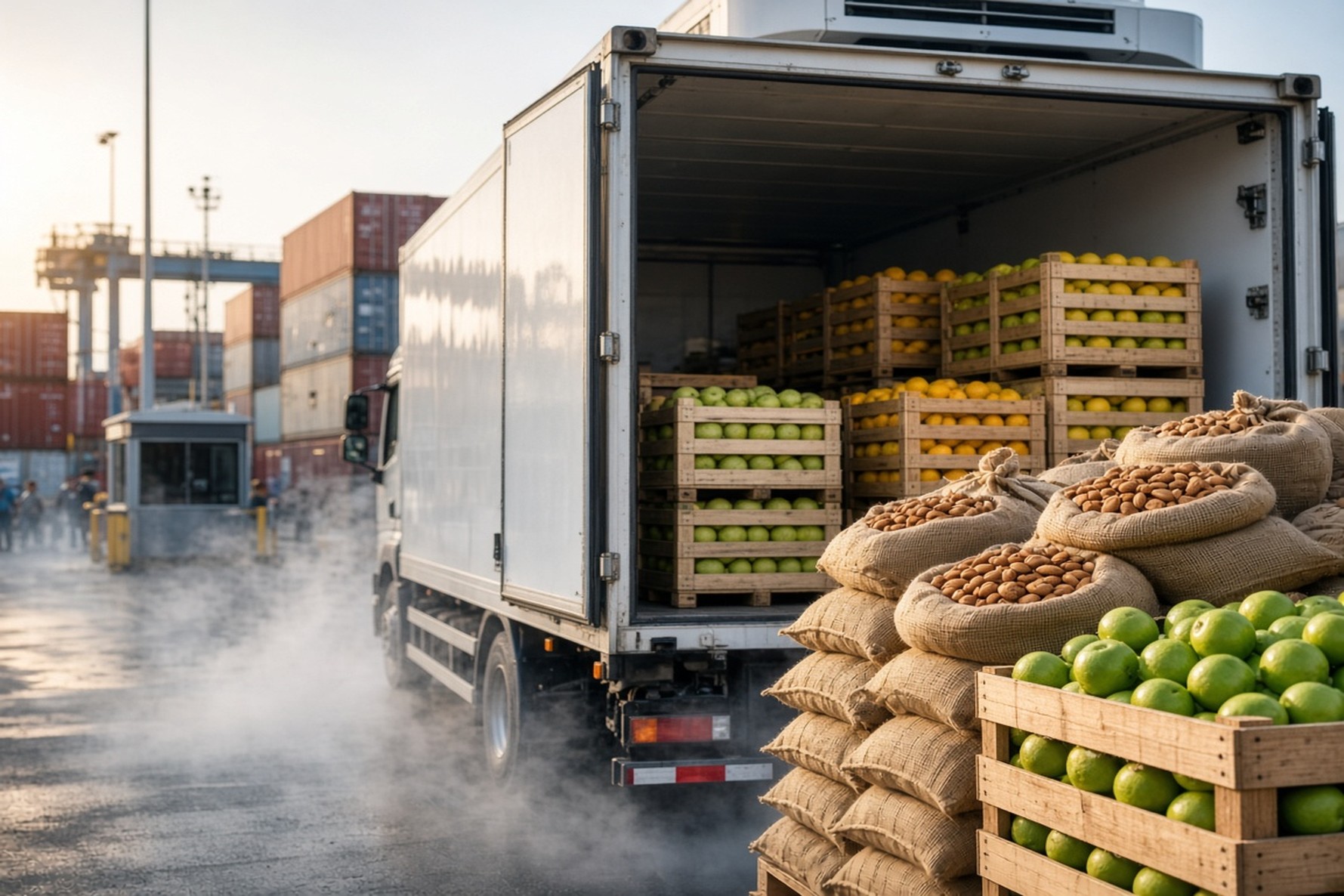
This is one of Russia's most visible import segments. Oranges, mandarins, lemons, grapefruit, bananas, grapes, kiwi and certain seasonal fruits are imported in significant volumes. In 2024 Turkey exported about 599,000 tonnes of citrus to Russia. Egypt, China, South Africa and Morocco also had a strong presence in this market. For Iran, direct competition across all these items is not always logical; opportunity arises when an Iranian product offers the right harvest window, shorter haul distance, overland delivery option, retail-suitable appearance, uniform sizing, competitive cost, regular supply capability or sufficient shelf life for the Russia route.
Vegetables and Greenhouse Products
For part of the year Russians have substantial need for imported fresh vegetables. Tomatoes, bell peppers, cucumbers, aubergines, fresh herbs and some greenhouse products can be attractive in specific seasonal windows. Iran's advantage in this group is the ability to produce in regions with harvest seasons different from Russia's. Fresh vegetables are, however, more logistically demanding than dried fruit and nuts; the smallest border delay or temperature fluctuation can cause loss of firmness, wilting, mould, softening or reduced commercial value.
Dried Fruit, Nuts and Kernels
This segment is especially important for Iran. Pistachios, raisins, dates, dried figs, certain kernels and dried processed products carry lower transport risk than fresh goods when they match buyer specifications. A Russian buyer in this group usually does not order by product name alone; size, colour, moisture content, breakage percentage, foreign matter, microbial contamination, aflatoxin in sensitive products, packaging and production date can all determine whether a consignment is accepted.
Coffee, Cocoa, Tea and Spices
Part of this category cannot be produced at scale in Russia because of climate; imports are therefore structural. Specialist origin countries and established supply chains dominate these markets. Iran is not naturally Russia's supplier of raw coffee or cocoa, but in spices, saffron, aromatic plants and certain food ingredients it can hold a more specialised position.
Food-Industry Raw Materials
Russia's market is not retail alone. Confectionery and chocolate plants, beverage makers, dairy processors, sauce producers, industrial bakeries, ready meals and fruit-processing factories also buy raw materials. Fruit concentrate, industrial tomato paste, purée, industrial dried fruit, crushed kernels, industrial raisins, saffron, permitted food extracts and certain processed inputs can be reviewed in this segment. In this market, stable technical specifications, delivered price, supply volume and repeatable quality matter more than attractive packaging.
| Product group | Reason for import appeal | Main buyer sensitivity | Potential for Iran |
|---|---|---|---|
| Fresh fruit | Russia's climate and production season | Appearance, firmness, shelf life | High in certain seasons |
| Greenhouse vegetables | Off-season supply | Temperature, sorting, durability | Significant |
| Dried fruit and nuts | Direct consumption and industry | Aflatoxin, moisture, uniformity | High |
| Dates and dried fruit | Retail and food industry | Texture, moisture, packaging | High |
| Saffron and spices | Food and industrial use | Purity and testing | Specialist |
| Tomato paste and products | Industrial consumption | Brix, colour, industrial pack | Worth reviewing |
| Concentrate and purée | Beverage and food industry | Brix, acidity, microbiology | Worth reviewing |
| Animal products | Specific market demand | Veterinary licence and approved facility | More difficult |
2. Which Products Attract the Most Attention from Russian Importers?
A Russian importer usually finds a product attractive only when it is not merely "good quality" but also economically and operationally deliverable. Four factors are decisive:
- Supply in the shortage season: A product arriving at the peak of Russia's domestic supply may face severe price pressure. The same product at the start or end of the domestic season can gain more value. For fruit and vegetable exporters, the supply calendar is almost as important as price.
- Consignment consistency: In wholesale trade, the buyer does not want the first truck to be excellent and later trucks merely average. Uniformity of size, colour, ripeness and packaging matters greatly.
- Repeat order capability: A large retailer or distributor prefers a supplier who can meet weekly or monthly delivery schedules.
- Delivered cost: Factory or cold-store price in Iran is only one component of the deal. The Russian importer usually compares landed cost to their own warehouse. An Iranian product may be cheaper at origin yet lose its advantage if border dwell is long, transport is inefficient, product deteriorates or clearance cost is high.
3. Who Are the Main Buyers of Imported Food in Russia?
Knowing the buyer helps with product choice, packaging and even transport route.
Wholesale Importers and Distributors
This group usually buys large consignments and distributes to wholesale markets, retail chains and regional wholesalers. For fresh fruit and vegetables, working with such an importer can be more practical than a seller able to deliver only a few pallets.
Retail Chains
Major Russian chains are sensitive to exact product specifications, barcodes and labels, packaging, delivery consistency, traceability, remaining shelf life at entry and consignment uniformity. Direct entry by a foreign producer into these networks is not usually simpler than working through a local importer.
Wholesale Markets and Distribution Hubs
A significant share of fruit, vegetables and dried fruit and nuts enters the market through wholesale networks. In this channel speed of trade and price matter more, but quality control remains serious.
Food-Processing Plants
For tomato paste, concentrate, industrial dried fruit, kernels, powders and raw materials, Russian factories can be more attractive customers than the consumer market. In this case technical specifications usually matter more than pack design.
Restaurants, Hotels and Food Service (HORECA)
This segment has demand for spices, dried fruit and nuts, dates, fruit, vegetables, frozen goods and certain specialty items, but orders are generally placed through distributors.
4. Through Which Routes and Borders Does Food Enter Russia?
No single route can be called "the largest route for all Russian food imports." Product type and origin determine which gateway matters most. St Petersburg, for example, plays a very large role in banana imports; according to regional data from Russia's agricultural oversight authority, in 2025 about 1.242 million tonnes of fresh bananas entered through the Port of Big St Petersburg alone.
Northwestern Ports and St Petersburg
This route is important for maritime cargo from Latin America and other distant origins. Bananas are a clear example; Ecuador is a very large supplier to the Russian market and a huge volume of this product moves by sea. 2024 export data from Ecuador to Russia shows more than 1.2 million tonnes of bananas.
Black Sea Ports
For goods arriving from the Mediterranean, Turkey, the Middle East or other southern routes, Russia's southern ports can matter. Product type, port conditions, shipping line schedules and final destination inside Russia determine whether this option is more economical than overland transport.
Caucasus Land Route
This route matters for Turkey, Azerbaijan, Iran and regional transit cargo. The Russia–Azerbaijan border in Dagestan is one of the key points of the North–South corridor. The Yarag–Kazmalyar crossing is one of the busiest land gateways on this axis, and the Tagirkent–Kazmalyar crossing is also active for freight.
Kazakhstan and Central Asia Route
Since both Russia and Kazakhstan are members of the Eurasian Economic Union, this axis matters for flows from Central Asia, China and the eastern North–South route.
Russia's Far East
Goods from China and East Asia can enter through Far Eastern ports and land crossings. The very long distance from this region to Moscow means transport economics must be calculated separately for each product.
| Entry route | Suitable origins | Typical goods | Main advantage | Main limitation |
|---|---|---|---|---|
| St Petersburg and Baltic | Latin America and maritime routes | Bananas, fruit, containerised food | High maritime capacity | Long distance from Iran |
| Black Sea | Turkey, Mediterranean, south | Fruit, vegetables, packaged food | Access to southern Russia | Dependence on shipping schedules |
| Caucasus and Dagestan | Iran, Azerbaijan | Fruit, vegetables, dried fruit and nuts | Suited to road haulage | Border queues and capacity |
| Caspian | Iran and littoral states | Container and general cargo | Reduces part of overland transit | Requires multimodal haulage |
| Central Asia | Iran, China, Central Asia | Container and rail cargo | Suited to large loads | Transit time and multi-network coordination |
| Far East | China and East Asia | Asian food products | Direct access to eastern Russia | Long distance to western centres |
5. Best Routes for Iranian Food Exports to Russia
For Iran, three main branches of the North–South corridor matter: the western route via Azerbaijan, the trans-Caspian route and the eastern route via Turkmenistan and Kazakhstan. Russia's Ministry of Transport stated that total cargo moved on the North–South corridor in 2024 was about 20 million tonnes, of which about 9.5 million tonnes passed through the western branch. In 2025 development of the various branches and increased border capacity continued.
Iran–Azerbaijan–Russia Land Route
For many fresh Iranian products this is one of the most practical options. The general pattern is: Iran → Iran–Azerbaijan border → Azerbaijan → Azerbaijan–Russia border → Dagestan → central Russian regions. The Yarag–Kazmalyar crossing on the Russian side is a key entry point for cargo from this axis. For goods such as vegetables, bell peppers, kiwi, apples, grapes and fresh fruit where transit time matters, refrigerated truck usually offers more flexibility. The main risk is border dwell; for perishable goods, even if driving time is acceptable, a few days of unforeseen delay can change quality.
Caspian Sea Route
Cargo can move from northern Iranian ports to Russian Caspian ports. On the Russian side, Astrakhan, Olya and Makhachkala ports matter in the Caspian and North–South transport network. The Russian government treats development of the trans-Caspian route as one of the main axes of this corridor. This route is better suited to container loads, dried fruit and nuts, longer-shelf-life foods and consignments that can use multimodal transport.
Eastern Route via Turkmenistan and Kazakhstan
The eastern branch can connect Iranian rail cargo to Russia via Turkmenistan and Kazakhstan. In November 2025 a Russian freight train entered Iran via Kazakhstan and Turkmenistan and the Incheh Borun border, completing the full route in about 12 days — a sign of greater operational activity on the eastern branch.
| Iran to Russia route | Best suited to | Advantage | Risk |
|---|---|---|---|
| Overland via Azerbaijan | Fresh fruit and vegetables, dried fruit and nuts | Speed and direct delivery | Border queues and truck cost |
| Caspian | Dried fruit and nuts, packaged food, containers | Suited to bulky cargo | Vessel schedule and port transfer |
| Eastern via Turkmenistan and Kazakhstan | Large and rail loads | High development capacity | Longer route for some destinations |
| Air | Very high-value and sensitive goods | High speed | Very high cost |
6. Main Regulations Governing Food Imports into Russia
Russia is a member of the Eurasian Economic Union; therefore most technical requirements for food imports are applied under EAEU technical regulations. The exporter must know, before production or packing, exactly which regulations apply to the product.
General Food Safety Regulation — TR TS 021/2011
One of the most important regulations is TR TS 021/2011 on food safety. It sets the general safety framework, production process and food conformity assessment. HACCP-based procedures for food production are also envisaged under this regulation.
Conformity Declaration
A large share of processed foods entering the EAEU market require a declaration of conformity. Article 23 of TR TS 021/2011 defines the conformity declaration system for food products. Unprocessed animal products and specialised foods fall into exempt groups and follow a different assessment path. An exporter should not assume an "Iranian factory quality certificate" replaces the legal documents required for the Russian market.
State Registration for Special Products
- Infant food
- Therapeutic diet food
- Certain therapeutic mineral waters
- Food for athletes
- Food for pregnant and breastfeeding women
- Dietary supplements
Labelling — TR TS 022/2011
TR TS 022/2011 governs food labelling. For packaged food, core information includes product name, ingredients, net quantity, production date, expiry date or shelf life, storage conditions, manufacturer details, importer details where required, nutritional value, information on genetically modified organisms where applicable and the EAEU market circulation mark. Mandatory text must be provided in Russian.
EAC Mark
Products that enter the EAEU market after lawful conformity assessment must, where required, carry the unified EAC circulation mark. This mark must not be printed on packaging for appearance alone; its use must align with the product's legal conformity status.
Packaging Regulation — TR TS 005/2011
TR TS 005/2011 covers packaging safety requirements. Packaging in contact with food must comply with relevant requirements on material migration, hygienic properties and mechanical performance.
Food Additives — TR TS 029/2012
For products containing additives, flavourings or processing aids, TR TS 029/2012 also matters.
Product-Specific Regulations
- Milk and dairy products: TR TS 033/2013
- Meat and meat products: TR TS 034/2013
- Fish and seafood products: TR EAEU 040/2016
An exporter therefore cannot cover all product requirements by reading the general food regulation alone.
7. How Are Phytosanitary and Veterinary Controls Applied?
For fruit, vegetables and many raw agricultural goods, plant quarantine control is one of the essential entry stages. The product must be acceptable from a quarantine pest standpoint and, where applicable, must be accompanied by a valid phytosanitary certificate. Presence of soil, pests, live insects, plant disease or document mismatch can lead to hold, sampling, disinfection, return or other legal measures.
For Iranian fruit and vegetable exporters, four actions are especially important:
- Review phytosanitary conditions of the product before contracting
- Control orchard or farm and packing facility
- Inspect goods before loading
- Align phytosanitary certificate precisely with consignment and commercial documents
Animal products follow a stricter path. Production facility, veterinary status of country and plant, veterinary certificate and whether the establishment is authorised for export may all be reviewed. Systems and lists of approved establishments are maintained under Russia's veterinary and agricultural authority. For meat, dairy, seafood or products containing animal raw materials, market access for both product and factory must be clarified before any serious sales negotiation.
8. Tariffs, Taxes and the Cost of Importing Food into Russia
Import cost in Russia should not be calculated from "freight alone." The real structure can include these components:
Impact of the Iran–EAEU Free Trade Agreement
From 15 May 2025 the full free trade agreement between Iran and the Eurasian Economic Union has been in force. About 90% of the trade basket falls under the free trade regime, and for goods with preferential Iranian origin the general EAEU import duty rate is zero; goods on the exception list are subject to the rates set in that list. This is very important for Iranian food exporters, but it does not mean all products automatically have zero tariff.
- Exact product code
- Whether the product is on the exception list
- Proof of preferential Iranian origin
Proof of Origin
The Iran–EAEU agreement sets specific rules of origin. Goods wholly produced in Iran, or products meeting defined processing criteria, can qualify for preferential origin. The agreement also allows origin declaration for eligible consignments up to a customs value of EUR 5,000 within the prescribed framework. For large commercial shipments, a preferential certificate of origin must be planned correctly before transport.
Value Added Tax
From 1 January 2026 Russia's general VAT rate increased from 20% to 22%. A preferential 10% rate remains for specified groups of food products and socially important goods. The key point is that a product being "food" alone does not mean 10% VAT; tariff code and legal product description must match the relevant list. For example, fresh fruit and vegetables may fall under the preferential rate, while some of their processed forms fall under the general rate.
Why Quoting One Fixed Transport Cost Is Wrong
Truck or container freight depends on many factors: season, truck shortage or surplus, fuel cost, truck type, need for refrigeration, consignment weight, loading city, Russian destination, transit route, border queues, backhaul, insurance and regional political and transport conditions. Importers should therefore obtain freight price at the time of actual order placement, not from rates quoted months earlier.
| Cost component | What changes it? |
|---|---|
| Product price | Season, quality, size, volume |
| Packaging | Retail or bulk, carton material, pallet |
| Cold storage | Storage duration and required temperature |
| Haulage in Iran | Distance from farm or factory to border |
| International transport | Route, weight, refrigerated or not |
| Import duty | Product code, origin and trade agreement |
| Tax | Product code and legal category |
| Testing | Product group and control programme |
| Storage | Clearance time |
| Distribution in Russia | Distance to Moscow, St Petersburg or destination city |
9. Technical Specifications and Packaging Expected by Russian Importers
One common exporter mistake is to open an offer with phrases such as "Grade 1 export apples available" or "We have high-quality pistachios." That is not enough for professional purchasing.
Fresh Fruit
- Product type, size or diameter range, weight per fruit, colour, ripeness level, firmness
- Soluble solids where relevant, maximum visible defects, net carton weight
- Internal carton layout, pre-cooling, transport temperature, harvest and packing date
Vegetables
For bell peppers, for example, colour, weight or size, uniformity, wall thickness and health, firmness, stem length, surface defect level and carton type can all be purchase criteria.
Dried Fruit and Nuts
Parameters vary by product, but usually include size, moisture, breakage percentage, foreign matter, pest damage, colour, purity, fungal contamination, aflatoxin in relevant products and packaging type.
Industrial Raw Materials
For tomato paste, concentrate or purée, the buyer may require Brix, pH, colour, viscosity, acidity, microbial load, heat treatment type and industrial packaging.
| Product group | Key purchase specifications | Common export packaging |
|---|---|---|
| Fresh fruit | Size, colour, firmness, defects | Ventilated carton |
| Vegetables | Size, condition, firmness | Moisture-resistant carton |
| Pistachios and kernels | Size, moisture, aflatoxin | Bag or carton with protective liner |
| Raisins | Colour, moisture, foreign matter | Carton or inner bag |
| Dates | Texture, moisture, size | Retail pack or bulk carton |
| Saffron | Purity, colouring strength, moisture | Airtight, light-protected pack |
| Industrial paste | Brix, colour, microbiology | Aseptic bag in drum |
| Concentrate | Brix, acidity, microbiology | Aseptic or industrial tank |
10. Cold Chain Transport: Where Shipment Profit Can Be Lost
In fruit and vegetable trade with Russia, quality at loading is only half the issue. Product may be excellent in Iran yet lose value at destination.
Pre-Cooling
Product loaded directly from field heat into a refrigerated truck imposes a large thermal load on the system. A refrigerated truck is not designed to cool several tonnes of warm fruit quickly; its main job is to maintain the temperature of prepared cargo.
Temperature Selection
There is no single temperature for all products. Wrong temperature can cause chilling injury, increased respiration, loss of firmness, colour change, decay or surface condensation. Set-point temperature must therefore be chosen according to the product, ripeness stage and valid technical guidance.
Stacking and Temperature Recording
If cartons block air circulation, the unit set-point does not necessarily mean uniform temperature throughout the load. Professional consignments can use temperature recorders so that, if seller, carrier and buyer disagree, there is a record of transport conditions.
Humidity and Condensation
Sudden ambient temperature change can cause moisture to form on the product. For some products this increases mould risk.
11. Competition in the Russian Market: Which Countries Does Iran Face?
Iran's advantage is not geography alone. Each product has different competitors. In citrus, Turkey, Egypt, South Africa, China and Morocco have strong presence. In bananas Ecuador holds a very large position. In many vegetables, Turkey, China, Central Asian countries and Russian domestic supply can compete. For Iran, competition must be analysed product by product.
| Factor | Iran | Distant maritime competitor |
|---|---|---|
| Distance to southern Russia | Favourable | Usually longer |
| Direct truck haulage | Possible | Limited |
| Fast response to orders | Potentially strong | More difficult |
| Production cost | Competitive depending on product | Varies |
| Large vessel capacity | More limited | Strong at some origins |
| Export standard consistency | Depends on supplier | Some rivals have established systems |
| Preferential tariff access | Important for many goods of Iranian origin | Varies |
Iran's real edge appears when shorter distance is combined with stable standards, suitable packaging and regular supply planning. Cheap but inconsistent product usually does not retain a professional customer.
12. Importer Checklist Before Placing an Order
Before signing a food import contract for Russia, the following should be reviewed:
- Define exact product name and processing form.
- Determine the EAEU tariff code before final pricing.
- Check whether the product qualifies for Iran–EAEU preferential tariff.
- Identify documents required to prove Iranian origin.
- Review conformity declaration or state registration status of the product.
- Confirm whether product-specific regulations apply in addition to TR TS 021/2011.
- Approve Russian label text before final printing.
- For plant products, review phytosanitary requirements.
- For animal products, verify country, factory and veterinary certificate eligibility.
- Evaluate a sample before commercial order.
- Write acceptance and rejection criteria in the contract.
- State size, weight, moisture or other technical parameters numerically.
- Test packaging type and strength for the transport route.
- For fresh product, plan pre-cooling and cold chain.
- Review main and alternative transport routes.
- Assign responsibility for truck or container dwell cost in the contract.
- Clarify risk and title transfer according to delivery terms.
- Specify required pre-loading tests.
- Match net weight, gross weight and package count with documents.
- Review expected clearance time and remaining shelf life at entry.
What Information Should Be Sent for an Accurate Price Quote?
A food price request for the Russian market should include at least:
- Exact product name and type or processing form
- Quality grade, size or weight range, key technical specifications
- Total order quantity and order schedule
- Weight per pack, retail or bulk packaging, private label or pallet requirement
- Storage conditions, destination city in Russia, preferred route or transport mode
- Delivery terms, required certificates and tests, label language and design
- Desired delivery date
A request such as "pistachio price for Russia" is not enough for commercial comparison. Price becomes comparable only when size, product form, moisture, defect limits, aflatoxin testing, pack weight, order volume and delivery point are identical.
Sourcing Iranian Food for the Russian Market
In trade with Russia, supplier selection should follow market requirements, not precede them. If an importer finds a seller first and then tries to fit whatever product is available to the Russian market, dispute risk rises. The better method is to define purchase specifications first: product, quality, size, order volume, packaging, testing, destination and transport mode.
The next step is to identify which Iranian producer or packer can genuinely repeat those specifications. For foreign buyers, Iranco can serve as a platform to register purchase requests and review supply options from Iran. For fresh product, preparation time, cold storage, sorting method and loading capacity should be reviewed alongside price. For dried fruit and nuts and industrial raw materials, samples and laboratory specifications matter more.
If the goal is supply for Russia, destination city also matters; landed cost to Makhachkala is not comparable with Moscow or St Petersburg.
Summary
Russia is a large food import market, but real opportunity is not equal across all products. The greatest import dependence appears in groups where Russia's climate limits sufficient production or year-round supply — including citrus, bananas, certain fresh fruit and vegetables, coffee, cocoa, dried fruit and nuts, spices and part of food-industry raw materials.
For Iranian exporters, the most attractive opportunities are not necessarily the products with the largest Russian import volumes. Bananas are a good example: the market is very large, but supply structure is dominated by specialist origins such as Ecuador. By contrast, Iran can build more logical commercial advantage in dried fruit and nuts, dates, raisins, pistachios, saffron, orchard products, greenhouse vegetables and certain processed inputs.
Another advantage that has become more prominent from 2025 is the Iran–EAEU free trade agreement. Real use of this opportunity depends on correct product code and compliance with origin rules; zero import duty for many goods of preferential Iranian origin does not remove quarantine, conformity, labelling or import tax requirements. In logistics, the Iran–Azerbaijan–Russia route is especially important for fresh product, while the Caspian and eastern branches can be more economical for other groups. A successful deal in the Russian market therefore combines five factors: the right product, precise technical specifications, regulatory compliance, suitable transport route and full landed cost calculation.
Frequently Asked Questions (FAQ)
Is Russia still a major food importer?
Yes. Russia is a large producer in many agricultural groups, but the value of its food and agricultural raw material imports in 2024 exceeded USD 37.7 billion. The greatest import opportunity is in products limited by climate or requiring year-round supply.
Which fruits does Russia import most?
Citrus and bananas are among the largest import groups. In 2024 about 1.9 million tonnes of citrus and nearly 1.4 million tonnes of bananas entered Russia. Grapes, various seasonal fruit, tropical fruit and certain orchard products also form part of the country's import trade.
What is the best route for Iranian fruit exports to Russia?
For many fresh fruits and vegetables, road transport from Iran to Azerbaijan and then entry into Dagestan, Russia is an important option because it allows refrigerated truck use and direct delivery. For dried fruit and nuts and longer-shelf-life goods, the Caspian or rail route can also be reviewed.
Do Iranian goods enter Russia at zero tariff?
From 15 May 2025 the Iran–EAEU free trade agreement has been in force. For many goods of preferential Iranian origin the import duty rate is zero, but an exception list exists. Product code and origin conditions must therefore be checked separately for each item.
What is the import tax on food in Russia?
VAT rate depends on legal category and product code. From the start of 2026 Russia's general rate is 22%, but a 10% rate remains for specified food groups and socially important goods. The exact rate must be checked for each product.
Is a Persian label enough to sell food in Russia?
No. Mandatory product information must comply with EAEU regulations and Russian market requirements. TR TS 022/2011 sets requirements for name, ingredients, weight, production date, shelf life, storage conditions, manufacturer and other information, and mandatory information must appear in Russian.
Do all foods require a phytosanitary certificate?
No. Phytosanitary certificate requirement depends on product nature and quarantine category. Fruit, vegetables and many raw plant products fall under quarantine control. Processed product may have a different status, so classification must be done before shipment.
How can Iranian food be sourced for a Russian importer?
Product, quality, volume, packaging, destination and testing requirements must first be defined. Production or packing options are then matched to those criteria and samples evaluated before bulk order. Buyers can submit these specifications through an Iranco purchase request so available options in Iran are reviewed on that basis.
Why do prices for the same Iranian product differ greatly between suppliers?
Price differences can come from raw material quality, size, defect percentage, purchase season, sorting, packaging, testing, order volume, payment terms and delivery point. For fresh product, cold storage and harvest method also have large effect. Comparing price without identical purchase specifications usually does not produce a reliable result.
For fresh product, is a refrigerated truck alone enough?
No. A refrigerated truck must be part of a cold chain. If product is loaded while still warm, lacks suitable ventilated packaging or blocks air circulation inside the truck, unit temperature setting alone will not necessarily preserve quality. Pre-cooling, proper stacking and temperature recording must be managed together.
Featured Products










Related Articles



