 Iranco Magazine Team
A practical guide to Oman’s food market — from high-demand categories and Iran’s product position to sea and land routes, product registration, standards, labelling, tariffs, tax and shipment control
Market Report · Food Imports · Oman
Practical Guide to Oman’s Food Market: High-Demand Products, Entry Routes, Registration, Standards, Tariffs and True Landed Cost
From in-demand categories and Iran’s product position to sea and land routes, labelling, tax and shipment control
Four key market indicators
2024 trade data show Oman’s food imports are not limited to a few staples but span a wide range of raw, fresh, frozen and processed products.
Analytical introduction
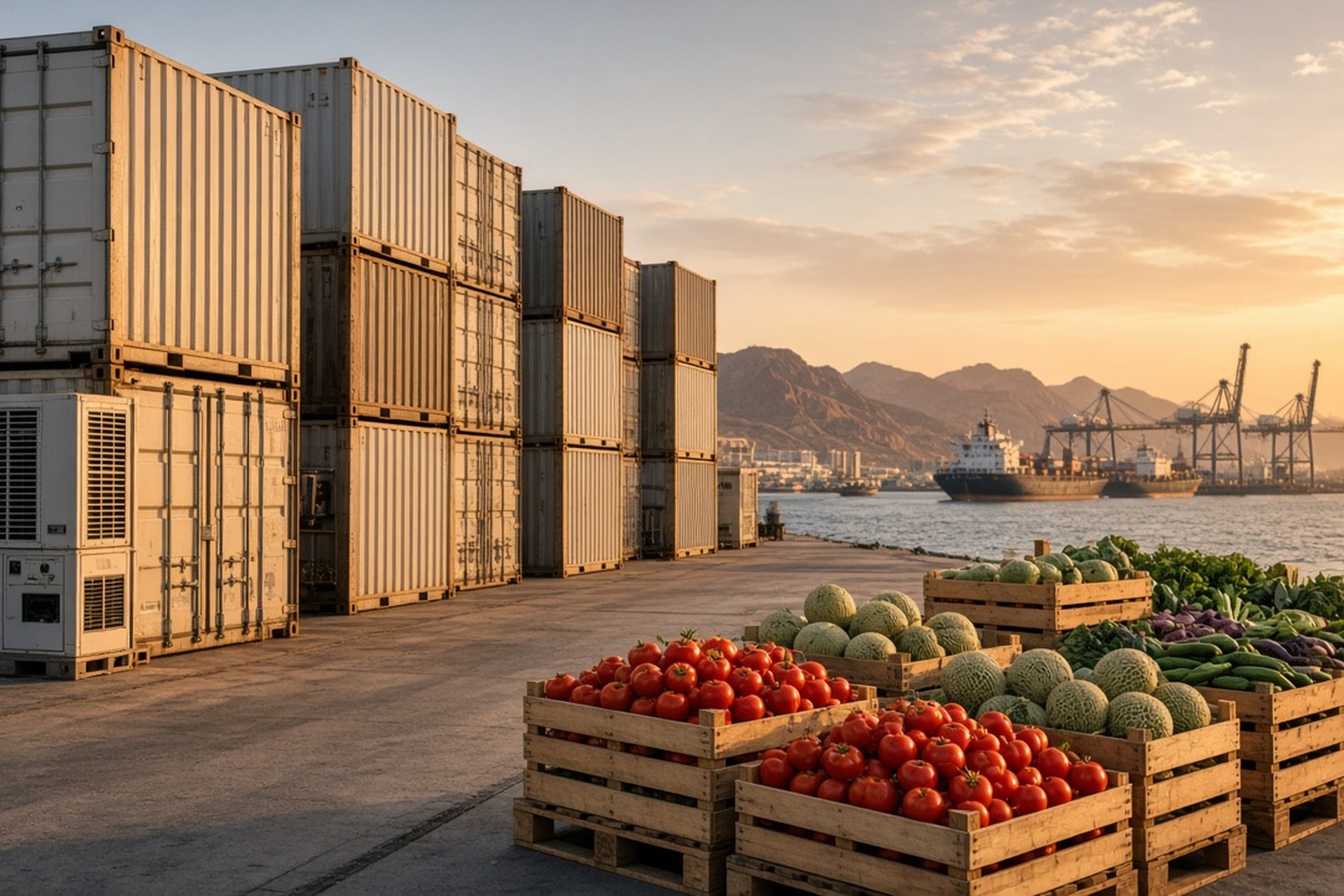
Oman is not a trivial market for food exporters. Despite a smaller population than Saudi Arabia, climate, urban consumption, expatriate communities, tourism and modern retail drive diverse food imports.
Total goods imports reached about USD 43.5 billion in 2024. The UAE was the largest recorded origin at 23.6%, followed by China, Kuwait, India and Saudi Arabia. Some food flows enter via UAE distribution networks before crossing into Oman by land or sea.
Iran’s recorded sales to Oman in 2024 included about USD 31.06 million of vegetables, USD 22.63 million of fruit and nuts, USD 8.69 million of fruit/vegetable products and USD 4.82 million of grain/bakery products — strongest in fresh, horticultural and selected processed lines.
Success requires four simultaneous answers: demand-fit product choice, full regulatory compliance, appropriate routing and true landed cost to the importer’s warehouse.
1. Which foods do Omani importers focus on?
Cereals, dairy, meat and poultry, fruit and nuts, flour/bakery products, edible oils, vegetables and processed foods form major import demand. High import value alone does not mean an easy win for Iranian suppliers.
Cereals: large market, hard entry
Wheat and wheat-mix imports were about USD 316.7 million in 2024; Russia led supply. Rice imports exceeded 306,000 tonnes (USD 303 million), dominated by India and Pakistan. Iran’s rice share is very limited.
Dairy and related products
Imports exceeded USD 781 million in 2024. Iran’s sales to Oman in this group were about USD 1.76 million (cheese, condensed milk, yoghurt, butter, honey). Health paperwork, cold chain and product registration are decisive.
Fruit, nuts and vegetables
Fruit/nut imports were about USD 420.6 million and vegetables about USD 291.6 million. Iran exported about USD 22.63 million and USD 31.06 million respectively. Fresh/chilled Iranian tomatoes alone reached about USD 11.62 million.
2. Where do Iranian foods already compete in Oman?
Assess opportunity on real trade, not domestic fame. Fresh vegetables, fruit, tomato/vegetable products, bakery lines and selected dairy show the strongest recorded flows.
3. Main import routes into Oman
Three networks dominate: direct sea entry, land entry from the UAE/GCC, and sea–land flows via regional hubs. Sohar serves the north/centre, Salalah the south; Khatmat Milahah, Hatta–Al Wajajah and Al Buraimi are key UAE–Oman corridors.
4. What specs does a professional importer check?
Define the product before pricing: exact name, HS code, net weight, formulation, production and shelf-life dates, packaging, storage, acceptance criteria, lab documents and label compliance.
5. Legal steps for food import
Food product registration on Oman’s government services platform should precede shipment. Plant products need per-shipment import permits and phytosanitary certificates. Animal products need veterinary permits requested before cargo leaves the exporting country.
6. Standards, labelling and food safety
Oman applies OS GSO 9:2022 for pre-packaged food labels and OS GSO 2500:2025 for permitted additives. Arabic or Arabic/English labels must be approved with the importer before mass production.
7. Tariffs, tax and true landed cost
Duty depends on HS code, product description and origin. Base VAT is 5% but 513 staple foods are zero-rated. Excise tax applies to carbonated soft drinks (50%) and energy drinks (100%). Landed cost includes purchase, freight, insurance, duty, tax, inspection, clearance and inland delivery.
8. Packaging and transport
Match logistics to product: dry containers for grains and biscuits, fast or reefer moves for fresh produce, cold chain for dairy, frozen chain for meat and poultry.
9. Shipment quality control
Approved samples start negotiations; commercial lots must match them numerically — size, uniformity, defects, ripeness and pack integrity for fresh goods; formulation, microbiology, additives and label match for processed goods.
10. Pre-order importer checklist
Twenty checkpoints cover HS code, duty and VAT, registration status, plant or veterinary permits, label approval, commercial reference sample, acceptance spec, entry port, Incoterms and claim clauses — all before prepayment.
11. Information needed for accurate pricing
Provide product name/type, pack weight, master carton, order volume, Arabic label need, Oman destination city, preferred port, transport mode and delivery terms. Vague RFQs cannot be compared fairly.
12. Sourcing Iranian food for Oman
Geographic proximity alone does not create contracts. Iranco can host structured purchase requests to match supply against real order criteria.
Conclusion
Oman’s food market is import-driven, competitive and rule-bound. Iran has real trade in vegetables, fruit, tomato/vegetable products and selected processed foods. The winning mix is stable quality, correct documentation, suitable packs and predictable delivery — not price alone.
Oman food import groups
| Food group | 2024 import value | Commercial read |
|---|---|---|
| Cereals | ~USD 807.93M | Very large market; fierce origin competition |
| Dairy, eggs, honey | ~USD 781.64M | High demand; hygiene rules decisive |
| Meat & offal | ~USD 426.43M | Halal & veterinary control critical |
| Fruit & nuts | ~USD 420.59M | Key opportunity area for Iran |
| Grain/bakery products | ~USD 399.76M | Strong UAE & Turkey competition |
| Edible oils & fats | ~USD 392.54M | Large market; heavy price competition |
| Vegetables & roots | ~USD 291.55M | Important regional fresh produce market |
Iran exports to Oman — 2024 summary
| Iran export group | 2024 value | Key products |
|---|---|---|
| Vegetables & plant foods | ~USD 31.06M | Tomato, onion, garlic, carrot, cabbage |
| Fruit & nuts | ~USD 22.63M | Melon, apple, grape, citrus |
| Fruit/vegetable products | ~USD 8.69M | Tomato products, juice, pickles |
| Grain/bakery products | ~USD 4.82M | Bakery and flour-based lines |
| Dairy, eggs, honey | ~USD 1.76M | Cheese, condensed milk, yoghurt, butter |
Main entry routes
| Route | Best for | Entry points | Feature |
|---|---|---|---|
| Sea to Sohar | Dry/reefer containers | Sohar Port | North & central Oman |
| Sea to Salalah | Long-haul cargo | Salalah Port | Southern Oman |
| UAE–Oman land | Packed & fresh | Khatmat Milahah/Hatta | Distribution & re-export |
| Saudi–Oman land | Saudi-origin goods | Rub al Khali | Direct land corridor |
Practical importer checklist
- Confirm HS code with customs broker
- Check duty and zero or 5% VAT
- Verify food registration before shipment
- Obtain plant or veterinary permit if required
- Approve Arabic label before printing
- Fix entry port or border
- Calculate true delivered cost
- Include acceptance criteria and claims in contract
Frequently asked questions
Which foods are most attractive to Omani importers?
Based on 2024 import structure, cereals, dairy, meat, fruit and nuts, bakery/grain products, edible oils and vegetables are major groups. For Iranian exporters, fruit, vegetables, fruit/vegetable products and some processed foods matter most.
Do all foods in Oman pay 5% VAT?
No. The base rate is 5%, but hundreds of essential food items are zero-rated. The rate must be checked against the exact HS code.
What is the best transport route from Iran to Oman?
For direct containers, sea freight to Oman is usually the main option. For cargo consolidated in the UAE, land crossing from UAE–Oman borders is often more practical. Fresh produce should be judged on door-to-door time.
Do imported fruit and vegetables need a permit?
Yes. Plant products require an import permit and phytosanitary certificate. The request must be made before purchase is finalised and cargo is inspectable on arrival.
What documents are needed for meat and poultry imports?
Veterinary import permit, health certificate, certificate of origin and halal certificate for meat and poultry are core documents.
Is a Persian label enough for Oman?
No. Labels must comply with OS GSO 9:2022 and Omani requirements. Arabic or Arabic/English versions must be approved before mass printing.
How is true landed cost calculated?
Purchase price plus freight, insurance, customs duty, tax, inspection, clearance, storage and inland delivery must all be included.
Do Iranian products have a real presence in Oman?
Yes. 2024 data show over USD 31 million of vegetables and over USD 22 million of fruit and nuts imported from Iran.
Featured Products




Related Articles



