 Iranco Magazine Team
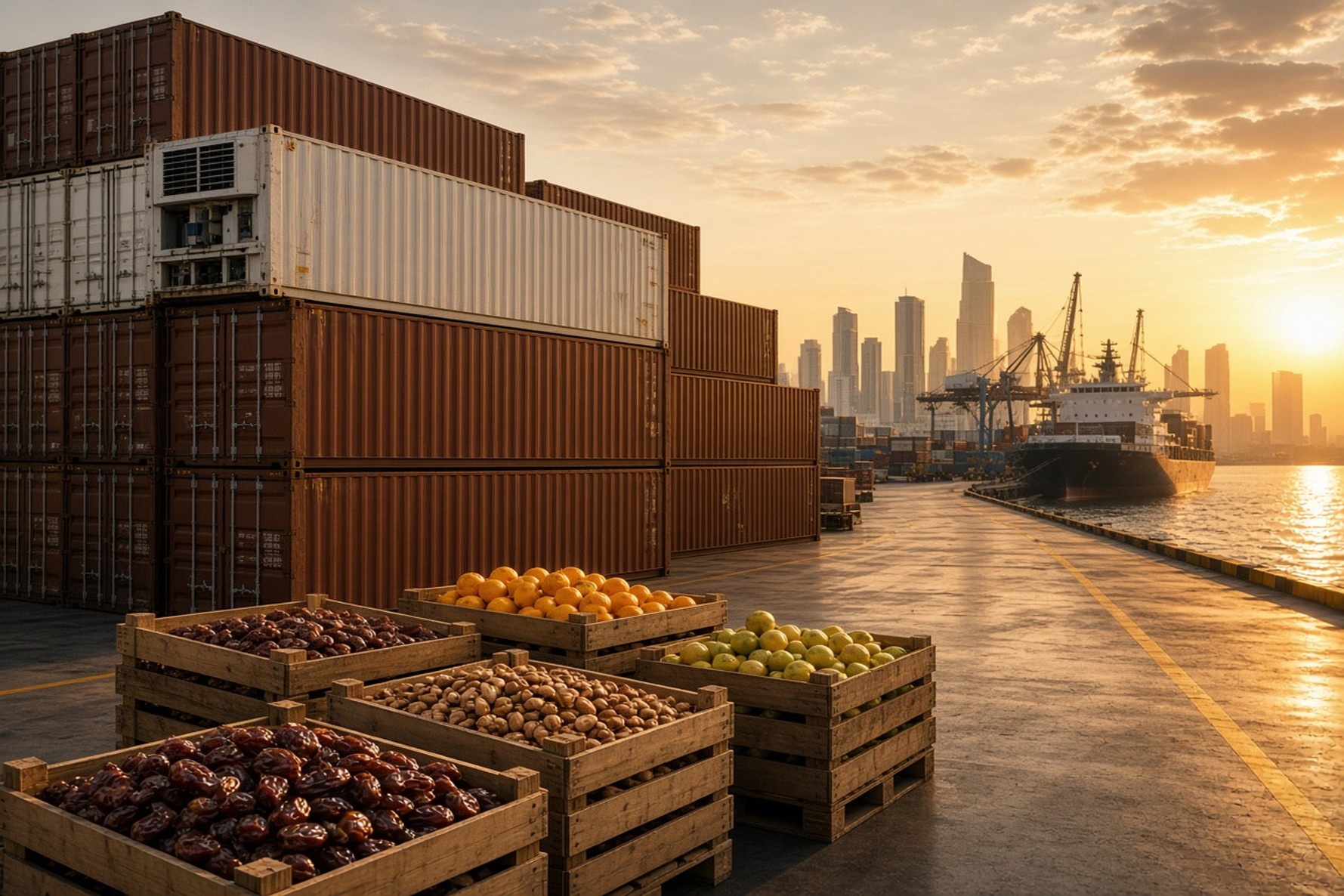
Kuwait food market review — high-demand import groups, main ports and borders, food authority requirements, customs tariff, documents, packaging, transport and true landed import cost
Market Report · Kuwait · Food Imports
Kuwait Food Import Market: High-Demand Categories, Ports and Borders, Customs Rules and Iranian Export Opportunities
Kuwait sources a major share of its food needs from global markets. Meat, dairy, cereals, fruit and nuts, processed foods and many fresh products all have significant import demand. This report identifies which food groups matter most to Kuwaiti importers, which ports and borders goods enter through, and what Iranian exporters must manage to clear customs, health controls and commercial requirements.
1. Analytical Introduction
Kuwait's food market cannot be assessed on population alone. Limited water and agricultural land, climate constraints, high urbanisation and modern distribution structures mean imports play a major role in the national food basket. That makes the country attractive to regional and international producers — but market appeal does not mean easy entry.
Trade data shows that in 2024 alone, six groups — meat, dairy/eggs/honey, cereals, fruit and nuts, cereal preparations and flour, and miscellaneous prepared foods — each recorded imports worth hundreds of millions of dollars. Kuwaiti importers therefore look beyond staples. Packaged consumer goods, snacks, sauces, bakery products, fresh fruit, nuts, dairy and food-industry raw materials all form part of the commercial landscape.
For Iranian exporters, geographic proximity to Kuwait is a potential advantage, but commercial success depends more on regulatory compliance, supply stability, packaging quality, remaining shelf life at arrival, verifiable documents and the ability to work with a licensed Kuwaiti importer. In categories such as fresh produce, nuts, honey, spices, saffron, vegetable and fruit products and processed foods, Iran has a production basket worth evaluating; in meat, Kuwait's large market size does not by itself imply a significant Iranian share.
Kuwait's food import rules are also under strict oversight by the Public Authority for Food and Nutrition (PAFN). Customs clearance alone is insufficient without successful food control, document verification, cargo identification and technical compliance. Export contracts to Kuwait should therefore be written from the start around "clearability," not with regulatory issues left until the container arrives.
2. Which Food Products Do Kuwaiti Importers Focus on Most?
In short, animal protein, dairy, cereals, fruit and nuts, cereal and bakery preparations, vegetables and processed foods are among the most important segments of Kuwait's food import market. Attractiveness for an Iranian exporter is not identical to total import volume; competition, licensing, cold chain and trading history also matter.
2024 trade data gives a clear picture of several major groups:
| Product group | HS chapter | Kuwait import value 2024 |
|---|---|---|
| Meat and edible offal | 02 | USD 874.71 million |
| Dairy, eggs, honey and other edible animal products | 04 | USD 747.72 million |
| Cereals | 10 | USD 651.59 million |
| Fruit, nuts and citrus/melon peel | 08 | USD 528.08 million |
| Cereal preparations, flour, starch and milk products | 19 | USD 510.71 million |
| Miscellaneous edible preparations | 21 | USD 434.93 million |
These figures show that viewing the Kuwait market only as "fruit and vegetable export" is incomplete. Kuwaiti importers buy from raw materials through to finished consumer products.
Meat, poultry and protein products
Meat is the largest group among those listed. Brazil, Australia, Saudi Arabia, Pakistan and South Africa were among the main HS Chapter 02 suppliers to Kuwait in 2024. Competition comes from both large global producers and regional suppliers.
Entry into this segment is not only about price. Approval of the production or slaughter facility, origin-country health status, animal-disease regulations, cold chain and halal requirements are central factors. A new supplier entering the meat market is therefore more complex than exporting many dry goods.
Dairy, cheese, butter, milk and honey
Imports exceeding USD 747 million in Chapter 04 show dairy and related products are a substantial market. Buyers look beyond price to shelf life, temperature control, composition, fat content, additives, packaging quality and stable distribution.
For Iranian exporters, honey and some dairy products may be worth evaluating; in chilled dairy, cold-chain cost and remaining shelf life at arrival are decisive.
Cereals and flour/bakery preparations
Kuwait is not only a buyer of raw grain. Alongside USD 651.59 million in cereal imports in 2024, Chapter 19 products exceeded USD 510 million — covering certain flour preparations, bakery and related food products.
For Iranian producers of biscuits, wafers, some industrial bakery lines, confectionery inputs and packaged cereal products, this segment is commercially worth review — provided formulation and labelling comply with Kuwait rules.
Fresh fruit, nuts and plant products
Chapter 08 imports reached USD 528.08 million in 2024. 2025 data for the same group shows USD 587.69 million.
This segment matters more for Iran, whose domestic basket includes fresh fruit, nuts, dried fruit and specialised products. In fresh produce, transport speed alone is not enough. Sorting, pre-cooling, export packaging, size uniformity, pesticide-residue control and phytosanitary status must be managed together.
3. Which Groups Are More Practical for Iranian Exporters to Kuwait?
The largest market is not always the best starting point for an Iranian exporter. A smaller segment with simpler licensing, better transportability and a real supply advantage may offer a better commercial opportunity.
| Group | Kuwait market appeal | Potential Iran advantage | Main challenge |
|---|---|---|---|
| Fresh fruit & vegetables | High and ongoing | Proximity and production diversity | Shelf life, sorting, quarantine and cold chain |
| Nuts & dried fruit | Suitable | Product range and production history | Uniformity, aflatoxin, moisture and packaging |
| Saffron & spices | Specialist, high unit value | Iran's saffron position | Authenticity, purity, packaging and brand |
| Honey | Active import market | Iranian varietal supply | Authenticity, composition, testing and labels |
| Sauces, paste & vegetable products | Notable | Industrial capacity | Formulation, additives and brand competition |
| Confectionery, biscuits & industrial bakery | Competitive market | Industrial production capacity | Formula match, shelf life and pack design |
| Canned, pickled & ready foods | Worth review | Production diversity | Salt, additives, packaging and market acceptance |
| Meat & poultry | Very large market | Product and licence dependent | Health approval, halal and cold chain |
For Iran, fresh fruit and vegetables, nuts, saffron, honey, tomato and vegetable products, sauces and some packaged foods are usually among the groups worth commercial review. That does not guarantee sales; it means there is meaningful overlap between Iran's production capacity and Kuwait's import structure.
A Kuwaiti buyer does not necessarily view "Iranian product" as a single category. Decisions are made on a specific purchase specification: exact product, commercial grade, pack weight, shelf life, private-label possibility, monthly capacity and delivery point.
A proposal stating "we export all kinds of food" usually has little commercial value. A professional offer must be built product by product.
4. Kuwait Market Structure and Main Food Buyers
Imported food in Kuwait typically flows from importer and distributor to retail, cooperatives, stores, food service and food industry. Kuwait's current trade guide also highlights agents, distributors and importing companies in storage and distribution, and notes that some cooperatives and food operators may import certain goods directly.
Importers and distributors
This group is the most important operational partner for foreign exporters. A suitable importer is not only a buyer; they must be able to register or track the product file in the relevant system, manage clearance, move goods to appropriate warehousing and maintain a sales network.
In initial discussions, clarify:
- Which product groups is the importer licensed for and experienced in?
- Does a similar product already sit in their portfolio?
- Is their network retail or food service?
- Do they have cold storage or refrigerated fleet?
- Will the importer's own brand appear on the product?
- Who is responsible for product registration and label correction?
- How will a trial order be structured?
Stores and cooperatives
For packaged consumer goods, entering the retail network means competing for shelf space, consumer price, pack design, pack size and stock continuity. A product that is acceptable in quality but irregular in supply creates risk for a professional distributor.
Hotels, restaurants and food service (HORECA)
Food service pays more attention to larger packs, quality consistency and predictable pricing. Sauces, paste, confectionery nuts, cheese, frozen products, rice, spices and kitchen raw materials may be supplied with specifications different from retail packs.
Food industry
The raw-materials market differs from consumer goods. A Kuwaiti plant may ask about moisture, particle size, brix, salt, fat, protein, purity, microbial load or additive composition. Consumer packaging matters less; technical specifications matter more.
5. Through Which Routes and Borders Does Food Enter Kuwait?
Kuwait has three main commercial entry modes: sea, land and air. For bulky, containerised and much general trade, ports are central. For land transport, three official border crossings — Nuwaiseeb, Abdali and Salmi — operate within Kuwait's customs system.
Shuwaikh Port — main commercial gateway
Kuwait Ports Authority describes Shuwaikh as the country's main commercial port. In 2024 it had 21 berths and handled 613,093 TEU of containers and more than 3.2 million tonnes of general cargo.
For containerised food exporters, Shuwaikh is the first port to consider when reviewing freight rates and arrival planning — especially for dry, packaged and reefer containers accepted by relevant lines and terminals.
Shuaiba Port
Shuaiba lies in southern Kuwait's industrial zone. In 2024 it recorded 282,870 TEU and more than 23.6 million tonnes of general cargo. It plays an important role in industrial and commercial freight and may be an entry option depending on shipping line, cargo type and terminal schedule.
Doha Port
Doha has a different profile from Shuwaikh and Shuaiba and serves smaller vessels and regional trade. Official 2024 port statistics recorded entry or movement of 749,000 head of livestock — showing this port's distinct role in certain trade flows.
Nuwaiseeb border
Nuwaiseeb lies on the southern road link with Saudi Arabia and handles truck and goods traffic. Kuwait Customs operational reports in 2026 also describe goods entry and clearance trends at this crossing.
Abdali border
Abdali is in northern Kuwait and matters for land routes from Iraq. For cargo moving from Iran overland via Iraq, transit permits, insurance, customs in transit countries and the ability to move food products must be reviewed before contract.
Salmi border
Salmi is one of Kuwait's three official land crossings. Choice among land gateways is not based on distance alone; truck destination, transit country, cargo type and the haulier's operational plan decide.
| Route | Suitable for | Strength | Key note |
|---|---|---|---|
| Shuwaikh | Food containers, dry and reefer | Main commercial port; highest container volume among declared ports | Line booking, terminal, container dwell and clearance time |
| Shuaiba | Commercial and industrial freight, containers | High operational capacity | Choice depends on shipping service and cargo type |
| Doha | Some regional trade and special cargoes | Regional access | Not the first choice for every containerised food cargo |
| Nuwaiseeb | Land haul from Saudi Arabia | Southern road connection | Border formalities and pre-declaration |
| Abdali | Land haul via Iraq | Northern route | Transit risk and documents must be checked separately |
| Salmi | Land haul | One of three official land gates | Route choice depends on haulage network |
| Air | Low-volume, urgent or high-value goods | Speed | High freight cost; limited economics for bulky cargo |
Best route for Iranian food exports to Kuwait
For much commercial cargo from Iran, reviewing sea freight and entry via Shuwaikh is the more logical starting point. Land routes require transit through a third country and therefore more transit documents and border operations. Air freight is mainly justified for samples, low-volume high-value goods or shipments where speed outweighs cost.
6. How Does Food Import and Clearance Work in Kuwait?
Food clearance in Kuwait should not be viewed as "customs clearance" alone. The consignment must be acceptable both to customs and to food regulations. Kuwait's updated food import rules under PAFN Ministerial Resolution No. 6 of 2023 have been in force since September 2023 and set the framework for control of imported food shipments.
The usual practical sequence includes:
- Agree product specifications with the Kuwaiti importer.
- Verify product and origin-country eligibility.
- Check product registration or approval where rules require it.
- Prepare invoice, packing list and transport documents.
- Obtain health, veterinary, quarantine or other product-specific certificates.
- Submit information for customs declaration.
- Arrival at port, airport or land crossing.
- Document and cargo identity verification.
- Inspection or sampling where required.
- Payment of duties and related charges.
- Release approval and transfer to warehouse or distribution network.
In 2026 Kuwait Customs has also expanded electronic pre-declaration for land shipments. Under Instruction No. 24 of 2026, land cargo information and declaration can be filed in the system before goods arrive. A registered declaration whose cargo does not enter within 30 days is automatically cancelled.
This matters for exporters because document quality and speed before truck movement gain importance.
Core commercial documents
The full file varies by product, but a typical commercial dossier includes:
- Commercial invoice
- Packing list
- Sea, air or land manifest / bill of lading
- Certificate of origin
- Delivery order at the relevant stage
- Customs declaration
- Importer permits and information
- Health certificate for products that require it
- Veterinary documents for animal products
- Phytosanitary certificate for applicable plant products
- Halal documents where required
- Test report or COA where regulations, registration file or purchase contract require it
Missing or inconsistent documents can halt clearance. Kuwait food import rules identify issues such as absent packing lists, document–cargo mismatch, health-certificate validation problems and incomplete meat-product paperwork as serious control points.
7. Health, Standards and Labelling Rules for Food in Kuwait
The practical basis for food entry is that the product is safe for human consumption, complies with applicable technical regulations, is not subject to import prohibition and meets health conditions set by PAFN. The 2023 rules also specify reference to national regulations, Gulf standards and, where absent, international standards.
Risk-based inspection
Not every shipment is assessed the same way. Kuwait import rules apply stricter control to higher-risk foods. A first-time import, a history of non-compliance or concerns about origin or other markets may trigger additional control, documents, inspection or hold pending decision.
This matters for new exporters. A first order should not be planned with the same assumptions as a multi-year established supply.
Labelling standard
Kuwait's official standards system lists KWS GSO 9:2023 as the active technical regulation for pre-packaged food labelling, covering required pack information and how it is displayed.
Before printing tens of thousands of packs for Kuwait, the final label file must be reviewed by the importer and regulatory contact. Product name, ingredients, net weight, manufacturer, country of origin, dates, storage conditions and other mandatory data must align exactly with the applicable standard.
Label correction after arrival should not be the main plan. Rules may allow supervised correction of unintentional errors in some cases, but that path adds cost, time and risk; repeated errors can have legal consequences.
Food additives
For beverages, confectionery, sauces, meat products, dairy and ready meals, additive control is critical. Kuwait's standards system shows active KWS GSO 2500:2023 and its 2024 amendment for permitted food additives.
A formula permitted in Iran or another market must not be produced for Kuwait without review. Additive name, use level and food category must match the relevant rule.
Partially hydrogenated oils
Kuwait has also updated fat regulations. KWS GSO 2483:2025 prohibits use of partially hydrogenated oils in covered food products — directly relevant to confectionery, biscuits, creams, some bakery products and industrial fats.
8. Halal, Animal Products and Special Conditions for Iranian Exporters
Halal in Kuwait is not only marketing text on a pack. For meat and products with animal components, origin approval, slaughter, composition, segregation and certificates can directly affect entry.
PAFN's 2025 halal guide bases control on a set of Gulf standards including general halal requirements, slaughter standards and certifying-body rules.
An important point for Iranian exporters: the guide grants Islamic countries a general exemption for certain halal certificates related to foods containing meat, fat or animal components, and for slaughter certificates for unprocessed meat — yet Kuwaiti authorities retain the right to review and request certificates where necessary. Exporters should not treat exemption as removal of all halal or health-document control.
Health certificates still have an independent role and must be verifiable.
For products containing gelatin, enzymes, emulsifiers, animal fat, animal-derived flavouring or similar complex inputs, ingredient origin must be clarified before export production. A vague phrase such as "permitted flavouring" is insufficient in a professional technical file.
Fresh plant products
Fresh fruit and vegetables also raise phytosanitary issues. Official export guidance from origin countries that meet Kuwait destination requirements may demand phytosanitary certificates and freedom from pests, soil and foreign matter for certain plant shipments.
For Iranian product, exact conditions must be aligned with the specific product and origin phytosanitary status before loading, together with the importer and competent authority.
9. Kuwait Food Import Tariffs and Real Landed Cost
There is no single tariff for all Kuwait food imports. The general customs duty under the GCC Common Customs Tariff is 5% of CIF value for many imported goods, but some goods and essential items are exempt or carry different rates. Kuwait's tariff schedule shows some food lines at 5% and others at 0%. Correct HS code before final pricing is therefore essential.
CIF value comprises goods price, insurance and freight to the entry point. If duty is 5%, that rate applies to the customs value — but duty is only one component of total cost.
Kuwait had not implemented a general VAT by 2026. The announced fiscal programme for 2024–2028 does not include VAT in that period.
| Cost component | What changes it? |
|---|---|
| Product purchase price | Quality, season, order size, packaging and contract |
| Domestic haul in Iran | Factory or cold store distance to exit point |
| Iran export operations | Product type, exit point, documents and services |
| International freight | Sea, land or air; dry or reefer container |
| Insurance | Value and coverage terms |
| Kuwait customs duty | HS code and CIF value |
| Port and terminal charges | Container type, services, dwell time and handling |
| Inspection and food services | Product type and required process |
| Broker or customs agent | Clearance service contract |
| Warehouse or cold store | Storage duration and temperature conditions |
| Demurrage and container detention | Document or clearance delays |
| Domestic haul in Kuwait | Port to warehouse or distribution centre |
| Label or pack correction | If correctable discrepancy arises |
| Commercial loss | Spoilage, quality decline or transport damage |
Kuwait Ports Authority and PAFN publish service fee tables and rules, but "clearance cost for one food container" is not a fixed number. Final amount depends on service type, port, container type, days of dwell, inspection and file conditions.
10. Packaging and Logistics — Where Many Deals Lose Their Margin
Kuwait's climate and import-driven market mean packaging and logistics are part of the product's commercial specification, not something decided after contract.
Dry foods
Nuts, spices, biscuits, powders, cereals and similar goods must be protected from moisture, heat, contamination, odour ingress and mechanical damage. For high-fat nuts, oxygen and oxidation are also important.
A professional buyer should agree on:
- Pack layer materials
- Sealability
- Net weight
- Units per carton
- Outer-carton crush resistance
- Pallet-friendly dimensions
- Stacking method
- Maximum carton weight
- Storage conditions
Fresh fruit and vegetables
In fresh produce, an attractive carton cannot compensate for a weak cold chain. Harvest, sorting, removal of damaged product, pre-cooling where needed, pack ventilation, carton strength, humidity and transport temperature must be seen as one system.
Suitable temperature is not the same for all fruit and vegetables; a single generic temperature for "export fruit to Kuwait" is wrong. Transport temperature must match the product, cold sensitivity and transit duration.
Frozen and chilled products
Meat, poultry, fish, dairy and frozen meals are more sensitive to cold-chain breaks. Temperature logging en route, container or truck condition, loading time, door openings and border dwell can affect commercial acceptance.
Retail packs vs food-service packs
For retail, pack weight, shelf visibility and consumer information matter more. Restaurants or plants may prefer larger packs with lower packaging cost per unit. Exporters should not propose one pack for the entire Kuwait market without knowing the sales channel.
11. How to Prepare a Suitable Commercial Offer for a Kuwaiti Buyer
The best export offer is not the longest product list; it is the file that lets the buyer decide.
Each product should have its own specification sheet. Content varies by item, but the structure below is practical:
| Parameter | Example required information | Why it matters |
|---|---|---|
| Exact product name | Trade name and real description | Avoids tariff and contract dispute |
| Product type | Fresh, frozen, dry, processed, etc. | Defines purchase conditions |
| Quality specs | Product-specific | Makes quality measurable |
| Net weight | Per pack | Pricing and labelling |
| Packaging | Material and dimensions | Transport and retail |
| Outer carton | Unit count and weight | Logistics calculation |
| Shelf life | Based on valid testing | Sales planning |
| Storage conditions | Product-based | Supply chain |
| Ingredients | Full list | Regulatory review |
| Country of origin | Iran | Customs documents |
| Supply capacity | Commitment volume | Purchase planning |
| Delivery terms | Agreed Incoterms | Price comparison |
| Available documents | Product-specific | Clearability assessment |
For agricultural products, size, colour, ripeness, defect percentage, moisture or brix may matter where relevant. For industrial products, composition, chemical specs, microbial profile and processing conditions are more prominent.
What information is needed for an accurate quote?
A Kuwaiti importer or buyer should specify at minimum:
- Exact product name
- Required type and grade
- Order quantity
- Key quality specifications
- Weight per pack
- Bulk or consumer packaging
- Private-label need or not
- Units required per shipment
- Port or delivery point in Kuwait
- Preferred transport mode
- Delivery terms
- Required tests and certificates
- Approximate purchase date
Without this information, comparing two prices can mislead. One seller may quote bulk pack and another retail; one may quote factory price and another port delivery.
At Iranco, purchase requests can be reviewed more precisely when these specifications are provided together with quantity and destination, and suppliers are evaluated against a clear product definition.
12. Importer Checklist Before Placing an Order from Iran
A Kuwaiti buyer should complete these checks before payment or order confirmation:
- Finalise exact product description. Generic terms such as "Iranian nuts" or "fresh herbs" are insufficient for contract.
- Verify proposed HS code with a Kuwait customs broker.
- Check eligibility of origin country and product.
- Confirm whether prior registration or approval is required.
- Approve final label file before mass printing.
- Receive a real sample and match it to contract specifications.
- Define relevant tests for that product.
- Write numerical, measurable defect acceptance limits.
- Clarify net weight and weight tolerance.
- Confirm packaging material and outer-carton dimensions.
- Set expected shelf life at loading and at arrival.
- Specify required health, quarantine, veterinary or halal certificates before shipment.
- Verify supplier's real capacity for follow-on orders.
- State delivery terms with a defined Incoterms rule in contract.
- Assign responsibility for detention, extra inspection and document correction costs.
- Coordinate entry route and port with the clearance agent before booking freight.
- For chilled or frozen product, define cold-chain responsibility step by step.
- Review draft documents before final issue.
- For a first order, factor inventory risk and sell-through speed into volume.
- Define rejection criteria clearly in contract.
This list matters especially in a first transaction with a new supplier. Commercial disputes often start not from very poor product quality but from vague quality definition.
13. Sourcing Iranian Food for the Kuwait Market
In food supply for Kuwait, the difference between two offers is not only unit price. One proposal may suit the product but use packaging not designed for sea freight or Kuwaiti retail. Another may carry a higher price but lower risk through documents, shelf life, production uniformity and delivery terms.
To review supply from Iran, the buyer should first define product, type, quality specifications, quantity, packaging, destination and delivery terms. Suppliers should then be compared on the same basis.
Iranco can be used as a purchase-request channel to review supply options in Iran. Importers can include product, grade, approximate volume, pack weight, packaging type, destination country and expected conditions so initial supply review is based on real buying needs.
Where samples matter, sample specifications must match the commercial shipment standard. A premium sample that will not be repeated in bulk production is not a sound buying tool.
For reviewing Iranian food supply for Kuwait, precise product definition matters more than sending a generic "export price" request.
14. Summary
Kuwait's food market is import-driven and competitive. Trade data shows meat, dairy and animal products, cereals, fruit and nuts, cereal preparations and processed foods each have substantial import markets. Market size alone should not be the only criterion for choosing an export product from Iran.
Real opportunity for Iranian producers arises when three factors align: production capacity matching buyer specifications, an economical logistics path and the ability to pass Kuwait's food regulatory system without problems. Products such as fresh fruit and vegetables, nuts, saffron, honey and some processed foods merit commercial study because they overlap with Iran's production capacity — but each product must be evaluated separately.
For transport, Shuwaikh — Kuwait's main commercial port with 613,093 TEU moved in 2024 — is the primary reference for containerised freight. Shuaiba is also an important commercial route, and Nuwaiseeb, Abdali and Salmi form the land-entry network.
On regulation, the main mistake is to produce and load first and then ask about labels, health certificates, product registration or halal conditions. In food trade with Kuwait, the technical file and documents must be designed with the product.
Competitive price only matters when the shipment is truly clearable, distributable and sellable.
15. Frequently Asked Questions
Which food products have the strongest import demand in Kuwait?
By trade value, meat and meat products, dairy and animal products, cereals, fruit and nuts, cereal preparations and processed foods are major groups. In 2024 Kuwait's meat imports were about USD 874.71 million, dairy/eggs/honey about USD 747.72 million and cereals about USD 651.59 million.
What is Kuwait's main port for food imports?
Shuwaikh is Kuwait's main commercial port and the first option to review for containerised shipments. It handled more than 613,000 TEU in 2024. Shuaiba is also an important commercial port; final choice should follow shipping service, cargo type and delivery point.
Is land import of food into Kuwait possible?
Yes. Three official land crossings — Nuwaiseeb, Abdali and Salmi — handle land entry. From 2026 Kuwait Customs also operates electronic pre-declaration for land shipments. For Iranian cargo, land routes require transit through a third country and transit cost and complexity should be compared with sea freight.
What is the food import tariff rate in Kuwait?
The general GCC tariff rate for many goods is 5% of CIF value, but not all food lines use the same rate. Some food tariff lines are exempt or at 0%. The final rate is only known after the exact HS code is fixed.
Is a halal certificate required to export Iranian food to Kuwait?
It depends on product type. Kuwait's 2025 halal guide provides exemptions for Islamic countries in some halal and slaughter-certificate cases, yet Kuwaiti authorities may still request documents or review where needed. Animal products must still meet health and origin requirements.
For exported fruit and vegetables to Kuwait, what matters beyond price?
Sort uniformity, visual condition, shelf life, packaging, temperature management, phytosanitary status and related documents matter greatly. Fresh product that is fine at loading but loses quality in transit through poor pack or temperature can cause more commercial loss than a small price difference.
How is the final cost of importing one food container into Kuwait calculated?
Add product price and international freight to customs duty, port and terminal services, clearance, food controls, warehouse or cold store, domestic Kuwait haul and possible detention cost. Freight and terminal charges are not fixed, so one general number for all food containers is not reliable.
What specifications should be agreed before sending a sample to a Kuwaiti importer?
The sample should represent the same product type, grade, formula, size, quality and packaging the producer can supply commercially. It is better to send a specification sheet, ingredients, storage conditions, shelf life and relevant test report with the sample so the buyer does not decide on appearance alone.
How can food needed for the Kuwait market be sourced from Iran?
Define product, quality specifications, quantity, pack weight, packaging, delivery terms and destination first. Then evaluate suppliers with capacity for those specifications and review samples and documents. Buyers can submit this information as an Iranco purchase request so available Iranian supply options are reviewed against their needs.
Why is label approval before mass production important?
Kuwait rules for pre-packaged food have specific requirements, and active standard KWS GSO 9:2023 is an important labelling reference. Incorrect information on print can cause hold, supervised correction or extra cost. Importer approval of the final file before printing is one of the lowest-cost ways to reduce risk.
16. Submit a Food Purchase Request for the Kuwait Market
Iranco (iranco.com) is a specialised B2B platform for international importers and buyers:
- Submit purchase requests by product type, grade, packaging and technical specifications
- Coordinate supply of fruit, nuts, saffron, honey and processed foods from Iranian producers
- Advice on health certificates, labelling, halal and export documents for Kuwait
In international food supply, choosing a supplier on price alone usually does not produce a satisfactory outcome. The difference between two purchase offers can relate to quality, documents, shelf life, production uniformity and delivery terms.
Importers planning to buy food from Iran for the Kuwait market should define their expected specifications before requesting a price quote. Product type, pack weight, packaging type, order volume, destination and delivery timing form the basis of a precise commercial discussion.
Featured Products
Related Articles



