 Iranco Magazine Team
Jey, Greater Isfahan, Morch-e-khort, Razi & Gaz clusters — logistics, industrial dairy & Gulf exports
Market Report · Industrial Parks
Atlas of Isfahan Food Industry Factories: Processing Infrastructure, Industrial Clusters & Wholesale
A comprehensive guide to food production clusters in Isfahan Province — from Jey Industrial Park to the Gaz & Nabat cluster — covering central logistics, industrial dairy, water recycling and B2B access through Iranco.
1. Isfahan: Central Iran’s Logistics Hub
Thanks to its central geography and borders with nine provinces, Isfahan plays a key role in Iran’s north–south and east–west transit corridors. Roughly more than 10% of national freight originates or passes through the province. The Shiraz–Isfahan freeway sits at the heart of this corridor, providing reliable access to Bandar Abbas and other central provinces. The Tehran–Isfahan railway and the rail route to Bandar Abbas also enable rail freight.
These advanced road and rail infrastructures — especially the Isfahan–Tehran freeway and the railway to Bandar Abbas — have made Isfahan a national logistics pole, strengthening links with the capital, southern ports and western provinces. For wholesalers and commercial managers, understanding this transport network is essential when planning bulk supply of dairy, traditional confectionery and edible oils from Isfahan factories.
- Isfahan–Tehran and Shiraz–Isfahan freeways — fast access to domestic markets and southern ports
- Tehran–Isfahan railway and Bandar Abbas rail line — bulk and packaged rail freight
- Shahid Beheshti Airport — air logistics for products with limited shelf life
2. Isfahan Food Industrial Parks & Clusters
Jey Industrial Park
Covering about 320 hectares, Jey is one of Isfahan’s first and largest industrial parks, with more than 600 production and craft units. As the closest industrial complex to Isfahan Airport (4 km) with fast access to the Isfahan–Najin main road, Jey has special logistics importance. Air and ground transport access has attracted diverse packaging and food industries.
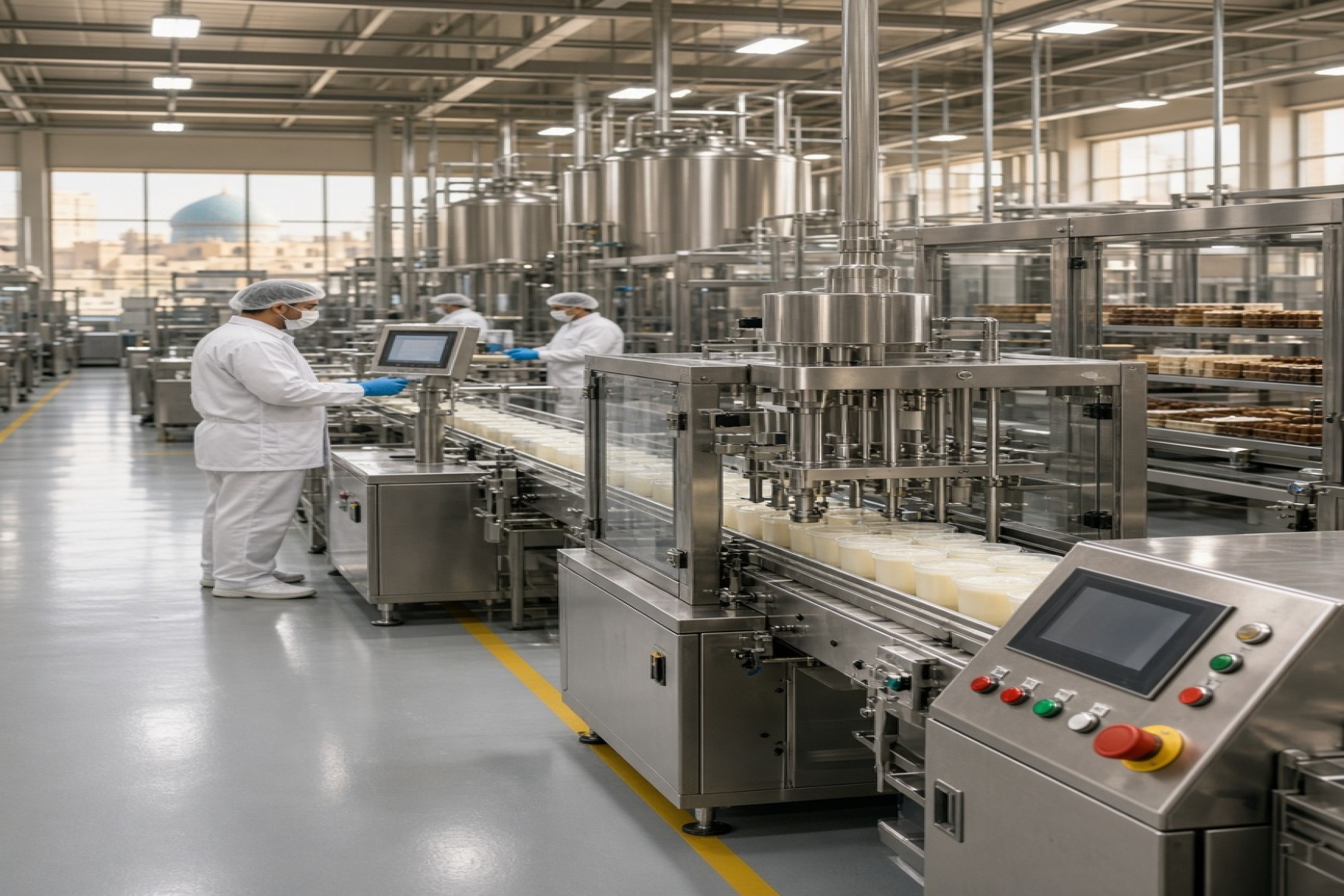
Major dairy and confectionery plants operate in Jey, including Kalleh Dairy, Kermani Gaz Factory, Asalat Food Industries, Farrokhi Biscuits, Shahdineh Aran and Naji Food Industries. These units use automated production machinery and modern packaging lines to support Isfahan’s dairy and sweets supply chain. Kalleh Dairy — one of Iran’s leading brands — is located here with advanced dairy production lines.
Greater Isfahan Industrial Park
At about 1,860 hectares, this is the province’s largest and one of the country’s biggest industrial parks. Located at the northern entrance to Isfahan (Tehran–Qom–Isfahan route) with more than 1,100 active industrial units, its main sectors include metals, compressed-air tanks, hall construction and some heavy food industries.
Although metals dominate, food packaging and processing units — such as cold-room components and meat packaging — are also present. Direct access to the Tehran–Qom–Isfahan freeway and North Isfahan railway station provides strong transport infrastructure for export and distribution.
Morch-e-khort & Razi Industrial Parks
These two parks lie on the Shahin Shahr–Shahreza axis and concentrate modern food and pharmaceutical industries. Morch-e-khort, close to the main Tehran–Isfahan route, is well suited for food processing and aseptic packaging plants. Vegetable oil production and canning units (oil mills and dried-fruit packaging) operate here.
Razi, near Shahreza, hosts mainly chemical and pharmaceutical industries, with several dietary supplement and pharmaceutical manufacturers. Edible oil processing (sesame and vegetable oils) and can/tin packaging lines are visible in these areas. Road links provide easy access to other provinces and domestic markets.
Gaz, Poolaki & Nabat Cluster
Traditional Isfahani sweets — Gaz, Poolaki and Nabat — are produced across workshops and small factories. Units typically automate cooking and cooling stages and use metallized packaging to preserve moisture and shelf life. Well-known brands such as Kermani Gaz, Mozaffari Gaz, Poolaki Shahkar and Farrokhi Sugar Boilers produce to food safety standards.
The traditional sweets cluster, with strong exports to Persian Gulf countries, focuses on export-grade packaging and Halal certification — especially GSO standards for Gulf markets.
3. Isfahan Food Production Poles Matrix
| Cluster / Industrial Park | Main Food Sector | Key Brands | Transport Infrastructure | Wholesale Destinations |
|---|---|---|---|---|
| Jey Industrial Park (Isfahan) | Milk & dairy; sweets & Gaz | Kalleh, Kermani, Asalat, Farrokhi | Isfahan–Tehran freeway; Tehran–Isfahan railway; near Shahid Beheshti Airport | Domestic (Tehran, Isfahan) & Gulf exports |
| Greater Isfahan Industrial Park | Meat & meat processing (livestock) | Livestock & slaughter units | Tehran–Qom–Isfahan freeway; railway; provincial rail network | Domestic (major cities) |
| Morch-e-khort & Razi (Shahin Shahr) | Vegetable oil, aseptic packaging, pharma | Processing & pharmaceutical industries | Near Isfahan–Tehran route; regional roads | Domestic & Persian Gulf |
| Gaz & Nabat Cluster (Isfahan) | Traditional sweets (Gaz, Poolaki, Nabat) | Kermani, Mozaffari, Farrokhi, Shakri | Urban road freight & port exports | Gulf exports & domestic market |
4. Industrial Livestock Infrastructure & Raw Milk Quality
Isfahan hosts several of Iran’s largest industrial dairy and cattle farms. Qiam Isfahan Cultivation & Livestock on the Isfahan–Tehran road (km 9, Dehq road) operates 10,000 breeding cattle and produces over 170 tonnes of raw milk daily. Using advanced technology (fully automatic milking and on-site feed mill) and 500 hectares of farmland, it guarantees high-protein raw milk with low microbial load.
Goldasht Namune Isfahan (Qaleh Khajeh area) produces about 100 tonnes of milk daily with modern feeding and wastewater systems, ranking among national dairy supply leaders. Such large-scale livestock infrastructure makes Isfahan raw milk known for high protein and low microbial load — essential for milk powder, cheese and protein products.
- Qiam Isfahan: 170+ tonnes raw milk/day — high protein, low microbial load
- Goldasht Namune: ~100 tonnes milk/day — modern feeding & wastewater management
- Dairy chain: Supplies milk powder, filtered cheese and export protein products
5. Water Scarcity & Recycling in Factories
Isfahan Province faces water scarcity, and food industries rely on treatment and water-recycling technologies. Many plants install advanced reverse osmosis (RO) on production wastewater for desalination and reuse. A second recycling phase on cooling lines and boilers yields significant water savings.
Dairy plants, for example, rotate cooling water and reuse treated streams to minimize water per kilogram of processed milk. Closed-loop water in washing and cooling has become an operational standard in Isfahan factories so the food industry can cope with water constraints.
6. Export Capacity: Traditional & Dairy Products
Traditional Isfahani products — especially low-moisture Gaz, Poolaki and Nabat — have found strong markets in Persian Gulf countries. Export packaging uses moisture-resistant materials such as metallized films. Halal certification and Gulf Standardization Organization (GSO) compliance are mandatory for branding and trust in neighboring markets.
Gaz producers with Halal and GSO certificates export to Iraq, Kuwait and the UAE. Rising regional demand for milk powder and filtered cheese also drives export packaging upgrades and cold-chain logistics on international routes. Export packaging and international certificates remain key requirements for expanding Isfahan food exports.
7. FAQ for Wholesale Buyers & Suppliers
Q: How does toll manufacturing work for snack and oil plants?
Many Isfahan snack and vegetable-oil factories sell bulk through contract/toll (commission) arrangements: the buyer funds initial production and pays a commission after sale. Minimum orders often start at several tonnes; commission and payment terms are agreed bilaterally. Plants guarantee quality standards and factory-label pricing without intermediary markup.
Q: How can I access multi-purpose cold storage capacity?
Major Isfahan food companies usually operate advanced multi-purpose cold stores that can hold purchased goods until delivery. Wholesale buyers can reserve space through the factory supply or warehouse manager. Some plants also offer cold storage for rent or via logistics partners for wholesale traders.
Q: What is the minimum order for industrial or traditional Gaz cartons?
Gaz is packed in multi-kilogram cartons; minimum orders are typically several thousand bite-size pieces per order (e.g. about 20 cartons of 10 kg). Some plants set weight minimums for first orders (e.g. 100 kg), but lower volumes are often possible by arrangement. Buyers should confirm carton counts and weights with sales before bulk ordering.
Q: How do I request milk powder or other dairy prices?
Bulk dairy prices follow global and domestic cost drivers. For daily quotes, buyers can use official factory sites or B2B platforms such as Iranco and submit a price inquiry form. Sales teams usually respond quickly with factory price (no intermediary) and delivery terms. Direct contact with factory sales remains common for updated price lists.
8. Price Inquiry & Bulk Ordering on Iranco
Iranco provides a direct bulk-order gateway connecting wholesalers, cash-and-carry traders and distributors with commercial managers at Isfahan food factories. To place a bulk order, visit the product profile on Iranco and submit your request online — it goes straight to the factory. Factory prices are transparent and orders are routed without intermediary interference, so buyers can see updated prices and order in a few clicks.
Sources: This article is based on official Isfahan industrial park reports, economic news and industry data. Tables and analysis use statistics from relevant websites.
Related Articles



