 Iranco Magazine Team
A practical guide to carcass weight, product temperature, slaughter date, free drip, visual quality, packaging, sampling, lot acceptance and cold chain for Iranian chicken exports to Iraq
Technical Guide · Poultry Export · Iraq
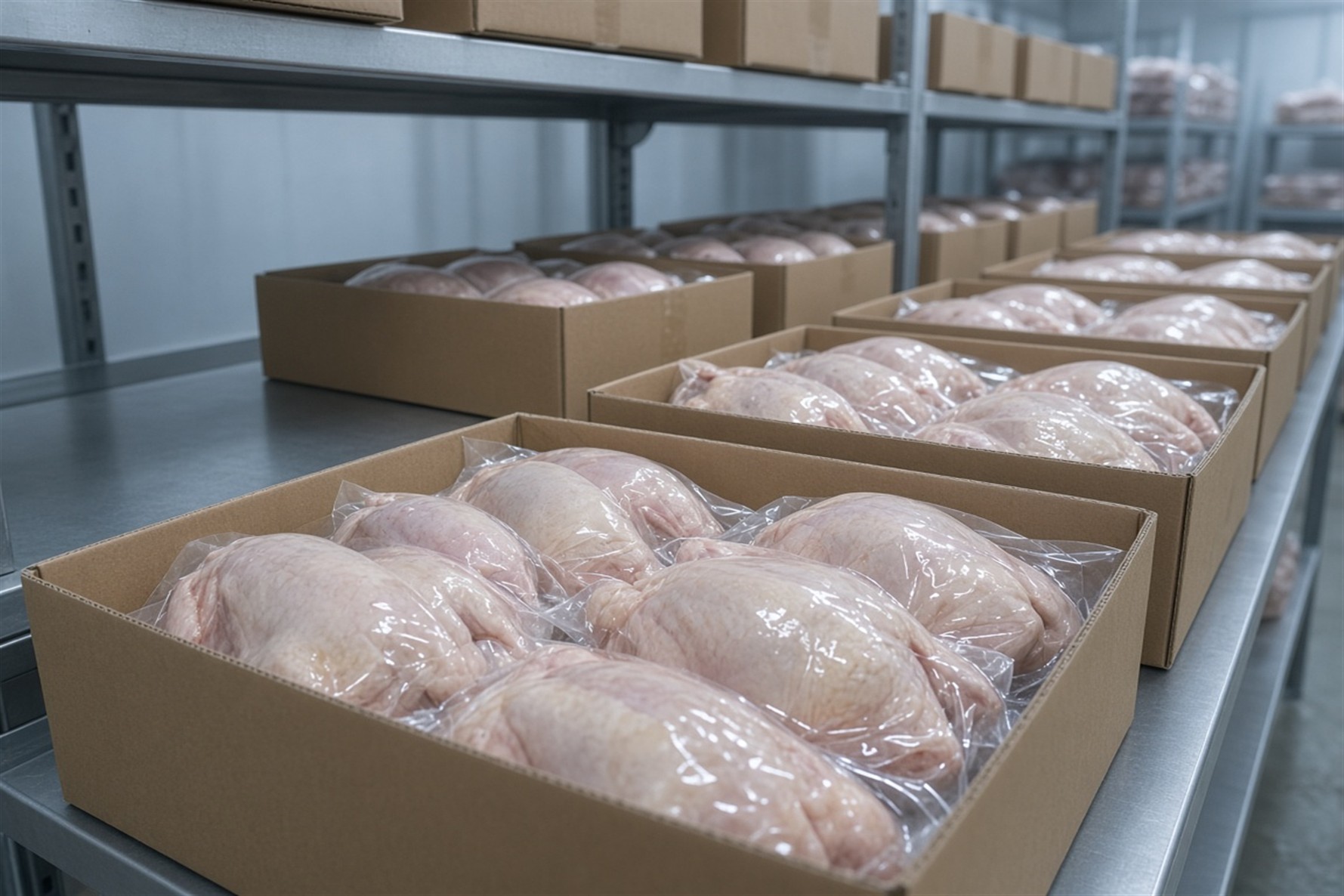
Recommended Technical Specifications for Ordering Fresh Chilled Whole Chicken from Iran — From Sample to Contract
A practical guide to defining carcass weight, product temperature, slaughter date, free drip, visual quality, packaging, sampling, shipment acceptance and cold chain management for export orders of Iranian chicken to Iraq — published in the Iranco Magazine.
Export purchasing of fresh chilled whole chicken becomes controllable only when product quality moves from a vague phrase such as "grade-one chicken" to a set of measurable specifications and clear acceptance criteria. This guide provides a practical framework for preparing purchase specifications, evaluating samples, controlling shipments, packaging and cold chain management, with the Iraq market examined as an established regional route.
2024 Trade Data — Iraq Whole Fresh/Chilled Chicken
In 2024 trade statistics, Iraq recorded approximately 1.84 million kg of imports under the legacy HS statistical category for "whole fresh or chilled chicken", of which more than one million kg was reported from Iran. This data shows that the Iraqi market for fresh and chilled product is not merely a potential market — it has documented commercial flows from Iran.
Fresh chilled whole chicken is one of those products where the gap between a "good sample" and an "acceptable commercial shipment" can be very wide. Two carcasses may look similar at first glance, yet differences in weight, core temperature, time since slaughter, free drip inside the pack, skin condition, offal removal quality, bag seal integrity and transport temperature history can completely change their real value to the buyer.
This issue matters even more in regional export. Unlike frozen chicken, chilled product has limited room to recover from delay, border hold-ups or cold chain disruption. A purchase contract should therefore specify not only quantity, price and destination, but also what product is accepted, how it is controlled and under what conditions the buyer may reject or demand correction.
Under Iranian veterinary regulations, "fresh chilled chicken meat" is defined as product slaughtered, packed and marked in an authorised industrial abattoir, cooled after slaughter to 0 to 4°C, and transported and stored within the same range. This definition turns temperature from a secondary attribute into a core part of product identity.
From a market perspective, Iraq also has practical importance for Iranian chicken. 2024 trade data for the broader HS group of poultry meat and edible offal shows Iraq imported approximately 134.5 million kg, with Iran among recorded origins alongside countries such as Brazil and Turkey. However, Iran's geographic advantage becomes a commercial advantage only when slaughter, pre-chilling, packing, cold store release, road transport and border delivery are managed as one continuous chain.
What a professional buyer needs is a purchase specification sheet — a document that converts quality from preference into measurable criteria.
1. What Exactly Should Fresh Chilled Whole Chicken Be?
Before any price negotiation, the product definition must be clear. The phrase "whole chicken" alone is not enough. The status of head, feet, neck, edible offal, evisceration method, packaging and thermal state must all be specified.
Under Iranian veterinary regulations, whole chicken refers to the slaughtered bird body without head, feet, feathers and internal organs. For export orders, these components should likewise be defined contractually and without ambiguity.
In international classification, domestic fowl of the species Gallus domesticus, not cut in pieces and presented fresh or chilled, falls under the current six-digit HS code 020711.
Fresh and Chilled vs Frozen
In chilled chicken trade, product must not reach the frozen stage. Terms such as "fresh chicken", "chilled chicken" and "refrigerated chicken" should therefore be accompanied by a temperature definition in the contract.
For Iranian product, the range of 0 to 4°C is a reliable technical basis for transport and storage of fresh chilled chicken. Target temperature should be reached after slaughter and the cold chain maintained until consumption or the next handover.
This is especially important for exports to Iraq. Shorter geographic distance alone does not guarantee quality. Product left for several hours on a warm loading dock may arrive in worse condition than a shipment that travelled farther but maintained stable temperature throughout.
Recommended Contract Product Definition
| Element | What Must Be Specified in the Order |
|---|---|
| Species | Domestic fowl |
| Product form | Whole carcass, not cut in pieces |
| Thermal state | Fresh and chilled, not frozen |
| Head and feet | Exact status to be stated |
| Neck and offal | Presence or absence to be specified |
| Weight | Target weight or defined weight class |
| Packaging | Primary pack type and master carton |
| Temperature | Permitted delivery and transport range |
| Date | Slaughter or production date and time |
| Destination | City, border point or delivery location in Iraq |
A common mistake is reviewing all these details only after price is agreed. In practice, price without technical specifications has limited meaning, because two offers may differ fundamentally in carcass weight, freshness, packaging and delivery conditions.
2. Recommended Technical Specification Sheet for Chilled Whole Chicken Orders
The purchase specification sheet should be capable of becoming a direct contract annex. The key principle is that for each parameter it must state what is measured, how it is controlled and what happens in case of non-conformance.
| Parameter | Recommended Contract Specification | Why It Matters |
|---|---|---|
| Product form | Whole carcass, not cut in pieces | Prevents disputes over product definition |
| Carcass weight | Target weight or agreed weight groups | Pack uniformity and market acceptability |
| Thermal state | Fresh and chilled | Separation from frozen or semi-frozen product |
| Product temperature | Within 0 to 4°C | Safety and cold chain control |
| Slaughter date | Accurate and traceable marking | Assessment of real freshness |
| Delivery timing | Defined relative to slaughter date | Management of remaining commercial shelf life |
| Skin appearance | Intact, clean and per agreed standard | Retail and wholesale acceptance |
| Feather residue | Acceptance limit defined contractually | Visual quality |
| Breakage or damage | Acceptance criteria specified | Waste reduction |
| Free drip | Assessment method and acceptance criteria defined | Prevents quality loss and weight disputes |
| Odour | Natural, without abnormal smell | Early indicator of spoilage or poor storage |
| Primary pack | Material, thickness and seal type specified | Leak prevention |
| Master carton | Adequate strength for cold environment | Transport damage reduction |
| Labelling | Origin, weight, date and other required data | Traceability and customs clearance |
| Cold chain | Temperature logging and monitoring in transit | Evidence of storage conditions |
This table must be completed for each contract. For example, there is no universal "appropriate weight". The ideal weight depends on sales channel, consumption habits, unit price, pack type and the Iraqi buyer's order profile.
3. Carcass Weight — Why Average Weight Is Not Enough
Weight is one of the main sources of discrepancy between sample and shipment. The sample sent may be exactly the buyer's preferred size, while the main shipment includes a wide spread of weights.
The buyer should not simply write "chicken at approximate desired weight". Three matters must be defined separately:
Target Weight
The weight the buyer's market prefers for each carcass should be defined from the outset. If the buyer wants several weight groups, each group should have its own order, price or allocation ratio.
Weight Tolerance
Both parties should agree how much deviation from the weight class is acceptable and how it is measured. Tolerance should not be set after production or at inspection.
Weighing Method
The weighing method also matters. The contract should specify:
- Whether weight refers to the bare carcass or includes packaging;
- How neck or packed offal is counted in the weight;
- At which stage weighing is performed;
- How the scale used is verified;
- How weight samples are selected from the shipment.
Restaurant and wholesale buyers usually lose margin when weight dispersion is high. For retail, wide weight variation also disrupts unit pricing and shelf presentation. Instead of "average shipment weight", the contract should focus on weight distribution.
4. Temperature and Slaughter Date — Two Core Measures of Chilled Chicken Value
In fresh chilled chicken, temperature is not merely a number at delivery — temperature history matters more. Product may be within range at final inspection yet have spent several hours outside the cold chain beforehand.
Iranian veterinary regulations require cooling after slaughter and transport and storage of fresh chilled chicken meat within 0 to 4°C.
Product Temperature Control
The contract should preferably specify:
- Which part of the product is measured;
- Which calibrated instrument is used;
- How many points in the load are checked;
- That samples are taken from the front, middle and rear of the load;
- That vehicle air temperature is recorded separately from product temperature;
- That route temperature loggers, if agreed, form part of delivery documentation.
Measuring only container or truck air is not enough. Cold store air temperature can be acceptable while part of the product is not yet fully chilled.
Slaughter Date Matters More Than the Word "Fresh"
"Fresh" is a marketing description. Slaughter date and time are controllable data. In export contracts, at minimum the following should be traceable:
- Slaughter date;
- Batch or production lot number;
- Packing date;
- Cold store release time;
- Loading date;
- Planned delivery date.
This allows the buyer to assess remaining product life at delivery.
Why Is the Iraq Route Sensitive?
Land proximity between Iran and Iraq can be an advantage for chilled goods because potential transit time is shorter than from distant origins. However, customs hold, cargo transfer, border waiting and documentation delays can erase that advantage. The chilled chicken transport plan should therefore start at slaughter, not when the truck departs.
5. Free Drip — A Parameter That Must Not Be Overlooked
Some moisture in raw meat packs is natural, but excessive free liquid can signal processing, storage or product condition problems for the buyer.
Free drip matters in several ways:
- It makes the pack look unappealing;
- It can trigger retail complaints;
- It reduces usable product weight for the buyer;
- It may indicate poor chilling or storage management;
- Leakage can contaminate master cartons and other packs.
How to Define Free Drip Contractually
Writing "no water" is usually not an adequate technical definition. Both parties should agree a specific assessment method. For example, they may agree that packs are examined after being placed in a defined condition and that free liquid volume or the number of packs with abnormal accumulation is recorded. The exact method, observation time and acceptance criteria should be identical on the reference sample and in the contract.
If the buyer requires a weight-based test, the method for separating liquid, drain time, temperature conditions and calculation basis must be approved before contracting.
The key point is that the free drip criterion must be repeatable. Phrases such as "not too much water" are almost impossible to enforce in commercial disputes.
6. Visual Quality — What Should a Good Sample Look Like?
Sensory and visual assessment remains one of the fastest acceptance steps for whole chicken, but it must move away from subjective judgement.
Items to Check on the Sample
The carcass should be evaluated for:
- Surface cleanliness;
- Skin integrity;
- Tears;
- Visible breakage;
- Bruising;
- Abnormal spots;
- Feather residue;
- Prohibited offal residue or visible contamination;
- Abnormal odour;
- Quality of abdominal cavity evisceration;
- Abnormal liquid accumulation;
- Pack condition.
| Defect Type | Control Method | Suggested Decision Approach |
|---|---|---|
| Skin tear | Direct observation | Classify as minor or major defect in contract |
| Bruising | Observation and location/extent assessment | Acceptance criteria defined in advance |
| Feather residue | Count or sample evaluation | Contractual limit |
| Visible contamination | Observation | Classified as serious defect group |
| Abnormal odour | Sensory evaluation | Reject suspicious sample pending review |
| Breakage | Observation or touch | Classified by target market |
| Excessive free drip | Agreed method | Recorded quantitatively or by pack count |
| Pack leak | Observation | Recorded as packaging defect |
| Incomplete label | Document check | Separate critical error from correctable error |
The best approach is for buyer and seller to maintain an approved reference sample. Photos are useful, but photos alone cannot show temperature, odour, weight or free drip level.
7. Packaging — Part of Product Specification, Not a Side Issue
For export chilled chicken, packaging is not a simple task. It must keep product in a cold, humid environment, prevent leakage, allow stacking and withstand road handling.
Primary Pack
The primary pack must be suitable for food contact and maintain performance at cold-store temperature. The contract should at minimum specify:
- Pack type;
- Closure method;
- Vacuum or standard pack status, if applicable;
- Print or label;
- Date marking location;
- Product visibility if required by the market;
- Leak resistance.
Master Carton
Cartons must bear internal pack weight in cold, humid conditions. Loss of carton strength from moisture is a major cause of load deformation in road transport. Important carton information includes:
- Number of carcasses or packs;
- Net weight;
- Gross weight if required;
- Batch number;
- Production or slaughter date;
- Product name;
- Country of origin;
- Storage conditions;
- Buyer or destination regulatory information.
Stacking and Air Circulation
International meat hygiene principles emphasise that product in cold rooms must be stored to allow air circulation and control cross-contamination from drips and condensate. Overfilling a refrigerated truck or blocking cold air paths can create warm spots in the load even when the refrigeration system is functioning.
8. From Initial Sample to Shipment Approval — How Should Sampling Be Designed?
The biggest buyer mistake is treating an approved sample as equivalent to a guarantee for the entire shipment. A sample has contractual value only when its link to commercial production is clear.
A professional process can have four stages.
Stage 1: Commercial Sample
The seller provides a sample from actual production. Ideally the sample comes from the intended export line and packaging, not product prepared separately for presentation. At this stage weight, carcass shape, appearance, free drip, packaging, label, temperature and sensory quality are reviewed.
Stage 2: Reference Sample
After approval, sample specifications are recorded on a sheet. Standard photos, weight, pack information, slaughter date and agreed test results can be attached. The goal is not for every carcass to look identical, but to define an acceptable quality level.
Stage 3: Commercial Production Sampling
For the main shipment, samples must be taken from different points in the batch or load. Taking a few cartons from the truck door cannot represent the whole shipment. In large contracts, statistical sampling plans such as ISO 2859-1 frameworks for attribute inspection or general food sampling guidelines may be used, provided inspection level, defect definition and acceptance criteria are agreed in advance.
Stage 4: Delivery Sampling
For chilled goods, destination control is not merely a repeat of origin control. Product temperature, pack integrity and load condition after transport must be re-checked.
| Stage | Primary Controls |
|---|---|
| Before contract | Product and pack sample |
| Production start | Line conformity with sample |
| Before loading | Weight, appearance, temperature, pack and label |
| During loading | Truck condition and temperature logging |
| At delivery | Load temperature, transport damage, leakage and documents |
9. How to Write Shipment Acceptance Criteria
Technical specifications without acceptance criteria are incomplete. If the contract only says "product must match sample", determining the outcome in a dispute becomes difficult.
For each characteristic, one of three statuses should be clear:
- Definitive criterion: Such as product type, fresh or chilled state, essential identity characteristics or mandatory documents.
- Tolerance-based criterion: Such as weight, certain visual defects or dimensional spread.
- Correctable criterion: Such as part of carton information that can legally be corrected before clearance under specific conditions.
Critical, Major and Minor Defects
An effective method is defect classification. A critical defect may disrupt safety, product identity or legal entry eligibility. A major defect seriously reduces commercial quality or saleability. A minor defect moves product away from ideal specification but does not remove primary usability. Both parties should agree before production which category each defect falls into and what happens when acceptance limits are exceeded.
Contractual Actions for Non-Conformance
Contractual options may include:
- Shipment rejection;
- Segregation of non-conforming portion;
- Pack or label correction before delivery, if legally permitted;
- Commercial renegotiation for non-safety defects;
- Joint inspection;
- Referral of sample to agreed laboratory.
In food safety or veterinary compliance areas, price discount must not replace legal conformity.
10. Export of Iranian Chilled Chicken to Iraq — Market Opportunity and Practical Requirements
The Iraq market is one case where Iran's geographic proximity can create a practical advantage for chilled product. Trade data confirms this.
In 2024, Iraq recorded approximately 134.5 million kg of imports for the full HS 0207 group covering fresh, chilled or frozen poultry meat and edible offal, valued at over USD 392 million. In this group, Brazil, Turkey, Iran, the United States and Ukraine were among the main recorded origins. Reported imports from Iran totalled approximately 15.1 million kg.
For the statistical sub-category of whole fresh or chilled chicken, Iraq recorded approximately 1.84 million kg of imports in the same year. Approximately 1.04 million kg of this was reported from Iran, with Turkey and Brazil also among recorded suppliers.
This data tells the buyer two things. First, Iran has real trade history in this market. Second, competition is not on price alone — Iranian product must compete on quality, uniformity, freshness and reliable delivery.
Import Licences and Destination Control
For poultry products, the importer must verify import licence status and current requirements of Iraqi health authorities before shipment. Export guidance published for Iraq also emphasises obtaining necessary permits from competent Iraqi authorities before poultry export.
Iraq has simultaneously expanded control of imported goods conformity. In 2026, the Central Organisation for Standardisation and Quality Control of Iraq announced continued inspection, sampling, testing and conformity certification at entry points, as well as development of systems for registering suppliers and imported goods.
Commercial chicken orders should therefore not be loaded before the Iraqi importer confirms the latest permits, veterinary documents and quality control requirements.
Health Certificates
Exported animal product must carry health and veterinary documents acceptable to the destination country. In Iran, issuance of export health certificates for products under veterinary supervision is part of the official export mechanism. For halal chicken, slaughter method and certificate acceptance by buyer and destination authority should also be clarified before ordering.
11. Cold Chain Management from Slaughterhouse to Iraqi Customer
In chilled chicken, product quality at slaughter is only the starting point. The cold chain should be designed as one integrated process.
Pre-Chilling
The aim is to bring product to the appropriate cold range after slaughter and stabilise thermal condition before loading. Loading product that still carries high initial heat can consume refrigerated truck capacity. A refrigerated truck is designed essentially to maintain cold load temperature, not to fully replace product chilling.
Origin Cold Store
Product must be stacked to avoid blocking air circulation. Condensate control, drip management and inappropriate pack contact with contaminated surfaces matter. These principles are also emphasised in international meat hygiene regulations.
Loading
Before product entry, transport space condition must be checked: cleanliness; wall and floor integrity; refrigeration system performance; absence of odour or contamination from previous load; adequate air circulation; readiness of temperature logger if agreed. Prolonged door opening during loading can also admit heat.
Land Route and Border
For exports to Iraq, route time should include a margin for potential border delay. A plan that considers only "driving time" is insufficient for chilled chicken. Documents should be ready before the load arrives. Every unnecessary stop consumes part of the product's commercial life.
Delivery
At unloading, before fully opening the load, the following should be recorded: seal condition; route temperature log; compartment air temperature; sample product temperatures; presence of leakage; carton condition; batch number and document match.
Importer Checklist Before Placing an Order
Before issuing a purchase order, a professional buyer should confirm at minimum the following:
- Record the precise definition of whole chicken and included or removed components.
- Define fresh and chilled product by temperature.
- Specify carcass weight or weight groups.
- Set weight tolerance in advance.
- Define slaughter date and recording method.
- Define maximum acceptable time between slaughter and delivery in the contract.
- Record criteria for skin condition, bruising, breakage and feather residue.
- Have an agreed assessment method for free drip.
- Obtain and approve a real commercial sample.
- Document approved sample specifications in writing.
- Confirm primary pack type and sealing method.
- Define number or weight of packs per master carton.
- Align label language and content with Iraq regulations.
- Approve sampling plan and shipment acceptance criteria before production.
- Verify required veterinary and health documents with the Iraqi importer.
- Confirm destination import licence status before loading.
- Specify transport temperature logging and control method.
- Define each party's responsibility in case of border delay.
- Specify exact point of risk transfer and goods delivery under commercial terms.
- Include dispute resolution method and agreed laboratory or inspector in the contract.
12. How to Compare Chilled Whole Chicken Prices
Price per kilogram alone is not a suitable basis for comparing two offers. The buyer should review at minimum these factors simultaneously:
| Factor | Commercial Impact |
|---|---|
| Weight group | Affects sales channel and unit price |
| Weight uniformity | Changes sorting effort and waste |
| Slaughter date | Determines remaining selling life |
| Free drip | Affects usable weight and pack appearance |
| Pack type | Affects waste and leakage |
| Units per carton | Changes handling and warehouse cost |
| Inspection | Changes cost and dispute risk |
| Delivery terms | Determines which costs are in the price |
| Distance and border | Affects chilled transport cost |
| Destination documents | Part of export compliance cost |
One seller's initial price may be lower, but weight dispersion, free drip, short remaining life or higher pack damage rate can increase the buyer's real cost. For professional comparison, offers should be requested against one unified technical specification. Through Iranco, buyers can submit requests with weight, pack type, order volume, destination and other technical criteria so sourcing options are reviewed on a comparable basis.
What Information Should Be Sent to Obtain an Accurate Price?
A chilled chicken price request that only says "price for one tonne of chicken for Iraq" will not necessarily yield comparable responses. A price request should include at minimum:
- Fresh chilled whole chicken;
- Desired weight or weight class;
- Status of head, feet, neck and offal;
- Approximate order volume;
- Number of shipments or purchase schedule;
- Primary pack type;
- Carton count or weight;
- Label type;
- Producer brand or private label if required;
- Desired visual criteria;
- Free drip requirements;
- Required tests;
- Halal certificate requirement;
- Destination country;
- Delivery city or border point;
- Commercial delivery terms;
- Transport method;
- Preferred delivery timing.
Without this information, the response is more likely an indicative price than a reliable commercial offer.
13. From Sample to Contract — Recommended Order Structure
A suitable contract can place technical specifications in a separate annex.
Part 1: Product Definition
Name, type, product form, chilled state, carcass component status and tariff code.
Part 2: Quantitative Criteria
Weight, quantity, weighing method and agreed tolerances.
Part 3: Quality Criteria
Appearance, free drip, carcass condition, defects, pack and label.
Part 4: Temperature and Timing
Temperature range, slaughter date, loading time and delivery criteria.
Part 5: Sampling
Sampling location, selection method, sample count per agreed plan and inspector responsibility.
Part 6: Documents
Health, veterinary and halal certificates if required, origin documents and other destination paperwork.
Part 7: Non-Conformance
Complaint recording method, notification time, re-sampling procedure and enforceable outcome.
Many export disputes arise not from poor product but from ambiguity in these very sections.
14. Sourcing Export Fresh Chilled Whole Chicken from Iran via Iranco
In international chilled chicken purchasing, the main stage begins before finding a seller: the buyer must define required product in measurable terms.
Two producers may both offer "chilled whole chicken", yet differ in carcass weight, uniformity, slaughter date, packaging type, free drip, visual quality and delivery conditions. Receiving several prices without a common specification usually leads to incorrect comparison.
Iranco (Iranco.com) can serve as a channel for submitting purchase requests for Iranian food products. Buyers can specify product type, weight group, order volume, packaging format, destination market and required criteria so sourcing options are reviewed against the same need.
For chilled chicken orders to Iraq, delivery timing, destination border or city, transport type, label specifications and document requirements should be included from the outset. Samples should also be prepared against the same specifications intended for commercial production.
If the goal is continuous supply, the first order should not be viewed merely as a goods purchase — it should serve as a test of production uniformity, pack quality, cold chain discipline and supplier delivery capability.
- Chilled chicken sourcing: Connection to producers and suppliers with measurable specifications and supporting documentation.
- Contractual specifications: Defining weight, temperature, packaging and quality ranges in the purchase request.
- Sample coordination: Arranging sample receipt before commercial order.
- Continuous supply: Evaluating quality consistency for repeat orders.
Summary
Technical specifications for ordering fresh chilled whole chicken should answer one simple question: "At the moment of delivery, how can we determine without personal interpretation that the seller has delivered exactly what the buyer ordered?"
To reach that point, phrases such as "grade-one chicken", "export quality" and "good packaging" are not enough. Carcass weight, product temperature, slaughter date, free drip, visual defects, pack integrity, sampling method and acceptance criteria must be defined before production.
For Iranian chilled product, the 0 to 4°C range is a key cold chain basis. On the Iraq route, Iran's geographic advantage gains economic value only when product is chilled quickly after slaughter, placed in appropriate packaging and delivered without cold chain failure.
Trade data also shows Iraq is a real market for whole fresh or chilled chicken and Iran has presence in recorded trade for this product. That history does not replace contractual technical analysis — on the contrary, the more operational the market, the more important product uniformity and document control become.
For a professional buyer, price negotiation is not the best starting point. Product specifications should be written first, then the sample approved on that basis, and only then should contract, inspection and acceptance criteria be linked to the same specifications. This simple sequence reduces much of the risk of discrepancy between sample, shipment and delivered goods.
Frequently Asked Questions
Does the 0 to 4°C temperature range have contractual importance for Iranian chilled chicken?
Yes. Under Iranian veterinary regulations, fresh chilled chicken meat is product cooled after slaughter to 0 to 4°C and transported and stored within the same range. Buyers should therefore include temperature control in purchase specifications and inspection plans, not rely only on truck air temperature at unloading.
What is the tariff code for whole fresh or chilled chicken?
For domestic fowl of the species Gallus domesticus, whole, not cut in pieces, fresh or chilled, the six-digit HS subheading 020711 applies. This code differs from frozen whole chicken and from fresh or chilled cuts. Exact product specification should be aligned with commercial documents and classification used in the destination country before customs declaration.
Does Iraq actually import chilled whole chicken from Iran?
In 2024 trade data for the statistical category "whole fresh or chilled chicken", Iraq recorded approximately 1.84 million kg of imports, of which approximately 1.04 million kg was reported from Iran. Turkey and Brazil were also among suppliers that year. This route therefore has documented commercial trade and is not merely a hypothetical market.
What is the most important characteristic to check on a chilled chicken sample?
No single parameter is enough. Weight, temperature, slaughter date, skin condition, free drip, odour, evisceration quality and packaging should be checked together. Sample results should also be recorded on a specification sheet, because verbal approval of "good quality" is not an adequate basis for accepting several tonnes of commercial product.
How should water inside the chicken pack be controlled?
The free drip criterion must be defined with a specific, repeatable method. Buyer and seller can agree an observation or measurement method and apply it to the reference sample. The important point is converting vague phrases such as "not too much water" into a measurable criterion or contractual acceptance limit.
Is checking truck air temperature sufficient for chicken acceptance?
No. Compartment air temperature is only part of cold chain information. For proper assessment, product temperature itself must be checked at different points in the load. Route temperature logging, pre-chilling status and load stacking can also help determine whether the cold chain was truly maintained.
Is an approved sample sufficient to guarantee shipment quality?
No. The sample must be linked to a specification sheet, sampling plan and acceptance criteria. Otherwise the seller may provide a suitable sample while the shipment differs in weight dispersion or defects. A reference sample is effective only when the method for comparing shipment against it is defined in advance.
What information is needed to obtain a price for Iranian chilled chicken?
At minimum, product type, weight or weight class, order quantity, head/feet/offal status, pack type, carton count or weight, destination, transport method, delivery location and quality requirements should be specified. For Iraq orders, destination border or city and document needs should also be stated. This information can be included in an Iranco purchase request so sourcing options are reviewed against actual order specifications.
What should be confirmed with the importer before sending chilled chicken to Iraq?
Import licence status, veterinary requirements, health documents, labelling requirements and quality control procedures must be confirmed before loading. Official guidance on poultry entry to Iraq also emphasises coordination between exporter and importer and obtaining necessary permits from competent authorities before export.
Featured Products
Related Articles



