 Iranco Magazine Team
Commercial atlas for bulk shrimp, aseptic paste, sugar, export dates and southern port access
B2B Industry Atlas
Food Factories in Southern Iran: Bushehr, Hormozgan, Fars & Khuzestan
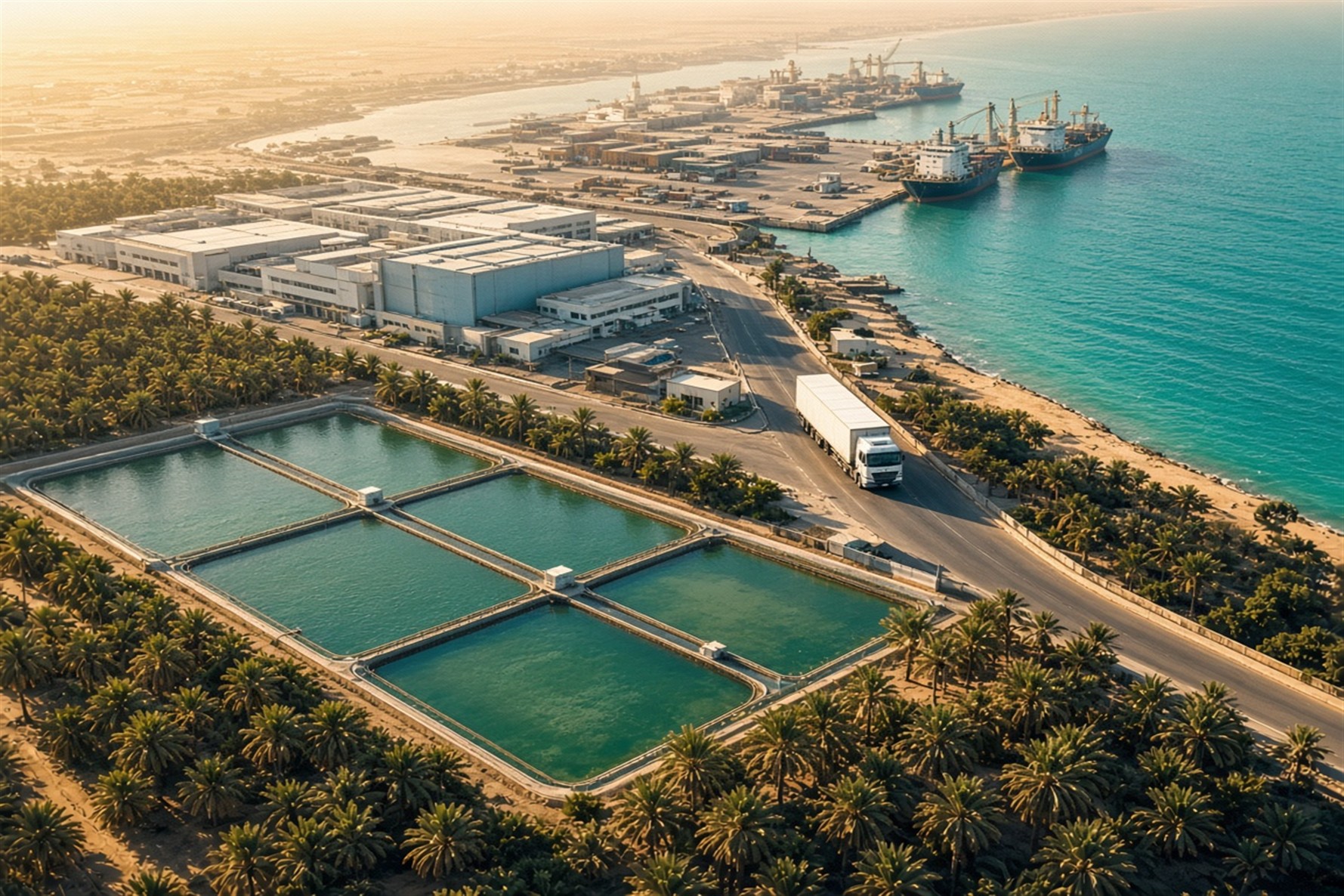
Southern Iran is not merely an agricultural or fisheries production zone — in practice it is a continuous chain from farms and palm groves through shrimp ponds, processing plants, cold stores, packaging units, road haulage and commercial ports. This atlas maps real capacity, export gateways and pre-shipment controls across four key provinces for bulk buyers, Gulf importers and distributors.
Why "southern Iran food factories" is not a simple list
For professional buyers, real purchasing decisions rest on delivery capacity, specification consistency, private-label capability, health certificates, sustained supply, distance to port, cold-chain quality and settlement terms. In food trade, even a lower factory price can make a supplier more expensive overall if cargo cannot reach the port on time with correct documents and stable quality.
- Fars: Marvdasht tomato paste and processing cluster — roughly 60% of provincial paste capacity.
- Khuzestan: Large-scale sugarcane and Stamaran date industries.
- Bushehr: Vannamei shrimp farming and Kabkab dates — a dual seafood and palm advantage.
- Hormozgan: Seafood, canned tuna and Piarom dates — proximity to Bandar Abbas and Shahid Rajaee.
Commercial geography and maritime access
The four provinces sit along one of Iran's most important food production and export corridors, yet each has a different port advantage. Hormozgan benefits from Bandar Abbas and Shahid Rajaee; Bushehr has direct coastal access; Khuzestan links to Khorramshahr and other Khuzestan ports; and Fars, though landlocked, can route via Bushehr or Hormozgan ports depending on destination and sailing schedule.
For Gulf trade, the value lies in shortening the inland factory-to-coast leg and consolidating loads for the UAE, Qatar and Oman. For temperature-sensitive products such as frozen shrimp, reducing time from cold store exit to port terminal directly affects cold-chain risk.
The four production hubs
Fars — Marvdasht: tomato paste and processing hub
Provincial reports cite 38 tomato paste units in Marvdasht, 33 active, with nominal capacity of about 139,600 tonnes per year — roughly 60% of Fars paste capacity. Some lines are equipped with aseptic systems for longer shelf life and export.
Importers can compare several producers in one geographic cluster on equal specs: soluble solids, colour, viscosity, salt, mould count, microbiology, aseptic bag type, net weight, season and production date. Codex provides an independent product framework for processed tomato concentrate.
Khuzestan — industrial sugar scale and date depth
The Sugarcane Development Company reports designed capacity of 700,000 tonnes of sugar per year across seven main units. Haft Tappeh also has independent raw and white sugar capacity. Over 90% of Khuzestan dates are produced in six main counties; Stamaran is a leading commercial cultivar.
Foreign buyers do not purchase "dates" in the abstract — they purchase a commercial specification: cultivar, size, moisture, skin separation, defects, pit presence, box type, net weight and storage conditions.
Bushehr — dual shrimp and Kabkab date advantage
Farmed shrimp output rose from about 17,000 tonnes in 2024 to over 30,460 tonnes in 2025. Bulk Vannamei prices are meaningless without specs: count per kg, head-on/off, shell-on/peeled, glaze percentage, freezing type, packaging and lab status.
Provincial forecasts for 2026 cite about 230,000 tonnes of dates, roughly 75% Kabkab. Shrimp cold chain and date warehousing must be managed entirely separately.
Hormozgan — seafood, canned tuna and Piarom at the port gate
Seafood processing intake capacity is reported at about 920,000 tonnes, covering export seafood products, dried fish, canned fish and fish powder. Piarom is Hormozgan's leading export date — about 56,000 tonnes from nearly 7,000 hectares of groves.
Comparative capacity, product and exit-gateway atlas
| Province & hub | Product group | Capacity indicator | Exit gateway | Key controls |
|---|---|---|---|---|
| Fars, Marvdasht | Aseptic paste & processing | 33 active units; ~139,600 t nominal | Bushehr or Shahid Rajaee | Solids, microbiology, aseptic pack integrity |
| Khuzestan, sugar | Raw & white sugar | 7 units; 700,000 t design capacity | Khuzestan ports, Khorramshahr | Chemical analysis, bag weight, customs docs |
| Khuzestan, dates | Stamaran & regional cultivars | 90%+ in six counties | Khorramshahr, SW ports | Cultivar, moisture, sort, moisture-barrier pack |
| Bushehr, shrimp | Frozen Vannamei | 30,460+ t actual output 2025 | Bushehr port | Cold chain, glaze, microbiology |
| Bushehr, dates | Kabkab | ~230,000 t; 75% Kabkab | Bushehr port | Moisture, grading, warehouse control |
| Hormozgan, seafood | Shrimp, canned tuna, fish powder | ~920,000 t raw intake capacity | Shahid Rajaee, Bandar Abbas | Histamine, heavy metals, can seam |
| Hormozgan, Piarom | Premium export dates | ~56,000 t from ~7,000 ha | Hormozgan ports | Colour/size uniformity, moisture-proof pack |
No professional buyer should equate nominal capacity with deliverable capacity. Real contract capacity depends on harvest season, raw material stocks, maintenance schedules, prior commitments and producer liquidity.
Quick freezing and canned tuna technology
Shrimp export quality begins at farm harvest. Rapid temperature reduction, hygienic ice and water, and short harvest-to-processing time affect texture and safety. In blast freezers, uniform air flow matters; for shrimp, IQF allows partial use without thawing an entire block.
- Glaze percentage, net weight after glaze deduction and moisture/oxygen barrier packaging must be specified.
- Cold-chain temperature must be logged from plant cold store through reefer truck, port and destination.
- For canned tuna: proper seaming, retort sterilisation and histamine control for susceptible species.
- Histamine cannot be "fixed" by cooking — prevention requires raw-material and time/temperature control from catch to processing.
Date processing: from sorting to heat-resistant packaging
Export date processing starts at harvest, not at the packaging machine. Advanced export lines separate foreign matter, pest damage, fermentation, skin separation and visual defects. "Grade one" or "export" labels alone are insufficient — contracts need measurable indices for size, moisture, colour and defect percentage.
Piarom in Hormozgan commands premium retail packaging value; Kabkab in Bushehr and Stamaran in Khuzestan each require cultivar-specific marketing. Mazafati is not the signature cultivar of these four provinces — Piarom, Kabkab and Stamaran should be positioned accordingly.
GCC export standards and health controls
Food exports to GCC countries rest on regional GSO standards and each country's national rules. Pre-packaged food labelling is fundamental — domestic labels must not be exported without destination-language review.
- GSO 193: Maximum contaminant and pesticide limits — heavy metals for seafood.
- GSO 1016: Microbiological limits — test panels differ for dates, aseptic paste, shrimp and canned tuna.
- GSO 2055: General halal food requirements across the chain.
- Product registration: Qatar MOH and Dubai Municipality approvals must be completed before loading.
FAQ for foreign buyers and bulk traders
How should FOB terms be written for southern ports?
Under FOB the seller delivers goods onto the vessel at the named port. For many containerised exports the seller first delivers to the terminal — automatic "on board" wording is not always best for refrigerated shrimp.
What specs should accompany a bulk aseptic paste inquiry from Fars?
End use, soluble solids, colour and viscosity indices, maximum salt, microbiological limits, production season, net weight, drum and aseptic bag type, and total order volume — then batch COA, lead time, MOQ and port pricing.
What is the MOQ for frozen shrimp from Bushehr or Hormozgan?
There is no universal figure — it depends on plant, season, size, packaging and full-container acceptance. Submit species, size, processing form, glaze, destination and approximate monthly volume for a real MOQ.
How should international payment via exchange houses be managed?
Every payment route must be lawful, parties identifiable, and commercial documents aligned with the real transaction flow. Sanctions screening before selecting banks, exchange houses or carriers is mandatory.
Iranco RFQ portal and southern supply network
Structure your inquiry in five steps: (1) precise product definition; (2) volume and purchase schedule; (3) destination and delivery point; (4) mandatory certificates; (5) comparison on delivered cost, not factory price alone.
Southern Iran's competitive advantage is not built on a single factor. Fars offers processing density and paste; Khuzestan industrial sugar and dates; Bushehr a rare shrimp-and-Kabkab combination with coastal access; and Hormozgan large seafood processing, canned tuna and Piarom dates beside the country's main maritime gateways.
The real value of searching "food factories in southern Iran" lies not in the longest supplier list, but in reaching an assessable supplier, a clearly specified product, a comparable price and an executable export route.
Featured Products







Related Articles



