 Iranco Magazine Team
Materials engineering, international food-contact standards, master cartons, palletizing and container rain control
Export Packaging Engineering
Export Food Packaging: How to Choose the Right Package for International Markets
Materials engineering, international food-contact standards, master cartons, palletizing and container rain control — a technical guide for export managers, QA teams and importers sourcing from Iran.
Domestic retail packaging rarely survives a 30–45 day sea leg, Gulf summer warehousing or EAEU customs inspection. This guide links barrier film selection (OTR / WVTR), active formats (MAP and vacuum), regional compliance (EU 10/2011, GSO 1863, TR CU 005/2011, China GB standards), corrugated engineering (McKee BCT), ISPM 15 pallets, container rain mitigation, HS declarations and laboratory QC into one export-ready framework.
1. Export packaging as a compliance and logistics system
Export food packaging is not merely branding: it is the primary barrier between product, atmosphere, mechanical stress and regulatory scrutiny from factory gate to importer shelf. A failure at any layer — primary pack seal, secondary wrap, master carton crush, pallet quarantine hold or misdeclared HS code — can trigger total cargo rejection, RASFF alerts in Europe or demurrage costs exceeding the product margin.
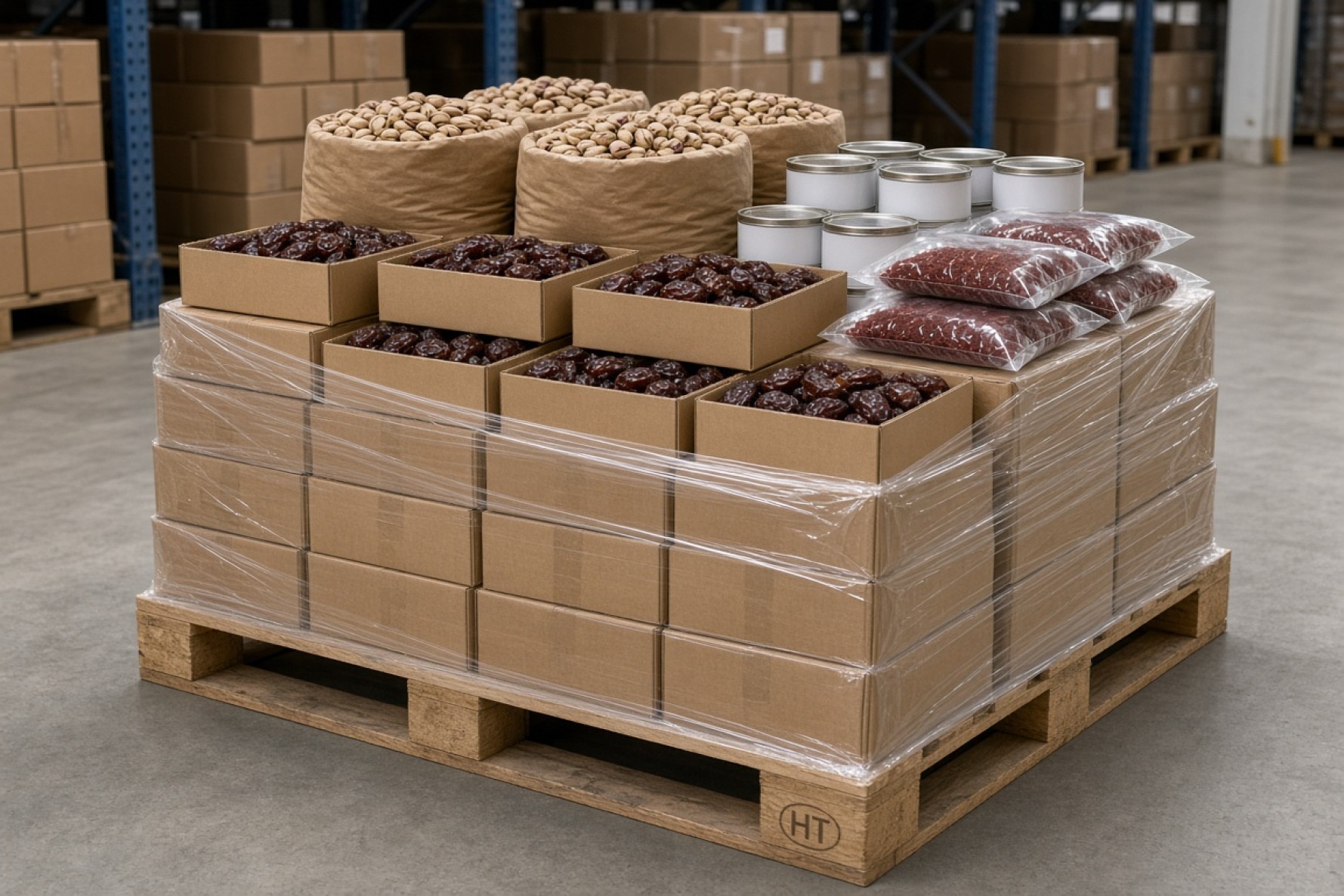
Iranian exporters typically ship dried spices, saffron, dates, nuts, tomato paste, canned vegetables, confectionery, rice and chilled produce. Each matrix demands a different packaging stack: hygroscopic powders need low WVTR; oxygen-sensitive oils need low OTR; heavy canned goods need high BCT master cartons; chilled meat needs breathable secondary packs and validated cold-chain data loggers inside the container.
- Primary pack: Direct food contact — pouches, jars, trays, tins — must meet destination food-contact rules and migration limits.
- Secondary pack: Retail-facing unit (display box, shrink bundle) carrying barcode, lot and language requirements.
- Tertiary / shipper: Master carton, stretch wrap, corner boards and pallet load pattern engineered for container stacking height.
2. Oxygen and water-vapor barriers: OTR and WVTR
Permeation through polymer films drives oxidative rancidity, color fade (e.g. saffron crocin loss), mold on dried fruit and caking in powdered mixes. Two standardized metrics govern material choice:
- Oxygen Transmission Rate (OTR): Mass of oxygen passing through 1 m² of film in 24 h at defined temperature, humidity and partial pressure — typically reported in cm³/m²·24 h·bar or cc/m²/day.
- Water Vapor Transmission Rate (WVTR): Water vapor flux through the film — g/m²·day at 38°C / 90% RH is common for tropical export lanes.
Monolayer polyethylene alone cannot deliver export-grade barriers. Co-extruded structures with EVOH, metallized PET, aluminum foil or oriented polyamide (PA) central layers are standard for 45-day maritime lanes to the Gulf and Europe.
| Product & transit profile | Suggested OTR | Suggested WVTR | Typical structure |
|---|---|---|---|
| Saffron threads · 45 d sea · Gulf | < 2 cm³/m²·24 h | < 1 g/m²·day | Tin / glass + N2 flush; or PET/Al/PE |
| Pistachio & dried fruit · bulk | < 5 | < 2 | PET/EVOH/PE or PA/PE vacuum |
| Tomato paste pouch / can | Near zero (metal) | N/A in can | Easy-open tin + lacquer; pouch Al barrier |
| Fresh MAP vegetables · 14 d | Controlled (per gas mix) | < 2 | PP/EVOH/PE tray + anti-fog lid |
| Bread / short shelf bakery | > 1000 (breathable) | Moderate | Micro-perforated BOPP or paper window |
Always request supplier COA stating test method (ASTM D3985 for OTR, ASTM F1249 or ISO 15106 for WVTR) at the temperature and humidity of the destination market, not only at 23°C / 0% RH reference conditions.
3. Food-contact materials matrix for export
Material selection balances barrier, heat-seal window, migration profile, recyclability claims and importer audit expectations. The table below summarizes common export formats from Iranian food plants.
| Format | Polymers / substrate | Best-fit products | Export caveat |
|---|---|---|---|
| Stand-up pouch | PET / Al / PE or PET / EVOH / PE | Spices, paste, nuts | Declare overall migration & heavy metals on COA |
| Glass jar + metal lug cap | Soda-lime glass; tinplate cap with plastisol | Pickles, jams, honey | EU requires declaration of conformity for food contact |
| Three-piece / DWI can | Tinplate or aluminum with internal lacquer | Tomato paste, beans, fish | Enamel type must match pH and fat content |
| MAP tray + lidding film | PP/EVOH/PE tray; PE or PET lid with EVOH | Fresh produce, protein, ready meals | Gas mix and residual O2 must be validated per SKU |
| Vacuum skin pack (VSP) | High-elasticity PE skin on PP/PET tray | Premium meat, fish | Higher film cost; lower drip vs MAP |
| Woven PP + LDPE liner | PP sack with food-grade inner liner | Rice, legumes, onion | Liner must be documented food-contact grade |
4. Modified atmosphere, vacuum and gas flushing
Modified Atmosphere Packaging (MAP) replaces headspace air with food-grade N2, CO2 and sometimes low O2 to slow microbial and enzymatic spoilage. Vacuum packaging removes oxygen entirely for oxidation-sensitive fats. Nitrogen flushing in tins and jars displaces oxygen before sealing — critical for saffron crocin stability and nut rancidity control.
| Technology | Mechanism | Typical export use | Validation point |
|---|---|---|---|
| MAP tray sealer | Gas flush into tray headspace after partial vacuum | Fresh herbs, broccoli, red meat | Seal integrity & residual O2 ≤ 2% |
| Chamber vacuum | Full air removal; tight film on product | Dried fruit, cheese, portion meat | No pinholes; correct PA/PE gauge |
| Skin pack (VSP) | Vacuum + conforming top film | Premium export protein display | Film elasticity and tray compatibility |
| Gaseous flush (tin/jar) | N2 or CO2 before seaming | Saffron, ground spice, nuts | Headspace O2 analyzer at line |
Export contracts should specify gas composition, seal width, leak-test sampling frequency and whether absorbent pads are required in MAP meat trays. Importers in the EU and GCC increasingly request batch records linking gas mixer calibration to production lot numbers.
5. Regional food-contact and packaging regulations
A film or carton approved for domestic sale in Iran may still fail third-country registration if migration limits, substance lists or declaration formats differ. Build a market-specific compliance matrix before artwork approval.
| Market bloc | Key instruments | Packaging focus | Typical evidence |
|---|---|---|---|
| European Union | Regulation (EU) 10/2011 on plastic FCM; Framework Reg. 1935/2004 | Overall & specific migration; authorized substances list | Declaration of Compliance (DoC); lab per EN 1186 |
| GCC (GSO) | GSO 1863 (food packages); GSO 9:2022 labelling | Migration, heavy metals, Arabic label panels | GSO-aligned COA; nutrition table GSO 2233 |
| EAEU | TR CU 005/2011 packaging safety; TR CU 021/2011 food safety; TR CU 022/2011 labelling | EAC conformity; Cyrillic label mandatory | Test protocols recognized in EAEU union register |
| China | GB 4806 series (food-contact materials); GB 7718 labelling | National standards for plastics, paper, metals | Chinese-label stickers or direct print; CIQ-relevant tests |
When one production run serves Qatar, Germany and Kazakhstan simultaneously, use the strictest migration limit and the union of labelling fields — do not ship “minimum label” stock with plan to overstick at port; many Gulf authorities reject secondary date stickers.
6. Master carton engineering and the McKee formula
Master cartons (shipper cases) must survive pallet column loads in a fully stuffed 40-foot container — often six to eight tiers — while relative humidity in reefers or Gulf ports erodes compression strength. Box Compression Test (BCT) and Edge Crush Test (ECT) ratings must be specified in purchase orders, not assumed from “5-ply” wording alone.
The McKee equation estimates empty carton compression strength from board ECT, flute type and footprint. A widely used form:
Where BCT is box compression (N or kgf), ECT is edge crush (kN/m), Z is board thickness factor for flute profile (B, C, BC, etc.), and L × W are internal length and width. Apply a safety factor (SF) of 3.0 to 4.5 for heavy canned tomato paste on BC five-layer board when container stack height exceeds 2.2 m — matching load to measured pallet weight rather than nominal “8-high” marketing claims.
- Specify virgin kraft liners and moisture-resistant adhesive when reefer RH runs 85–95%.
- Use corner boards and horizontal strapping on 100 × 120 cm euro pallets.
- Perform Cobb water absorption tests on liner paper when targeting Gulf summer storage.
- Align carton dimensions with automated palletizer pattern to avoid overhang crush points.
7. Palletizing and ISPM 15 phytosanitary wood rules
Wooden pallets and dunnage without International Standards for Phytosanitary Measures No. 15 (ISPM 15) treatment are a leading cause of quarantine holds at EU, Gulf and CIS ports. Export loads must use heat-treated (HT) wood marked with the IPPC logo, country code and facility number — or switch to plastic / presswood pallets exempt from bark-pest rules.
- Heat treatment: Core wood ≥ 56°C for minimum 30 minutes in a certified kiln.
- Moisture ceiling: Keep pallet wood moisture ≤ 18% before container stuffing to limit mold, weight gain and nail loosening.
- Stacking pattern: Column stack for maximum BCT transfer; brick patterns reduce bottom-tier load capacity by up to ~45% in some finite-element models.
- Chilled meat: Avoid fully enclosed stretch wrap that blocks evaporative cooling; use ventilated film per carrier guidelines.
8. Container rain, desiccants and maritime humidity
Container rain (cargo sweat) forms when warm moist air enters a box or when temperature cycles drop dew point below carton surface temperature. Condensation wicks into master cartons, destroys BCT, and can trigger mold on dried fruit or label adhesive failure on retail packs.
- Deploy calcium chloride desiccant bags sized to container volume (absorption capacity up to ~200% of bag weight).
- Use full thermal liners or insulated blankets for hygroscopic goods (rice, powder mixes) on routes with large day–night ΔT.
- Pre-cool reefers and log set-point plus return-air temperature with at least two data loggers per FCL.
- Keep pallet load 15 cm off floor and away from container walls to allow air circulation.
- Choose moisture-resistant five- to seven-layer master cartons with semi-kraft liners for Gulf discharge in summer.
For 45-day lanes from Bandar Abbas to Rotterdam or Jebel Ali, model humidity exposure explicitly when selecting saffron tin specs — low OTR primary packs cannot compensate for saturated shipper cartons.
9. HS codes, customs declarations and packaging data
Harmonized System (HS) codes on the certificate of origin, bill of lading and invoice must match the actual product form and pack type. Mismatch triggers extended inspection, repalletizing fees and rejection when declared packaging does not match physical shipment (e.g. bulk vs retail-packed saffron).
| Product (examples) | HS heading | Pack note for customs |
|---|---|---|
| Saffron threads | 0910.20 | Retail tin/jar vs bulk sack — net weight per unit |
| Tomato paste | 2002.90 | Drum vs can; Brix and pack material on invoice |
| Pistachios in shell | 0802.51 | Vacuum carton vs jute bag — aflatoxin test ref |
| Chocolate confectionery | 1806.90 | Halal / gelatin declaration tied to label |
| Prepared / canned vegetables | 2005 / 2004 | Hermetic seal; incubation test reference on COA |
Declare gross and net weight per master carton, units per pallet and pallet count on the packing list. Photos of load pattern and seal numbers reduce dispute risk under CIF contracts.
10. QC tests, COA documentation and B2B sourcing tiers
Importers tier suppliers by how completely packaging evidence is bundled with each lot. Tier-1 export-ready plants provide synchronized product and pack COA files before vessel sailing.
| Test | Purpose | Reference methods |
|---|---|---|
| Overall migration | Food-contact safety of plastics | EN 1186; EU 10/2011 simulants |
| Specific migration (e.g. heavy metals) | Tin, lead, cadmium limits | GSO 1863 / EU limits |
| Seal strength & leak | MAP / pouch integrity | ASTM F1140; bubble emission; dye penetration |
| BCT / ECT | Shipper structural adequacy | TAPPI T804 / T811 |
| Headspace O2 | Modified gas or N2 flush verification | Electrochemical analyzer on line |
B2B sourcing tiers (packaging readiness)
- Tier A — Retail export: Market-specific artwork, validated barrier specs, full DoC / migration file, audited pallet photos.
- Tier B — Wholesale import: Neutral master cartons + compliant primary pack; importer applies local sticker under supervision.
- Tier C — Bulk / HORECA: Food-grade liner in woven sack or drum; emphasis on COA and fumigation / ISPM compliance rather than retail finish.
Export labeling cross-check
Align pack panels with destination rules: Arabic for GCC (GSO 9:2022), Cyrillic for EAEU (TR CU 022/2011), English plus simplified Chinese for China (GB 7718), allergen bolding and nutrition tables where mandatory. Ingredient order by descending weight, fixed production/expiry formats, and halal or gelatin origin statements must match the same lot referenced on the health certificate.
Ten-point importer packaging checklist
- Written spec for OTR, WVTR and film structure in contract annex
- Approved pre-production artwork signed by both parties
- Migration / food-contact COA dated within 12 months
- Master carton ECT / BCT values and McKee safety factor documented
- ISPM 15 pallet photos and moisture ≤ 18% declaration
- Desiccant count and placement diagram for container load
- Cold-chain logger placement map (if reefer)
- Packing list with HS code, net/gross, units per carton
- Seal integrity sampling plan for MAP / vacuum lines
- Alignment of certificate dates with production lot on label
11. FAQ for export managers and packaging engineers
How do I choose OTR and WVTR for saffron and dried nuts on a 45-day sea route to the Gulf?
Target OTR below 2 cm³/m²·24 h and WVTR below 1 g/m²·day for saffron tins or foil laminates; nuts in vacuum PA/PE bags typically need OTR below 5 and WVTR below 2. Pair barrier film with nitrogen flush and moisture-resistant five-layer master cartons plus container desiccants — primary barrier alone fails if shipper cartons saturate in container rain.
What is the difference between MAP and vacuum packaging for export protein?
MAP retains a controlled gas headspace (often high O2 for red meat color plus CO2 for microbes), while vacuum removes air entirely and is better for fat oxidation control in poultry and fish. MAP may need absorbent pads due to drip; vacuum skin pack minimizes purge but requires higher film cost and specialized equipment.
Which EU and GCC documents prove food-contact compliance for plastic pouches?
For the EU, importers expect a Declaration of Compliance referencing Regulation (EU) 10/2011 and overall migration tests per EN 1186 simulants. For GCC markets, align with GSO 1863 migration and heavy-metal limits plus Arabic labelling under GSO 9:2022. Keep film supplier and converter certificates on file for each resin lot.
How is McKee BCT used when stacking tomato paste cans in a container?
Measure or specify board ECT, flute type and carton footprint, apply the McKee formula to estimate empty BCT, then divide by a safety factor of 3.0–4.5 for the actual pallet column load at planned container stack height. Five-layer BC corrugated with virgin kraft liners is typical for 16 kg paste cans; recalculate whenever carton dimensions or stack tiers change.
Why was our pallet rejected despite correct product quality?
Untreated wood pallets missing ISPM 15 HT marks are destroyed or re-palletized at importer expense. Wood moisture above ~18% also raises mold risk and invalidates some buyer QA programs. Use stamped HT pallets or plastic pallets and attach treatment certificates to shipping documents before cut-off.
What causes container rain and how can it be prevented?
Temperature swings along the route drop dew point on container walls and cartons, condensing moisture (“cargo sweat”). Mitigate with calcium chloride desiccants, thermal liners for hygroscopic cargo, proper reefer pre-cooling, and cartons with high Cobb resistance. Monitor logger data to prove cold chain where contract requires it.
Do HS codes need to reflect packaging type?
The HS code describes the product, but customs and quarantine compare declared form (retail tin vs bulk sack) to physical shipment. Packing lists must state net weight, units per master carton and pallet count consistently with invoice and certificate of origin to avoid holds and fines.
What QC tests should importers require before releasing payment?
Minimum pack-related set: overall migration (and specific migrants where relevant), seal/leak test for flexible packs, BCT/ECT certificate for shippers, headspace oxygen for flushed products, plus product-specific microbiology and residue tests. Tie final 10–20% payment to destination inspection or third-party pre-shipment audit when possible.
Packaging suppliers and export engineering on Iranco
Iranco (iranco.com) connects Iranian food exporters with barrier film converters, corrugated suppliers, MAP line integrators and importers who need documented OTR/WVTR specs, ISPM 15 pallet compliance and market-specific label artwork review. Submit your destination country, product matrix and planned stack height to receive matched supplier RFQs and technical consulting.
- Directory of food-grade film, tinplate, glass and master-carton manufacturers
- RFQ workflow with barrier targets, McKee load cases and pallet diagrams
- Cross-market labelling and migration checklist support for EU, GCC, EAEU and China
- Links to export-ready brands and co-packers with Tier-A documentation habits
Featured Products


Related Articles



