 Iranco Magazine Team
Canada food import market analysis — high-demand categories, land and sea routes, CFIA requirements, tariffs and labelling, import costs and Iranian product positioning
Market Report · Canada · Food Imports · CFIA · Montreal
Canada Food Import Market: High-Demand Categories, Land and Sea Routes, CFIA Rules and Iranian Export Opportunities
Canada is one of the world's largest and most diverse importers of agricultural, food and seafood products, sourcing heavily from the United States, Latin America, Europe and Asia. Successful market entry requires more than a suitable product: importer licensing, food safety control, bilingual labelling, tariff classification, traceability documents and the right logistics path all directly affect clearance feasibility and landed cost.
1. Analytical Introduction
Canada's food market should not be viewed only as a wealthy North American consumer market. Geography, cold climate across much of the country, cultural diversity, a powerful retail network and a large food-processing sector make imports a permanent part of the national food supply chain.
Import dependence is not uniform across food groups. Ready and semi-ready foods, coffee, certain fruits and vegetables, spices, ethnic specialty products, confectionery and chocolate, bakery products, sauces and condiments, edible oils and many out-of-season items all have substantial import markets. Dairy, poultry and eggs, by contrast, sit under more sensitive tariff and quota regimes.
For an Iranian exporter, "demand in Canada" does not automatically mean "entry from Iran is possible." Origin, sanitary rules, product-specific restrictions and even counterparty status under sanctions must be reviewed separately. Iranian pistachios are a clear example: Canada was a notable importer in 2024, but CFIA suspended entry of pistachios and certain pistachio products of Iranian origin from 2 December 2025 over Salmonella-related concerns. Relying on historical pistachio statistics without checking current status can lead to costly export decisions.
Trade data show that in 2024 Canada imported about CAD 75.4 billion of agricultural, food and seafood products. The United States supplied CAD 39.6 billion — 52.5% of the total — with Mexico next at about CAD 4.7 billion among major suppliers.
Canada is attractive to suppliers who can manage three issues at once: the right product, regulatory compliance and economical logistics. The gap between a sellable offer and a high-risk shipment usually lies in those three areas.
2. Which Food Products Does Canada Import Most?
At the six-digit HS level, Canada's largest import lines in 2024 included other food preparations, grape wine, bread and bakery products, dog and cat food, green coffee, raw cane sugar, soybean oil, sauces and condiments, and roasted coffee. Total agricultural, food and seafood imports in the same year were about CAD 75.4 billion.
For a food-industry participant, import rank alone is not enough. Each group must be assessed for buying structure and whether a new exporter can realistically enter that supply chain.
| Product group | Why it matters to Canadian importers | Competitive position |
|---|---|---|
| Ready and composite food preparations | Retail consumption and industrial use | Highly competitive; US holds a large share |
| Bakery and confectionery | Large retail and food-service market | US, Europe and domestic production |
| Coffee and beverage inputs | Canada is not a coffee producer | Structurally import-dependent |
| Fruit and dried fruit/nuts | Direct consumption and food industry | US, Latin America, Turkey and Asia |
| Vegetables and produce | Off-season and cold-region supply | Mexico and US are very strong |
| Spices and aromatic plants | Ethnic diversity and industrial use | Multi-origin market; quality-sensitive |
| Sauces, condiments and pickles | Retail, restaurants and ethnic foods | Brand and label matter greatly |
| Processed fruit and vegetables | Long shelf life; easier sea freight | Tariff varies by HS code |
| Dates | Ethnic market, health and religious occasions | Tunisia, Iran, Turkey, Jordan and others |
| Saffron | Low volume, high unit value | Intense competition on authenticity and quality |
Why tropical, fruit and vegetable imports matter
Canada depends on imports for many tropical products and for part of its fresh fruit and vegetable supply. In 2024, Canada's agricultural and food imports from Latin America and the Caribbean reached CAD 13.3 billion. Within that flow, fruit and nuts were worth about CAD 3.5 billion and vegetables and edible roots about CAD 1.9 billion.
That does not mean every Iranian fresh fruit is suitable for Canada. Fresh product must be justified both by origin eligibility and by plant quarantine, commercial shelf life and cold-chain cost.
Processed foods — large market, heavy competition
Canada's largest six-digit HS import line in 2024 was "other food preparations" under code 210690, at about CAD 2.818 billion. More than 80% of imports in that line in the same year came from the United States.
| Product line | HS code | Market feature |
|---|---|---|
| Other food preparations | 210690 | Largest line; over 80% from US |
| Grape wine | 2204 | Structural imports from Europe and US |
| Bread and bakery products | 1905 | Retail and food-service demand |
| Green and roasted coffee | 0901 / 0902 | Canada is a net importer |
| Sauces and condiments | 2103 | Brand and label competition |
| Soybean oil | 1507 | Industrial raw material |
For food mixes, beverage powders, composite ingredients or functional foods, a low export price alone is not enough. Formula, on-pack claims, ingredients, allergens, the Nutrition Facts table and front-of-pack nutrition symbol status must all align with Canadian rules.
3. Which Groups Are More Realistic for Iranian Exporters to Canada?
Rather than looking only at Canada's CAD 75 billion import total, Iran should focus on groups where it has supply history, product advantage or market recognition — and where regulatory entry remains feasible.
| Group | Canada market appeal | Potential Iran advantage | Main challenge |
|---|---|---|---|
| Dates | Active ethnic and retail demand | Varietal range and export history | Moisture, grade, packaging and shelf life |
| Saffron | Specialist, high unit value | Iran's saffron position | Authenticity, testing, packaging and brand |
| Raisins & dried fruit (non-pistachio) | Multi-cultural snacking market | Production diversity | Moisture, aflatoxin, foreign matter and packaging |
| Pickles & preserved vegetables | Ethnic retail and food service | Traditional processing capacity | Tariff by HS code, additives and labelling |
| Traditional sweets & packaged confectionery | Ethnic niche demand | Product identity and variety | Front-of-pack nutrition from Jan 2026 |
| Spices & herbs | Industrial and retail use | Regional supply base | Purity, adulteration control and labels |
| Iranian pistachios | Historical demand existed | Former major supplier status | CFIA import ban from 2 Dec 2025 |
Dates
Dates are one of the clearest examples. Trade data show Canada imported about 2.35 million kg of Iranian dates in 2024, with reported value of roughly USD 4 million. Unlike many fresh fruits, dates tolerate sea freight and inventory planning better. Grade, moisture, softness, size, pit presence, cold-storage conditions and consumer packaging must nevertheless be defined before pricing.
Saffron
Canada imported about USD 2.6 million of saffron in 2024, with Iran among recorded supplier countries. Saffron is classified under tariff code 0910.20.00, and its MFN rate in Canada's 2026 customs tariff is duty-free. Because shipment value is high relative to weight, freight is a smaller share of cost; authenticity, colouring strength, packaging, test results and quality consistency matter more.
Raisins, dried fruit and non-pistachio nuts
Canada has a multi-cultural market for nuts, dried fruit and fruit-based snacks. Iranian product must be controlled for moisture, microbial contamination, pesticide residues, foreign matter, storage pests and packaging integrity. Low-moisture goods are often logistically simpler than fresh produce, but preventive control is not simpler — nuts, seeds and dried fruit can attract attention for Salmonella, mould, mycotoxins or allergens under an importer's PCP.
Processed vegetables, pickles and traditional products
Canada recorded some Iranian imports in certain prepared or preserved vegetable lines in 2024, but tariffs are not uniform across Chapter 20. In Canada's 2026 tariff, some lines such as group 2005.99 can carry an MFN rate of about 8%. The generic word "pickle" or "canned vegetable" is therefore insufficient for customs costing — composition, preservation method, vinegar, sugar, oil and main ingredient can change classification.
Packaged sweets and traditional confectionery
Canada's ethnic market can absorb products such as gaz, sohan, traditional sweets, rock sugar and certain fruit-based snacks. Imports under line 170490 from Iran appear in official Canadian importer statistics. This group must also be reviewed for front-of-pack nutrition symbol requirements in 2026: products with high levels of saturated fat, sugars or sodium may need the mandated symbol on the principal display panel when rules apply. Enforcement began on 1 January 2026.
4. Where Does Canada Source Its Food Imports?
The United States is Canada's dominant food supplier. In 2024 about CAD 39.6 billion of agricultural, food and seafood products came from the US — 52.5% of the total. Mexico ranked next at CAD 4.7 billion (6.2%), China at about CAD 2.6 billion, and European Union countries collectively at about CAD 8 billion.
| Origin | Approx. import value 2024 | Supply-chain feature |
|---|---|---|
| United States | CAD 39.6 billion | Mostly land haul; short transit; integrated chain |
| European Union | CAD 8 billion | Branded goods, beverages, specialty products |
| Mexico | CAD 4.7 billion | Produce and tropical goods; land transport |
| China | CAD 2.6 billion | Diverse food and processed products |
| Latin America & Caribbean (ex-US) | Significant and diversifying share | Fruit, vegetables, coffee, sugar and oils |
| Iran | Small overall market share | Specialty and ethnic products rather than bulk staples |
This structure carries two messages for Iranian exporters. First, direct price competition with the US or Mexico on bulky, low-value goods is very difficult — American suppliers benefit from proximity, land networks, trade arrangements and fast delivery. Second, Iran's opportunity lies more in products with favourable value-to-weight ratios or distinctive identity: saffron, dates, certain dried fruits, traditional foods and inputs for which buyers will build a dedicated supply chain.
5. Main Routes and Entry Points for Food Imports into Canada
Canada's food import flows cannot be reduced to a single border. Route depends on origin. US and Mexican goods enter mostly by land, while European, Middle Eastern and much Asian cargo moves through container ports and then rail and truck distribution networks.
US–Canada land borders
The US supplies more than half of Canada's agricultural and food imports. Trucking dominates bilateral goods trade; in 2024 road transport accounted for more than half of US–Canada trade value. Major truck crossings include:
| Crossing | Canadian province | Truck crossings 2024 | Logistics role |
|---|---|---|---|
| Windsor–Ambassador Bridge | Ontario | 2.64 million | Detroit–Windsor axis; large Ontario market |
| Sarnia–Blue Water Bridge | Ontario | 1.86 million | Michigan to southern and central Ontario |
| Fort Erie–Peace Bridge | Ontario | 1.06 million | New York link toward Greater Toronto |
| Pacific Highway | British Columbia | Major western gateway | Access to Vancouver and western Canada |
| Emerson | Manitoba | Central corridor | Northern US to Canadian prairies |
| Coutts | Alberta | West-central corridor | Land haul into Alberta |
Official Canadian transport statistics show the Ambassador Bridge accounted for nearly 24.7% of recorded truck traffic among major gateways in 2024. For fresh US and Mexican product, the advantage of these routes is short transit and widespread refrigerated trucking.
Port of Montreal
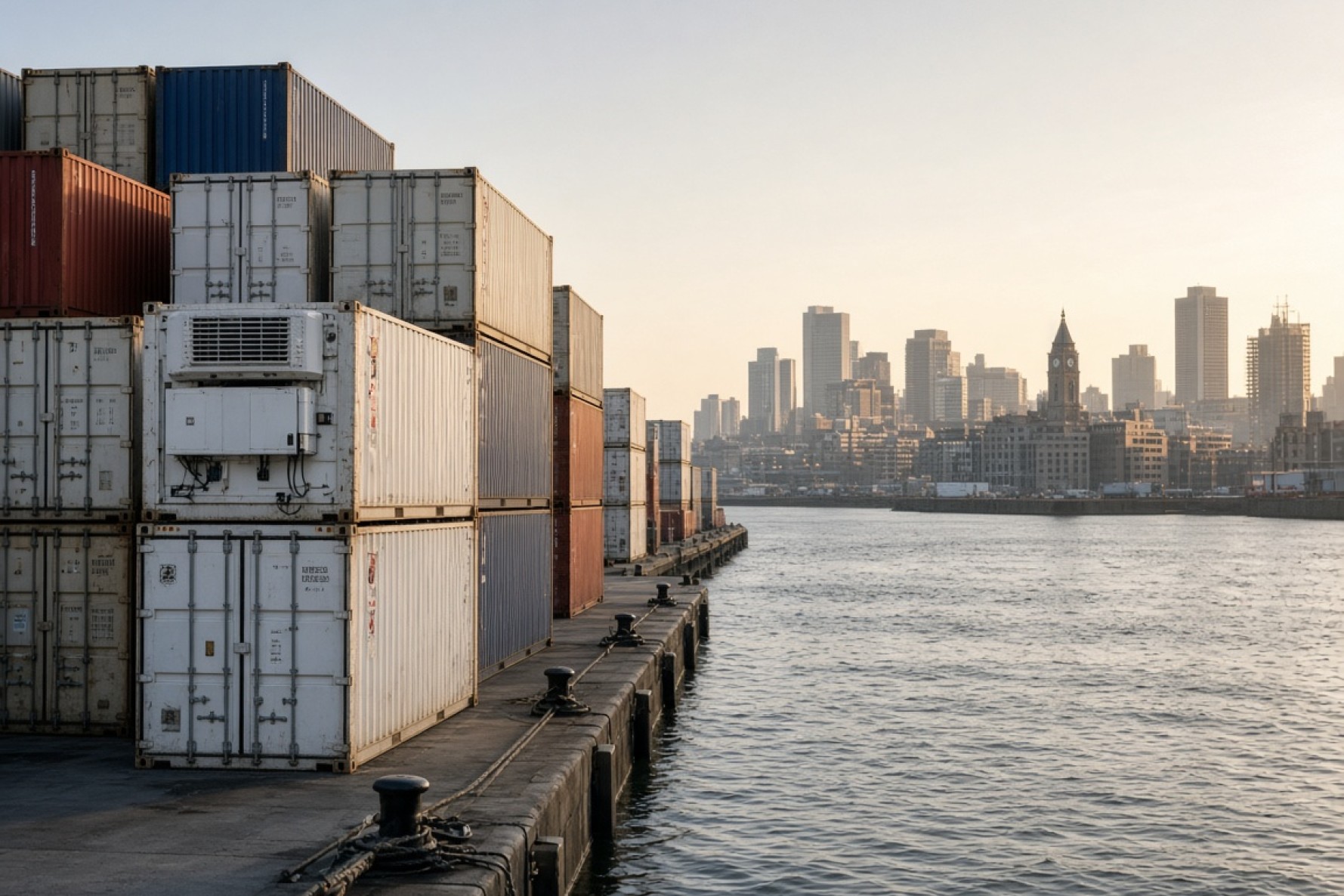
Montreal matters greatly for imports from Europe, the Mediterranean, the Middle East and routes whose final destination is Quebec, Ontario or eastern Canada. In 2025 about 1.954 million tonnes of containerised food products entered Montreal; total two-way containerised food movement was about 2.815 million tonnes.
For an Iranian exporter, Montreal can be a practical destination for dry goods, saffron, dates, permitted dried fruit and packaged products — provided shipping route and transhipment are economical in time and cost.
Vancouver and western ports
British Columbia ports are the natural entry for Asian and Pacific cargo. For goods arriving from East Asia or Pacific-linked shipping networks, western entry plus inland rail can be logical. For Iranian cargo, the choice between Montreal and western Canada should be based on actual origin port, line schedules, transhipment frequency and buyer destination — not map distance alone.
Air freight
Air freight suits high-value, low-volume, urgent or highly sensitive food shipments. Saffron is a product where air freight can be economically viable. Dates and bulky goods imported commercially at scale are usually more competitive by sea.
| Route | Suitable for | Strength | Key note |
|---|---|---|---|
| US land borders | US/Mexico-origin fresh and packaged food | Short transit; dominant import channel | Not the primary path for direct Iran-origin sea cargo |
| Montreal | Dry and packaged food containers | Key Atlantic gateway; ~1.954M t food imports 2025 | Line booking, dwell time and inland distribution |
| Vancouver / BC ports | Pacific-linked container cargo | Natural Asian entry point | Compare full landed cost with Montreal routing |
| Air | Saffron, samples, urgent high-value goods | Speed | High freight cost; limited for bulky cargo |
6. Licenses and Legal Conditions for Food Imports into Canada
The federal framework centres on the Safe Food for Canadians Regulations (SFCR). Importers are responsible for ensuring food entering Canada is safe and meets the same level of protection expected of food produced in Canada.
SFC licence
For most food import activities, the importer must hold a valid Safe Food for Canadians (SFC) licence. The licence must:
- Be active and not expired;
- Cover the activity "import food";
- Include the commodity group being imported;
- Be declared accurately on the import transaction.
CFIA's updated September 2026 guidance stresses that declaring an invalid licence number, a licence that does not cover imports, or a licence that does not include the relevant commodity group can result in rejection of the import transaction. Under CFIA's fee notice effective 31 March 2026, issuance or renewal of a covered licence costs CAD 307.96 for a two-year period.
Preventive control plan (PCP)
Many importers must maintain a written preventive control plan. This is not a paper exercise. The importer must define biological, chemical and physical hazards; how foreign suppliers control them; storage and transport conditions; testing; corrective actions; and complaint and recall management. CFIA states that importers must know how foreign suppliers provide a level of safety equivalent to Canadian requirements.
Traceability
Canada's system emphasises traceability. Importers must know from whom they received product and to whom they supplied it. Lot numbers, production dates, manufacturer details, transport documents and links between each shipment and quality-control records therefore have direct operational importance.
AIRS automated import reference system
Before any import, product requirements must be checked in CFIA's Automated Import Reference System (AIRS). The system displays requirements based on commodity, country of origin, destination in Canada, end use, HS code and any required licence, certificate or document. CFIA updates AIRS regularly; checks must be done for the exact product and origin each time.
The usual practical clearance sequence includes:
- Agree product specifications with the Canadian importer.
- Verify product and origin-country eligibility in AIRS.
- Confirm importer SFC licence scope and validity.
- Prepare invoice, packing list and transport documents.
- Obtain any required certificates or test reports.
- Submit customs declaration with correct SFC licence number.
- Arrival at port or airport.
- Document and cargo identity verification.
- Inspection or sampling where required.
- Payment of duty, taxes and related charges.
- Release and transfer to warehouse or distribution network.
7. Food Labelling in Canada — A Major Shipment Risk Point
An exporter who prepares packaging in English only is not ready for much of Canada's retail market. Mandatory information on most prepackaged consumer foods must appear in both official languages — English and French.
Depending on product, the following typically require review:
- Common name of the food;
- Net quantity;
- Ingredient list;
- Allergen information;
- Nutrition Facts table;
- Name and principal place of business of the responsible party;
- Imported-food indication where required;
- Best-before or expiry dating where applicable;
- Storage conditions;
- Country of origin where mandatory for the product group;
- Front-of-pack nutrition symbol where rules apply.
For multi-ingredient foods, ingredients are generally declared by weight in descending order. Allergens, gluten and added sulphites must be declared where rules require. For added sulphites, the 10 ppm threshold is important in labelling rules.
Major change from 2026: front-of-pack nutrition
From 1 January 2026, front-of-pack nutrition symbol requirements are fully in force. Many prepackaged foods whose saturated fat, sugars or sodium reach or exceed set thresholds must display the standard symbol on the principal display panel. This must be reviewed before printing for confectionery, some snacks, sauces, pickles, salty canned goods and products with added syrup or sugar.
Country of origin and importer information
Food wholly manufactured outside Canada must be labelled to show it is imported. Dairy, honey, fish, fresh fruit and vegetables, meat and certain processed fruit and vegetable groups have more specific origin-declaration rules. Post-arrival label correction, if not planned from the start, can add warehouse cost, labour and distribution delay.
8. Customs Tariffs and Import Taxes
There is no single "food import tariff" in Canada. Duty depends on exact HS code, product detail, country of origin, preferential-tariff eligibility and, for some goods, tariff-rate quota (TRQ) status. Iran is subject to MFN treatment in Canada's 2026 tariff schedule but does not benefit from a free-trade agreement with Canada. Iranian product therefore requires review of the MFN rate for the specific line.
| Product | HS code | MFN rate |
|---|---|---|
| Saffron | 0910.20.00 | Duty-free |
| Certain prepared/preserved vegetables | 2005.99 | About 8% |
| Other lines | Product-specific | Ad valorem, specific, quota or mixed |
Tariff-rate quotas
Canada applies TRQs on some sensitive agricultural products such as certain dairy, chicken, egg and supply-managed lines. Goods may enter within quota at lower duty but face much higher over-quota rates. Export proposals for such products without quota and import-permit review can be economically meaningless.
GST/HST
Many basic foods in Canada are zero-rated for GST/HST. Common grocery foods, bread, many vegetables, fruit and some staple items generally fall in the zero-rated class. Many snacks, confectionery and certain beverages may be taxable. The Canadian government states that basic grocery foods are generally zero-rated while specific groups may be taxed — product nature therefore affects final tax treatment.
9. Real Landed Cost of Food Imports into Canada
A common mistake is comparing two sellers on FOB price alone. A professional importer calculates cost to warehouse or distribution centre.
| Cost component | What changes it? |
|---|---|
| Product purchase price | Quality, grade, order size, season |
| Export packaging | Film, carton, pallet, consumer pack |
| Domestic haul in origin country | Factory distance to port or airport |
| Origin port charges | Loading, documents, terminal |
| International freight | Route, container type, season, line capacity |
| Insurance | Shipment value and coverage terms |
| Import duty | HS code and origin |
| GST/HST | Product tax status |
| Customs broker | Importer's broker contract |
| CFIA services | Inspection type and service applied |
| Warehouse and dwell | Clearance duration and controls |
| Domestic haul in Canada | Port to warehouse or DC |
| Cold chain | Temperature, time and equipment |
| Testing | Product risk and importer PCP |
| Label correction | If bilingual or nutrition issues arise |
Consider two date exporters offering similar prices. The lower-priced seller may use weak pallets, lack Canada-ready labels, provide incomplete lot data, ship in cartons unsuited to sea freight and offer no test reports. Even with a lower initial price, the importer may choose the second offer because total risk and correction cost are lower.
CFIA service fees vary by service. Under the fee schedule from 31 March 2026, some imported fruit and vegetable inspections are priced at CAD 1.69 per 100 kg with a minimum of CAD 83.77 — applicable only when that specific inspection service is triggered, not as a universal food-import charge.
10. Shipping Route Selection for Iranian Goods
For Iranian exporters, three main scenarios apply.
Dry and shelf-stable goods
Suitable for semi-dry and dry dates with proper packaging, raisins, some permitted dried fruit, spices, packaged processed foods, pickles and canned goods. Sea freight is usually the most economical choice for commercial volume. Container moisture, condensation, weak cartons and temperature swings can still cause damage. Before loading, review product moisture, moisture migration in packs, carton crush resistance, pallet pattern, distance from packs to container walls, desiccant use where needed, and container cleanliness and odour.
Temperature-sensitive goods
Soft dates, some processed products or goods whose quality declines with heat may need refrigerated containers or controlled temperature. Suitable temperature cannot be set generically for all foods; storage specs must follow the product, water activity, composition, packaging and commercial shelf life.
Low-weight, high-value goods
Saffron, commercial samples and some specialty inputs can move by air. Focus here is on shipment security, insurance, precise documents, tamper-evident packaging and lot control more than minimising freight per kilogram.
11. Quality Control — What Canadian Importers Expect from Suppliers
Control intensity varies by product. A professional buyer usually converts technical requirements into measurable contract terms before ordering.
| Parameter | Relevant products | Why it matters |
|---|---|---|
| Moisture | Dates, raisins, nuts, spices | Shelf life and mould risk |
| Salmonella | Nuts, seeds, some dry goods | Microbiological safety |
| Aflatoxin | Some nuts and raw materials | Chemical safety |
| Pesticide residues | Fruit, vegetables, spices | Legal compliance |
| Sulphites | Dried fruit and some processed foods | Safety and labelling |
| Foreign matter | Spices, nuts, raisins | Quality and safety |
| Size and grading | Dates, dried fruit | Commercial uniformity |
| Colour and appearance | Saffron, nuts, processed foods | Market acceptance |
| Net weight | All packaged goods | Contract and label match |
| Pack integrity | All products | Contamination and damage prevention |
A pre-contract sample is not enough unless it becomes a specification. For dates, "export quality" should be replaced by variety name, pitted or unpitted, size range, softness grade, agreed moisture, defect percentage, visible sugar crystallisation limits, packaging, net weight, storage conditions and required tests. For saffron, "premium coupe" alone is insufficient — laboratory indices, purity, moisture and acceptance criteria must be fixed in advance.
What information is needed for an accurate quote?
A request for "food price for Canada" is commercially incomplete. A comparable offer requires at minimum:
- Exact product name and commercial variety where relevant;
- Processing form and quality grade;
- Technical specifications required;
- Order quantity and pack weight;
- Consumer or bulk packaging;
- Private-label requirement or not;
- Need for English and French labels;
- Required tests and certificates;
- Acceptable country of origin;
- Delivery city or port in Canada;
- Transport mode and Incoterms;
- Required delivery timing.
At Iranco, purchase requests can be reviewed more precisely when these specifications are provided together with quantity and Canadian destination, and suppliers are evaluated against a clear product definition.
12. Special Conditions for Iran–Canada Food Trade
Exporting food from Iran to Canada is not only a customs and CFIA matter. Counterparty and financial-route review also matters.
Canada maintains active sanctions against listed Iranian persons and entities. Special Economic Measures regulations restrict dealings with designated parties and assets owned or controlled by them. That does not mean all food trade with Iran is prohibited, but bank, exporter, importer, carrier and other parties must be screened for compliance. Related regulations were amended several times in 2026.
Canadian financial institutions must scrutinise Iran-related transactions under anti-money-laundering and sanctions-evasion guidance. FINTRAC guidance in 2026 continues to place Iran in a higher-risk transaction category.
Practical consequences for commercial deals include:
- Parties should clarify real company identity and ownership.
- Payment route should be confirmed before final production.
- Intermediaries should not enter the chain without commercial justification.
- Canadian bank and counterparty should confirm ability to receive or pay in advance.
- Exporter, buyer and other material parties should be screened against Canadian regulations.
This step should precede mass packaging, raw-material purchase or freight booking.
13. Importer Checklist and Sourcing Iranian Food for Canada
A Canadian importer or buyer planning purchases from Iran should complete these checks before confirming an order:
- Define exact product name and processing form. Generic terms such as "Iranian nuts" are insufficient for contract.
- Verify proposed HS code with a Canadian customs broker.
- Check entry eligibility in AIRS for that origin country and product.
- Confirm SFC licence validity and commodity scope.
- Evaluate supplier and production unit.
- Receive written technical specifications.
- Assess pre-production or shipment sample against contract specs.
- Define required tests based on product risk.
- Write numerical, measurable defect acceptance limits in contract.
- Approve English and French label text before printing.
- Review front-of-pack nutrition symbol requirements.
- Finalise net quantity and consumer pack size.
- Confirm master packaging and palletisation.
- Specify temperature and storage conditions.
- Set entry route and port or border with the broker before booking freight.
- Calculate customs duty on exact HS code.
- Review applicable GST/HST treatment.
- State delivery terms with a defined Incoterms rule in contract.
- Define traceability documents and lot numbering.
- Confirm payment feasibility and Iranian/Canadian party compliance before order.
In food supply for Canada, the difference between two offers is not only unit price. One proposal may suit the product but use packaging not designed for sea freight or Canadian retail. Another may carry a higher price but lower risk through documents, shelf life, production uniformity and delivery terms.
Iranco can be used as a purchase-request channel to review supply options in Iran. Importers can include product, grade, approximate volume, pack weight, packaging type, Canadian destination and expected conditions so initial supply review is based on real buying needs. Where destination rules are sensitive — such as products whose entry status has changed, including Iranian-origin pistachios — eligibility must be verified before commercial talks proceed.
For retail packs, bilingual label preparation, nutrition information and importer details should be built into the production plan from the start. For reviewing Iranian food supply for Canada, precise product definition matters more than sending a generic "export price" request.
14. Summary
Canada's food market is large, import-driven and regulation-intensive. Agricultural, food and seafood imports reached about CAD 75.4 billion in 2024, but more than half came from the United States. An exporter entering from Iran or other more distant origins must offer advantage beyond raw commodity price.
For Iran, dates, saffron, certain dried fruits, spices, traditional products and specialty processed foods can have a more logical position than bulky generic goods. Historical statistics must not be used without checking current rules; CFIA's current ban on Iranian-origin pistachios and some pistachio products is an important example.
Four decisions shape a Canada import programme most: choosing an eligible and competitive product, defining technical specifications, full CFIA compliance and correct logistics and clearance design. Before ordering, importers should review SFC licensing, preventive control plans, AIRS status, tariff code, bilingual labels, front-of-pack nutrition rules, MFN duty, payment route and traceability documents.
For transport, Montreal — with about 1.954 million tonnes of containerised food imports in 2025 — is a key reference for Middle Eastern and European-linked sea routes. Western ports matter for Pacific-linked cargo. US land borders dominate North American overland flows but are not the primary path for direct Iran-origin containerised exports.
In this market, a successful transaction does not start with a pro forma invoice; it starts with a precise purchase specification. The earlier product, packaging, testing, transport and acceptance criteria are defined, the more realistically suppliers can be compared and final cost controlled.
15. Frequently Asked Questions
Which food products attract the most attention from Canadian importers?
Canada's import market is very broad, but ready food preparations, bakery products, coffee, fruit and vegetables, sauces and condiments, edible oils, nuts and culturally specific foods are major groups. Export product choice should follow HS code review, actual import volumes in that group, main competitors and entry feasibility from the origin country.
Can Iranian food products be exported to Canada?
Many products can be, but entry eligibility must be checked product by product. Goods must meet SFCR, food safety, labelling and AIRS requirements. Iran-related transactions must also be reviewed for Canadian sanctions and financial rules. Some products carry special restrictions.
Can Iranian pistachios be exported to Canada in 2026?
Under current conditions, CFIA has refused entry of pistachios and certain pistachio products of Iranian origin under specified codes from 2 December 2025. High 2024 import statistics therefore do not indicate current export feasibility. Official status for the exact commodity code must be checked before planning any shipment.
Is Iranian saffron subject to customs duty in Canada?
Saffron is classified under 0910.20.00 and its MFN rate in Canada's 2026 customs tariff is duty-free. Import cost is not duty alone — freight, insurance, brokerage, testing, packaging and domestic Canadian distribution must also be included in landed-cost calculation.
Is English-only packaging enough to sell food in Canada?
For most prepackaged consumer foods, no. Mandatory information generally must appear in both English and French. Beyond language, the Nutrition Facts table, ingredients, allergens and, where applicable, the front-of-pack nutrition symbol must comply with Canadian rules — fully enforced from 1 January 2026.
What is the best entry route for food imports into Canada?
Origin and destination decide. US and Mexican imports move mainly by land and truck. European, Middle Eastern and Asian cargo typically enters through container ports such as Montreal or western Canadian ports. Low-volume, high-value goods such as saffron may also justify air freight.
Does a Canadian importer need a licence to import food?
For most commercial food imports, the importer needs a valid Safe Food for Canadians licence covering food import activity and the relevant commodity group. The licence number must be declared correctly on the import transaction. Issuance or renewal costs CAD 307.96 for a two-year licence under CFIA's fee schedule from 31 March 2026.
How is the landed cost of food imports into Canada calculated?
Add product price, packaging, origin haulage, international freight, insurance, customs duty, applicable tax, brokerage, CFIA inspection or testing, warehousing and domestic Canadian haul. A lower FOB price does not necessarily mean a cheaper purchase for the importer.
How can Iranian food be sourced for the Canadian market?
Define product and specifications including grade, packaging, order volume, tests and destination first. Then assess entry feasibility from Iran, supplier capability and samples. Buyers can submit these details as an Iranco purchase request so available Iranian supply options are reviewed against stated needs.
16. Submit a Food Purchase Request for the Canadian Market
Iranco (iranco.com) is a specialised B2B platform for international importers and buyers:
- Submit purchase requests by product type, grade, packaging and technical specifications
- Coordinate supply of dates, saffron, raisins, dried fruit and processed foods from Iranian producers
- Advice on CFIA requirements, bilingual labelling, AIRS checks and export documents for Canada
In international food supply, choosing a supplier on price alone usually does not produce a satisfactory outcome. The difference between two purchase offers can relate to quality, documents, shelf life, production uniformity and delivery terms.
Importers planning to buy food from Iran for the Canadian market should define expected specifications before requesting a price quote. Product type, pack weight, packaging type, order volume, Canadian destination and delivery timing form the basis of a precise commercial discussion.
Featured Products








Related Articles



