 Iranco Magazine Team
From green-leaf selection and factory processing to packaging, transport, warehousing and market QC
Quality & Supply Chain
Foreign Black Tea Quality Cycle: From Production to Retail Shelf
From green-leaf selection and factory processing to packaging, transport, warehousing and market QC — an expert guide for importers and procurement managers on Iranco Magazine.
Analytical Introduction
Foreign black tea quality is not the outcome of a single stage; it is the result of a continuous chain spanning raw-material selection, processing, factory control, packaging, transport, storage conditions and market distribution. This article examines the critical points in that cycle so importers, procurement managers and food-industry professionals can apply more precise criteria when selecting and sourcing black tea.
Foreign black tea is a major commodity in global beverage trade, and its quality is not limited to country of origin or brand name alone. For a professional buyer, a tea shipment is valuable only when its characteristics are preserved from production through final consumption. Even the finest raw material can lose desirable attributes — aroma, liquor colour, flavour and stability — if production, packaging or transport are not managed correctly.
Iran's foreign black tea market is shaped by consumer taste, usage patterns, global prices, import conditions, shipment quality and the supplier's ability to deliver consistent product. Importers typically face one fundamental question: how can they choose product that is not only acceptable at purchase, but also retains quality after transport, warehouse entry, repackaging or retail shelf placement?
The foreign black tea quality cycle begins on the estate, but quality is not fixed at that point. Harvesting practices, oxidation control, drying method, grading, factory storage, export packaging type and even container stowage can all affect the final outcome. For bulk buyers, understanding this cycle matters greatly because many commercial disputes between buyer and seller emerge not at initial delivery, but after packages are opened, product is distributed or storage conditions change. A rigorous review of quality-sensitive points helps align purchase contracts, technical specifications and acceptance criteria with greater precision.
1. Position of Foreign Black Tea in Trade and Supply Chains
Black tea is one of the most widely consumed tea types worldwide and is consumed in different patterns across countries. Some markets favour whole-leaf teas with aromatic character, while others have high demand for broken grades suited to tea bags or industrial blends.
Market differences have led foreign tea producers to offer products across multiple grades. A professional importer must know the intended application before purchase:
- Direct household consumption
- Private-label packaging
- Use in tea blends
- Tea-bag production
- Institutional use (hotels and restaurants)
- Industrial use in ready-to-drink beverages
Each application creates different quality criteria. For direct-consumption tea, attributes such as aroma, brewed liquor colour and visual uniformity carry greater weight; for industrial production, colour strength, flavour stability and total cost may be more important.
Factors Affecting the Quality Position of Foreign Tea
Final black tea quality depends on a combination of factors:
- Growing region and climate
- Production elevation
- Harvest timing
- Leaf maturity at plucking
- Processing method
- Oxidation control
- Drying method
- Post-production grading
- Packaging conditions
- Storage duration
None of these factors alone guarantees product quality. Tea from an appropriate origin can still lose its characteristics under poor storage.
2. Black Tea Production Stages and Quality Control Points
Black tea production comprises several main stages, each with a direct effect on final product characteristics.
Green-Leaf Harvesting
Tea quality begins at harvest. Young leaves typically contain more desirable compounds for aroma and flavour. Plucking method, speed of transfer to the factory and prevention of mechanical damage also matter. Long delays between harvest and processing can cause undesirable leaf changes. Professional factories therefore control the time gap between plucking and the start of production.
Withering
During withering, leaf moisture is partially reduced to prepare material for subsequent stages. Control of moisture reduction is critical; excessive or insufficient withering can affect flavour and aroma quality.
Rolling and Leaf Structure Disruption
At this stage, leaf cell structure changes and internal compounds are released for subsequent reactions. The method used varies across tea types. Two common approaches are:
| Method | Main characteristic | Typical application |
|---|---|---|
| Orthodox | Greater leaf-structure preservation; varied particle sizes | Whole-leaf teas and specialty markets |
| CTC | Rapid crushing and shaping of leaf | Tea bags and high-colour-yield production |
Oxidation
Oxidation is one of the most sensitive stages in black tea production. Control of time, temperature and environmental conditions at this stage affects product colour, aroma and flavour. Insufficient oxidation can produce a greener taste, while excessive oxidation may reduce desirable tea characteristics.
Drying
The primary goal of drying is moisture reduction and fixation of characteristics developed during production. Product without controlled moisture is more exposed to quality loss during storage.
3. Black Tea Grades and Buyer Selection Criteria
Black tea in commercial trade is classified by particle size, leaf shape and end use. Grade selection should be based on target market, not simply the lowest price.
| Product type | Characteristic | Typical use |
|---|---|---|
| Whole leaf | Larger particles; appearance closer to original leaf | Teas focused on visual quality |
| Broken leaf | Balance between appearance and brewing strength | General consumption |
| Fine particles | Faster brewing | Tea-bag production |
| Tea dust | Very small particles | Special industrial applications |
Important Grade Selection Criteria
Before ordering, the buyer should specify:
- Which market or use is the product intended for?
- How important is aroma relative to colour yield?
- What will the final packaging format be?
- Will the product need blending with other teas?
- What is the expected storage period?
Incorrect grade selection can increase product-correction costs, returns or reduced customer satisfaction.
4. Technical Specifications Expected by Professional Buyers
In bulk black tea purchasing, descriptions such as "excellent quality" or "premium tea" alone are insufficient. Purchase specifications must be converted into verifiable parameters.
| Parameter | Importance to buyer |
|---|---|
| Moisture content | Shelf-life control and prevention of quality loss |
| Particle uniformity | Effect on appearance and product performance |
| Brewed liquor colour | Important criterion for end consumers |
| Aroma and flavour | Determinant of market acceptance |
| Foreign matter percentage | Safety and quality control |
| Packaging type | Quality preservation during transport and warehousing |
In commercial contracts, product characteristics, evaluation method, approved sample and shipment acceptance criteria should be defined in advance.
5. Black Tea Quality Control Before Purchase and Market Entry
Quality control for tea is not limited to visual package inspection. An appropriate control programme should begin at supplier selection.
Preliminary Sample Evaluation
Before bulk ordering, samples should be assessed for:
- Dry tea appearance
- Colour uniformity
- Particle size
- Dry aroma
- Aroma after brewing
- Liquor colour
- Flavour and aftertaste
The sample must be a true representative of the product to be shipped.
Quality Control Tests
Depending on target market and purchase requirements, tests such as the following may be performed:
- Moisture analysis
- Microbiological testing
- Potential contaminant screening
- Foreign matter control
- Sensory attribute evaluation
Test selection should align with market type, destination regulations and final product application.
6. Black Tea Packaging: Where Produced Quality Is Preserved or Lost
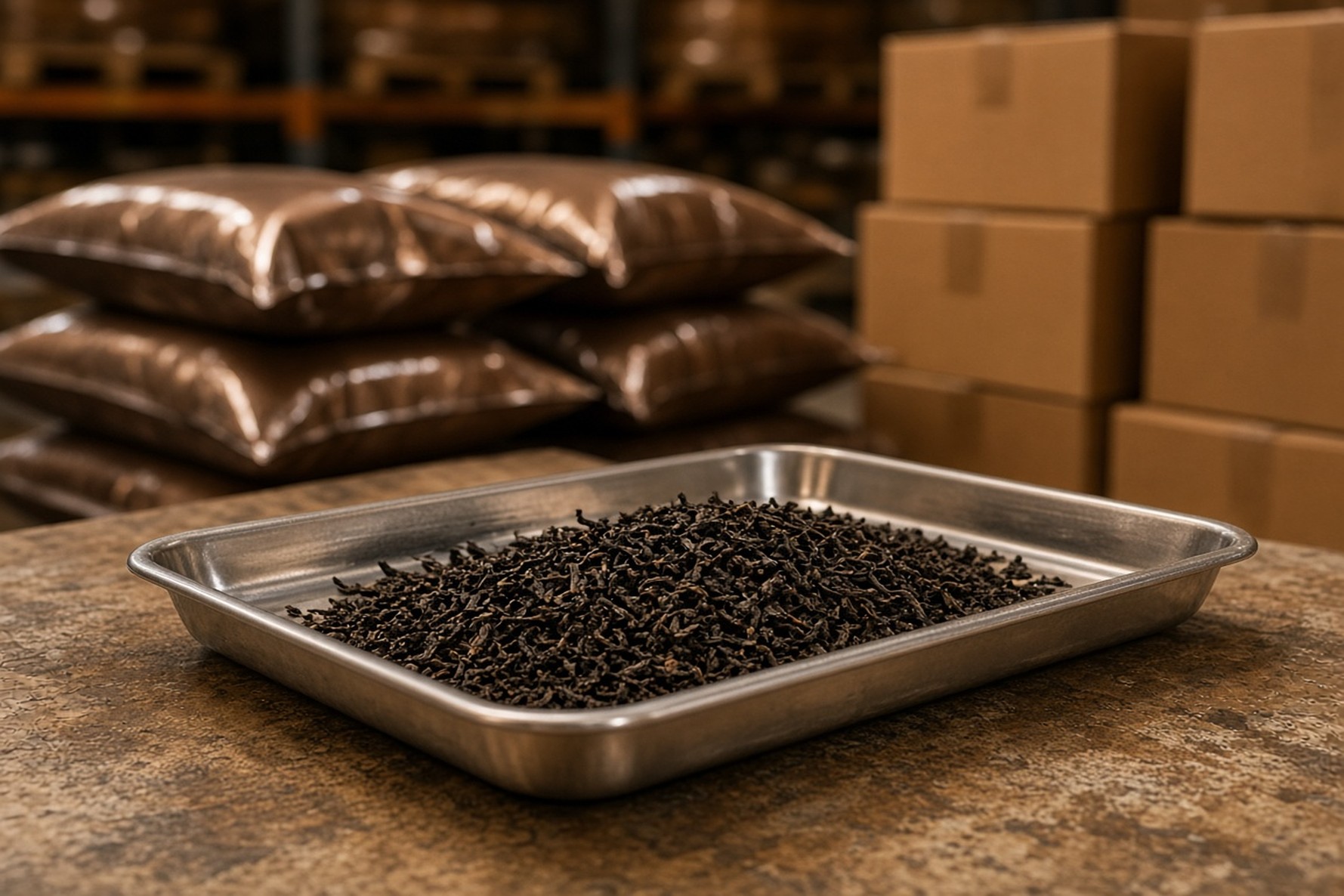
In the foreign black tea quality chain, packaging is not merely a transport cover; it is a protective layer between product and environmental factors. Dry tea, due to its porous structure, can rapidly absorb external odours, ambient moisture and adverse storage conditions.
Many quality problems observed by end consumers are not necessarily created at the producing factory. Sometimes product manufactured to acceptable quality loses characteristics due to incorrect packaging choice or unsuitable transport and warehousing conditions.
Characteristics of Suitable Export Tea Packaging
Professional packaging should fulfil several primary objectives:
- Prevent moisture absorption
- Prevent transfer of external odours
- Reduce oxygen contact
- Protect against environmental contamination
- Withstand international transport conditions
- Preserve product appearance
Packaging choice depends on market type. Tea purchased for consumer packaging has different requirements from bulk tea used by packing factories.
| Packaging type | Application | Key note |
|---|---|---|
| Multi-layer bags | Bulk transport and export | Better moisture protection |
| Master cartons | Transport and distribution | Mechanical strength matters |
| Small consumer packs | Final retail sale | Design, product information and protection equally important |
| Private-label packaging | Commercial brands | Technical specification alignment with target market is essential |
Common Packaging Errors
Some problems observed in the market include:
- Use of packaging with insufficient moisture barrier
- Excessive product compression
- Mismatch between package type and transport route
- Storage of packages in humid environments
- Package damage during handling
For importers, packaging type review should be part of supplier evaluation, not an after-purchase concern. In export orders, specifying package weight, wrapper type, units per carton, palletisation method and delivery conditions can prevent later disputes. Buyers seeking foreign black tea supply from Iranian producers or regional trade routes can include precise packaging requirements in their Iranco purchase request so available options are reviewed against these criteria.
7. International Transport and Its Effect on Tea Quality
Unlike many food products, black tea does not require a cold chain; however, it is sensitive to moisture, external odours and adverse environmental conditions. Correct transport therefore plays an important role in quality preservation.
Risk Factors During Transport
In international transport, several factors can reduce product quality:
- Ambient humidity: Increased humidity inside the transport space can cause tea to absorb moisture, negatively affecting aroma, flavour and shelf life.
- Proximity to other goods: Tea readily absorbs external odours. Simultaneous transport with strongly scented goods can alter sensory quality.
- Mechanical damage: Excessive pressure on packages, poor stowage or repeated handling can cause unnecessary particle breakage.
| Factor | Appropriate action |
|---|---|
| Humidity | Use resistant packaging and control container conditions |
| Stowage | Prevent excessive pressure on packages |
| Ventilation | Prevent moisture accumulation |
| Transit time | Minimise exposure to unsuitable conditions |
Transport Mode Selection
For most commercial tea shipments, sea freight is the primary option because it enables high-volume transfer at a more reasonable cost. Air freight is typically used for samples, limited orders or high-value products. In purchase contracts, delivery terms, each party's responsibility during transport and pre-loading packaging requirements should be clearly defined.
8. Black Tea Warehousing: The Forgotten Stage in Quality Preservation
Even after shipment arrival in the destination country, the quality cycle does not end. Poor warehousing can convert sound product into low-quality stock.
Suitable Warehouse Conditions
A tea warehouse should:
- Be dry.
- Have adequate ventilation.
- Be distant from odour sources.
- Not expose product to direct sunlight.
- Prevent direct contact of packages with floor or walls.
- Maintain proper stock rotation discipline.
Stock Rotation Principle
Tea should not remain in warehouse for extended periods without a plan. Inventory management should ensure older shipments enter the sales cycle first.
| Problem | Consequence |
|---|---|
| Increased moisture | Reduced brewing quality |
| Odour absorption | Altered sensory characteristics |
| Excessive heat | Reduced aroma stability |
| Extended storage | Gradual quality decline |
Quality Control After Warehouse Entry
Professional importers typically do not rely on delivery-time inspection alone. Re-sampling after shipment arrival can reveal differences between the preliminary sample and final product.
9. Market Distribution and the Effect of Final Packaging on Consumer Experience
The final stage of the quality cycle is when product reaches the consumer. At this point, actual product quality is measured by customer perception. Tea may have acceptable quality at the producing factory, but if final packaging, in-store storage or display methods are unsuitable, the consumer experience will change.
Factors Affecting the Sales Stage
Product appearance: Dry tea colour, particle shape and uniformity affect the customer's first impression.
On-pack information: Product labels should present information required by the destination market appropriately. Details such as product type, net weight, production date and market-relevant specifications must comply with that market's requirements.
Retail Shelf Conditions
Retailers should store product under conditions where:
- Humidity is controlled.
- Packaging remains undamaged.
- Product is not placed near heat sources.
- Contact with strongly scented materials is minimised.
10. Comparison of Quality-Sensitive Points Across the Supply Chain
Foreign black tea quality is the result of coordinated performance across multiple stages. Weakness at any stage can change the final outcome.
| Stage | Primary risk | Control action |
|---|---|---|
| Green-leaf production | Poor raw-material quality | Select a reputable supplier |
| Processing | Inadequate oxidation control | Factory process control |
| Grading | Product non-uniformity | Precise grade definition |
| Packaging | Moisture and odour absorption | Select appropriate packaging |
| Transport | Unsuitable environmental conditions | Loading management |
| Warehousing | Gradual quality decline | Storage condition control |
| Retail | Poor consumer experience | Correct product display |
Importer Checklist Before Placing a Black Tea Order
Before placing a bulk order, the buyer should specify the following:
- What is the product's final end use?
- Which grade is required?
- Is the tea for direct sale, repackaging or industrial use?
- What are the approved sample specifications?
- How is shipment acceptance defined?
- What is the export packaging type?
- How are package weight and unit count determined?
- What labelling requirements apply in the destination country?
- Which tests are required for quality confirmation?
- How are transport and delivery terms defined?
- What lead time is required for order preparation?
- Is a sample available before bulk purchase?
In professional transactions, the more precise the purchase specifications, the lower the likelihood of mismatch between buyer expectations and delivered product.
What Information Is Required for Accurate Black Tea Pricing?
Foreign black tea pricing is not determined by a single factor. Tea type, grade, quality, order volume, packaging and destination all affect the final price.
For a more accurate quotation, the buyer should specify:
- Required tea type
- Product grade
- Final application
- Order quantity
- Packaging type
- Weight per package
- Destination country
- City or delivery location
- Preferred transport mode
- Need for private-label or custom-branded packaging
Requests that include this information enable more precise comparison of supply options. At Iranco, buyers can submit purchase specifications including product type, volume, packaging and destination so suitable supply options are reviewed against their requirements.
Export Black Tea Procurement Based on Buyer Specifications
In international black tea purchasing, the difference between two offers is not limited to price alone. Grade type, uniformity, sensory characteristics, packaging type, order volume and transport conditions can all change the final transaction outcome.
Iranco enables buyers and importers to submit black tea purchase requests based on precise product specifications. Information such as tea type, required grade, order quantity, packaging type and destination country can be included in the request so available supply options are reviewed against buyer needs.
For commercial orders, defining specifications precisely before purchase makes product selection, sample receipt and offer evaluation more structured.
Conclusion
The foreign black tea quality cycle begins at production but continues until consumption. True shipment quality is preserved only when all supply-chain links — from raw-material selection through final distribution — operate in coordination.
For professional buyers, attention to country of origin or package appearance alone is insufficient. Review of grade, technical specifications, processing conditions, packaging type, transport method and quality-control standards forms the foundation of successful purchasing.
The most important factor in foreign black tea supply is converting the general concept of quality into measurable criteria. When the buyer knows which product, with which specifications, for which market and under which conditions is needed, the ability to select an appropriate supplier and reduce transaction risk increases.
In a competitive tea market, the difference between an ordinary purchase and a professional one is usually found in details such as precise grade definition, sample control, packaging management and supply-route oversight.
Frequently Asked Questions
Which foreign black tea type is best for import?
The best tea type depends on purchase objective. For direct retail sale, sensory characteristics and consumer acceptance carry greater weight; for tea-bag production or industrial use, particle uniformity and brewing strength become more important.
Does a lower tea price always mean a more economical purchase?
No. A lower price may come with reduced quality, unsuitable grade or correction and repackaging costs. An economical purchase is formed when quality, product application and total cost are evaluated together.
How is black tea quality assessed before bulk purchase?
Sample review, visual evaluation, quality-control testing and comparison of product technical specifications with market requirements are among the most important methods.
What is the main cause of tea quality loss in warehousing?
Moisture, absorption of external odours, excessive heat and long-term storage are the primary factors reducing tea quality in warehouse conditions.
Does packaging type affect tea price?
Yes. Wrapper type, package weight, custom design, unit count and destination-market requirements can all change the final product cost.
How can black tea be sourced directly from Iran?
Purchase specifications must first be defined, including product type, grade, order quantity, packaging and destination. Supply options can then be reviewed based on this information. International buyers can submit these specifications to Iranco as a purchase request so available options are evaluated.
What is the minimum order quantity for black tea import?
Order volume depends on transaction type, packaging, supplier capacity and transport conditions. Bulk orders typically require more precise planning for transport and warehousing.
What information is needed to obtain black tea pricing?
Tea type, grade, quantity, packaging type, destination, delivery terms and quality-control requirements are the primary information needed for a more accurate price quotation.
Featured Products


Related Articles



