 Iranco Magazine Team
Afghanistan food market — high-demand products, Iran and Central Asia corridors, customs tariffs, import licences, documentation and real trade costs
Market Report · Food Imports · Afghanistan · Trade Borders
Afghanistan Food Imports; Market, Borders & Regulations
Afghanistan food market analysis — high-demand products, Iran and Central Asia import corridors, customs tariffs, import licences, documentation and real trade costs for Iranian exporters.
Analytical Introduction
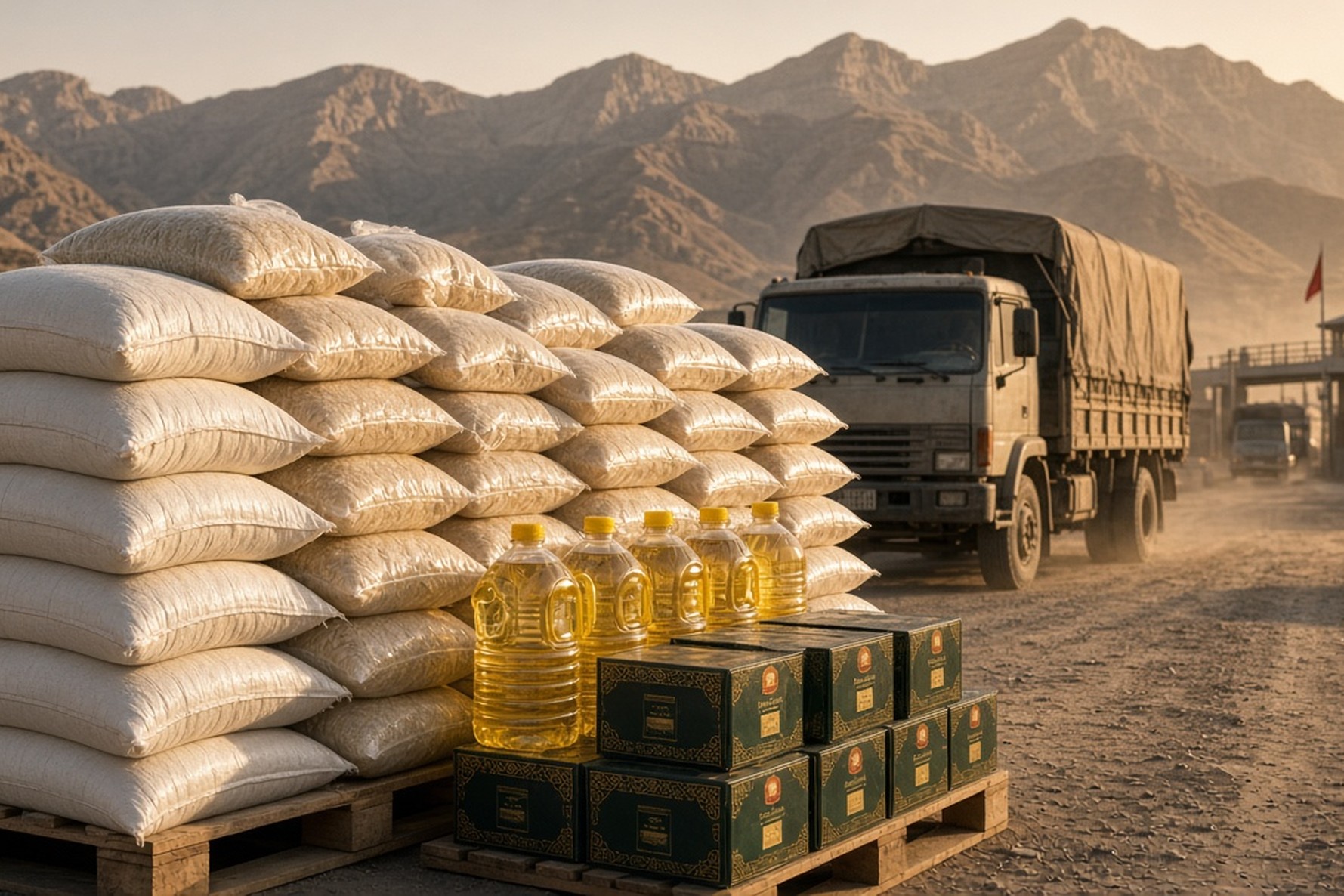
Afghanistan is one of the region's most important import markets for food. Wheat flour, rice, edible oil, sugar, tea, dairy, cereal products, biscuits, confectionery, chocolate, beverages and a wide range of packaged foods all sit in this country's trade basket. For Iranian exporters, success in this market depends on more than factory price alone — border route, tariff, product registration and import licence, importer credibility, shelf life, packaging, freight cost and distribution capacity from Herat or other consumption centres all play decisive roles.
Afghanistan's food market should not be treated as a discount outlet for cheap goods alone. Demand spans price-sensitive staples — flour, rice, edible oil, sugar and tea — through to branded factory products: dairy, confectionery, beverages, cereal-based foods and raw materials for local food plants.
Import dependence remains high. In 2024 total merchandise imports reached roughly USD 10.8 billion, with food accounting for about USD 2.2 billion — one of the country's largest import groups. For Iranian exporters this figure carries a clear message: Afghanistan is not an incidental or marginal food market; food imports are a structural part of the national supply chain.
Import geography has shifted in recent years. Iran was Afghanistan's largest source country in 2024. By June 2026, roughly 48% of total imports moved through Central Asian corridors and about 46% through the Iran corridor. Border choice is no longer purely a matter of distance; customs capacity, rail access, corridor stability and the final destination inside Afghanistan matter more.
For Iranian companies, western Afghanistan — especially Herat — offers clear land-access advantages. But successful sales require precise knowledge of product fit, distribution channels, tariffs and Afghan regulations. The cheapest factory price is not necessarily the most competitive offer; importers compare landed cost to their warehouse, clearance time, capital tied up, spoilage risk and speed of resale.
1. What Food Products Do Afghan Traders Seek?
Afghan import demand divides into several main groups. Each group has different buying behaviour, and exporters should not approach all of them with a single sales pattern.
Staples and high-turnover goods
Wheat flour, rice, edible oil, sugar, tea and some pulses form a large wholesale market. Afghan wheat flour imports in 2024 were reported at roughly USD 641 million, largely supplied from Central Asia — especially Uzbekistan and Kazakhstan. Rice is equally significant: Pakistan's recorded rice exports to Afghanistan in 2024 alone were about USD 390 million and over 611,000 tonnes.
Edible oils and fats
Liquid oils, household vegetable oils and fats used by bakeries, confectioners and food factories are high-volume categories. Bulk buyers focus on landed cost per kg or litre, product composition, net weight, shelf life, packaging strength on rough roads, household and bulk pack options, and batch-to-batch quality consistency.
Sugar, confectionery and chocolate
Afghanistan is not only a market for raw sugar. Biscuits, cakes, cookies, wafers, chocolate, candy and baking inputs have a visible place in retail networks. Protective tariffs on domestic production have risen — in 1403 tariff decisions, duties on chocolate, biscuits and cakes/cookies increased to 30%. A product with an attractive factory price in Iran may lose its edge once tariff, freight, unloading, distribution and wholesaler margin are added.
Cereal-based products
Pasta, noodles, instant cereals, packaged flour, industrial bakery inputs and other flour-based products have distinct demand. Competitive pricing matters, but cooking quality, pack weight, bag or wrap durability in warm warehouses and expiry dates are equally important.
Milk and dairy
Evaporated milk, milk powder, shelf-stable dairy and some cold-chain products are traded. Refrigerated imports are more complex; for Iran–Afghanistan road trade, ambient-stable or heat-tolerant products are usually easier to operate. Protective tariffs have also increased — evaporated milk rose to 30% in one 1403 decision.
Tea and beverages
Tea is a well-known Afghan staple. China exported over 1.28 million kg of tea to Afghanistan in 2024, worth more than USD 3.6 million. Juices, soft drinks, drink powders and syrups also have markets, but each product needs its own tariff review. Alcoholic goods are subject to separate legal and religious restrictions.
Canned goods, sauces, tomato paste and ready foods
Tomato paste, canned vegetables and pulses, pickles, sauces, condiments, jam, processed fruit and shelf-stable meals are relevant for urban and wholesale channels. For Iranian exporters, proximity to the border enables more frequent road shipments; however, the weight of paste and canned goods makes freight a major share of final price.
| Product group | Demand type | Main buyer sensitivity | Market competition |
|---|---|---|---|
| Flour & cereals | Daily bulk consumption | Price & steady supply | Very high |
| Rice | Household, wholesale, food service | Cooking quality & price | Very high |
| Edible oil | Household & industrial | Price, composition, net weight | High |
| Sugar | Household & industrial | Landed cost | High |
| Tea | Household | Taste, colour, brand, price | High |
| Biscuits & confectionery | Retail | Consumer price & packaging | High |
| Shelf-stable dairy | Household & stores | Shelf life & brand trust | Medium to high |
| Paste, sauce & canned | Household & food service | Price, weight, taste | High |
| Non-alcoholic drinks | Retail & food service | Price, brand, distribution | High |
| Food raw materials | Factories & workshops | Technical specs & supply stability | Specialist |
2. Real Market Structure: Who Buys Imported Food?
The Afghan buyer is not always a shop or end consumer. Bulk trade usually passes through several layers.
Licensed importers
This group purchases from foreign producers, manages import and clearance documents, then distributes inside Afghanistan. Iranian exporters must verify that the counterparty holds legal permission to import the specific food product — owning a warehouse or running wholesale activity alone is not equivalent to a food import licence.
Wholesalers and market networks
A large share of food moves from warehouses in Herat, Kabul, Mazar-i-Sharif, Kandahar and other trade hubs into wholesale networks. These buyers favour fast inventory turnover; premium packaging or features that raise consumer price without clear value are not always advantages.
Urban retail
In Kabul, Herat, Mazar-i-Sharif and other larger cities, branded packaged foods, beverages, biscuits, confectionery, canned goods, shelf-stable dairy and factory-style consumer products have defined channels. Shelf appearance, pack weight, shelf life and label clarity matter more here.
Food factories and workshops
The raw-materials market differs from consumer goods. Plants may buy oil, sugar, flour, starch, concentrate, milk powder, permitted additives, baking inputs or packaging materials. Consumer packaging is irrelevant; buyers focus on technical analysis, batch consistency, price per kg, payment terms and continuous supply.
3. Iran's Role in Supplying the Afghan Market
Iran was Afghanistan's largest import source in 2024, accounting for about 30% of total imports. In June 2026 Iran remained the top source at roughly 31%. These figures cover all commodity groups, not food alone, but they show substantial transport, trade, payment, warehousing and distribution links between the two countries.
Iran's advantage for western Afghanistan
For buyers in Herat, Farah and parts of western Afghanistan, Iran is a nearby supplier. A shorter route can mean less capital tied up in transit, more frequent orders, faster response to demand shifts, easier sample and trial shipments, reduced expiry risk for some products and simpler communication with producers. This advantage is especially important for low- to medium-value-per-tonne goods.
Who competes with Iran?
Competitors vary by product. Uzbekistan and Kazakhstan dominate flour and cereals. Pakistan is strong in rice and some foods. Regional vegetable-oil producers, Turkey, China, India, European suppliers and Afghan domestic production compete in processed foods. The phrase "Afghanistan is a nearby market for Iran" alone is not enough for an export decision.
Does the Iranian product still offer an acceptable price–quality–shelf-life balance after tariff, freight, clearance and distribution margin?
4. Where Do Afghanistan's Imports Enter Today?
Afghan import corridors have shifted significantly in recent years. In June 2026 Central Asian corridors handled about 48% of total imports and the Iran corridor about 46%. Air freight was roughly 5%, while Pakistan-border flows were reported as very limited due to border disruptions.
Iran corridor: Dogharoon – Islam Qala
The primary land route for Iran–Herat trade exits Dogharoon and enters at Islam Qala customs. It is the natural choice for shipments from Khorasan Razavi, Tehran, central Iran and much of the country heading to Herat. After Islam Qala, cargo can be unloaded in Herat or continue to other Afghan destinations. It is especially important for dry foods, biscuits, confectionery, canned goods, paste and sauces, beverages, shelf-stable dairy, food raw materials, oil and packaged products.
Milak – Zaranj
Iran's Milak border connects to Zaranj in Nimroz province — suitable for south and south-west destinations or cargoes using the Sistan corridor. Zaranj links to the Zaranj–Delaram highway. Route choice between Islam Qala and Zaranj must follow final destination.
Mahiroud – Abu Nasr Farahi
Mahiroud in Iran and Abu Nasr Farahi in Farah province serve some western and south-western destinations. This border makes sense when origin distance, inland destination, fleet availability and clearance conditions align with the shipment.
Hairatan — northern rail gateway
Hairatan on the Uzbek border is a major rail entry point. Official Afghan rail statistics for solar year 1404 show more than 4.26 million tonnes moved through Hairatan. Cereals, flour, oil, sugar and other heavy cargoes benefit from northern rail capacity.
Aqina and Torghundi
These borders connect Afghanistan to Turkmenistan for Central Asian and transit cargoes. Rail throughput in 1404 exceeded 743,000 tonnes at Torghundi and 472,000 tonnes at Aqina.
Khaf – Herat railway
The Khaf–Herat line is a strategic option to expand Iran–Afghanistan rail share. More than 642,000 tonnes moved on this axis in 1404. For heavy, low-margin foods such as flour, sugar and cereals, rail development matters greatly.
| Corridor | Origin link | Afghan entry point | Key use |
|---|---|---|---|
| Dogharoon – Islam Qala | Iran | Herat | Iranian & transit goods, fast access to Herat |
| Milak – Zaranj | Iran | Nimroz | South-west, Zaranj–Delaram axis |
| Mahiroud – Abu Nasr Farahi | Iran | Farah | West & south-west markets |
| Khaf – Herat | Iran | Herat | Rail freight, bulky cargoes |
| Hairatan | Uzbekistan | Balkh | Cereals, flour, heavy north trade |
| Aqina | Turkmenistan | Faryab | Central Asian & transit cargoes |
| Torghundi | Turkmenistan | Herat | Rail & west Afghanistan trade |
| Torkham | Pakistan | Nangarhar | Traditional east & Kabul access |
| Spin Boldak | Pakistan | Kandahar | Southern Afghanistan |
5. Choosing the Right Border for Iranian Exporters
In food exports, border selection should follow final destination, not precede it. A Mashhad plant selling to a Herati importer usually gains a clear advantage on Dogharoon–Islam Qala; Kandahar-bound cargo requires comparison of Islam Qala, Zaranj and other options.
Real route cost = freight to border + border operations + dwell time + clearance + inland Afghan freight + spoilage or damage risk + financial cost of tied-up capital.
Truck rate alone is not a valid comparison metric.
Dry foods
For flour, rice, sugar, pulses, biscuits and other dry goods, moisture control, truck cleanliness, odour prevention and pack integrity matter.
Heat-sensitive products
Chocolate, some confectionery, dairy and fatty products are more vulnerable in summer. If several days' border delay risks damage, a smoother route at higher freight may be cheaper overall.
Refrigerated products
Meat, some dairy, frozen foods and chilled products require cold chain aligned with product specifications. Refrigeration equipment, temperature logging and expected border dwell must be checked before loading. Border, delivery city and cost responsibility at each stage should be fixed before proforma invoice issue.
6. Rules and Conditions for Food Entry into Afghanistan
Commercial food import does not end when a truck reaches the border. Importers need appropriate business status and licences; products requiring pre-import registration or permission must complete steps with the responsible authorities first. The 2025 law on preventing smuggling of food, spices and health products published in Afghanistan's official gazette sets an important framework. Where the Ministry of Public Health or Ministry of Agriculture requires pre-import registration or permission, the importer must act before import. Carriers may not bring food cargoes belonging to firms lacking valid trade licences and food import permission. Buyer credibility should not be assessed solely on prepayment or warehouse ownership.
Food product registration
Afghanistan's National Food and Spices Administration manages food registration and pre/post-import market control. Before producing Afghanistan-specific packaging, confirm whether the product requires registration, whether the importer or their agent files the dossier, which manufacturer documents are required, whether samples are requested, which analyses must be submitted, and whether formula or packaging changes require dossier updates. Starting mass production before answering these questions can freeze capital in unsellable stock.
Shipment analysis certificate
Where quantity and quality assessment cannot be done inside Afghanistan, the importer must provide the relevant batch analysis certificate from the producing factory. Iranian exporters need real batch traceability and COA linked to the actual shipment — a generic lab report from months ago for a different product is not a substitute.
Original document delivery
After arrival, the importer must deliver original documents to customs and relevant agencies. Mismatch among invoice, packing list, certificate of origin, waybill, label and analysis certificate creates cost and delay.
| Document | Purpose |
|---|---|
| Commercial invoice | Seller, buyer, goods and transaction value |
| Packing list | Package count, net/gross weight, layout |
| Certificate of origin | Proof of production or origin country |
| Transport document | Vehicle and shipment identification |
| Importer licence | Legal authority to import |
| Product licence or registration | For regulated products |
| Analysis certificate | Quality and hygiene proof |
| Health or quarantine documents | For applicable regulations |
| Manufacturer documents | If requested by registration authority |
| Contract or proforma | Commercial basis of the deal |
7. How Are Food Import Tariffs Calculated in Afghanistan?
A common pricing mistake is assuming one general food tariff percentage. No such single rate exists. Duties are set by HS code — sometimes with national codes — plus new tariff decisions and even seasonal tariffs.
| Chapter | Product group | Published range |
|---|---|---|
| Chapter 7 | Edible vegetables | 5–60% |
| Chapter 8 | Fruit & edible nuts | 10–60% |
| Chapter 9 | Tea, coffee & spices | 2.5–16% |
| Chapter 10 | Cereals | 2.5 & 5% |
| Chapter 11 | Milling products | 2.5 & 5% |
| Chapter 17 | Sugar & confectionery | 2.5–20% |
| Chapter 18 | Cocoa & preparations | 2.5–10% |
| Chapter 19 | Cereal & flour preparations | 5–20% |
| Chapter 20 | Vegetable & fruit preparations | 10–60% |
| Chapter 21 | Miscellaneous food preparations | 10–30% |
This table illustrates tariff structure, not final duty on a specific shipment. Afghanistan has raised duties on several products to protect domestic production. In 1403 tariff decisions:
- Chocolate rose to 30%.
- Biscuits rose to 30%.
- Cakes and cookies rose to 30%.
- Evaporated milk rose to 30%.
- Noodles rose to 20%.
In other decisions, duties on pasta and chips also increased. Exporters must match exact product description, composition, pack format and HS code with the importer and customs broker before quoting a firm price.
Seasonal tariffs
Some agricultural products face seasonal tariffs to protect domestic harvest periods. Export pricing for seasonal fruits and vegetables should not be assumed flat year-round.
8. Real Cost of Importing Food into Afghanistan
For professional importers, factory price is only one component. Comparison must use delivered cost.
Cost components
- Product purchase price: The largest component for many goods — quality, pack weight, brand, order volume, raw materials and payment terms.
- Domestic haul in exporter country: Factory distance to Dogharoon, Milak, Mahiroud or rail terminal directly affects cost.
- International freight: Truck type, weight, season, backhaul balance, border conditions and fleet demand.
- Border and customs charges: Import duty is not the only cost — brokerage, unloading, dwell, warehousing, weighing and related operations vary by file and corridor.
- Testing and control: Sampling, lab tests, registration or specialist control add time and cost.
- Inland Afghan freight: Islam Qala is not the commercial end unless delivery is border-only; post-border freight must be calculated separately.
- Capital cost: Weeks tied up in purchase, transport and clearance have a financial cost.
| Cost component | Determining factors |
|---|---|
| Product price | Quality, volume, pack weight |
| Haul to border | Factory-to-exit distance |
| International freight | Truck, weight, route, season |
| Import duty | HS code & tariff decision |
| Official fees | Customs & administrative services |
| Testing & registration | Product nature |
| Storage & dwell | Clearance speed |
| Inland freight | Final Afghan city |
| Loss & damage | Breakage, leakage, spoilage, heat |
| Financial cost | Capital tied-up period |
| Distribution margin | Wholesale & retail layers |
Purchase price + haul to border + international freight + customs duty + official fees + testing & control + dwell + inland Afghan freight + probable loss = warehouse entry cost.
Distribution margin and profit are added afterward. This enables real comparison with Pakistani, Turkish, Central Asian and other suppliers — not factory price alone.
9. Packaging Suited to the Afghan Market
Packaging must align with transport route and distribution model.
Dry goods
For rice, flour, sugar and pulses, bag strength is critical. Tears during loading, unloading and rough roads become weight loss and commercial disputes. Bag size must match real weight and stitching must survive repeated handling.
Biscuits and fragile products
Outer cartons must resist vertical compression. Over-empty cartons allow internal movement; over-tight stacking causes breakage. Packaging should be road-tested under real transport conditions before bulk export.
Oil, sauces and liquids
Leakage, container deformation and cap failure are the main risks. A cheap container that leaks in transit costs more than a better one.
Heat-sensitive products
Chocolate, some confectionery and fatty products must match route temperatures. A closed truck or container in direct sun can reach levels that alter appearance and texture.
Label information
For formal market entry, label artwork must be confirmed with registration requirements and the importer before printing. Product name, ingredients, net weight, batch, production and expiry dates, storage conditions, manufacturer details and origin must align with commercial documents. Afghanistan's standards body has expanded food and labelling standards in recent years.
10. What Afghan Importers Look for in a Supplier
Price still matters, but sustainable deals usually rest on several factors at once.
- Supply stability: Importers with sales networks cannot accept different taste, colour, weight or packaging every shipment.
- Remaining shelf life: Goods arriving with much of their shelf life already consumed are unattractive for import markets.
- Repeatable pricing: A low first shipment followed by a sharp second-order increase usually ends the relationship.
- Pack integrity: Cartons must survive to destination, not just leave the factory looking fine.
- Document readiness: Invoice, packing list, origin, analysis and related papers must be fast and consistent.
- Private label capability: Minimum order, design and print cost, brand ownership, label language and registration responsibility must be agreed before production.
11. Pre-Order Checklist for Importers
- Define exact product name and specifications.
- Confirm usable tariff code with customs broker.
- Check current duty and any seasonal tariff.
- Verify company food import licence.
- Confirm whether pre-import registration or permission is required.
- Obtain physical sample before bulk order.
- Record approved sample specs in contract.
- Review composition, net weight and shelf life.
- Request COA or relevant test documents.
- Approve final label and carton artwork before print.
- Fix units per carton and cartons per truck.
- Select entry border based on destination city.
- Calculate Iran and Afghanistan inland freight separately.
- Clarify clearance responsibility and customs costs in contract.
- Set acceptance criteria for damaged or short goods.
- Record payment terms and transaction currency precisely.
- Verify supplier capacity for follow-on orders.
- Define minimum remaining shelf life at delivery.
- Specify insurance or damage liability for transport.
- Size first order to real distribution capacity.
12. Information Needed for an Accurate Quote
A request for "food prices for Afghanistan" is not enough for a professional offer. Buyers should specify:
- Exact product name
- Required composition or technical specifications
- Producer brand or private label
- Pack weight
- Units per carton
- Approximate order volume
- Consumer or bulk packaging
- Required shelf life
- Destination city in Afghanistan
- Preferred border
- Transport mode
- Delivery terms
- Required tests or certificates
- Sample needs
- Expected reorder frequency
"Tomato paste for Herat" is too vague. A professional request specifies pack weight, target brix, container type, units per carton, order quantity and delivery point. Importers can submit these details in an Iranco purchase request so available Iranian supply options are reviewed against actual commercial needs.
13. Sourcing Food for the Afghan Market via Iranco
In Afghanistan food trade, two offers differ by more than carton price. One producer may quote a lower factory price but sit farther from the border, use weaker packaging or slow document preparation. Another with a slightly higher ex-works price may reduce the importer's final cost.
Iranco enables purchase requests with exact specifications — product, commercial grade, pack weight, order volume, destination city, entry border, test requirements and delivery terms — for review of Iranian supply options. For the Afghan market, destination city is especially important; delivered price to Herat, Kabul, Kandahar or Mazar-i-Sharif is not the same, and route choice must be part of every quote request.
- B2B purchase requests with product specs, pack weight and approximate order volume
- Comparison of Iranian producers by product and Afghan destination city
- Delivery coordination at Dogharoon, Milak, Mahiroud or the Khaf–Herat rail axis
- Expedited commercial documents, analysis certificates and shipment-related paperwork
14. Summary
Afghanistan is a large import market for food, but successful entry requires precise understanding of cost structure and distribution routes. Flour, rice, oil, sugar, tea, cereal products, confectionery and biscuits, shelf-stable dairy, canned goods, paste, sauces, beverages and food-industry raw materials all have meaningful trade presence.
For Iranian exporters, geographic proximity and access through Islam Qala, Zaranj, Abu Nasr Farahi and the Khaf–Herat railway are real advantages — yet Iran is not the only supplier. Central Asia competes strongly in cereals and flour; Pakistan in rice and some foods; other regional producers in processed categories.
Afghan food import rules are also becoming more formal. Importers need appropriate licences; regulated products require registration or permission. Document alignment, analysis, packaging and tariff codes must be resolved before loading. The decisive commercial metric is not factory price but final warehouse cost. Exporters who manage price, quality, packaging, documents and delivery timing together are best placed to build repeat sales in Afghanistan.
15. Frequently Asked Questions
Which food products have the strongest trade potential with Afghanistan?
Staples such as flour, rice, edible oil, sugar and tea have large volumes but intense price competition. Factory products — biscuits, canned goods, paste, sauces, shelf-stable dairy and food-industry raw materials — also offer opportunity. Selection should follow landed cost, tariff, distribution network and supply capacity.
What is the main import route from Iran to Afghanistan?
For Herat and much of western Afghanistan, Dogharoon–Islam Qala is the primary land route. Milak–Zaranj serves Nimroz and some southern destinations; Mahiroud–Abu Nasr Farahi serves Farah and surrounding areas. The Khaf–Herat railway is growing in importance for rail trade.
Is Iran Afghanistan's largest supplier?
In 2024 Iran accounted for about 30% of Afghanistan's total imports — the largest single source. In June 2026 Iran's share was about 31%. These figures cover all commodities, not food alone.
What is the food import tariff rate in Afghanistan?
There is no single fixed rate for all food. Duty is set by HS code and varies widely by group. Some products also have seasonal tariffs or recent tariff decisions. Exact product code must be checked before firm pricing.
Must food products be registered before entry?
Where responsible ministries require pre-import registration or permission, the importer must complete those steps. Afghanistan's National Food and Spices Administration also runs product registration and market control. Status must be confirmed before export production.
What documents are needed to sell food to Afghanistan?
Commercial invoice, packing list, transport document and certificate of origin are core trade papers. Depending on product, import licence, product registration, analysis certificate and health or quarantine documents may also be required. All information must match the actual goods and labels.
How much does freight from Iran to Afghanistan cost?
There is no universal fixed rate. Factory origin, exit border, Afghan destination, weight, dry or refrigerated truck, border conditions and market demand all affect freight. Quote the specific route and shipment at order time.
Does selling to Herat differ from selling to Kabul?
Yes. Herat is closer to the Iran border and Iranian goods usually follow a different cost and time structure than Kabul. Kabul requires inland Afghan freight, longer transit and often higher logistics cost. Destination city must appear in every price request.
How can Iranian food be sourced for the Afghan market?
Define product, specifications, pack weight, order volume, destination and delivery terms first. Then compare samples, documents, price and supplier capacity. Buyers can submit these details through Iranco as a purchase request for review of available Iranian options.
What volume is appropriate for a first order?
Order size should match sell-through speed, product shelf life, warehouse capacity, factory minimums and freight economics. For untested products, a shipment large enough for real market evaluation but within distribution capacity is usually smarter than an oversized first commitment. Volume can increase once turnover is proven.
Featured Products


Related Articles



