 فريق مجلة إيرانكو
تحويل اللون والحجم والرطوبة والعناقيد واللزوجة والمعالجة والتعبئة إلى مواصفات قابلة للإثبات للفئات الأعلى
زبيب · جودة ممتازة · تصدير · EU
الزبيب الإيراني للسوق العالمي الممتاز
كيف تُحوَّل اللون والحجم والرطوبة والعناقيد والمواد الغريبة واللزوجة ونوع المعالجة والتعبئة إلى مواصفات قابلة للإثبات للبيع في الفئات الأعلى.
Iranian raisins have a long history in regional and European trade, but entering the premium global segment depends on measurable technical specs, batch-to-batch consistency, food safety, controlled processing and valid documentation — not origin name or appearance alone. This guide shows professional importers how to separate marketing claims from quality provable in samples, laboratories and final shipments.
1. What exactly is premium raisin?
| Claim | Contract form |
|---|---|
| Large berry | Count per weight or agreed sizing method |
| Excellent colour | Approved reference or numeric colour range |
| Very clean | Foreign matter, stem and stalk limits |
| Suitable for Europe | Shipment compliance with destination rules |
Premium is not a single cultivar; it is a combination of traits defined for a specific market and application. Retail premium differs from industrial premium.
Retail: uniform colour, sound even-sized berries, minimal stems, cleanliness, controlled stickiness, natural aroma, attractive moisture-resistant pack and traceability.
Industrial bakery & cereals: stable specs shipment to shipment, controlled moisture, line-friendly size, low stems and foreign matter, flowability, controlled stickiness, metal control and acceptable safety results.
3. Iranian raisin types and processing
| Type | Colour | Use |
|---|---|---|
| Natural sun-dried | Brown to dark | Bakery, natural packs |
| Sultana | Light to dark brown | Bakery, cereals, retail |
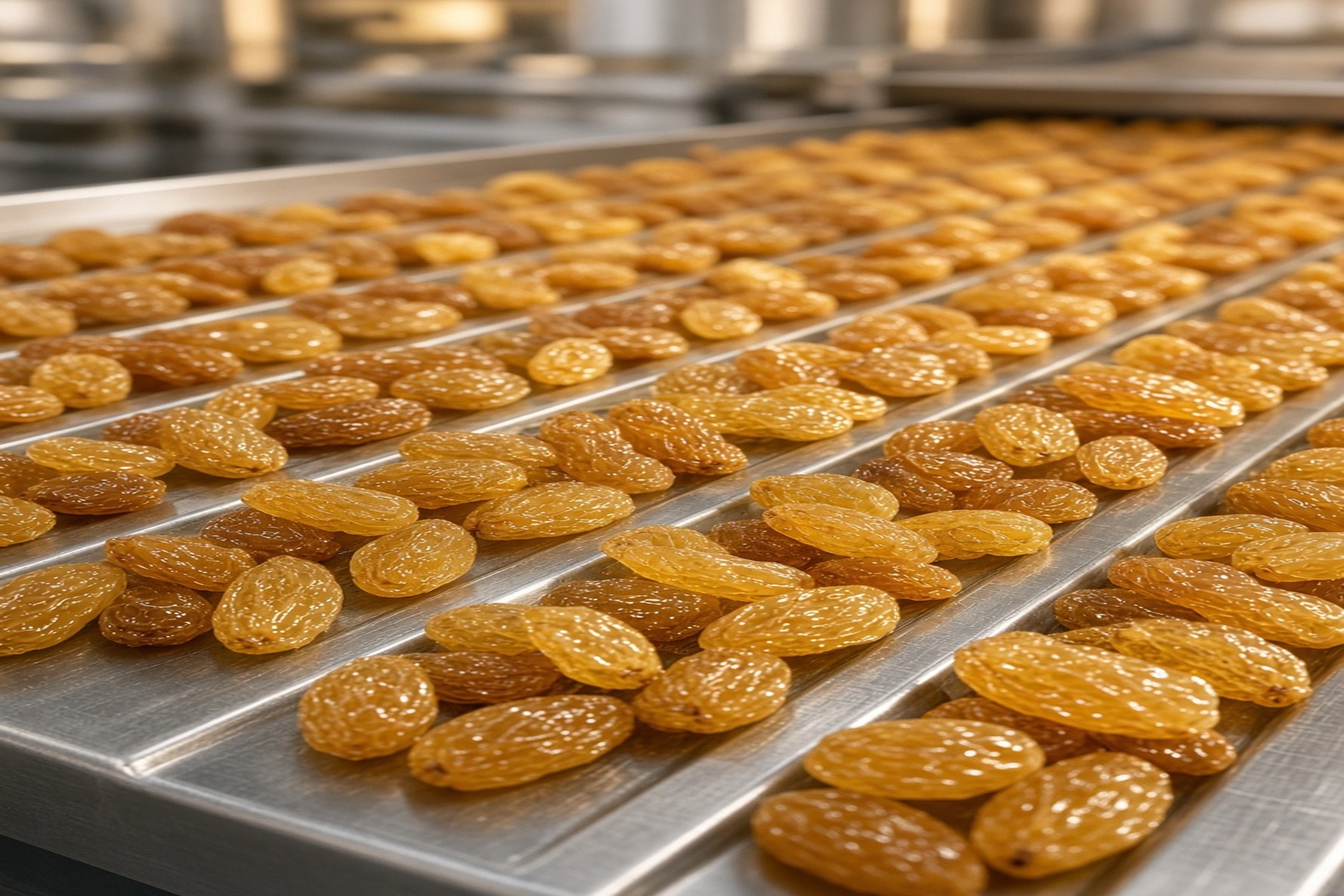
| Golden | Golden to amber | Premium retail, confectionery |
| Green/long | Green to yellow-green | Direct consumption, value-added |
Natural/sun-dried: darker brown; valued where less processing is preferred — but 'sun-dried' alone does not guarantee quality.
Sultana: major seedless trade type; industrial buyers focus on size, moisture, stems and line behaviour.
Golden: amber colour via controlled sulfiting; SO₂ and destination labelling must be controlled (EU declaration above 10 mg/kg total SO₂).
Green/long: length and colour uniformity for direct consumption and value-added packs.
2. Iran's position in international markets
In 2024 the EU imported ~227,000 t of dried grapes; ~13,900 t from Iran — an active market. Diverse destinations show one spec cannot fit all markets.
Global competition includes Turkey (volume), USA, South Africa, Chile and China. Iran's premium strategy cannot rely on price alone; repeatable, documented quality is required.
4. Technical specs before ordering
Minimum spec sheet: type, colour reference, size method, moisture, stems, foreign matter, defects, stickiness, SO₂, aflatoxin, OTA, pesticide residues, packaging and CoA.
Moisture: UNECE DDP-11 seedless 13–18%; buyers should set a target range for their application.
Size: 'large' without a reproducible method is meaningless. Colour: mobile photos are not contract references.
5. Real quality: stems, foreign matter, stickiness
Stems indicate separation and cleaning performance; in multi-container orders they scale to millions of pieces.
Sand and stone are barely tolerated in premium markets; professional lines use sieves, air, stone separators, optical sorting, magnets and metal detectors.
Stickiness depends on moisture, temperature, pack pressure and storage; clumping is an operational issue on industrial lines.
6. Testing and food safety
OTA EU limit for dried grapes: 8 μg/kg. Aflatoxin B1 max 2 μg/kg and total 4 μg/kg for consumer dried fruit.
Pesticide residues under Reg. 396/2005; 'pesticide-free' is not a professional claim.
A CoA matters when batch number, sampling date, method and shipment link are clear.
7. Why Europe matters for premium Iranian raisins
EU dried grape imports exceeded USD 605 million in 2024. Iran supplied ~13.9 kt after Turkey, South Africa, China and Chile.
Iran's edge is product diversity — only with a clear technical catalogue.
8. Standards and entry requirements
'EU compliant' is not one document. Layers: mycotoxins, pesticide MRLs, HACCP, sulfite declaration, HS 080620.
Spray programmes should start from the destination market.
9. Packaging, warehouse and transport
Bulk packs must protect against moisture uptake, contamination, odour, tearing, crushing and storage pests.
Warehouses: dry, clean, odour-free, pest control, off-floor storage, controlled stock rotation.
Shelf life depends on moisture, processing, film and storage temperature.
10. How to compare price
Lower price may mean mixed size, more stems, higher defects or limited testing.
Hidden cost of low quality: re-sorting, line stops, waste, customs delays and forced discounts.
11. Six drivers of higher-tier sales
1) Repeatable specs 2) Evidence for every claim 3) Representative samples 4) Batch-based QC 5) Packaging as part of spec 6) Traceability.
12. Supply path from Iran
Sourcing starts with spec definition, then sampling and comparison. Iranco is the B2B path to register structured food purchase requests.
قائمة تحقق المستورد قبل الطلب
- Define raisin type precisely (natural, sultana, golden, long).
- Obtain a representative sample from commercial-scale production.
- Set a target moisture range — not just 'standard'.
- Define the size measurement method.
- Set separate limits for stems and foreign matter.
- Classify defects (immature, burnt, damaged).
- Record processing and sulfite status.
- Define destination-market tests before final production.
- Specify OTA, aflatoxin and SO₂ where relevant.
- Record pack type, net weight and liner in the PO.
- Require batch numbers and traceability.
- Verify supplier capacity for the same grade.
FAQ
Is lighter colour always higher quality?
No. Uniformity, berry soundness and match to order spec matter more than absolute lightness.
Best export moisture?
No single number fits all; UNECE 13–18% for seedless; industry often wants a tighter band.
Key EU tests?
OTA, aflatoxin, pesticide MRLs and SO₂ for sulfited product; plus moisture and foreign matter.
How to evaluate 'premium' claims?
Ask the seller to convert 'premium' to numbers and lock an approved sample in the contract.
Summary
يحتاج الزبيب الإيراني إلى مواصفات قابلة للإثبات للأسواق الممتازة — وليس قصص تسويق جديدة.
منتجات مميزة








مقالات ذات صلة



