 فريق مجلة إيرانكو
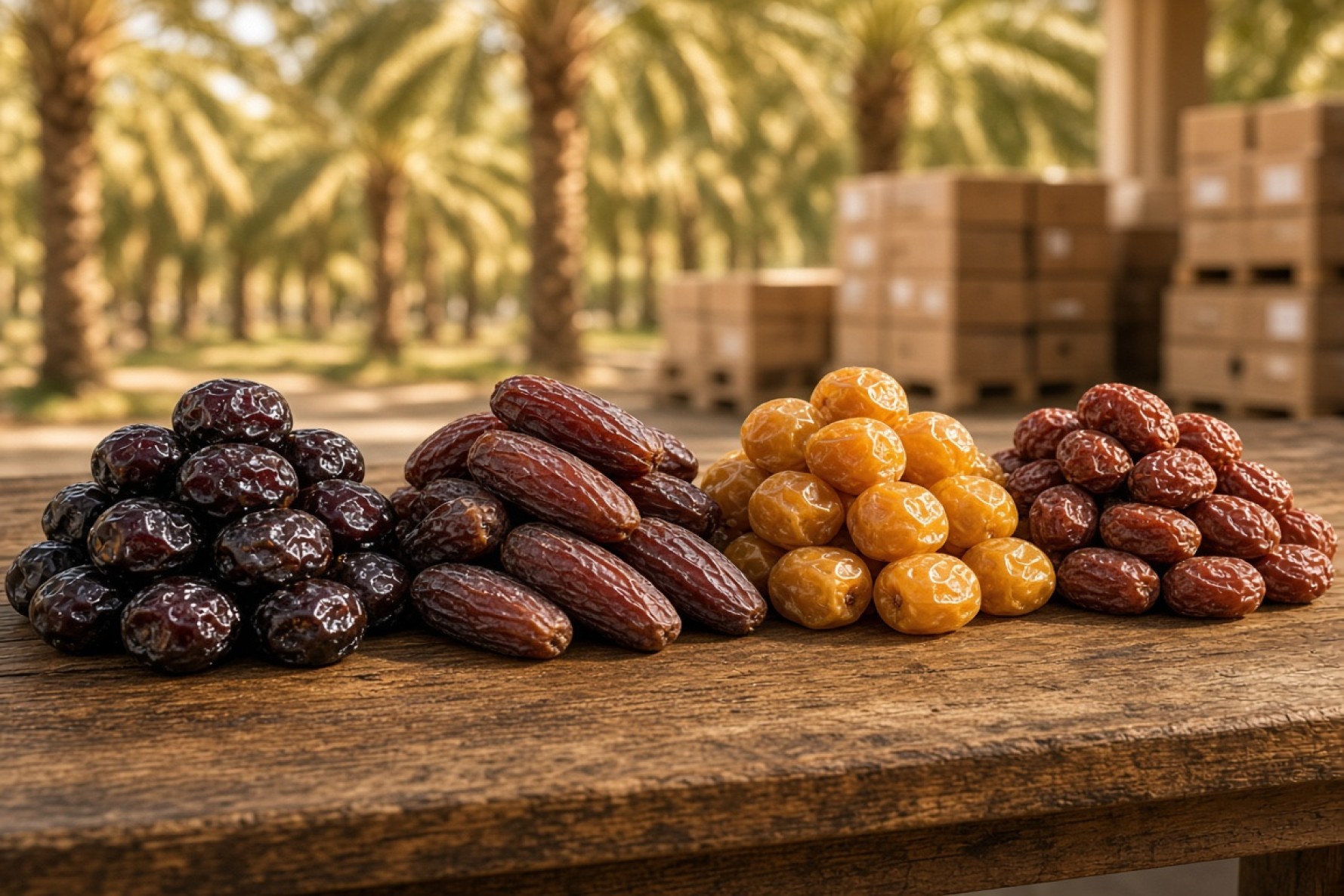
من المزافتي والبرحي إلى السعمران والزاهدي والكبكاب والربي؛ الفروق في القوام والرطوبة والاستخدام والتخزين وأسواق التصدير
أصناف التمر الإيراني · الفروق · أسواق التصدير
أصناف التمر الإيراني: الفروق والمواصفات الفنية وأهم أسواق التصدير
التمر الإيراني ليس منتجاً واحداً بمواصفات ثابتة. من مظافري الطري إلى پیارم واستعمران وزاهدي وكبكاب وربی شبه الجاف — تؤثر الفروق في القوام والرطوبة والتعبئة والمدة والنقل والسوق المستهدف مباشرة على السعر والاستخدام. هذا الدليل موجه للمشترين بالجملة والمستوردين ومديري المشتريات.
۱. مكانة التمر الإيراني من النخيل إلى التجارة العالمية
إيران من الدول القليلة التي تنتج تموراً طرية وشبه جافة وجافة على نطاق واسع.
إنتاج 1403 نحو 1.66 مليون طن. FAOSTAT 2024: 1.18 مليون طن، المركز الرابع.
اختيار الصنف أهم من ترتيب الإنتاج.
1403: 423.5 ألف طن بقيمة 391.26 مليون دولار إلى 84 دولة.
المناطق في جنوب إيران.
خوزستان استعمران؛ مظافري كرمان؛ پیارم هرمزگان؛ ربی سيستان؛ كبكاب بوشهر.
التنوع ميزة؛ رفع القيمة لكل كيلو عبر الفرز.
۲. الفروق الرئيسية بين أصناف التمر الإيراني
الرطوبة والقوام هما الفاصل التجاري.
| الصنف | القوام | اللون | المنطقة | الدور |
|---|---|---|---|---|
| Mazafati | Soft and fleshy | Very dark brown to black | Kerman, especially Bam | Retail and direct consumption |
| Piarom | Semi-dry | Dark brown | Hormozgan, Hajiabad | Premium and value-added packs |
| Stamaran/Sayer | Semi-dry | Brown to reddish brown | Khuzestan | Bulk export and processing |
| Zahedi | Dry to semi-dry | Golden yellow to brown | Fars, Bushehr, Khuzestan | Bulk trade and food industry |
| Kabkab | Soft to semi-soft | Brown to dark brown | Bushehr and Khuzestan | Direct consumption and processing |
| Rabbi | Semi-dry | Dark red to brown | Sistan and Baluchestan | Export and retail |
| Shahani | Soft to semi-dry | Golden brown | Fars | Direct consumption and processing |
| Khasoei | Soft, usually small | Light brown to red | Bushehr and Khuzestan | Specialty markets |
مظافري 23%، كبكاب 21%، شاهاني 17%، پیارم 15%، زاهدي 13%.
۳. أصناف التمر الرئيسية في التصدير
Below, six heavily traded export varieties — Mazafati, Piarom, Stamaran, Zahedi, Kabkab, and Rabbi — are reviewed in more detail. Shahani and Khasoei appear in the comparison table above.
Mazafati: soft dates dependent on temperature management
Mazafati is one of Iran's best-known dates. Ripe fruit is usually very dark, soft, and attractive in flesh-to-pit ratio for consumers.
Its retail strength — dark appearance, fleshy texture, and eating experience — is also its commercial weakness: higher moisture. The wetter the product, the more important temperature control, fermentation prevention, mould and yeast control, syrup leakage, and colour stability become.
Export Mazafati should not be compared with Zahedi or Piarom on carton weight and price alone. Buyers should fix at least moisture, size, skin condition, syrup level, storage temperature, and cold-chain status before ordering.
Piarom: semi-dry and suited to premium positioning
Piarom is mainly linked to Hajiabad in Hormozgan. Elongated shape, dark colour, and skin adhering to flesh are key visual traits.
Lower moisture than soft dates makes Piarom easier to ship and store. Together with appearance, that supports small packs and higher unit-value markets.
Commercial Piarom should be graded by size, uniformity, skin-separation percentage, surface defects, moisture, and cleanliness. The phrase "premium Piarom" alone is not a measurable specification.
Stamaran: suited to volume trade and processing
Stamaran, also known as Sayer in trade, is closely tied to Khuzestan. Agricultural reports show a large share of the province's palm area dedicated to this variety.
Semi-dry texture and simpler storage and shipping versus very soft dates make it attractive for bulk trade and food industries.
For plants pitting, chopping, making date paste, syrup, or bakery inputs, raw-material uniformity, sugar, moisture, and pitting behaviour usually matter more than luxury single-fruit appearance.
Zahedi: more resistant for shipping and industrial use
Zahedi is drier and firmer than Mazafati. Colour is usually lighter, in yellow, golden, and brown ranges.
That makes the product more resistant in bulk shipping, carton pressure, and normal distribution swings. Zahedi is a logical choice where price, shelf life, and industrial use outweigh softness and dark appearance.
Kabkab: fleshy and sweet
Kabkab is an important Bushehr and south-west Iran date. Fruit is relatively large and fleshy and softer at full ripeness than Zahedi or Piarom.
In Kabkab trade, syrup level, crushing, and stickiness inside the carton must be controlled. High-moisture product in weak stacking can deform packs under upper-layer pressure.
Rabbi: elongated and export-friendly
Rabbi is a signature product of Sistan and Baluchestan. Elongated shape and semi-dry texture suit export channels.
Versus soft dates, Rabbi tolerates shipping and warehousing better, but market quality varies widely; size, colour uniformity, firmness, dryness, and defects should be written into the contract.
۴. المواصفات الفنية التي يحددها المشتري
A common bulk-buying mistake is asking for "Grade A Mazafati price" or "export Piarom price". Two sellers may use the same phrase but supply measurably different goods.
| Parameter | How to define | Why it matters |
|---|---|---|
| Variety name | Mazafati, Piarom, Stamaran, etc. | Core product identity |
| Production region | Province and district if needed | Traceability and traits |
| Ripeness stage | Rutab or tamr as applicable | Texture and shelf life |
| Moisture | Agreed % and test method | Stability and storage |
| Size | Fruit weight or count per unit weight | Grading and price |
| Colour | Acceptable colour range | Visual uniformity |
| Skin condition | Maximum skin separation | Retail importance |
| Defects | Permitted damage and spot % | Acceptance criteria |
| Insect contamination | No live infestation | Safety and acceptance |
| Pit | Pitted or unpitted | Application |
| Packaging | Net weight, inner pack, master carton | Shipping and supply |
| Storage conditions | Temperature and RH | Quality retention |
| Tests | Microbiology, residues, mycotoxins | Destination compliance |
| Traceability | Batch code and pack date | Quality control |
Codex CXS 143-1985 defines optional size classes for pitted dates: large below 80 fruits per 500 g, medium 80–100, small above 100. Minimum weight is 4.75 g pitted and 4 g unpitted. Many commercial buyers use their own specs; count per unit weight should be written directly into the contract.
۵. جودة التصدير والعيوب
Date quality combines appearance, flavour, texture, cleanliness, safety, and supply-chain stability. A sample can look excellent at inspection yet decline after weeks because of wrong moisture, high microbial load, or weak cold chain.
Codex sets defect groups for dates intended for direct consumption: defined surface spots max 7% by count, combined damage and immature fruit max 6%, soil/foreign matter and insect-related defects max 6%, combined fermentation, mould, and decay max 1%. Live infestation is not permitted.
Main visible defects
Severe spotting and colour change, sunburn, mechanical damage, flesh tearing, immature fruit, surface contamination, abnormal skin separation, heavy syrup leakage, and pit pieces in pitted product are key inspection points.
| Defect | Sign | Commercial message |
|---|---|---|
| Mould | Visible fungal growth | Shipment rejection risk |
| Fermentation/souring | Alcoholic or acidic odour | Moisture and poor storage |
| Insect contamination | Insects, larvae, or frass | Serious acceptance issue |
| Crushing | Torn flesh and shape loss | Retail value loss |
| Skin separation | Skin detached from flesh | Reduced shelf appeal |
| Surface sugar crystals | Sugar bloom | Mainly appearance |
| Immature fruit | Low weight, rubbery texture | Reduced uniformity |
| Foreign matter | Sand, soil, plant debris | Weak sorting |
A common risk is a sample taken from the best stock while the main lot has wider quality spread. The fix is acceptance criteria with numbers, not adjectives.
۶. الاختبارات المخبرية
Required testing should match product type and destination. Running one expensive fixed panel on every shipment is rarely sensible.
Moisture
Moisture is one of the most influential date parameters. It affects texture, shelf life, yeast and mould risk, and cold-chain choice.
Codex CXS 143-1985 sets maximum moisture in the 26–30% range depending on invert-sugar group. Commercial contracts can be much tighter.
Microbial load, mould, and yeast
For soft moist dates, mould and yeast control is especially important. High moisture, heat, and condensation inside packs create unfavourable conditions.
Inspectors should check abnormal odour and fermentation signs, not only surface appearance.
Aflatoxin and ochratoxin
Contaminant rules matter strongly in the EU. For consumer dried fruit/nuts, maximum aflatoxin B1 is 2 µg/kg and total B1+B2+G1+G2 is 4 µg/kg.
Maximum ochratoxin A for other dried fruit is 2 µg/kg. Exporters targeting Europe must control sourcing, drying, warehousing, sampling, and accredited testing.
Pesticide residues
The EU manages maximum residue limits under EC 396/2005. Each active substance must be checked separately; there is no single "date residue" number.
For European buyers, multi-residue testing aligned with orchard risk profile is usually more valuable than a generic "pesticide-free" statement.
۷. دول تصدير التمر الإيراني
Iranian dates are not limited to neighbouring markets. FY 1403 domestic data show exports to 84 countries, and 2024 mirror-trade data confirm significant Iranian presence in Asia, Europe, and other regions.
Under HS Code 080410, importer-reported 2024 data show India as one of the largest recorded destinations for Iranian dates, followed by significant volumes in Pakistan, Turkey, Kazakhstan, and China.
| السوق | الحجم | القيمة | ملاحظة |
|---|---|---|---|
| الهند | 105.1k t | $45.3M | حجمي |
| باكستان | 67.2k t | $15.5M | سعر |
| كازاخستان | 27.6k t | $10.5M | آسيا الوسطى |
| تركيا | 27.1k t | $14.6M | إقليمي |
| الصين | 13.5k t | $7.8M | نمو |
| أذربيجان | 7.4k t | $8.7M | قريب |
| ماليزيا | 3k t | $6.8M | معبأ |
| ألمانيا | 2.6k t | $6.2M | قيمة |
These figures come from importer-reported data for calendar 2024 and should not be merged directly with Iran's FY 1403 totals. HS 080410 does not split varieties.
Claims such as "Country X is the largest Piarom buyer" need variety-specific evidence; general HS 080410 statistics alone cannot prove them.
۸. متطلبات كل سوق
India
India is one of Iran's highest-volume date markets, spanning bulk trade, consumer packs, and processing.
Indian food standards set maximum moisture at 30% and require product free of objectionable foreign matter, live insects, mould, and fermentation signs. Food imports fall under FSSAI, and product must retain at least 60% of declared shelf life at import.
Pakistan
Pakistan is itself a large date producer, yet trade data show significant imports from Iran.
Price competition and bulk trade dominate. Product for this market should be designed for economical packaging, land transport, and practical grading uniformity.
Turkey
Turkey imported about 70.8k t of dates worldwide in 2024, with more than 27k t recorded from Iran. Egypt, Palestine, Tunisia, Saudi Arabia, and Iran were major suppliers.
Several strong suppliers mean Iranian product cannot compete on geography alone. Quality consistency, packaging, appearance, and delivered price all matter.
Kazakhstan and Central Asia
Kazakhstan's high import volume from Iran shows Central Asia is a real market, not only a potential one.
Dates with better land-transit stability have an advantage. Temperature swings en route and crush-resistant packaging matter strongly.
China
China recorded more than 13.5k t of Iranian dates in 2024 data. From June 2026, new GACC rules require foreign food-facility registration, and dried fruit/nuts are among the categories where production-unit registration matters.
China sales should not be planned after production. Packing-unit registration status must be checked before contracting.
European Union
Europe is not always the largest volume destination, but it matters for packed, premium, higher unit-value product.
European buyers focus on traceability, lab results, residues, mycotoxins, food-safety systems, and batch consistency. Mandatory label information includes food name, net quantity, best-before date, and responsible market operator details.
۹. التعرفة وCodex والوثائق
The main HS code for fresh or dried dates is 080410. It covers fresh and dried dates in trade statistics and does not separate varieties.
Codex standard CXS 143-1985
This standard covers whole pitted or unpitted dates intended for direct consumption. It addresses ripeness, moisture (26–30% by group), size classes (large below 80/500 g, medium 80–100, small above 100), minimum weight 4.75 g pitted and 4 g unpitted, defects, foreign matter, insect contamination, and labelling.
Common export documents
- Commercial invoice and packing list
- Certificate of origin and bill of lading
- Health certificate or destination-required sanitary document
- Phytosanitary certificate where applicable
- Laboratory report (COA)
- Product specification and batch traceability records
- Food-safety system documents if requested
- Foreign facility registration records for China (GACC) where required
One document alone does not replace destination regulation review. An EU buyer may require a specific pesticide panel; a Chinese buyer may verify production-unit registration.
۱۰. التعبئة والنقل
Post-harvest conditions must match product moisture and texture. Ripe dates can be stored near 0°C for extended periods, but shelf life depends on variety.
| Product | Main trait | Suitable packaging | Logistics note |
|---|---|---|---|
| Soft Mazafati | Higher moisture | Retail tub or protected master carton | Controlled temperature chain critical |
| Piarom | Semi-dry | Retail box or bulk carton | Easier than soft dates |
| Stamaran | Semi-dry | Bulk carton with inner bag | Volume and industrial trade |
| Zahedi | Drier | Bulk carton or consumer pack | Better long-route resistance |
| Kabkab | Fleshy | Carton with controlled stacking | Prevent crushing |
| Rabbi | Semi-dry elongated | Carton or retail pack | Long routes with moisture control |
Why temperature swings are dangerous
When cold product enters a warm humid environment, condensation can form on pack or fruit. Free moisture supports microbial growth.
In soft dates, rising temperature can worsen colour change, excessive softening, and souring. UC Davis post-harvest guidance cites about 0°C and 70–75% RH for ripe dates, with frozen storage around −18°C for longer periods.
Do not store dates beside strong odours
Dates absorb odours. Storage beside onion, garlic, and other strong-smelling goods is not recommended.
۱۱. التسعير
There is no single global price for Iranian dates. Even average export customs value is a poor proxy for the daily price of one specific product.
- Variety, production region, and harvest year
- Size, moisture, colour, and uniformity
- Skin separation, syrup, and defect percentage
- Pitted or unpitted and sort grade
- Required standards and tests
- Bulk or consumer packaging and private label
- Order volume, season, and cold-storage capacity
- Destination, freight mode, and Incoterms
Comparing two offers on price per kilogram alone is wrong. Sorted Mazafati in 600 g retail packs with cold chain is not comparable to mixed product in 5 kg cartons, even if both are called "export Mazafati".
للتسعير عبر iranco.com.
۱۲. الاستخدام الصناعي
A large share of the global date market feeds food industries. Product may become paste, syrup, puree, pieces, pitted material, or compound-food input.
| Application | Desired traits |
|---|---|
| Premium direct consumption | Uniform appearance, sound fruit |
| Pitted dates | Good flesh and easy pitting |
| Date paste | Process-friendly texture |
| Date syrup | Suitable sugar; appearance less critical |
| Confectionery and bakery | Stable flavour and dough compatibility |
| Energy bars | Pitted, uniform texture |
| Chocolate-coated dates | Uniform size and shape |
| Vinegar and fermented products | Specs matched to plant process |
Buying visually premium fruit for syrup or paste is usually uneconomic. The right approach is an "industrial grade" defined by traits that truly matter to the process.
۱۳. قائمة 20 نقطة
Before confirming an Iranian date order, at least the following should be clear:
- State the variety explicitly. Mazafati, Piarom, Stamaran, Zahedi, Kabkab, or Rabbi should appear on documents.
- Specify production region where it matters. Province and district improve traceability.
- Define the commercial texture group. Soft, semi-dry, or dry must be clear.
- Set target moisture in the contract. "Semi-dry" does not replace a number.
- Make size numerical. Average weight or count per 500 g.
- Define skin separation and crushing limits. Spots and damage separately.
- Set rejection criteria for mould and insects. Live infestation is a red line.
- Approve a representative sample. Before production or loading.
- Define final shipment sampling method. Carton count and procedure.
- Run destination tests before loading. Residues and mycotoxins in strict markets.
- Fix net weight and tolerance. Match destination rules.
- Confirm inner pack and master carton. Food-contact materials.
- Review pallet pattern and carton pressure. Pallet height and stacking.
- Set storage and transport temperature for sensitive product. Especially Mazafati.
- Align shelf life with transit time. India requires 60% remaining life at import.
- Approve labelling before printing. Language, origin, net weight.
- Fix Incoterms and freight responsibility. Before price comparison.
- Verify supply capacity and lead time. For large orders.
- Match customs and health documents. COA, origin, phytosanitary where required.
- Write sample-to-shipment variance into the contract. "Equal to sample" needs numerical limits.
۱۴. معلومات عرض السعر
A professional date purchase request should include at least:
- Variety name and preferred region if any
- Soft, semi-dry, or dry requirement
- Target moisture and size or fruit weight
- Grade or quality criteria and defect tolerance
- Pitted or unpitted
- Pack net weight and packaging type
- Total order quantity and destination country
- Delivery city or port and freight mode
- Cold-chain requirement
- Private label or generic pack
- Label language and mandatory information
- Requested tests and certificates
- Delivery terms (Incoterms)
A request that says only "price for one container of Grade A dates" usually produces offers that cannot be compared.
۱۵. التوريد عبر Iranco
In international date buying, the gap between two offers is usually more than price. One seller may ship freshly sorted export packs while another offers different moisture, size, or grade in the same variety name.
Supply should start with need definition: variety, size, moisture, quality level, pack type, order volume, destination, and required tests.
Iranco (iranco.com) لطلبات الشراء.
If you need Iranian dates for your market, define product specifications, pack weight, approximate volume, and destination in the request.
۱۶. الخلاصة
Iranian dates are a family of products with different commercial behaviour. Mazafati attracts soft-date retail buyers but needs strict temperature and moisture management. Piarom suits premium semi-dry positioning. Stamaran and Zahedi work well in bulk and food-industry channels, while Kabkab and Rabbi occupy other retail and export niches.
The first question should not be "which date is best?" but which market, sales channel, transit time, and application the product serves.
Iran's export markets are not uniform. India, Pakistan, Turkey, Kazakhstan, and China dominate volume trade; European markets can reward higher-standard packed product with higher unit value.
The main way to reduce transaction risk is to turn labels like "Grade A" and "export quality" into measurable specs: moisture, size, colour, defect percentage, skin separation, insects, packaging, tests, and storage conditions.
When those specs are clear from the start, price comparison, sample approval, pre-loading control, and supplier selection become far more reliable.
۱۷. الأسئلة الشائعة
أفضل تمر للتصدير؟
حسب السوق: مظافري تجزئة، پیارم ممتاز، زاهدي/استعمران حجم.
فرق مظافري وپیارم؟
مظافري أطرى؛ پیارم شبه جاف.
أكثر الدول استيراداً؟
الهند، باكستان، تركيا، كازاخستان، الصين.
رمز HS؟
080410.
سلسلة باردة لمظافري؟
نعم.
اختبارات مهمة؟
رطوبة، عفن، آفات، متبقيات.
لماذا أسعار مختلفة؟
حجم، رطوبة، عيوب.
معلومات السعر؟
صنف، حجم، رطوبة، كمية.
صناعي vs تجزئة؟
المظهر vs مواصفات العملية.
منتجات مميزة




مقالات ذات صلة



