 فريق مجلة إيرانكو
مراجعة تقنية لأنواع الزرشك المنتفخ والأناري والمواصفات المخبرية والمعايير وهندسة التعبئة وسلسلة التبريد وتحليل أسواق التصدير
زرشك · منفوش · حبّات رمانية · تصدير · سلسلة باردة
الزرشك الإيراني؛ دليل الشراء بالجملة والتصنيف والتصدير
مراجعة فنية لأنواع الزرشك المنفوش والحبّات الرمانية، مؤشرات المختبر، المعايير، هندسة التعبئة، السلسلة الباردة وتحليل أسواق التصدير.
This comprehensive guide examines Iran’s export barberry value chain in depth: structural differences between processing types, laboratory requirements, and maximum residue limits for plant protection products. Trade managers, importers, and food-industry producers who study this guide gain a precise understanding of sorting criteria, cold-chain storage methods, international market analysis, and pre-purchase checklists.
Edible seedless barberry is one of Iran’s most distinctive orchard products in international trade. More than 95% of global supply originates in the arid and semi-arid climate of eastern Iran, especially South Khorasan Province. The crop’s tolerance of saline irrigation water and dry soils gives it a strategic role in the region’s agricultural economy. Yet the fruit’s physiology—small size, very thin skin, unstable anthocyanin pigments, and high acidity—makes post-harvest processing and supply chain management highly sensitive and technical.
Bulk buyers and traders in target markets have long faced challenges such as colour shift from ruby red to dark brown, moisture swings, clumping, plant protection residues, and physical impurities. Successful entry into premium markets in the European Union, North America, and the Gulf requires moving beyond traditional practice to standards grounded in rigorous physicochemical testing, microbiological hygiene, optical sorting, and modified-atmosphere packaging. A solid grasp of puffy versus sun-dried processing and robust quality-inspection procedures protects buyer capital and stabilises high-tonnage commercial contracts.
1. Production geography and barberry supply chain in Iran
Iran’s unrivalled position in edible seedless barberry rests on the unique ecological structure of South Khorasan. Agricultural statistics put productive barberry orchard area in the province at more than 24,000 to 27,000 hectares, yielding roughly 100,000 to 130,000 tonnes of fresh on-branch barberry per year. With a fresh-to-dry conversion factor of about 4:1 based on natural moisture loss, national commercial dried barberry output is estimated at 20,000 to 25,000 tonnes annually.
Qaenat County is recognised as the historic and quality hub of barberry production, followed by Birjand, Zirkuh, Darmian, and Sarbisheh counties, which account for the largest shares of the production map. Harvest timing depends on elevation and microclimate, starting in early Mehr (late September) and continuing through late Aban (mid-November). Harvest management and separation of clusters from thorny branches directly affect fruit tissue integrity; mechanical skin damage at picking leads to sap leakage, higher fungal contamination risk, and early enzymatic browning.
2. Commercial classification and types of export barberry from Iran
In Iran’s dried-fruit trade, barberry is not classified by genetics or botanical cultivar name, because eastern orchards are dominated by one seedless edible species, Berberis vulgaris. What defines commercial character, texture, colour, and value is post-harvest processing and drying physiology. From this perspective, three main commercial categories are traded:
Puffy barberry (Anari-style shade-dried on branch)
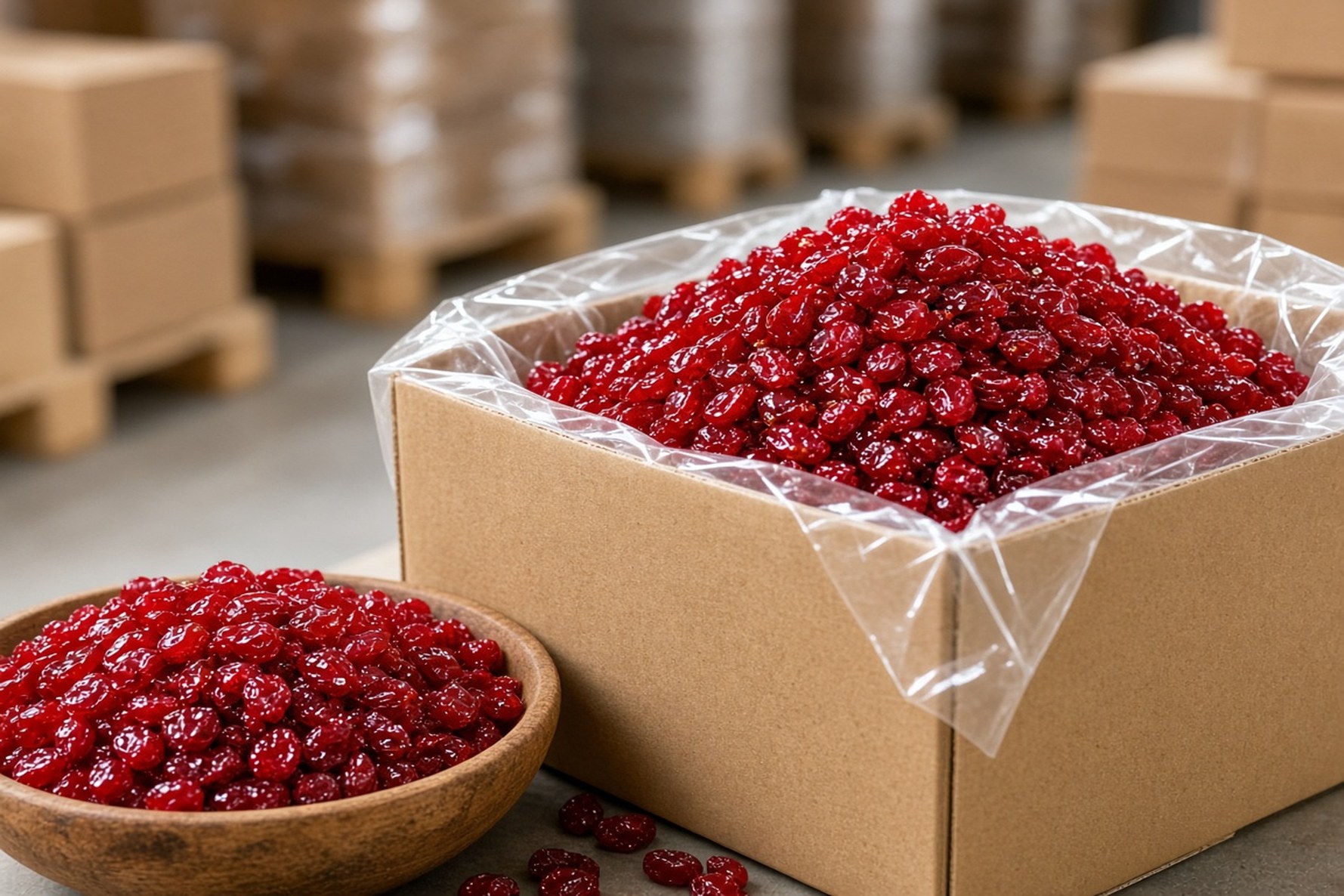
This type represents the highest apparent and technical quality in international markets. In the puffy method, barberry clusters with cut branches are moved to covered, dark halls with natural ventilation of cool dry air—known as talār (drying halls). Clusters are laid on wooden racks or multi-tier wire trellises at set spacing so tissue moisture falls gradually over 3 to 6 months.
Absence of direct UV sunlight and slow moisture release preserve a spherical, plump, puffy structure, minimal wrinkling, and stable bright ruby-red colour. This product typically reaches market from late Bahman through Ordibehesht (February–May) and is the first choice of European buyers, luxury packers, and international restaurants.
Sun-dried barberry (Daneh-anari)
In this method, fruit is stripped from clusters immediately after harvest—often by beating clusters against branches—and spread on cloth or concrete in open air under direct sun. The process takes about 2 to 4 weeks depending on heat and airflow.
Direct sun and heat stress oxidise part of the anthocyanins, deeply wrinkle the tissue, compress the fruit, and darken colour toward deep crimson or dark cherry. Sun-dried barberry enters the market from late Aban through early Azar (November–December). Lower price and higher moisture make it suitable for industrial use, sauces, syrups, confectionery, and regional Middle Eastern markets.
Floor / under-hall barberry (Zir-talāri)
During puffy storage in halls, some berries fall early from rack vibration or wind before full drying and collect on the hall floor. Contact with the floor and irregular moisture loss yields a mix of puffy and sun-dried traits. After collection, winnowing, and screening, this grade is sold as an economic mid-tier product.
| Commercial parameter | Export puffy barberry | Sun-dried (Daneh-anari) | Under-hall (Zir-talāri) |
|---|---|---|---|
| Drying method | Shade-dried in hall with continuous ventilation | Sun-dried in open air | Mixed floor and shade |
| Dehydration period | 90 to 180 days | 15 to 30 days | Variable through storage season |
| Market availability | Farvardin & Ordibehesht (Mar–May) | Azar & Dey (Nov–Jan) | Bahman & Esfand (Jan–Mar) |
| Appearance colour | Bright, glossy ruby red | Dark red, liver-toned | Red with moderate uniformity |
| Shape and texture | Spherical, puffy, non-sticky | Flat, compressed, highly wrinkled | Semi-compressed, moderate uniformity |
| Optimal export moisture | 14 to 16% | 15 to 17% | 15 to 16.5% |
| Origin price level | Highest base trade rate | 15 to 25% below puffy | About 10% below puffy |
| Primary consumption channel | EU retail chains, luxury gifting, Gulf | Food industry, juice, baking, Middle East bulk | Catering, meal prep, local restaurants |
3. Technical specifications, physicochemical indices, and buyer acceptance criteria
Precise contract specification of physical and chemical parameters is the main barrier to legal disputes between buyer and exporter. National and international standards for export barberry define specific indices that must be recorded and confirmed on certificates of analysis (COA).
Moisture is among the most critical indices. Although Iranian national standard ISIRI 3337 allows moisture up to 18%, moisture above 16% for international shipments carries irreversible risk, activating pigment-degrading enzymes and moisture-loving mould spores.
Acid-insoluble ash directly indicates dust, soil particles, and sand from improper open-air drying or wind exposure. Full physical purity and removal of thorns, leaves, and plant debris require mechanised screens, magnetic stone removers, and optical sorting lines.
| Parameter | Commercial standard range | Reference test method | Importance to buyer |
|---|---|---|---|
| Final moisture (%) | 14.0 to 16.0% by weight | Vacuum oven drying (ISIRI 3337) | Controls mould, souring, and clumping |
| Acid-insoluble ash | Maximum 0.5% by weight | Ignition and dissolution in 10% HCl | Evidence of sand, grit, and dust removal |
| Total ash | Maximum 4.5% by weight | Calcination at 550°C | Measure of organic purity |
| Total acidity (as malic acid) | 7.5 to 11.0% by weight | Titration with 0.1 N NaOH | Natural sour taste and fruit authenticity |
| Reconstituted juice Brix | 12 to 18° | Refractometer | Ripeness and soluble sugars |
| Extraneous vegetable matter | Maximum 1.0% by weight | Mechanical separation and weighing | Uniform appearance and packing-line safety |
| Extraneous mineral matter | Zero tolerance | Gravity separation and magnetic trap | Consumer and brand protection |
| Adhered and crushed berries | Maximum 2.0% by weight | Manual inspection of 100 g sample | Pack quality and physical pressure |
| Sun-scorched berries | Maximum 3.0% in puffy | Colorimetry and machine vision | Visual uniformity in clear packs |
4. Sensory evaluation, defect control, and identifying premium barberry
Quality assessment at warehouse or loading—before time-consuming chemical tests—is possible with standardised sensory checks. Distinguishing fresh lots from old stock, poor storage, or adulterated cargo requires attention to specific indicators.
Elasticity and mechanical texture behaviour
Squeeze a handful of barberry and release after five seconds. Premium puffy barberry at standard moisture should not stick to itself or to the palm; berries should separate immediately and recover their original spherical shape. Clumping, tacky skin, or sap residue on the hand indicate moisture above 17% and inadequate aeration—which, under transit container heat, makes spoilage and blackening almost certain.
Aromatic and olfactory characteristics
Fresh barberry has a sharp, lively sour aroma reminiscent of sour cherry; there should be no mustiness, earthiness, alcoholic souring, or rancid oil notes. Any vinegar or mould smell indicates fermentation of internal sugars in excess moisture.
Anthocyanin polymerisation
Fresh puffy barberry is uniformly bright, clear red without dullness. Beyond about 9 months from harvest, or storage above 20°C, anthocyanins polymerise and colour shifts toward dull crimson, brown, and eventually black. A proportion of black or faded berries suggests blending of the current crop with previous-year stock.
5. Laboratory testing, biosafety, and plant protection regulations
Access to high-value destination markets—including the EU, Japan, and North America—depends on strict food-safety compliance. Maximum residue limits (MRLs) under EU Regulation (EC) 396/2005 are among the most important acceptance criteria.
Many organophosphate and pyrethroid insecticides and fungicides used in traditional orchard management are banned in the EU or limited to the limit of quantification (0.01 mg/kg). Exceedances for substances such as chlorpyrifos, malathion, diazinon, and fenpropathrin can lead to detention and destruction at EU entry customs.
Mycotoxin contamination is the second critical rejection point. If clusters are harvested in rain or stock is held in high humidity with poor ventilation, Aspergillus and Penicillium can grow on fruit tissue and produce total aflatoxin, aflatoxin B1, and ochratoxin A. Under EU food import rules, the maximum for aflatoxin B1 is 2 µg/kg and for the sum of aflatoxins B1, B2, G1, G2 is 4 µg/kg.
- Total aerobic mesophilic count, mould and yeast counts
- Absence of E. coli in 1 g and Salmonella in 25 g
- Chemical panels by LC-MS/MS and GC-MS/MS at accredited laboratories
- Verification of results before issuing shipping documents for international buyers
6. Export market geography and international demand patterns
Consumption of Iranian barberry abroad is highly diverse, spanning ethnic and Middle Eastern retail through industrial segments and health-oriented markets.
Germany and Western Europe
Germany, as Europe’s main dried-fruit import hub, handles the largest volume of Iranian barberry on the continent. The market splits between ethnic food distributors offering puffy barberry in retail packs, and innovators in breakfast cereals, fruit snacks, premium chocolate, and herbal infusions using barberry as an antioxidant “superfood” ingredient. Entry requires official lab documentation aligned with pesticide residue and mycotoxin standards.
United Arab Emirates and Oman
The UAE—especially Dubai and Jebel Ali—redistributes barberry across the Middle East, North Africa, and India. Traders receive bulk puffy barberry in cartons, repack into luxury formats, and supply Gulf retail chains. Hotels and premium hospitality in Dubai and Abu Dhabi demand large, well-coloured puffy grades. Oman is an emerging destination.
Turkey, Russia, Kazakhstan, Canada, and Australia
Turkey’s proximity and overland logistics make it a steady buyer of sun-dried and under-hall grades for confectionery and lokum, re-exporting sorted puffy barberry to Eastern Europe. Eurasian Economic Union countries are strategic; Russian cuisine pairs well with natural sour notes. Middle Eastern diaspora communities in Toronto, Vancouver, Sydney, and Melbourne sustain demand for quality puffy barberry.
| Destination country | Dominant grade | Typical packaging | Consumption channel | Iran’s competitive edge |
|---|---|---|---|---|
| Germany | Super puffy, organic | 10 kg carton / Doypack | Innovative food, organic retail | Seedless authenticity, antioxidant richness |
| UAE | Large puffy, laser-sorted | 5 and 10 kg cartons | Hotels, export repacking | Short sea routes |
| Turkey | Sun-dried, under-hall | 10 kg bulk carton | Confectionery, lokum, re-export | Fast overland access |
| Russia | Sun-dried and commercial puffy | 10 kg master carton | HoReCa and local restaurants | Shared protocols and Caspian corridor |
| Canada | Grade-one puffy | 200 to 500 g packs | Asian hypermarkets | Purchasing power for hand-selected lots |
7. Customs tariff codes, export documents, and declaration rules
Correct declaration under Harmonized System (HS) codes is a prerequisite for accurate duties, import charges, and avoiding holds at origin and destination customs. Under Iran’s export and import regulations, barberry is assigned the following codes:
- Tariff code 0810.90.20: under other fresh fruit, specific to barberry
- Tariff code 0810.90.21: seeded barberry declaration
- Tariff code 0810.90.22: edible seedless barberry declaration
- International code 0813.40.00: at destination customs, dried barberry is usually classified under other dried fruit; pre-alignment with the destination broker on HS 081340 avoids duty calculation errors
Documents required for lawful export and clearance:
- Commercial invoice stating Incoterms, product description, and customs value
- Packing list with net weight, gross weight, carton count, and pallet dimensions
- Certificate of origin issued by the Iran Chamber of Commerce, Industries, Mines and Agriculture
- Phytosanitary certificate from the Plant Protection Organization
- Valid laboratory analysis covering moisture, microbiological load, and pesticides
- International bill of lading (sea, road, or air)
- Halal certificate for Islamic markets per OIC/SMIIC standards
8. Export packaging engineering and colour-stabilisation technology
Colour change is a major driver of commercial value loss during storage and transport. Anthocyanin breakdown and brown melanoidin formation accelerate in the presence of oxygen, light, and heat. Export packaging must apply modern packaging engineering to address this.
- Multi-layer master cartons: 5-ply die-cut cartons with food-grade PE liner minimum 100 µm; air evacuation and heat sealing are mandatory.
- Modified atmosphere packaging (MAP): Evacuate air and replace with ~98% nitrogen and less than 2% CO₂; residual oxygen below 0.5% preserves red colour for up to 24 months.
- Matte retail Doypack: PET / aluminium foil / PE structure; clear pouches under shop lighting can blacken berries within 60 days.
| Packaging type | Net weight | Technical structure | Application | Shelf-life performance |
|---|---|---|---|---|
| 5-ply bulk master carton | 10 kg | Heavy kraft + PE liner | Industrial, bulk, repacking | Economical; requires cold store |
| MAP vacuum bag | 5 kg | Oxygen-barrier film | Long-haul export | Colour stability up to 24 months |
| Matte Doypack | 250 to 500 g | Three-layer aluminium foil | Supermarket shelf | Full light and oxygen barrier |
| Composite metal tin | 150 to 300 g | Metallised board + sealed lid | Luxury gifting | Maximum physical protection |
9. International logistics, cold-chain management, and container transit
Dried barberry must not be treated like a heat-resistant traditional dried nut. Thin skin, high organic acids, and reducing sugars make it prone to Maillard reactions and rapid colour loss under heat. Cold chain from processing plant door to buyer’s warehouse is the exporter’s most important capital-protection factor.
- Reefer container temperature: 0 to 4°C; relative humidity 50 to 60%
- Independent temperature and humidity data loggers at front, middle, and rear of load
- Direct transfer from cold store to pre-cooled container at covered dock to avoid dew point
- ISPM 15 standard pallets with open deck and minimum 45 cm clearance to container roof
| Transit mode | Approx. duration | Equipment | Temp / humidity | Pros and risks |
|---|---|---|---|---|
| Containerised sea | 20 to 45 days | Reefer container | 0–4°C / 50–60% | Economical at high tonnage; transshipment delay risk |
| International road | 7 to 14 days | Refrigerated TIR trailer | 2–6°C | Direct delivery; border delay risk |
| Air cargo | 2 to 4 days | Freight aircraft | Cool airport environment | Premium quality; high cost |
| Coastal feeder | 3 to 5 days | Regional vessel + reefer | Attached reefer unit | Fast link to Jebel Ali; vulnerable in humid seasons |
10. Pricing dynamics, cost drivers, and seasonal volatility
Export barberry landed cost at origin in Iran is multidimensional. At harvest in Mehr and Aban (September–November), sun-dried supply rises and prices hit seasonal lows. From Bahman and Esfand (January–March), first puffy lots leave halls and prices climb. Peaks usually occur in Ordibehesht through Tir (April–July), when puffy quality peaks and warehouse stocks thin.
- Sorting loss factor: 8 to 15% impurities including thorns, twigs, immature berries, and dust in non-mechanised winnowed lots
- Cost of laser sorting lines, vibrating screens, and inspection tables
- Full pesticide and mycotoxin panel at a tier-one partner laboratory
- MAP films, nitrogen flushing, and 5-ply export cartons
Importers can submit requirements such as grade, pack weight, order volume, and destination through إيرانكو so matching supply options can be reviewed.
11. Industrial applications in food and pharmaceutical sectors
Iranian seedless barberry is not only an Eastern-table condiment; in advanced food manufacturing, beverages, and pharma it functions as a functional raw material.
| Target industry | Recommended type | Raw material form | Technical function |
|---|---|---|---|
| Confectionery, chocolate, lokum | Sorted sun-dried, under-hall | Whole dried berry | Soft texture, sweet-sour taste, visual appeal |
| Beverages and juice | Sun-dried or IQF fresh | Concentrate and extract | Natural red colour, stable acidity, vitamin C |
| Pharma and supplements | Organic fruit or extract powder | Concentrated berberine extract | Metabolic regulation and insulin-resistance modulation |
| Food service and catering | Premium large puffy | Puffy dried berry | Colour highlight in rice pilaf garnish |
| Flavourings and sauces | Industrial sun-dried | Purée and micronised powder | Sweet-sour profile in barbecue sauces |
Barberry’s key bioactive is the alkaloid berberine, present in roots, stem bark, and fruit. Modern pharmacology links berberine to AMPK activation, reduced insulin resistance, and modulation of blood lipids and glucose.
12. Importer checklist before placing an order
- Choose processing type for the market: puffy for premium shelf or sun-dried for industrial and confectionery use
- Obtain a sealed 1 kg witness sample and archive a portion as reference
- Contract cap on moisture: maximum 16.0%
- Confirm pesticide (MRL) COA aligned with destination country
- Verify aflatoxin and ochratoxin limits from a tier-one partner lab
- Set physical impurity tolerances: extraneous vegetable matter below 1% and zero stone and metal
- Prohibit gloss agents and mineral or vegetable oil coating
- Define packaging: moisture-resistant 5-ply carton or nitrogen MAP
- Require refrigerated transport at 0 to 4°C with temperature data loggers
- Align clearance documents with destination customs before shipment moves
13. What information is needed for an accurate quote?
Fair, precise pricing from suppliers depends on clear technical information from the buyer. Include the following in your RFQ:
- Barberry type: luxury puffy, commercial puffy, premium sun-dried, or under-hall
- Cleaning and sort grade: traditional, double air, or laser with sub-0.5% error
- Order volume: net weight in tonnes (FCL or LCL)
- Pack type and size: 10 kg bulk carton, 5 kg MAP, or private-label retail
- Target hygiene regime: origin national standard, organic, or EU pesticide panel
- Delivery point and Incoterms: EXW, FOB Bandar Abbas, or CIF
- Delivery window: fresh autumn crop or cold-stored lots in other seasons
In export orders, precise product specification is critical. Through إيرانكو, buyers can register purchase requests with product, packaging, and destination details so supplier review follows the same basis.
14. Export barberry sourcing from Iranian producers
In international barberry procurement, the gap between two commercial offers is rarely price alone. Barberry type, texture, uniformity, moisture, packaging, transport temperature, and lab document credibility determine fate at destination port. Successful supply requires access to facilities that guarantee standard processing in halls and cold stores.
إيرانكو enables buyers and importers to register purchase requests against exact product specs. Details such as barberry type, grade, quantity, packaging, and destination are captured so supply options in South Khorasan production hubs can be screened and evaluated on the same basis. This trade structure supports reference samples, pesticide test oversight, and export packaging through reefer container loading.
الخلاصة
Iranian barberry holds a strong economic advantage in global markets, but commercial success requires replacing traditional views with scientific methods. The divide between puffy and sun-dried processing maps to different global consumption paths. Export quality rests on three foundations: rigorous moisture and pesticide residue control, light- and oxygen-barrier packaging such as MAP, and uninterrupted refrigeration throughout transit.
Buyers who embed these technical specs correctly in purchase documents minimise commercial risk and capture appropriate margin on this high-value commodity.
أسئلة شائعة
What is the main difference between puffy and sun-dried barberry?
The core difference is dehydration. Puffy barberry dries in covered, dark halls over 3 to 6 months, preserving volume, non-wrinkled texture, and bright red colour. Sun-dried barberry dries under direct sun in weeks, yielding a denser structure, compressed texture, and darker colour.
Why does barberry turn dark brown or black?
Anthocyanins oxidise and polymerise with oxygen, sunlight, and temperatures above 15°C. The reaction dulls colour and, with excess moisture, causes clumping.
What moisture range is standard for international transit?
Although the national standard allows up to 18%, the commercial optimum for sea export is 14 to 16%. Above 16% sharply increases mould and mycotoxin risk.
What challenges arise clearing barberry at EU customs?
The main causes of rejection are organophosphate residues above MRL thresholds and mycotoxins including aflatoxin and ochratoxin A. Shipments should travel with valid accredited laboratory certificates.
Which packaging suits long-term export best?
For bulk, 5-ply cartons with thick PE liner plus nitrogen MAP are recommended. For retail, matte multi-layer aluminium Doypacks give the longest shelf life.
What reefer temperature is ideal for barberry?
Set container temperature to 0 to 4°C and relative humidity to 50 to 60%. These conditions limit condensation and heat-driven pigment loss and preserve quality for up to 18 months.
How can oil-adulterated barberry be detected?
Press berries onto lint-free tissue or white paper; oil leaves a grease mark. Oiled lots also develop sharp rancid odour within weeks.
How can export barberry be sourced directly from Iranian producers?
Buyers can send technical requirements—puffy or sun-dried type, moisture, packaging, volume, and destination port—through إيرانكو so supply options aligned with destination standards can be reviewed.
منتجات مميزة


مقالات ذات صلة



