 فريق مجلة إيرانكو
تجارة دولية، فيزيología ما بعد الحصاد، الحجر الصحي، MAP وسلسلة التبريد
تصدير الكيوي · أسواق الهدف · الحصاد · السلسلة الباردة
تصدير الكيوي الإيراني؛ أسواق الهدف وتوقيت الحصاد وشروط الشحن للتصدير
من حصاد هايوارد في مهر–آبان عبر الفرز والتعبئة والتبريد المسبق والوثائق الجمركية إلى روسيا والهند والخليج وآسيا الوسطى — دليل عملي للمستوردين.
مؤشرات رئيسية لتصدير الكيوي الإيراني
| المؤشر | القيمة | ملاحظة المشتري |
|---|---|---|
| الإنتاج الوطني 1403 | ~294659 طن | خامس منتج عالمياً |
| صادرات مازندران | محور الشمال | فرز وتبريد قرب الموانئ |
| شحنات الهند | نمو مع وحدات معتمدة | شهادة صحة نباتية |
| حرارة التخزين | 0°م و 90–95% RH | صلابة وعمر تجاري |
لماذا يهم الكيوي الإيراني للتصدير؟
كيوي هايوارد الأخضر من شمال إيران — خاصة مازندران وگیلان — أصبح محوراً رئيسياً في تجارة الفواكه الطازجة. يحصل المستورد على حجم إنتاج، نافذة حصاد محددة، تخزين قرب 0°م وطرق برية إلى روسيا والقوقاز وآسيا الوسطى والعراق والخليج. النجاح يعتمد على النضج (البريكس والمادة الجافة) والفرز الموحد وMRL والتعبئة والسلسلة الباردة دون انقطاع.
١. مكانة إيران في إنتاج وتصدير الكيوي
بإنتاج نحو 294659 طن في 1403 تحتل إيران المرتبة الخامسة عالمياً بعد الصين ونيوزيلندا وإيطاليا واليونان.
تشير بيانات النصف الأول من 1404 إلى تصدير نحو 35000 طن إلى أكثر من 20 وجهة. روسيا والهند والعراق والإمارات وقطر وعمان وأذربيجان وجورجيا وآسيا الوسطى وجهات متكررة.
يجب على المشتري الجمع بين حجم إيران وضبط جودة قابل للإثبات — لا الاكتفاء بوجود كميات في السوق.
٢. مناطق الإنتاج؛ مازندران وگیلان وهايوارد
مازندران هي المحور الرئيسي: تنكابن ورامسر ونكا وبهشهر. گیلان (تالش، رضوانشهر) يوفّر عرضاً مبكراً. الصنف السائد هايوارد الأخضر.
اختلاف المناخ وتاريخ الحصاد يتيح برنامج شراء متعدد المراحل إذا حُددت مواصفات رقمية لكل دفعة.
- مازندران: تنكابن، رامسر، نكا، بهشهر — مركز الفرز والتبريد
- گیلان: تالش، رضوانشهر — عرض مبكر
- الصنف: هايوارد أخضر
| المعامل | مثال | أهمية التصدير |
|---|---|---|
| المحافظة | مازندران، گیلان | التتبع |
| الصنف | هايوارد | السوق والنضج |
| العيار | 90–110 غ | تجانس التجزئة |
| درجة UNECE | I أو Extra | العيوب |
| الصلابة | مقياس متفق | تحمل الشحن |
| Brix / DM | ≥6.2° / ~15% | حد النضج Codex |
٣. توقيت الحصاد للتصدير
Export picking concentrates from late Mehr through Aban, varying by elevation and province. Early pick sends firm but immature fruit on long lanes; late pick raises softening and ethylene risk.
Codex CXS 338-2020 and UNECE FFV-46 set minimum maturity at 6.2° Brix or 15% dry matter average. Link orchard sampling dates and lab averages to the cold-store batch actually loaded.
QC teams should record Brix, penetrometer firmness and agreed ripeness scores at several orchard points — fruit at 6.2° Brix but below loading firmness is unsuitable for 15–20 day lanes.
- Harvest index: Brix ≥6.2 or ~15% dry matter
- Firmness: numeric agreed range, not subjective wording
- Uniformity: avoid mixing multi-day picks in one carton
- Logging: date, orchard block, sorting operator
٤. الفرز والدرجات ومراقبة الجودة
Sorting lines should grade by weight or diameter, uniformity, skin defects, decay, pests and firmness — each with contractual limits.
For sensitive markets (EU, India, Gulf), MRL panels must reflect sprays used on the same orchard or batch. Sampling must cover multiple pallets and carton depths, not display rows only.
CXS 338 splits kiwi into Extra, Class I and II; bulk export usually trades Extra or I — Class II only by explicit agreement and price.
| Defect | Risk | Export approach |
|---|---|---|
| Decay | Fast spread | Zero tolerance |
| Bruise / wound | Decay entry | Very strict limit |
| Marks & sunburn | Appearance | Agreed % cap |
| Size mismatch | Value gap | Re-sort |
| Soft fruit | Short life | Near market or downgrade |
٥. أسواق التصدير المستهدفة
Destination mix shifts with season, exchange rates, destination cold capacity and competition from New Zealand, Chile and Turkey. The table is a roadmap; regional notes follow.
| Market | Role | Practical note |
|---|---|---|
| Russia | High volume | Cold chain, CA, price competition |
| India | Growing demand | Approved units, PC, labels |
| Azerbaijan | Land border | Fast delivery, documents |
| Georgia | Transit / consumption | Uniform quality |
| Central Asia | Kazakhstan, Uzbekistan… | Reefer road |
| UAE | Regional hub | Appearance, packing |
| Qatar & Oman | Retail & wholesale | Temperature stability |
| Iraq | Proximity | Speed and price |
Russia
Rail and sea lanes from northern Iran; firmness and temperature logs matter. Compete on landed cost and repeatable quality vs Chile and Turkey.
India
Entry requires phytosanitary certificates, registered production/packhouse units and quarantine compliance. Align English label text and PC codes before printing.
Gulf (UAE, Qatar, Oman)
Fast turnover markets — premium packs and size uniformity count. Shorter sea legs than Europe but port breaks in the cold chain are common.
Caucasus & Central Asia
Reefer road dominates. Border coordination, container seals and data loggers are critical for disputes.
٦. مستندات التصدير
Typical sets: commercial invoice, packing list, certificate of origin (if required), phytosanitary certificate (ISPM 12), bill of lading and sometimes quality or MRL reports. HS 081050 on the proforma must match the physical product (fresh kiwi).
Carton marks: product name, count, net weight, exporter, country of origin (Iran), traceability code and — for India — approved unit codes. Mismatches between labels and phytosanitary text can stop clearance.
- Invoice and packing list aligned on net weight and counts
- Phytosanitary certificate under ISPM 12
- Certificate of origin when tariff or preference rules require it
- Contract spec annex with Brix, firmness and defect limits
- MRL laboratory report for strict destinations
٧. التعبئة والبالتات
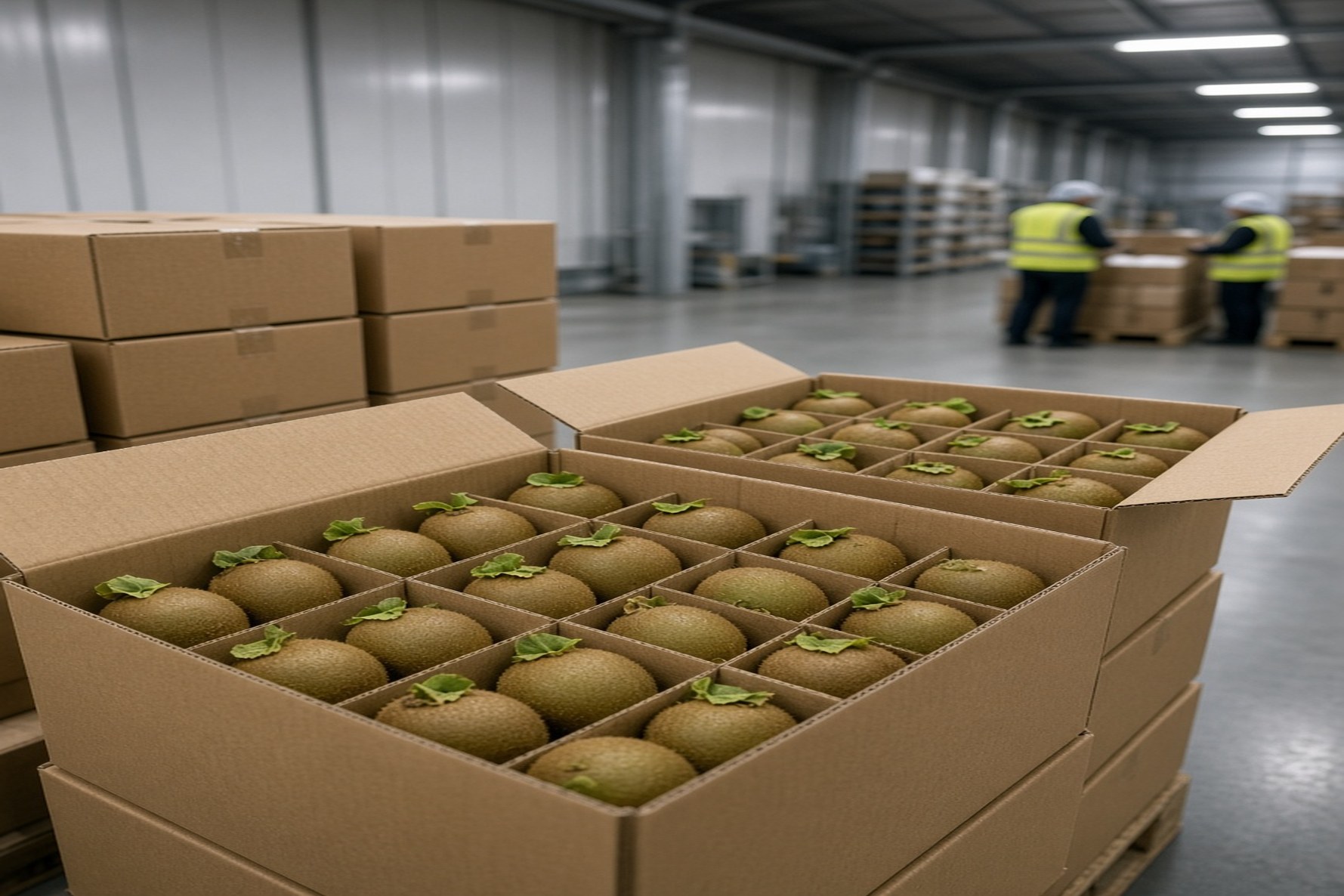
Common export packs: 3.5–10 kg cartons with trays or dividers, vent holes and moisture-resistant print.
EUR pallets with stretch wrap and corner boards; agree pallet weight and stack height with destination equipment. Sea freight needs cartons that tolerate high RH inside reefers.
| Type | Gross weight | Use |
|---|---|---|
| Single-wall carton + tray | 3.5–5 kg | Premium retail |
| Double-wall carton | 7–10 kg | Wholesale |
| Cell dividers | Variable | Long road haul |
| EUR pallet 80×120 | ~500–700 kg | Mechanised loading |
٨. السلسلة الباردة والشحن
Pre-cool after sorting until pulp nears 0°C before loading. Kiwi is highly ethylene-sensitive — store separately from apples, tomatoes and bananas. Data loggers are recommended for Russia and India lanes.
Reefer road for Iraq and Central Asia; reefer sea for India and the Gulf. Long ambient stops raise pulp temperature and halve commercial life.
Road: 0°C reefer trucks to Iraq, Azerbaijan, Armenia and Central Asia — shorter door-to-door but border delay risk.
Sea: reefers from northern ports to JNPT, Jebel Ali and Russian ports — needs sound seals, airflow management and a destination ripening plan.
| Stage | Target temp | RH / note |
|---|---|---|
| Post-harvest | Shade, rapid move | Lower respiration |
| Pre-cool | 0°C | Pulp ready before load |
| Cold store | 0°C | 90–95% RH |
| Loading | Pulp ≤2°C | Check before seal |
| Transit | 0°C set point | Ethylene & CO₂ control |
| Delivery | No broken chain | Logger report |
٩. مستويات التسعير
Export kiwi price is not a single number — three common negotiation levels exist. State which level you quote so FOB, CFR and delivered offers compare fairly.
Other drivers: sort-out %, testing fees, carton type, real pre-cool, FX, season (peak pick vs late season) and Chile/New Zealand supply in the same destination window.
| Factor | Effect | Negotiation note |
|---|---|---|
| Larger calibre | Higher unit price | Softening risk on long haul |
| Extra class | Better margin | Higher sort cost |
| Pre-cool | Energy cost | Required for sea lanes |
| Full MRL panel | Lab cost | EU/India gate |
| Volume | Scale discount | Batch uniformity |
| Level | Includes | Buyer risk |
|---|---|---|
| FOB orchard / packhouse | Sorted on line | Domestic haul & export formalities |
| FOB cold store | Pre-cooled inventory | Loading & international leg |
| CFR/CPT destination | Freight + insurance per Incoterms | Import clearance & last mile |
١٠. نهج التوريد عبر إيرانكو
Iranco (ایرانکو / إيرانكو) is the B2B path to register structured purchase requests for Iranian agricultural products — not “Iran Ceramic”. Buyers submit measurable specs (variety, calibre, firmness, Brix, pack, volume, destination, Incoterms) so northern orchard, sorting and cold-store options can be matched.
For large programmes, visits, batch samples and export document alignment (especially India and Russia) can be coordinated within the purchase request workflow.
Use the correct trade name Iranco (ایرانکو / إيرانكو) — avoid misleading abbreviations in English correspondence.
- Register a purchase request with variety, calibre, firmness and destination
- Match cold-store inventory to your loading window
- Approve samples from the same batch before the main contract
- Align documents: HS 081050, phytosanitary certificate, labels
- Align cold-chain mode with road vs sea routing
ملاحظات إحصائية وجمركية
The 294,659 t output figure anchors seasonal volume planning — confirm the lot matches the same harvest season and origin district.
Mazandaran is widely cited as the northern loading hub — align port/border loading with Incoterms on the proforma.
India shipments require approved unit lists and correct PC codes on the phytosanitary certificate — verify rule changes with the destination broker before loading.
HS 081050 applies to fresh kiwi; processed or mixed products may classify differently.
Before signing a seasonal contract, importers should audit packhouse and cold-store capacity at least once — carton photos or isolated samples are not enough.
On long lanes, subtract transit and retail distribution days from loading firmness so remaining sellable days are realistic. Structured Iranco purchase requests align suppliers on this math.
قائمة تحقق من 18 خطوة للمستورد
- State variety (Hayward) and country of origin on the proforma.
- Define average calibre or weight and uniformity tolerance numerically.
- Fix UNECE class or contractual equivalent (Extra / I).
- Write minimum 6.2° Brix or 15% dry matter in the contract.
- Agree firmness range and measurement method.
- Set skin defect limits and decay tolerance (prefer zero).
- Align harvest window and loading date.
- Record carton type, count per carton and net weight.
- Document pallet pattern and maximum stack height.
- Require real pre-cool and pulp temperature at loading.
- Specify data logger placement.
- Confirm separation from ethylene-producing fruit.
- Request MRL panel matching the destination.
- Verify phytosanitary certificate and unit codes (India).
- Approve English label text before printing.
- Clarify Incoterms (FOB, CFR, etc.) and delivery point.
- Define accept/reject criteria and optional third-party inspection.
- Document cold-chain responsibility after loading.
For an accurate quote, send at least: variety and calibre, quality class, volume (tonnes or pallets), pack type, destination port, Incoterms, MRL needs, loading window and allowed storage time at origin. Without this, comparing two “export kiwi price” lines is usually misleading.
الخلاصة
تصدير الكيوي الإيراني ينجح عندما يُدار الحصاد والفرز والوثائق وسلسلة 0°م كوحدة واحدة؛ روسيا والهند والخليج أسواق حجمية لكن مخاطر كسر الحرارة واختلاف العينة عن الشحنة حقيقية.
الأسئلة الشائعة
When is the Iranian export kiwi harvest season?
Mostly late Mehr through Aban, varying between Gilan and Mazandaran; contracts should state harvest and load dates.
What are the main export markets for Iranian kiwi?
Russia, India, Iraq, UAE, Qatar, Oman, Azerbaijan, Georgia and Central Asian states are recurring destinations.
What transport and storage temperature is used?
About 0°C at 90–95% RH; fruit should be pre-cooled before loading.
What is minimum export maturity?
At least 6.2° Brix or 15% dry matter average under CXS 338 and UNECE FFV-46.
How ethylene-sensitive is kiwi?
Very sensitive — keep separate from ethylene-producing commodities in storage and transit.
What packaging is typical?
Ventilated cartons with trays/dividers on EUR pallets with proper securing.
Is sea freight suitable?
Yes with 0°C reefers, loggers and intact seals; transit time must match fruit firmness.
Which tests matter most?
MRLs, firmness, Brix/dry matter, decay inspection and size uniformity.
What is needed for bulk purchase?
Volume, calibre, class, destination, Incoterms, pack type, MRL and loading window.
What is the HS code for fresh kiwi?
081050 under HS; reconcile with destination customs classification.
منتجات مميزة












مقالات ذات صلة



