 فريق مجلة إيرانكو
مجموعات غذائية ذات قدرة تجارية، المنافسة مع الإنتاج المحلي التركماني، متطلبات الدخول، التعريفات، التعبئة ومسارات باجگيران ولطفآباد وسرخس وإنشه برون
Market Report · Export · Turkmenistan · Land Border
Iran Food Export to Turkmenistan: Suitable Products and Land Transport Routes
Food groups with commercial potential, competition with Turkmen domestic production, entry rules, duties, packaging and route choice via Bajgiran, Lotfabad, Sarakhs and Incheh Borun.
In the first nine Iranian months to 21 December 2025, Iran's non-oil exports to Turkmenistan were reported about 22.5% higher in value than the same period a year earlier; agricultural and food products formed part of the export mix.
Analytical introduction
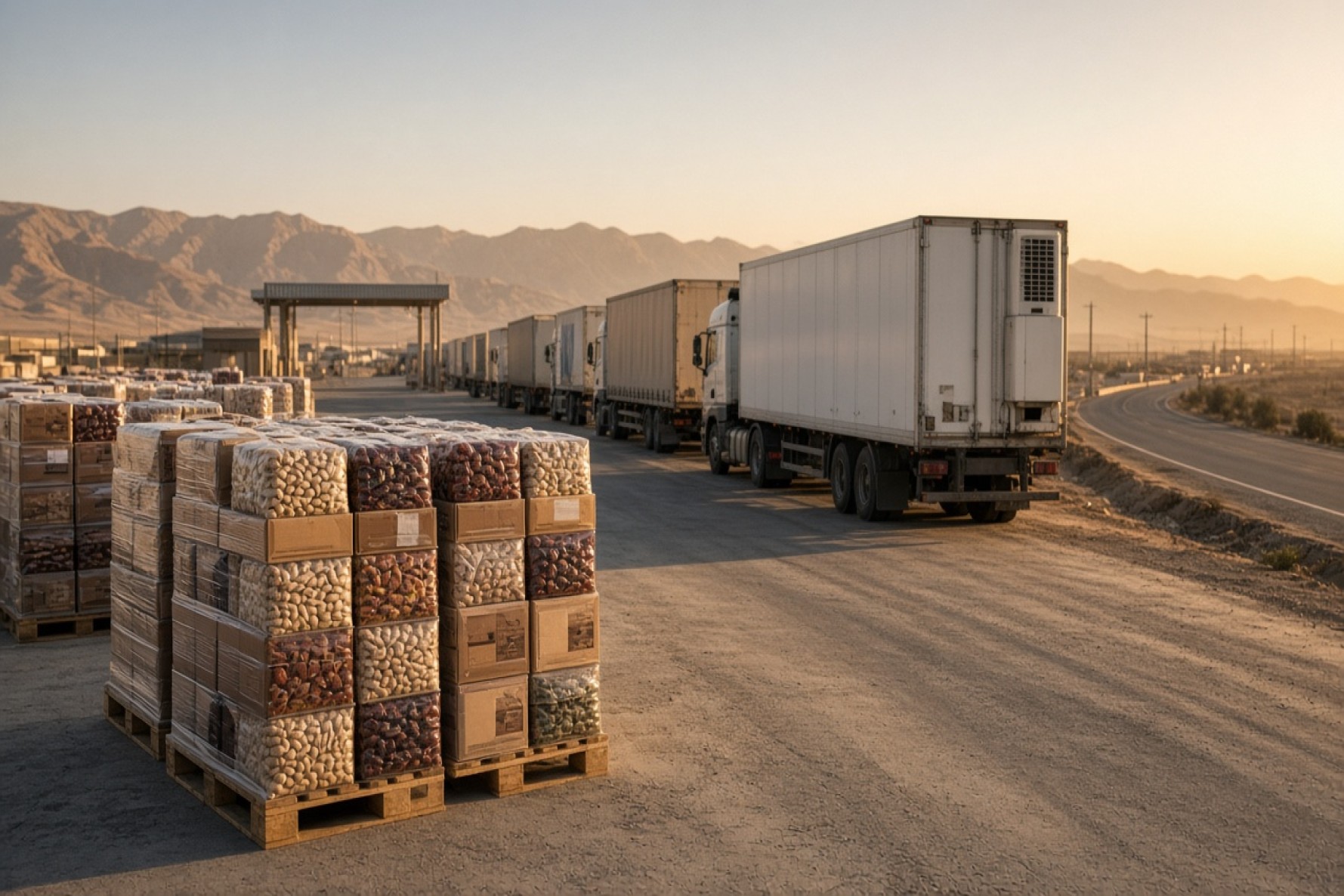
At first glance, food export from Iran to Turkmenistan looks like one of the region's simplest markets. The two countries share a long land border, four main road corridors and rail links via Sarakhs and Incheh Borun. For products where freight cost, delivery time and freshness drive competition, that is a practical advantage.
Turkmenistan should not be treated as a generic neighbour market. Domestic food production has expanded — greenhouse tomato, fruit and vegetables, beverages, dairy, ice cream, tomato paste, canned goods and confectionery — and some lines are now exported. Fresh tomato exports exceeded 181,000 tonnes in 2025.
Iran's opportunity sits in products with high value per kilogram, shelf stability on road haulage, clear differentiation from Turkmen output, or faster, cheaper delivery than distant suppliers. Nuts, dried fruit, selected confectionery and biscuits, specialty fruit/vegetable products, spices and saffron, shelf-stable dairy and a limited fresh-fruit window often beat bulky low-value lines.
For Turkmen importers, factory price is not the only question: import duty, contract registration, conformity certificates, Turkmen labelling, inland haul to Ashgabat, remaining shelf life and border clearance time all shape landed cost. Iranco accepts B2B purchase requests with precise specs to match Iranian suppliers.
1. Turkmenistan food market and Iran's role
Population is modest, but much trade can move without sea freight — by truck or rail. In nine months to 21 December 2025 Iran shipped about 1.18 million tonnes of non-oil goods worth nearly USD 495 million to Turkmenistan (not food-only, but proof of active infrastructure).
The food landscape is shifting: dairy, yogurt, ice cream, sausage, baby food, juice, tomato paste, sauce, canned goods, sweets and drinks are produced locally. Competition includes Turkey, Russia and China — and Turkmen plants.
Current vs potential demand
Observed imports include processed fruit/vegetables, confectionery, processed cheese, sauce, jam and beverages. Turkey exported about USD 4.47 million of HS chapter 20 products to Turkmenistan in 2023; sauces, jams, sugar confectionery and processed cheese appear in 2024 flows.
Potential demand favours differentiated Iranian lines: pistachios and nuts, premium dried fruit and dates, saffron and spices, distinct confectionery and food-industry inputs — always compared on landed price after duty.
2. Which Iranian foods fit Turkmenistan best?
Choose SKUs on delivered price after duty and clearance, not ex-factory Iran price alone.
| Product group | Commercial fit | Main reason | Main risk |
|---|---|---|---|
| Pistachios, nuts, dried fruit | High (premium) | Value/weight, shelf life | Aflatoxin, quality |
| Raisins, dates, dried fruit | Good | Simple road haul | Grade, regional rivals |
| Saffron and spices | Niche | High value, low weight | Authenticity |
| Biscuits, wafers, sweets | Conditional | Retail pull | Turkey, Russia, local |
| Canned, pickles, preserves | Conditional | Product differentiation | Duty, local plants |
| Fresh grapes and lemon | Seasonal | Proximity, listed duty | Spoilage, quarantine |
| Processed cheese, shelf dairy | Specialist | Import demand | Cold chain |
| Tomato paste | Limited | Strong Iran industry | USD 2/kg duty |
| Juice and beverages | Limited | Variety | High duty |
| Low-value vegetables | Seasonal | Short haul | Duty, greenhouses |
Nuts and dried fruit
Pistachios absorb road freight well; contracts need numeric grade, moisture, breakage and aflatoxin limits.
Confectionery and processed fruit
Edge comes from landed price, taste, pack weight and shelf life. Turkey competes in chapter 20; distinct pickles, jams and cans beat commodity lines Turkmen factories already run at scale.
Fresh fruit
Lemon and grapes carry a listed USD 0.5/kg charge; pre-cooling, sort, pack and border dwell time matter. Raisins and dates suit road haul with different pack sizes for retail vs wholesale.
3. Products to approach with extra caution
| Group | Why caution | Iranco note |
|---|---|---|
| Tomato paste | USD 2/kg duty, strong local output | Industrial grade or clear differentiation only |
| Juice and drinks | Up to USD 2/litre | Avoid cheap heavy beverages |
| Honey | USD 3/kg (0409) | Premium or specialty honey |
| Fresh vegetables | Listed charges, local greenhouses | Strictly seasonal review |
4. Technical specs before ordering
| Parameter | Define | Why it matters |
|---|---|---|
| Product name and form | Exact type | HS and price |
| Grade | Premium / industrial | Use case |
| Moisture | Nuts and dried lines | Shelf life |
| Composition | Ingredients | Label compliance |
| Net weight | Excluding pack | Delivery control |
| Shelf life | Production/expiry | Retail acceptance |
| Packaging | Primary and master | Road handling |
| Storage | Ambient / chilled | Truck choice |
| Testing | Batch COA | Clearance |
| Label language | Turkmen | Customs acceptance |
For pistachios, contract aflatoxin limits tied to the loading batch COA. Fresh fruit needs numeric size, ripeness, colour and rejection rules — not vague “grade one” wording.
5. Food import regulations
- Standards and conformity: imported goods must meet Turkmen national standards; conformity certificates from the standards body are required (trade guide, January 2026).
- Contract registration: contract-based imports must be registered on the state commodities exchange before arrival — product specs, origin, currency, unit price and total value.
- Documents: invoice/contract, packing list, CMR, customs declaration, origin and quality certificates.
- Quarantine: phytosanitary or veterinary certificates where applicable.
- Turkmen labels: name, ingredients, dates, net weight, storage, nutrition — approve text before printing.
6. Customs duty and HS codes
| Product | Code/group | Import charge |
|---|---|---|
| Honey | 0409 | USD 3/kg |
| Lemon and grapes | 0805 / 0806 | USD 0.5/kg |
| Meat products | 1601 | USD 2/kg |
| Chewing gum | 1704 10 | USD 2/kg |
| Chapter 20 (with exceptions) | 20 | USD 0.15/kg |
| Tomato paste | 2001 / 2002 | USD 2/kg |
| Ice cream | 2105 | USD 2/kg |
| Juice | 2009 | USD 2/litre |
Processing, sugar, packaging and fresh vs dried form change classification. Iranco can ask suppliers for proposed HS; final confirmation is the importer's duty at destination.
Fixed per-kg charges erase margin on cheap bulk lines; nuts, saffron and specialty inputs tolerate logistics better.
7. Land routes from Iran
| Corridor | Mode | Best for | Note |
|---|---|---|---|
| Bajgiran – Howdan | Road | Ashgabat | Quchan axis |
| Lotfabad – Artik | Road | Khorasan → Ahal | 2025–26 capacity upgrade |
| Sarakhs – Sarakhs | Road + rail | Heavy loads | Main trade hub |
| Incheh Borun – Altyn Asr | Road | Northern Iran | Western Turkmenistan |
| Incheh Borun – Ak-Yayla | Rail | Wagon/container | Iran–TM–Kazakhstan corridor |
Turkmen customs reported active crossings at Sarakhs, Artik, Howdan and Altyn Asr in March 2026 — Iranian sides: Sarakhs, Lotfabad, Bajgiran, Incheh Borun.
Bajgiran – Howdan
Capital-region deliveries via Quchan; nuts, biscuits and palletised inputs.
Lotfabad – Artik
Ahal province gateway; customs modernisation through 2025–26.
Sarakhs and Incheh Borun
Sarakhs road/rail for eastern Khorasan; Incheh Borun for northern origins and Ak-Yayla rail toward Kazakhstan.
8. Dry truck, reefer and rail
- Tilt/curtain truck: nuts, biscuits, spices, cans — chocolate and oils may need summer temperature control.
- Reefer: fresh fruit, chilled dairy — pre-cool before loading; set point in contract and CMR.
- Rail: large, shelf-stable lots with rail access at destination — Sarakhs and Incheh Borun (Ak-Yayla).
9. Export packaging for the Turkmen corridor
- Nuts: moisture and oxygen barrier; vacuum or MAP for premium SKUs.
- Biscuits: inner moisture barrier and strong master cartons.
- Glass/tins: dividers and impact protection.
- Fresh fruit: vented cartons and controlled pallet height.
10. Border formalities and pre-arrival checklist
Electronic pre-arrival data (ASYCUDA World / TIR-EPD) has been mandatory since June 2024.
- Importer permits and contract registration complete.
- Documents match customs data.
- Accepted HS code fixed.
- Pre-arrival message filed.
- CMR matches packages and weight.
- Origin and quality certificates ready.
- Health/quarantine certificates if required.
- Turkmen label text approved.
- Driver knows corridor and crossing.
- Reefer pre-checked before loading.
11. Pricing and Incoterms
- Drivers: quality, pack, volume, testing, haul to border, freight, duties, conformity fees, inland TM delivery.
- Quote three levels: factory, Iranian border, delivered in Turkmenistan.
- FCA, CPT or DAP — clearance service fee 0.2% of contract value (separate from product duty).
12. 18-step importer checklist
- Exact product name and form.
- Grade and acceptance criteria in contract.
- Sample matching production quality.
- Review ingredients and additives.
- Confirm HS for that exact form.
- Calculate duty before price comparison.
- Conformity and sanitary requirements.
- Approve Turkmen label before print.
- Net weight and master carton weight.
- Minimum remaining shelf life at delivery.
- Required lab tests before production.
- Verify real production capacity.
- Written lead time.
- Truck type and border crossing.
- Owner of pre-arrival filing.
- Incoterms and cost split.
- Weight/quality dispute clause.
- Contingency for perishables if border queues.
What to send for an accurate quote
- Product name, grade, measurable specs, pack weight, packaging, order volume.
- Label language, tests, destination city, preferred crossing, dry vs reefer, Incoterms.
- Nuts: moisture, size, breakage — fresh fruit: size, ripeness, cold chain.
13. Iranian food supply for the Turkmen market
Supplier quotes differ by more than per-kilo price. Iranco registers B2B purchase requests and matches Iranian producers — without replacing your customs broker or Turkmen importer. Name destination city (Ashgabat, Ahal, etc.) from day one.
Conclusion
Food export to Turkmenistan works when geographic proximity pairs with the right SKU. Nuts, dried fruit, saffron, confectionery and differentiated preserves merit review; paste, beverages, honey and cheap vegetables need post-clearance economics.
Four road axes plus rail via Sarakhs and Incheh Borun give routing flexibility. Short transit only pays off with HS codes, Turkmen labels, pre-arrival data and predictable delivery — not factory price alone.
Frequently asked questions
Is Turkmenistan a good market for Iranian food?
Yes for selected groups — direct border and short haul help high value/weight, shelf-stable lines. Bulky low-value goods need careful landed-cost math.
Which Iranian foods fit best?
Nuts, dried fruit, dates, saffron, spices, biscuits/sweets and differentiated preserves — subject to duty and local competition.
Best road route to Ashgabat?
Bajgiran–Howdan serves the capital; plants in eastern Khorasan may prefer Sarakhs or Lotfabad.
Is Turkmen labelling mandatory?
Yes — 2026 import rules require Turkmen-language labels with full product information.
Should we send samples first?
Recommended for professional deals; approved sample specs must become contract limits for bulk production.
Road or rail?
Trucks for small/medium, fresh and time-sensitive loads; rail for large shelf-stable volumes from Sarakhs or Incheh Borun.
How much is food import duty?
Not uniform — e.g. honey USD 3/kg, lemon/grapes USD 0.5/kg, tomato paste USD 2/kg; confirm HS before final pricing.
Key documents for fresh fruit?
Phytosanitary/quarantine certificates, packaging, origin and transport conditions before loading.
How to source Iranian food for Turkmenistan?
Define product, grade, volume, packaging and destination; compare suppliers or submit the same specs via Iranco.
Minimum info for an export price?
Exact name, quality, pack weight, volume, TM destination, transport mode and Incoterms; add moisture or COA for specialist lines.
تصدير الغذاء إلى تركمانستان — توريد B2B من موردين إيرانيين
اتصل بإيرانكوinfo@iranco.com · WhatsApp: +98 913 104 4182 · Telegram: @irancofood
منتجات مميزة








مقالات ذات صلة



