 فريق مجلة إيرانكو
من الفستق والزعفران والزبيب إلى سلامة الغذاء في الاتحاد الأوروبي والملصقات والملوثات والجمارك والتعبئة واللوجستيات للدخول المهني إلى إيطاليا
Export Guide · Italy · Food Market
Iran Food Exports to Italy: Suitable Products and Market Entry Requirements
From pistachios, saffron and raisins to EU food safety, labelling, contaminants, customs, packaging and logistics for professional entry into Italy
Italy is not an equal market for every Iranian food. Pistachios, saffron and raisins have measurable trade records while dates, processed goods and some fresh lines need a different strategy. This guide covers Italian demand, suitable products, EU requirements, QC, documents, packaging and preparing an acceptable export offer.
Analytical introduction
Italy cannot be treated as “just another European country” in a food export plan. It is a large food consumer with strong confectionery, chocolate, ice cream, bakery, nut processing, ready meals and retail/HoReCa networks.
In 2025 the EU imported €412M of agri-food goods from Iran; fruit and nuts were €210M (51% of food imports). Italy imported about 31.7k t of pistachios in 2024 with roughly 1.67k t directly from Iran; Iranian saffron about 5,217 kg and direct raisin exports over 875 t.
Many Iranian export strengths such as pistachios, saffron and raisins are industrial ingredients for Italian food manufacturing, so part of demand is processing rather than direct consumption.
Trade history alone is not enough. Italy is in the EU single market and importers must meet food safety, MRL, contaminant, traceability, labelling and official control rules. Iranian pistachios remain under intensified 2026 aflatoxin checks at 50% identity and physical inspection.
Exports must move from “selling available stock” to “designing product to buyer specifications and EU requirements”; that gap decides many deals.
1. Why Italy matters for Iranian food exporters
Italy is both a consumption market and a value-added processing hub. Italian food industry turnover exceeded €200B in 2025 with ~€59B exports; supplying raw materials to Italian manufacturers is itself a major market.
Industrial market
Industrial buyers may want pistachios for cream, praline, ice cream or pastry; kernel colour, flavour, aflatoxin, uniformity and milling performance can matter more than appearance. Industrial saffron goes into foods, ready meals, sauces or spice blends; raisins enter bakery, confectionery or cereals.
Retail market
In retail, pack design, label language, nutrition table, importer details, net weight, dates, allergens and traceability matter. Direct Iranian brands are usually harder than bulk sales to an Italian importer who packs locally.
HoReCa and specialty products
Restaurants, pastry shops, ice-cream makers and specialty wholesalers suit saffron, kernels, premium dates and nuts better than undifferentiated commodities.
2. Which Iranian foods are better suited for export to Italy?
Registered trade shows pistachios, saffron and raisins have the clearest history; dates are a large import market but Iran’s direct share is limited and competition with established suppliers is tougher.
Pistachios — clearest industrial opportunity
Italy imported about 31.7M kg of pistachios in 2024; Iran supplied about 1.67M kg directly. Germany and some EU hubs may re-distribute; exporters also compete with European distribution networks.
Saffron — small but valuable market
Iranian saffron imports were worth about USD 7M. ISO 3632-1:2025 updated dry saffron specifications and ISO 3632-2:2010 covers test methods; useful contractually but not a substitute for EU law.
Raisins and dates
Italy imported about 21.7M kg of raisins in 2024; Iran supplied about 875,922 kg. Date imports neared 20M kg but direct imports from Iran were about 89,000 kg; Tunisia dominates supply.
| Product | Italian market evidence | Iran’s position | Likely application | Main entry point |
|---|---|---|---|---|
| Pistachios | Very large import market | Significant presence | Ice cream, confectionery, cream | Aflatoxin control is critical |
| Saffron | High unit value | Important supplier | Food, spice, premium pack | Authenticity and quality testing |
| Raisins | Wide imports | Direct export record | Bakery, confectionery | Uniformity and contaminants |
| Dates | Significant imports | Limited share | Retail, processing | Differentiation and packaging |
| Nut-based product | Industrial market | Product-dependent | Paste, cream | Classification matters |
| Fresh fruit | Large complex market | Product-specific | Wholesale and retail | Phytosanitary and MRL |
3. Technical specifications the Italian buyer must define in the order
Terms like “Iranian pistachios” or “export saffron” do not create contract criteria; specifications must be measurable.
Pistachios for direct consumption or processing?
For pistachios sorted before final sale, maximum aflatoxin B1 is 12 µg/kg and total aflatoxins 15 µg/kg; for direct food use the limits are about 8 and 10 µg/kg. Clarify this before the bill of lading.
Thread or powder saffron?
Powdered saffron carries higher fraud risk; representative samples and independent lab reports beat vague “super” labels.
| Product | Key order parameters | Risk if undefined |
|---|---|---|
| Pistachios | In-shell or kernel, size, breakage, aflatoxin, moisture | Test rejection and price disputes |
| Saffron | Thread or powder, purity, ISO, moisture, colouring strength | Authenticity disputes |
| Raisins | Colour, size, moisture, stem, foreign matter | Industrial mismatch |
| Dates | Texture, moisture, pitted or unpitted | Quality loss in transit |
| Nut-based product | Main ingredient %, particle size, allergens | Changed behaviour on production line |
4. Buyers and sales channels in Italy
A product suited to a factory is not necessarily suited to a retail chain; choose the channel before designing packaging.
Importers and bulk ingredient wholesalers
The most practical entry point for Iranian exporters; the buyer imports in bulk packs and distributes after QC.
Confectionery, ice cream and bakery plants
Batch-to-batch stability and formulation yield matter more than price per kilo alone.
Packers and brand owners
Bulk product is sold under an Italian brand; consumer label responsibility is often in Italy.
Direct retail entry
Requires barcodes, supply planning, shelf life and stable availability; working with a specialist importer is a sensible start.
- Stable specs and pre-contract samples
- Per-shipment analysis and batch data
- Export pack type and defect tolerances
- Replenishment capacity
5. Legal requirements for Iranian food entering Italy
Requirements depend on product and HS code; there is no single fixed list for all foods.
Traceability, hygiene and labels
Article 18 of Regulation 178/2002 requires traceability in production and distribution. Regulation 852/2004 covers HACCP. Regulation 1169/2011 sets mandatory label information; Italian consumer labels are standard for retail. Minimum letter height is usually 1.2 mm.
Allergens
The EU requires mandatory declaration of 14 allergen groups; pistachios are tree nuts. Sulphur dioxide and sulphites above 10 mg/kg must be declared.
| Area | Core regulation | Practical effect |
|---|---|---|
| General food safety | Regulation (EC) 178/2002 | Safety and traceability |
| Hygiene | Regulation (EC) 852/2004 | HACCP |
| Labelling | Regulation (EU) 1169/2011 | Consumer information |
| Pesticide residues | Regulation (EC) 396/2005 | MRL |
| Contaminants | Regulation (EU) 2023/915 | Aflatoxin and ochratoxin |
| Official control | Regulation (EU) 2017/625 | Import control |
| High-risk goods | Regulation (EU) 2019/1793 | Intensified control |
| Plant health | Regulation (EU) 2016/2031 | Phytosanitary certificate |
6. Testing, aflatoxin, ochratoxin and pesticide residues
Testing criteria should be set before the contract. Iranian pistachios under Regulation 2019/1793 face 50% checks and ISO/IEC 17025 laboratory testing.
Regulation 2023/915 sets maximum ochratoxin A in raisins at 8 µg/kg. Residues are managed under Regulation 396/2005; where no limit is set, 0.01 mg/kg applies.
| Product | Key tests | Contractual controls |
|---|---|---|
| Pistachios | Aflatoxin, ochratoxin, MRL | Size, breakage, colour |
| Saffron | Authenticity, ISO 3632, MRL | Foreign matter, uniformity |
| Raisins | Ochratoxin, MRL, moisture | Colour, stem, defects |
| Dates | MRL, microbiology | Texture, size |
7. Tariff codes, customs and Italy entry documents
The tariff code must reflect the actual product form. Iran has no EU FTA; duty rates for the exact code and Iranian origin must be checked at transaction time.
Importers need an EORI number. From June 2026 inbound consignments must meet ICS2 requirements. Dates are exempt from phytosanitary certificates; many fresh fruits are not.
| Product | Relevant code |
|---|---|
| In-shell pistachios | CN 0802 51 00 |
| Pistachio kernels | CN 0802 52 00 |
| Saffron | CN 0910 20 |
| Raisins | HS 080620 |
| Dates | HS 080410 |
| Pistachio product | Chapter 20 or other codes |
- Commercial invoice and packing list
- Transport document and certificate of origin if required
- Analysis reports and official certificates
- Phytosanitary certificate for covered products
- Batch data and insurance docs
8. Packaging and logistics
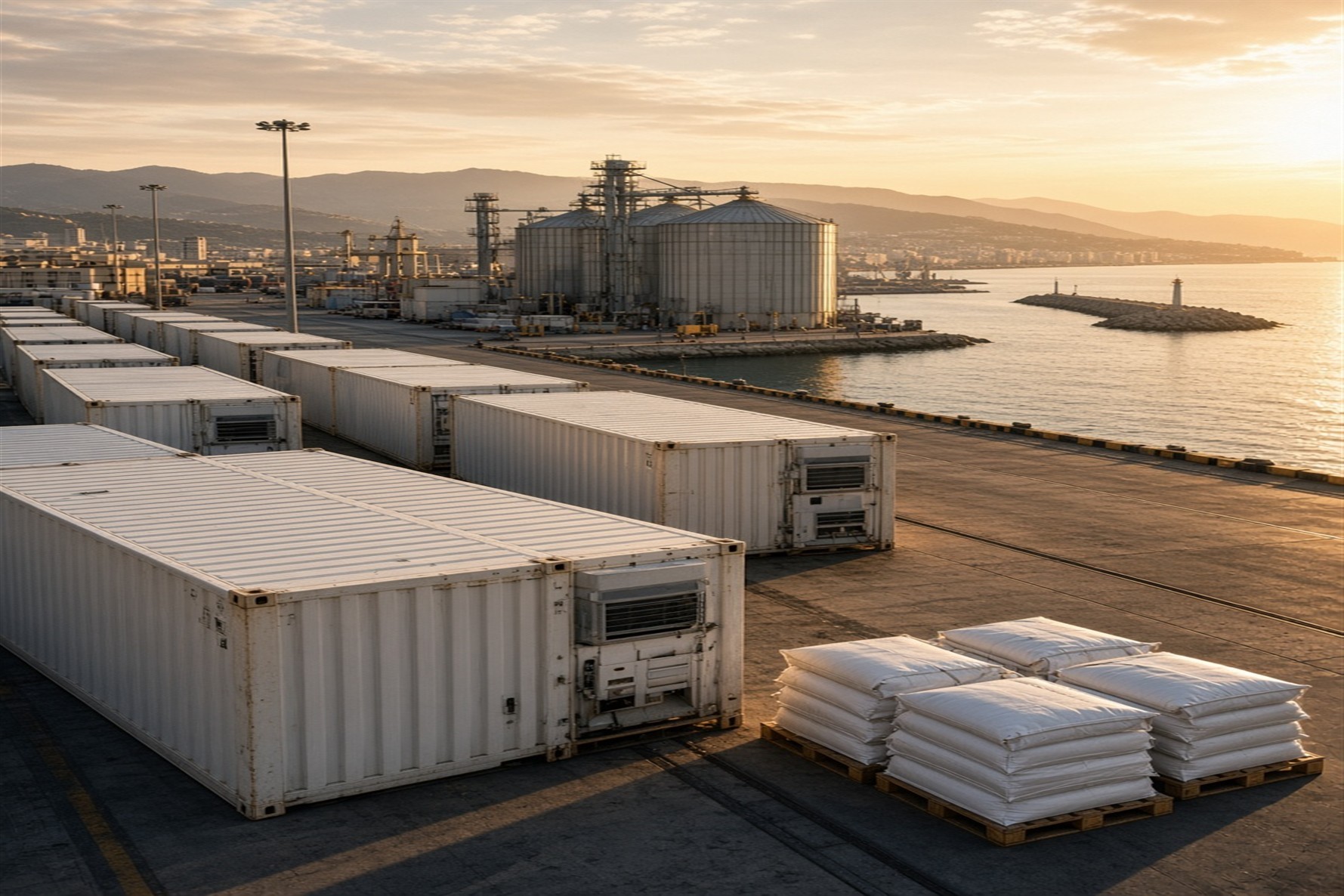
Pistachios, saffron, raisins and dates keep longer than many fresh goods but transport still needs management; a dirty or wet dry container can destroy quality.
Transport and routing
Air freight may suit small high-value saffron lots; bulk pistachios and raisins are usually road or sea. Routes via Turkey or Mediterranean ports should be chosen on total delivered cost. In 2026 check counterparty and payment compliance.
| Product | Main risk | Packaging approach |
|---|---|---|
| Pistachios | Heat, moisture | Moisture and oxygen barrier |
| Saffron | Light, moisture | Tamper-evident pack |
| Raisins | Moisture, mould | Suitable inner bag and strong carton |
| Dates | Pressure, fermentation | Moisture-appropriate pack |
9. Competition, pricing and commercial offer design
Price cannot be judged on ex-works price alone. The US and Turkey are key pistachio rivals; Spain leads in saffron imports; Turkey dominates raisins.
Iran’s edge must be defined with measurable specs, aflatoxin control and delivered price; low price with high border risk is not an advantage.
- Product form, grade and acceptance criteria
- Sorting cost, EU tests and packaging
- Order size, Incoterms, freight and insurance
- Special controls and payment terms
10. Importer checklist before placing an order
- Define product and supply form precisely.
- Confirm HS code before final pricing.
- Define the end use.
- Obtain a representative sample.
- Prepare written technical specifications.
- Align legal contaminant limits with product use.
- Set the testing programme before loading.
- Review pesticide residues product by product.
- Confirm primary and secondary packaging.
- Check labels before final printing.
- Evaluate batch number and traceability.
- Match entry documents to commodity code.
- Coordinate Regulation 2019/1793 process before shipment.
- Define EU entry route and point.
- Review payment and banking feasibility.
- Write delivery terms with Incoterms.
- Record acceptance/rejection criteria in the contract.
- Define laboratory arbitration method.
- Review repeat-order capacity.
- Align all information with importer and Italian customs broker.
This step matters for buyers sourcing directly from Iran; specs can be captured early in a structured purchase request.
11. What information should be sent for an accurate price quote?
A request for “pistachio price for Italy” is not enough for comparable quotes.
- Exact product name and supply form
- Technical specs and end use
- Order volume and unit weight
- Primary and master packaging
- Agreed tests and standards
- Destination and transport mode
- Delivery terms and purchase plan
- Pre-contract sample required
Iranco lets buyers register purchase requests with technical specs, volume, packaging, tests and destination.
In the sample stage, a technical data sheet adds more value than appearance alone.
For pistachios define supply form and aflatoxin; for saffron ISO and authenticity; for raisins colour and moisture.
The more precise the purchase request, the more meaningful supplier comparison becomes.
Summary
Iranian food exports to Italy work best when focused on pistachios, saffron and raisins with visible demand; dates have import volume but Iran’s direct share is smaller.
Compliance is decisive: aflatoxin for pistachios, ochratoxin and MRL for raisins, authenticity for saffron; fresh produce may need phytosanitary certificates and cold chain.
The right path starts with end use, specs, tests, packaging and EU entry point — then exports become repeatable supply relationships.
Frequently asked questions
Is Italy a suitable market for Iranian pistachios?
Yes — about 1,673 t direct imports in 2024, but intensified aflatoxin control is essential to the deal.
What is the main pistachio export requirement?
Aflatoxin control and Regulation 2019/1793 with 50% checks and official certification.
Is there demand for Iranian saffron in Italy?
Yes — direct value near USD 7M; authenticity and stable quality beat vague trade names.
Which saffron standard applies for export?
ISO 3632 is a useful contract tool but does not replace EU food safety law.
Is Italian labelling mandatory?
Information must be easily understood by Italian consumers; Italian labels are standard practice.
Do all foods require a phytosanitary certificate?
No — dates are exempt; many fresh fruits require a certificate.
What is the minimum order (MOQ)?
There is no single legal MOQ; it depends on product and freight; saffron trades in smaller lots.
What information is needed for pricing?
Product, quality, volume, destination, delivery and tests — register via Iranco purchase request.
Is a lower price always an advantage?
No — border risk, re-sorting and non-compliance raise total landed cost.
Can goods enter another EU country first and then go to Italy?
After proper entry formalities this is possible, but origin controls still apply to high-risk goods such as Iranian pistachios.
For advice on food exports to Italy and purchase requests from Iranian suppliers
Contact Irancoinfo@iranco.com · WhatsApp: +98 913 104 4182 · Telegram: @irancofood
منتجات مميزة












مقالات ذات صلة



