 فريق مجلة إيرانكو
دليل استراتيجي لجذب السوق والمواصفات الفنية واللوائح FSSAI والتعريفات وسلسلة التبريد
Export Guide · India · FSSAI · Cold Chain
Iran Food Exports to India: Which Iranian Products Have the Highest Sales Potential?
Strategic market pull, technical specs for high-demand lines, India FSSAI rules, tariff regime and reefer logistics — from pistachios and dates to apples, kiwi, saffron and asafoetida (hing).
India’s 1.4 billion consumer market, shifting diets and growing middle class make it one of the strongest destinations for Iranian agricultural and food exports. Iran benefits from climate diversity, counter-season harvests versus India and short Gulf/Oman sea lanes for freshness — but sustained success requires mastery of FSSAI, plant quarantine, tariffs, minimum import prices and the cold chain.
1. Strategic position of Iran–India agri-food trade
India is both a farming powerhouse and a top importer of fruit, nuts and condiments. Iran supplies meaningful volumes of dates, tree nuts and temperate fruit; when northern Indian apple and kiwi stocks run down, the Iranian supply window opens.
| Axis | Iran advantage | India impact |
|---|---|---|
| Sea logistics | Persian Gulf & Oman ports | 4–7 day transit, higher freshness |
| Season offset | Iran autumn–winter | Fills apple & kiwi gaps |
| Organoleptics | Strong flavour & oil in pistachio/dates | Preferred in mithai & nut retail |
| Tariffs & MIP | Accurate customs valuation | Avoids port holds |
Direct shipment from Iranian ports to Kandla, Mundra and Nhava Sheva, with origin traceability, cuts regional intermediary margins.
2. Highest-demand product groups
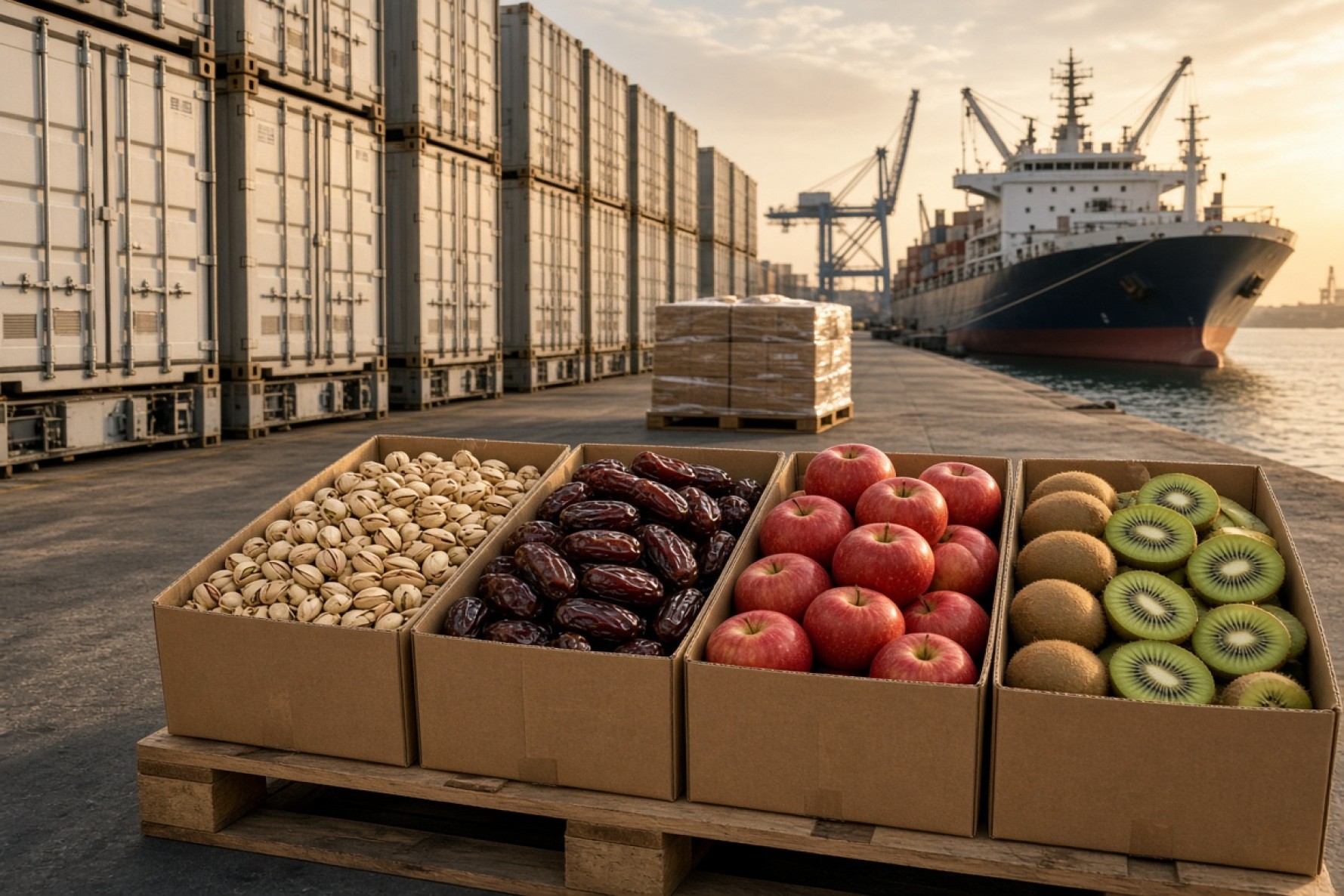
- Pistachios: Annual consumption above 55,000 t; Ahmad Aghaei for gifting, Fandoghi and Kaleh Ghouchi for processing and mithai.
- Dates: India imports over 350,000 t/year; Mazafati Bam (20–25% moisture), dry Zahedi, Stamaran and Rabbi for industry.
- Apples: Window Nov–Apr; Red/Golden Delicious from cold stores; MIP ₹50/kg CIF.
- Hayward kiwi: Health-driven demand; firm flesh, quarantine-clean.
- Saffron sargol: Crocin 240+; sweets, rice and Ayurveda.
- Golden & green raisins: Biscuit industry; SO₂ residue control.
- Asafoetida (hing): Onion/garlic flavour for vegetarian India.
3. Technical specs and grading
| Product | Key index | Contract limit |
|---|---|---|
| Ahmad Aghaei pistachio | 24–28/oz, moisture <5% | Closed shell <1%, dark stain <2% |
| Mazafati Bam | 65–85 count/lb, 21–24% moisture | Zero fermentation, sugar coat <1% |
| Red Delicious | 70–80 mm, Brix 12.5+ | Mechanical defect <3% |
| Hayward kiwi | 80–115 g, firmness 14–16 lb | No mealybug damage |
| Super Negin saffron | Crocin 240+ | No white style |
Pistachios must be naturally open; export Mazafati should be sorted at 21–23% moisture to avoid early fermentation in humid India.
4. Quality control and laboratory tests
- Total aflatoxins (B1+B2+G1+G2) max 15 ppb; B1 max 10 ppb for pistachios and dried fruit.
- Pesticide MRL for apple, kiwi and raisins; respect pre-harvest intervals.
- Residual sulphur on raisins: typically max ~1500–2000 mg/kg.
- Microbiology: TPC, coliforms, E. coli and no Salmonella in 25 g for kernels and processed lines.
- Common rejects: live insects, mixed calibres, condensation on fruit after reefer temperature swings.
5. FSSAI, labelling and certificates
All packaged food imports need FSSAI registration, lab testing and electronic NOC through SWIFT 2.0 / FICS.
- 60% shelf-life rule: At final customs clearance at least 60% of labelled shelf life must remain (or min. three months to expiry).
- Green Veg logo: Mandatory for plant-based foods; English label text with metric units.
- Importer 14-digit FSSAI licence, nutrition table per 100 g, Country of Origin: Iran.
- Non-GM / GM-Free: Required for apples and other notified lines — issued by authorised Iranian bodies.
6. Tariffs, HS codes and apple MIP
| Item | HS | Approx. effective duty |
|---|---|---|
| In-shell / kernel pistachio | 080251 / 080252 | ~16.5% |
| Soft / dry dates | 08041020 / 08041030 | ~32.7% |
| Fresh apples | 08081000 | 50–55% + MIP ≥₹50/kg CIF |
| Kiwi | 08105000 | ~36.5% |
| Saffron / asafoetida | 09102010 / 13019013 | ~36.8% |
DGFT notification 5/2023: fresh apples with CIF ≤ ₹50/kg are prohibited; invoices must reflect premium grades transparently.
7. Regional competition
US pistachios lead on uniform sorting and retail packs; Iranian pistachios win on processing flavour and unsaturated oil. Turkish apples look strong but 20+ day sea legs versus 4–7 days from Bandar Abbas to Nhava Sheva. Iraqi and UAE dates enjoy logistics and modern packing; Mazafati Bam and Zahedi pricing remain Iranian strengths.
8. Distribution channels and ports
Route: Bandar Abbas / Chabahar → 4–7 days → JNPT (Nhava Sheva), Mundra, Kandla → FSSAI & DPPQS clearance → Vashi (nuts/dates), Azadpur (fruit) → hypermarkets and quick commerce (Blinkit, Zepto, Instamart) with FSSAI retail packs.
9. Reefer logistics and packaging
| Product | Container / temp | Note |
|---|---|---|
| Apple / kiwi | 40ft reefer; 0 to +1.5°C | Pre-cool, ethylene filters, data loggers |
| Mazafati | Reefer; −4 to +2°C | 60–70% RH |
| In-shell pistachio | Dry + desiccants | 15–22°C, RH <60% |
| Saffron | Air or insulated | Sealed tins, <20°C |
ISPM 15 pallets, five-ply kraft for fruit, and 10–15 hanging container desiccants for dry pistachio loads are mandatory.
10. Seasonal calendar and settlement
- Jul–Sep: Apple import season starts; pistachio and dried fruit buys for Diwali.
- Oct–Nov: Peak dried fruit consumption (Diwali).
- Dec–Mar: Peak Iranian apple/kiwi arrivals; Mazafati ahead of Ramadan.
- Settlement: Special Rupee Vostro accounts at Indian banks; also AED settlement via UAE traders.
11. Ten-point importer checklist
- FSSAI product standard alignment.
- 60% shelf-life calculation to clearance day.
- Label proof: Veg logo, licence no., importer details.
- Confirm apple CIF > ₹50/kg.
- Non-GM certificate where applicable.
- Contract caps for aflatoxin and MRL.
- CFR/CIF terms with demurrage split.
- Pre-shipment inspection (SGS or equivalent).
- Data loggers and ethylene absorbers in reefers.
- Vostro / AED settlement and delay clauses.
12–13. Firm quotes and Iranco sourcing
Firm pricing needs cultivar, calibre, moisture, pack type, tonnage, port (JNPT / Mundra / Kandla), incoterm (FOB Bandar Abbas, CFR, CIF) and certificates (halal, phytosanitary, COA). Iranco validates orchards, cold stores and plants against India market specs.
14. Strategic summary
Iran’s pistachio flavour, Mazafati sweetness and apple/kiwi seasonality become durable export revenue with robust packs, mechanical sorting and clean documents. FSSAI scrutiny and apple MIP make cold-chain planning and compliance non-negotiable.
FAQ
Which Iranian pistachios sell best in India?
Ahmad Aghaei for gifting and Diwali hampers; Fandoghi and Kaleh Ghouchi for mithai and ice cream.
What is FSSAI’s 60% shelf-life rule?
At clearance, at least 60% of shelf life or three months to expiry must remain.
What is the apple MIP?
Per DGFT, CIF must exceed ₹50 per kilogram.
Reefer transit time to India?
Typically 4–7 days from Bandar Abbas or Chabahar to western Indian ports.
منتجات مميزة














مقالات ذات صلة



