 فريق مجلة إيرانكو
دليل متخصص لاختيار التمر للتصدير وتقييم الهند وتركيا وآسيا الوسطى والإمارات والصين وأوروبا ومراقبة الجودة والمعايير والتغليف واللوجستيات
Export Guide · Iranian Dates · Target Markets & Compliance
Iran Date Exports: Best Target Markets and Foreign Buyer Requirements
A specialist guide to choosing export dates, evaluating India, Turkey, Central Asia, the UAE, China and Europe, quality control, standards, packaging and logistics — for importers, wholesale buyers and procurement managers.
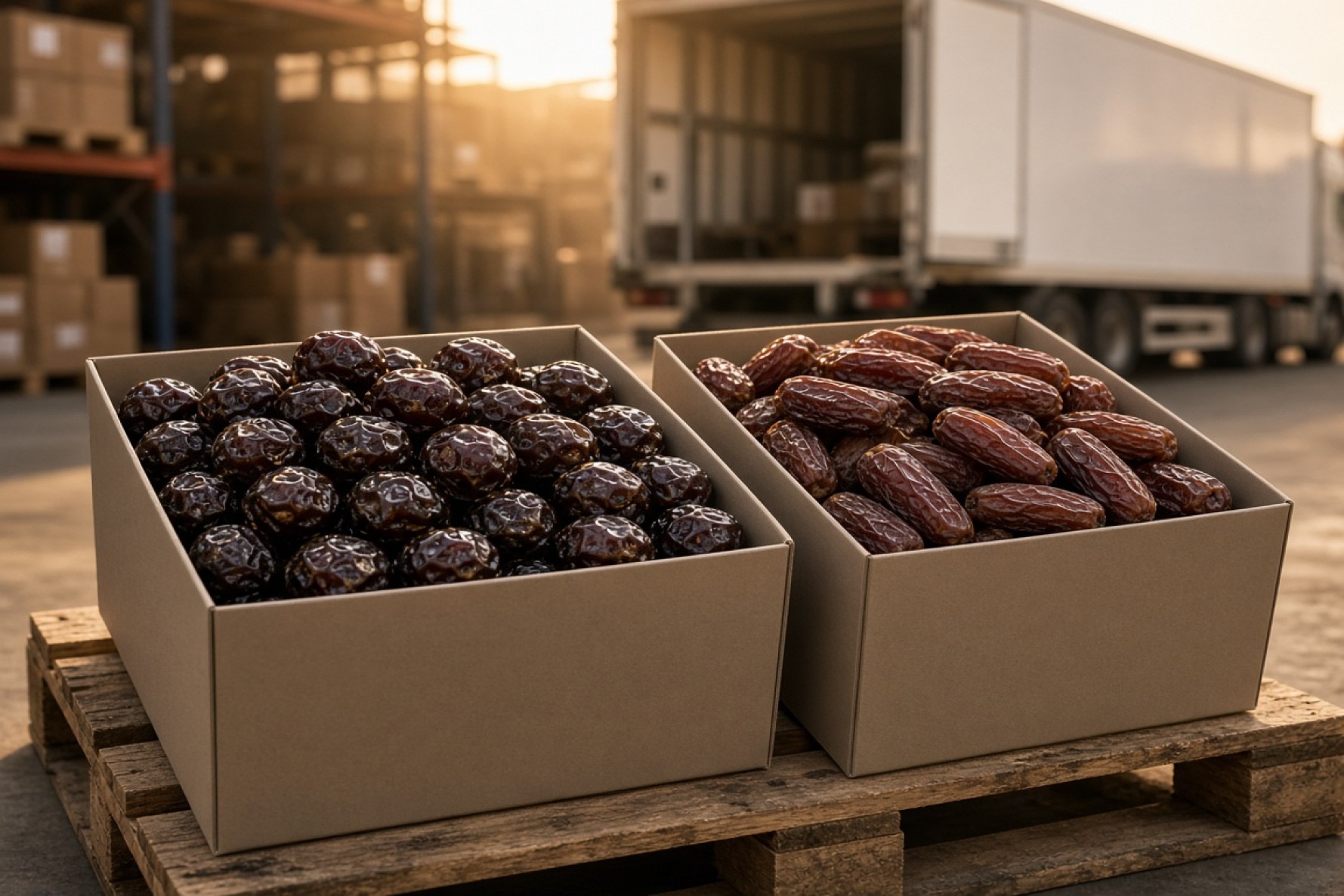
Iranian date exports are one of the few agricultural sectors where an exporter can enter foreign markets with products that differ completely in texture, moisture, appearance, shelf life, price level and commercial use. Soft Mazafati that needs tight temperature management does not share the same supply chain logic as dry or semi-dry dates sold in bulk, repacked or used industrially. The generic phrase “export dates” is therefore not enough for a professional contract.
Iran produced about 1.66 million tonnes of dates in FY 1403 and exported more than 423,000 tonnes in the same year. Production is spread across Kerman, Khuzestan, Fars, Bushehr, Hormozgan and Sistan and Baluchestan, giving international trade a wide basket of soft, semi-dry and dry dates.
High production volume alone does not guarantee high export value. Foreign buyers usually focus on a set of precise specifications: moisture, colour and size uniformity, fruit count per unit weight, defect levels, pitted or unpitted form, insect contamination, microbial condition, pesticide residues, packaging quality, shipment traceability and storage conditions.
Target markets are not identical. India is large and volume-driven; Turkey and Kazakhstan have a significant history of buying Iranian dates; the UAE combines domestic consumption with trade and redistribution; China is expandable but factory registration rules matter; the European Union offers higher value-added potential but applies stricter controls on contaminants, residues, labelling and documentation.
The exporter’s main question should not be only “which country should we sell to?” The professional question is: which date type, with which technical specs, packaging and quality level, fits which sales channel and which market?
1. Iran’s Production and Export Position in Dates
Iran is a major date producer, and its main advantage is not volume alone — product diversity and geographic spread of groves matter equally. From very soft, moist fruit to semi-dry and dry product, different options exist for retail, wholesale, repacking and food industries.
Kerman, Khuzestan, Fars, Bushehr, Hormozgan and Sistan and Baluchestan are core production hubs. Harvest timing varies by region and variety. Picking starts in the warmer months, with the bulk of commercial harvest in late summer and early autumn.
FY 1403 exports of about 423.5k tonnes to 84 countries show Iranian dates are not limited to one region. South Asia, the Middle East, Central Asia, East Asia and Europe each take part of demand.
The $391.26M export value implies an average customs figure below one dollar per kilogram. That average must not be read as the selling price of any single variety; export statistics blend grades, packs, destinations and delivery terms. Premium retail dates, bulk industrial grades and product sold for repacking cannot be valued with one price index.
Main opportunities to raise export value
For Iranian exporters, higher revenue does not necessarily mean higher tonnage. A meaningful share of value can come from:
- Tighter sorting and shipment uniformity
- Measurable technical specifications in contracts
- Moisture and defect control
- Packaging matched to the sales channel
- Pitted product where the buyer requires it
- Destination-required laboratory testing
- Batch traceability for every lot
- Cold chain for soft dates
- Reducing gap between approved sample and final shipment
- Retail packs and buyer private label development
In professional markets, buyers also pay for predictable quality. A shipment whose moisture, colour, size and defects swing sharply from one load to the next is high-risk for an importer even if the underlying fruit is good.
2. Key Iranian Export Date Types and Their Commercial Roles
No single Iranian date type is universally “best” for every market. Choice should follow texture, moisture, price level, sales channel, transit time and consumer expectations.
| Variety | Known regions | General trait | Suitable use | Buyer note |
|---|---|---|---|---|
| Mazafati | Kerman, especially Bam | Soft, dark, relatively high moisture | Retail, specialty stores, soft-date channel | Temperature and humidity control critical |
| Piarom | Hormozgan, Hajiabad | Semi-dry, dark, elongated | Higher value retail | Appearance and size uniformity matter |
| Stamaran | Khuzestan | Semi-dry, transit-friendly | Bulk, repacking, food industry | Moisture and grade must be in contract |
| Zahedi | Fars, Bushehr, south | Dry to semi-dry, lighter colour | Bulk and industrial | Ripeness handling and defects |
| Kabkab | Bushehr, Fars | Semi-soft to semi-dry | Retail, bulk, processing | Ripeness and moisture affect shelf life |
| Rabbi | Sistan and Baluchestan | Dense texture, dark colour | Bulk or retail by grade | Lot must match approved sample |
Mazafati: do not evaluate without cold chain
Mazafati is one of Iran’s best-known dates, but buyers should not treat it like a dry date. Higher moisture and soft texture make it more sensitive to temperature swings, fermentation, mould and texture change.
Professional Mazafati buying requires storage temperature, moisture, ripeness, colour uniformity, skin condition, pack date and remaining shelf life — not weight and appearance alone.
Piarom: markets where appearance creates value
Piarom’s elongated shape and lower moisture suit retail packs. Value spread between uniformly sorted product and mixed grades can be large; size, colour, natural wrinkling, spots, skin breaks and lot uniformity should be fixed upfront.
Stamaran and Zahedi: volume trade and industrial use
Semi-dry and dry types usually offer more logistics flexibility — important for bulk buyers, repackers and food plants. In industrial orders, appearance may matter less than moisture, sugar, microbial safety, pitting behaviour and supply stability. Industrial grade must not be defined by looks alone.
3. Technical Specifications Foreign Buyers Should Fix
Professional buyers should not list only variety name and order weight. The more precise the technical sheet, the more comparable supplier offers become.
| Parameter | What to define | Why it matters |
|---|---|---|
| Variety | Mazafati, Piarom, Stamaran, Zahedi, Kabkab, etc. | Texture, market and price |
| Form | Pitted or unpitted | Processing, price, application |
| Moisture | Agreed % and test method | Texture and shelf life |
| Size | Average weight or count per unit weight | Grading and price |
| Colour uniformity | Acceptable range | Retail packs |
| Defects | Permitted % or count per defect type | Accept or reject |
| Insect contamination | No live infestation; contractual frass limits | Safety and quality |
| Foreign matter | Contractual maximum | Cleanliness |
| Pit in pitted product | Maximum whole pits or pieces | Consumer complaints |
| Chemical tests | Pesticides, contaminants per destination | Clearance and food safety |
| Microbiology | Per market and buyer sheet | Safety and stability |
| Packaging | Material, net weight, units per carton | Cost and sales |
| Storage | Required temperature and RH | Shipping method |
| Traceability | Batch code, production and supply data | Claims and recalls |
4. Quality Judgement, Defects and Laboratory Control
Export-grade dates must be defensible on safety, texture stability and purchase specs — not appearance alone.
Defects to review before buying
- Visible mould
- Sour or fermented odour
- Live insect contamination
- Holes or feeding damage
- Rot
- Immature or underdeveloped fruit
- Soil and foreign matter
- Excessive crushing and bruising
- Severe colour or size mismatch
- Unacceptable skin separation where capped in contract
- Pit pieces in product sold as pitted
- Abnormal stickiness or moisture uptake in dry product
Codex sets numerical limits for some defect groups: defined spots up to 7% by count; combined damaged, immature and undersized up to 6%; combined contamination, insects and mites up to 6%; combined fermentation, mould and decay up to 1%. Live infestation is not permitted. Premium packs often use much stricter contract caps.
Moisture and water activity
Moisture is a primary variable: it changes texture but, at the wrong level, raises yeast activity, fermentation risk and shortens shelf life. Terms like “soft”, “semi-dry” or “dry” must not replace a laboratory percentage and test method in the contract.
In industrial buying, water activity can complement moisture — two lots with similar moisture may behave differently microbiologically and affect storage design for paste or syrup plants.
Yeast, mould, pesticides and mycotoxins
Soft, high-moisture dates are prone to fermentation and mould if stored poorly; yeast and mould counts often matter more than a generic total plate count alone. Acceptance limits should follow destination law, product use and contract.
EU markets set legal pesticide MRLs per active substance; chain retailers may require stricter internal limits. Test panels should follow orchard spray programmes and destination lists — not one fixed list for all countries.
For dried fruit sold to EU consumers or as food ingredient, aflatoxin B1 max is 2 µg/kg and total B1+B2+G1+G2 is 4 µg/kg. Product sorted or physically processed before final sale may follow higher tiers (5 µg/kg B1, 10 µg/kg total). Ochratoxin A max for other dried fruit is 2 µg/kg. Apply limits according to how the product is classified at destination — soft dates may follow a different control path.
Reference sample — five steps to cut disputes
- Obtain an initial sample before contracting.
- Record measurable specifications.
- Take standard photos of product and packaging.
- Seal approved reference samples with buyer and seller.
- Write final acceptance criteria into the contract.
This turns arguments like “colour differs from sample” or “shipment is softer” into measurable questions.
5. Best Target Markets for Iranian Date Exports
For Iranian dates, India, Turkey, Kazakhstan, the UAE, China and the European Union are six markets with different commercial logic. India offers scale; Turkey and Kazakhstan are established Iranian outlets; the UAE combines consumption and redistribution; China has growth potential but serious entry rules; the EU rewards standardised, value-added shipments but demands strict compliance.
| Market | Total date imports 2023 | Reported from Iran | Commercial note |
|---|---|---|---|
| India | approx. 490.6k t | approx. 86k t | Very large volume market |
| Turkey | approx. 64.7k t | approx. 28.4k t | Strong Iran presence, land access |
| Kazakhstan | approx. 35.6k t | approx. 28.7k t | High reliance on Iranian supply |
| UAE | approx. 197.3k t | approx. 21.8k t | Consumption, wholesale, re-export hub |
| China | approx. 28.5k t | approx. 10.3k t | Expandable; registration critical |
| European Union | approx. 135.5k t | approx. 11.3k t | Value-led, strict compliance |
These 2023 importer-reported figures are not the same period as Iran’s FY 1403 customs totals; use them to compare destination structure, not as a single merged dataset.
India — scale and intense competition
India imported nearly 491k t of dates in 2023, with about 86k t from Iran. Strengths for Iranian sellers are market size and channels from wholesale to consumer packs. Price, supply stability and documentary compliance matter equally; Iraq, the UAE, Saudi Arabia and others compete strongly. Exporters should define upfront whether product is for bulk distribution, repacking or retail — pack type, appearance and logistics cost differ for each.
Turkey — proximity and established trade
Turkey imported about 64.7k t in 2023, with more than 28k t from Iran — Iran is not a marginal supplier. Land access is an operational plus, but competition is not freight alone. Label language, importer responsibility, quality sheet, dates, storage conditions and entry documents should be fixed before loading.
Kazakhstan and Central Asia
About 28.7k t of Kazakhstan’s 35.6k t imports came from Iran, showing a deep operational role for Iranian dates. Trade history, land routes and product familiarity help growth, but existing presence does not remove quality or regulatory alignment. EAEU food safety and labelling rules (TR CU 021/2011 and 022/2011) plus phytosanitary requirements apply depending on product form — confirm with the importer.
UAE — consumption and distribution centre
The UAE imported nearly 197k t in 2023 from multiple origins. Trade links wholesale, repacking, food service and regional redistribution. Iranian exporters can target bulk for distributors or consumer packs for retail — each needs different appearance, pack, label language, master-carton quality and shelf life. Geographic proximity pays off only with regular delivery, uniform quality and sound documentation.
China — growth with regulatory gate
China imported about 28.5k t in 2023, with more than 10k t from Iran. From 1 June 2026, new GACC rules replaced the previous foreign food-facility registration framework. Dried fruit groups require production-unit registration; registration numbers must match import declarations. Fresh agricultural product can follow a different path — classify the date accurately before contracting. A factory with China-ready registration matters more than a cheap offer without documents.
European Union — value versus compliance
The EU imported more than 135k t worth over $358M in 2023 — high unit value versus many volume markets. Success needs a full compliance file: pesticides, contaminants, hygiene, traceability, labelling, nutrition where required and the responsible EU operator. Selling to EU buyers without an agreed laboratory panel is risky when retailers exceed legal limits internally.
6. Standards and Entry Requirements in Foreign Markets
Tariff code — HS 080410
Fresh or dried dates fall under international HS code080410. National subcodes may be finer; date paste, syrup or processed products may sit in other headings. Final declared code should be confirmed with the destination importer and customs broker.
India — FSSAI and import file
Food imports are regulated by India’s FSSAI alongside customs and food-control systems. Files often include:
- Import declaration
- Commercial invoice
- Packing list
- Certificate of origin
- Importer licence
- Lab report or certificate where required
- Agricultural or quarantine documents as applicable
- Label sample
Shipments may face document review, visual inspection and risk-based sampling and testing.
China — GACC from June 2026
New foreign manufacturer registration rules apply from 1 June 2026. Categories requiring authority referral in the country of origin must complete GACC registration. Dried fruit is among groups where factory registration is direct and registration numbers must match declarations. For dry dates to China, factory eligibility should be checked before final pricing — not after the container is ready.
European Union
Three areas dominate: mandatory labelling (food name, net quantity, best-before, storage, EU responsible operator, nutrition where applicable, in a language consumers understand); pesticide MRLs under EC 396/2005 aligned with orchard programmes; contaminant limits for dried fruit including aflatoxin and ochratoxin A, with different tiers for direct consumer sale versus sort/process before sale.
Kazakhstan and EAEU
TR CU 021/2011 (food safety) and TR CU 022/2011 (food labelling) apply alongside phytosanitary and import rules for plant products. Labels should be approved before mass printing — correcting labels after entry is usually costlier and riskier than control at origin.
Buyer contractual standards
Chain retailers and large packers may require HACCP or ISO 22000 even where not general law. Distinguish “legal destination requirement” from “private buyer condition”.
7. Export Date Packaging and Labelling
Packaging protects fruit from moisture, pressure, contamination, insects, foreign odours and environmental swings — not only for display.
| Product | Packaging approach | Main risk |
|---|---|---|
| Soft Mazafati | Sealed tub or wrap, then master carton | Fermentation, leakage, crushing, heat |
| Semi-dry | Sealed pack or inner bag in carton | Moisture uptake, insects, texture change |
| Dry dates | Moisture- and crush-resistant pack | Over-drying or rehydration |
| Pitted | Tight foreign-matter and pit control | Pit pieces, crushing |
| Industrial bulk | Food-contact liner in bulk carton or bin | Secondary contamination, weak traceability |
Consumer packs need visibility, acceptable reopening, transit strength and label space. Net weight should match destination buying habits — a pack that works in the Gulf is not automatically right for a European or East Asian chain.
Master cartons must carry inner pack weight without collapse; bottom cartons on pallets bear load for weeks. Weak cartons on soft dates cause pack crush, syrup escape and shape loss.
Dates absorb odours — avoid storage or transport beside strong-smelling goods or chemicals.
Typical label fields
- Product name and variety
- Pitted or unpitted
- Net weight
- Country of origin
- Producer or packer name
- Importer details where required
- Batch number
- Production or pack date
- Best-before date
- Storage conditions
- Nutrition information where mandatory
- Destination legal marks and warnings
Artwork should be approved by the importer before bulk printing.
8. Shipping, Cold Chain and Shelf Life
Soft dates should be managed like temperature-sensitive goods. Dry and semi-dry dates are more forgiving but still vulnerable to heat, humidity, insects and sharp temperature swings.
Post-harvest guidance often cites near 0°C and about 70–75% RH for many ripe dates; exact hold time depends on variety, moisture, harvest condition, pack and initial quality. Very long storage may use about −18°C.
Why temperature swings are dangerous
Cold product entering warm humid air can condense moisture on or inside packs — favourable for fermentation and mould on soft fruit. Cold chain is not only setting a container setpoint; control product temperature at loading, origin warehouse dwell, pre-load wait, container prep, border stops, discharge, importer warehouse and transfer to distribution.
In high-moisture dates, yeast and souring risk rises; technical literature suggests sensitivity increases above roughly 25% moisture — not a universal contract cap, but a reason soft dates need moisture control.
Warehouse temperatures below 13°C slow many stored-product pests; about 5°C or lower improves control — but cold storage does not replace sanitation, incoming inspection and pest programmes.
| Product status | Shipping approach |
|---|---|
| Soft, high-moisture | Refrigerated with unbroken cold chain |
| Semi-dry | Controlled transport by season, route and buyer spec |
| Dry | Ambient or controlled per climate and required shelf life |
| Premium retail packs | Extra protection from temperature, pressure and humidity |
| Industrial bulk | Focus on moisture stability, hygiene and logistics cost |
On hot routes or multi-week transits, “dry” alone is not always a reason to skip temperature control.
9. How Export Date Prices Are Determined
Two offers with the same product name can differ widely in moisture, size, quality, defects, packaging and delivery terms.
- Variety, grade and sorting intensity
- Size and uniformity
- Moisture percentage
- Pitted or unpitted
- Permitted defect level
- Washing and sort cost
- Testing cost
- Consumer or bulk packaging and private label
- Order volume and purchase season
- Cold-storage cost
- Freight mode and destination
- Incoterms and market standard requirements
- Pre-shipment inspection if required
FY 1403 average customs value was about $0.9/kg — a quotient of total value over total weight, not a market quote for Mazafati, Piarom or any single SKU. Compare price only after technical specs and delivery point align.
Why the cheapest quote is not always the cheapest purchase
A lower price with higher defects, wrong moisture, weak packs, incomplete tests, repack need at destination or higher waste can raise the true cost per saleable kilogram above a higher invoice price. Professional buyers compare sellable cost, not invoice price alone.
10. How Iranian Dates Compete with Other Exporters
Global date trade is layered and competitive. Countries differ by product type, market proximity, brand, packaging, price and distribution networks.
| Country / group | Commercial strength | Challenge for Iran |
|---|---|---|
| Saudi Arabia | Large production and exports, strong in Islamic and Asian markets | Scale, brand and sales network competition |
| UAE | Regional trade and redistribution hub | Aggregation, repacking and re-export capacity |
| Tunisia | Deglet Nour position in Europe | Premium retail competition |
| Iraq | Access to high-volume South Asian routes | Price and volume competition |
| Pakistan | Volume supply at competitive cost in some segments | Low-price and industrial segments |
| Jordan | Medjool in high-value niches | Premium segment competition |
| Iran | Wide soft, semi-dry and dry range at scale | Need more uniformity, professional packs and value-add |
Iran’s edge shows when exporters do not try to serve every market with one product and one pack. Mazafati differentiates in soft dates; Piarom suits value-led retail; Stamaran and Zahedi fit bulk and food-industry channels.
11. Importer Checklist Before Placing an Order
Before advance payment or purchase order release, confirm at least the following:
- Define use:retail, wholesale, repacking or industrial production.
- Fix exact variety:commercial name plus origin and sample appearance notes.
- State pitted or unpitted.
- Set acceptable moisture range or maximum.
- Define sizing:average weight or count per specified weight.
- Write defect caps:mould, souring, pests, mechanical damage, immature fruit, foreign matter.
- Obtain a real sample before contract.
- Keep a sealed reference sample for shipment matching.
- List laboratory tests by destination market.
- Agree lab accreditation and COA format.
- Approve inner pack and master carton before mass production.
- Review final label file against destination rules.
- Record storage and transport temperature in contract.
- Verify supplier capacity for order volume.
- Fix preparation timeline and loading window.
- Record Incoterms and exact delivery point.
- List import and clearance documents in advance.
- Plan pre-shipment inspection for large orders.
- Confirm batch coding and traceability system.
- Define dispute handling, resampling and claims in contract.
12. Information Needed for an Accurate Price Quote
A request for “export date price” without specs usually yields incomparable offers. A professional RFQ should include at minimum:
- Variety and pitted or unpitted requirement
- Target moisture and size or grading method
- Quality level and acceptable defects
- Order volume
- Pack net weight and pack type
- Bulk or consumer presentation
- Private label need
- Destination country
- Port, border or delivery city
- Requested Incoterms
- Refrigerated transport requirement
- Mandatory test list and certificates
- Target delivery timing
Buyers evaluating supply from Iran can submit the same data through an Iranco purchase request atiranco.comso offers are compared on identical specifications rather than mixed grades and packs.
13. Export Date Supply from Iran through Iranco
In international date buying, gap between two offers is rarely price per kilogram alone. Variety, moisture, size, defects, packaging, required tests, freight mode and destination market all shape the outcome.
The first step is turning a general enquiry into a clear purchase specification. Instead of “one container of Mazafati”, state quality level, moisture range, pack weight, label design or type, storage conditions, destination and required tests.
Iranco (iranco.com) is a channel to register such requests for Iranian food products. Buyers can share product data, approximate quantity, packaging and destination so supply options in Iran are reviewed against defined need; product specs and samples can be aligned before a final commercial decision.
If you need Iranian dates for your market, specify product type, quality level, order volume, packaging and destination in your request so suitable supply can be evaluated.
Conclusion
Iranian date exports succeed when decisions go beyond product name and price per kilogram. Iran combines high production with soft, semi-dry and dry varieties, but each market segment buys differently.
India matters for volume trade. Turkey and Kazakhstan are markets where Iranian dates already have established presence. The UAE adds a redistribution role beyond domestic consumption. China can be a growth path if factory registration and customs rules are resolved before loading. The EU offers more value-added potential for tested, well-packed product — with tighter legal and contractual control.
For buyers, three tools cut transaction risk most: numerical technical specs, an approved reference sample and clear shipment acceptance criteria. Moisture, size, defect percentage, contamination status, required tests, packaging and storage temperature should not rely on verbal understanding alone.
For exporters, value growth comes from quality consistency, traceability, channel-appropriate packaging and knowing destination rules. Product suited to bulk India is not the same specification a European retailer, Chinese importer or UAE distributor will request.
The best target market is not always the country with the largest imports — it is the market where product type, cost structure, compliance capability and supply model match what buyers there actually need.
Frequently Asked Questions (FAQ)
Which Iranian date type is best for export?
There is no single answer for all markets. Mazafati suits soft-date retail where cold chain exists. Piarom fits value-led retail. Stamaran and Zahedi offer logistics advantages for bulk and industrial buyers. Final choice depends on destination, channel, budget, shelf life and buyer specifications.
What is the HS code for fresh and dried dates?
Fresh or dried dates are classified under HS 080410 at six-digit level. Destinations may use finer national subcodes. Processed products such as paste or syrup may fall under other headings — confirm the declared code with the importer or customs broker at destination.
Why is India important for Iranian date exports?
India imported about 490.6k t of dates in 2023, with nearly 86k t from Iran — one of the world’s largest volume markets. Competition from many suppliers is intense; price, supply stability, FSSAI documentation, packaging and fit with wholesale or retail channels all matter.
Must Mazafati always be shipped under refrigeration?
For professional Mazafati trade, maintaining cold chain is highly important. Soft texture and higher moisture increase risk of fermentation, texture change and shorter shelf life when temperature rises or swings. Exact transport temperature should follow product, packaging and agreed buyer specs and be recorded through the chain.
Which laboratory tests matter for export dates?
Moisture, yeast and mould, pesticide residues and destination-relevant contaminants are core items. Depending on use and buyer, additional microbiology, water activity and other contaminant panels may apply. Agree the test panel with the final importer before production — EU, China, India and other markets are not identical.
What is the standard moisture limit for dates?
There is no one number for all varieties. Codex CXS 143-1985 sets maximums up to 26% or 30% by invert-sugar group. Commercial contracts often set tighter limits by variety and buyer need. For soft Mazafati, moisture also drives refrigeration need and shelf life beyond sensory grade.
How is the export price of Iranian dates determined?
Price follows variety, size, moisture, uniformity, defects, pitted or unpitted form, sorting level, packaging, order volume, tests, season, cold-storage cost, freight and delivery terms. Compare offers only when technical specs and delivery point match; otherwise price gaps may reflect quality or service differences, not true value.
How can I source Iranian dates directly for a foreign market?
Define product type, volume, moisture, size, quality level, packaging, destination and required tests first. Review samples and convert final specs into shipment acceptance criteria. International buyers can submit the same information as an Iranco purchase request so supply options in Iran are screened against defined need.
What matters most for pitted export dates?
Remaining pit pieces are a major risk. Codex allows limited whole pits or pieces in pitted dates, but food plants and retailers often require stricter limits. Pit removal performance, post-pitting inspection and sampling method should be visible in the supplier’s quality system.
منتجات مميزة







مقالات ذات صلة



